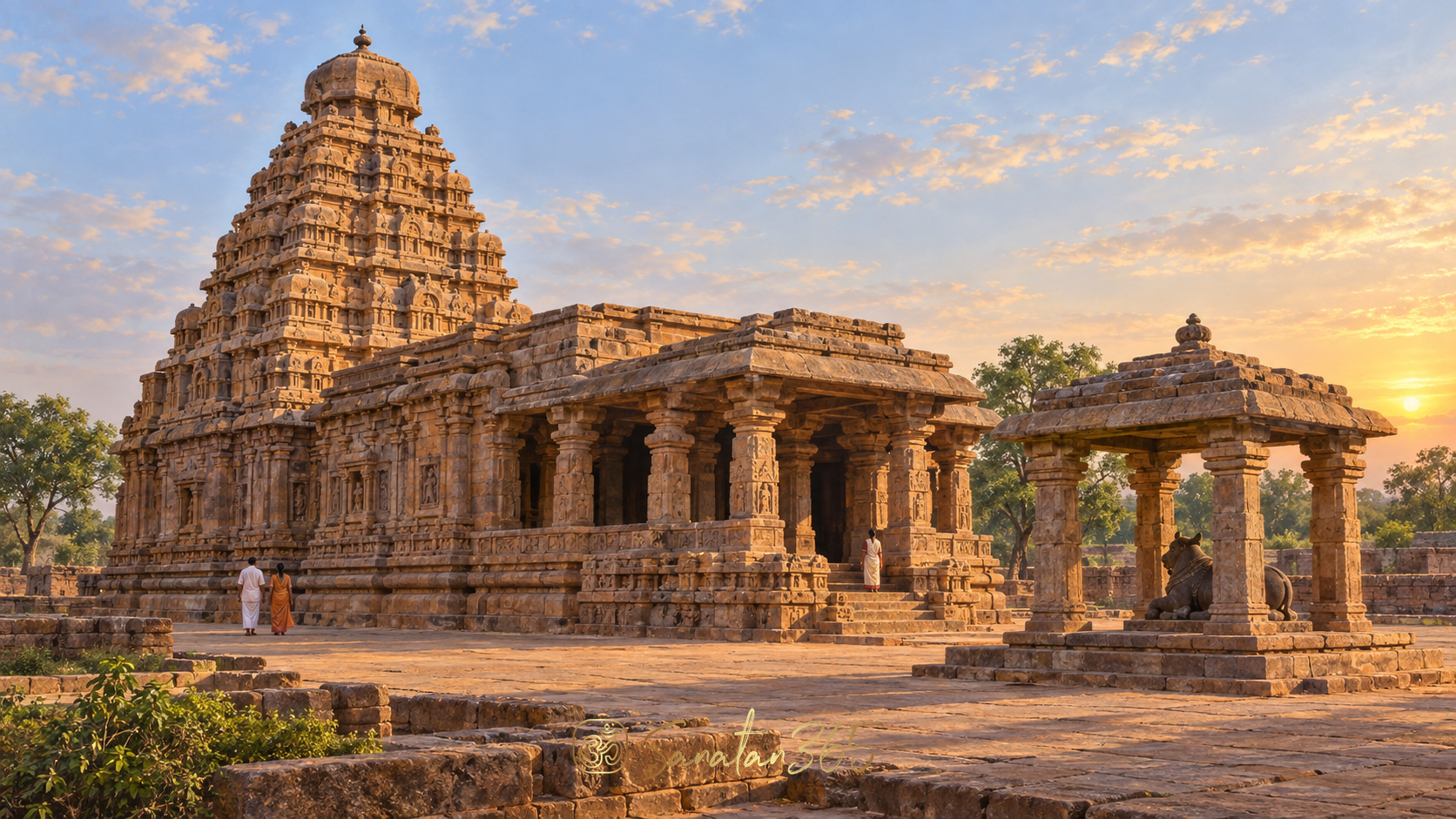
Virupaksha Temple Pattadakal: Shiva and Chalukya Art
A guide to Pattadakal's Virupaksha Temple: its Shiva dedication, Queen Lokamahadevi's patronage, intricate Chalukya architecture, and thoughtful ways to visit.
The first striking thing about the Virupaksha Temple at Pattadakal is not its size. It is the way an entire stone complex seems to arrange movement, story, and attention around worship of Shiva.
Virupaksha Temple Pattadakal is an eighth-century Shiva temple in Karnataka's UNESCO-listed Group of Monuments at Pattadakal. Queen Lokamahadevi commissioned it around 740 CE, according to the UNESCO World Heritage Centre. Its importance lies in a remarkably integrated plan, sculpted narrative, and the Chalukya artists' confident exchange between architectural traditions. It is both a historic monument and a place whose sacred purpose should guide the way it is encountered.
A visitor can admire the carvings without pretending to know every figure at a glance. The more rewarding question is how the building gathers a person from open ground toward the shrine, and how those choices express devotion rather than decoration alone.
Why is Virupaksha Temple Pattadakal significant?
Pattadakal sits near the Malaprabha River in northern Karnataka. Its temple group records a period when the Early Chalukya court supported ambitious experiments in stone architecture. UNESCO describes the site as a place where forms associated with northern and southern Indian temple building appear together, while the Archaeological Survey of India (ASI) gives the Virupaksha complex special prominence for the coherence of its plan. That does not mean every temple here looks alike, or that the builders merely combined two ready-made styles. It means artists worked with several design languages and made choices particular to each sacred commission.
The temple is dedicated to Shiva, worshipped here as Virupaksha. The name is also used at the Virupaksha Temple in Hampi, but these are distinct sites with different historical settings. Pattadakal's temple belongs to the Chalukya architectural landscape, while Hampi's living sanctuary is embedded in the later Vijayanagara city and the local devotion associated with Pampa. Keeping the two places separate matters for accurate history as well as for travel planning.
One reason Pattadakal rewards slow attention is that the temple is more than a tower viewed from outside. Its shrine, halls, subsidiary spaces, gateways, and Nandi pavilion relate to one another. ASI describes the Virupaksha as a complex designed and completed as a whole. Such coherence is visible in the way an approaching visitor moves through thresholds before reaching the innermost space. The monument's reputation rests not only on surviving old stone but on a carefully ordered experience.
The UNESCO designation belongs to the Group of Monuments at Pattadakal, not to one building in isolation. The neighboring temples are therefore essential context. They let visitors compare scale, tower forms, plans, and carved surfaces rather than calling the Virupaksha an isolated miracle. A heritage label also does not turn a sacred place into a theme park; respectful conduct remains part of understanding it.
Key takeaway: Virupaksha Temple matters because its entire Chalukya complex unites architectural planning, sculptural storytelling, and Shiva worship within Pattadakal's wider temple landscape.
Who built the Virupaksha Temple, and what can the sources establish?
UNESCO dates the temple to about 740 CE and credits its construction to Queen Lokamahadevi. The UNESCO account says the commission commemorated a victory of her husband, the Chalukya ruler Vikramaditya II. India's Ministry of Culture gives the same broad account. This is a historically grounded explanation of royal patronage, not a license to reduce the temple to a military trophy. A commissioned Shiva shrine had devotional, artistic, social, and dynastic dimensions at once.
Calling Lokamahadevi a patron matters. Monument histories often focus on kings and battles while passing quickly over the women who commissioned sacred architecture. Here, her role is stated in the principal heritage sources. Yet the craft was collaborative: sculptors, builders, planners, and ritual specialists made the project possible, even if surviving summaries do not identify every hand. The temple asks us to notice both a named patron and the many skilled people whose individual biographies remain less visible.
ASI discusses connections between the Virupaksha design and the Kailasanatha Temple at Kanchipuram. It also notes that Pattadakal's Virupaksha later informed the Kailasa Temple at Ellora. These are claims about architectural influence made by a heritage authority; they should not be inflated into the idea that one workshop copied another stone for stone. Shared forms can travel through artisans, royal patronage, observation, and adaptation. What appears at Pattadakal is a new sacred composition, not a diagram of a single straight line of influence.
The approximate date is another useful discipline. “Around 740 CE” communicates what the heritage record supports without pretending that the first chisel blow and final ritual happened on a known day. Heritage writing is strongest when it makes its evidence visible and leaves space for uncertainty. This is especially important with sacred sites, where devotion and historical inquiry answer different kinds of questions.
For readers who have seen other Indian temple traditions, the nearby Chennakeshava Temple at Belur offers a useful contrast. Belur's Hoysala setting and Vishnu dedication belong to a different period and artistic vocabulary. The comparison can sharpen attention to Pattadakal without ranking one tradition above another. Each shrine deserves to be understood on its own terms.
Key takeaway: Queen Lokamahadevi's documented patronage gives the temple a specific historical setting, while the building itself reflects the work of a larger community of artists and worshippers.
How does the temple's plan guide Shiva worship?
A Hindu temple is not only an image-bearing exterior. At Pattadakal, the movement toward the garbhagriha (गर्भगृह, “womb chamber” or inner sanctum) matters. The term names the protected space at the center of worship. A visitor approaches it through halls and thresholds, with the experience becoming more focused as the surrounding space narrows. The sequence encourages attention to move from public encounter toward a sacred center, though actual access and ritual practice should always follow current on-site rules.
ASI describes a tall vimana (विमान, the tower and structure rising over the sanctum), axial mandapas (मण्डप, pillared halls), peripheral shrines, an enclosure, and gateway structures in the Virupaksha complex. These words can sound technical, but each names a visible part of a purposeful arrangement. A mandapa offers a place to gather and pass through; a gateway marks a transition; the vimana makes the sanctum legible from beyond its walls. The parts are not random ornaments attached to a room.
The Nandi pavilion adds another devotional orientation. Nandi (नन्दी, Shiva's sacred bull and attendant) commonly faces a Shiva shrine. Seeing that alignment helps explain why the pavilion is part of the temple's spiritual logic rather than merely a photogenic structure. A visitor who pauses here can notice the relationship between Nandi, the hall, and the shrine before looking upward at the tower. That pause is often more revealing than a quick checklist of architectural labels.
The sacred center is traditionally associated with the Shiva linga (शिवलिङ्ग, the aniconic emblem through which Shiva is worshipped). “Aniconic” does not mean “without meaning”; it means the divine is represented through a form different from a human-like image. Interpretations vary among Shaiva traditions (शैव, traditions centered on Shiva), and the simplest respectful description is that the linga is a focal point of worship. It should not be reduced to a sensational or single-purpose symbol. The building's geometry, the direction of approach, and devotional practice all give the shrine context.
Stone architecture can shape attention without dictating a single inner experience. A historian may see construction choices; a devotee may arrive for darshan (दर्शन, reverent seeing of the deity); a family may come to learn about Karnataka's heritage. These approaches can coexist when the visitor recognizes that the shrine is not simply a backdrop. That is the difference between looking at a monument and being attentive to a temple.
Key takeaway: The gateways, halls, Nandi pavilion, tower, and inner shrine form a coherent approach to Shiva worship; the layout is part of the meaning.
What stories and symbols appear in its carvings?
The Virupaksha Temple's sculpted surfaces invite close looking, but they also call for care. ASI's monument account describes the complex's architectural and sculptural richness; UNESCO highlights its artistic distinction. Narrative carving can place familiar sacred stories in a setting where worshippers encounter them repeatedly, while decorative bands guide the eye across pillars, walls, and openings. Not every figure can be confidently identified without a guide or reliable site interpretation, and guessing is a poor substitute for observation.
Begin with what can be seen. Are figures arranged as a sequence, or does one image stand alone? Does a carving sit at an entrance, on a pillar, or near a shrine? Does a motif repeat? Those questions are useful even before a visitor knows the name of a scene. They reveal that placement has a role. A carved figure on a threshold may frame entry differently from a relief encountered inside a hall. The building teaches through position and rhythm as well as through recognizable characters.
The site also illustrates why “art” and “devotion” should not be pulled too far apart. A sculptor's command of stone can serve a sacred narrative; a patron's religious purpose can make room for visual experimentation. Neither fact requires us to claim that every motif has one fixed theological interpretation. Temples have been read through multiple regional, ritual, and scholarly traditions over time. Humility about interpretation is a strength, not a weakness.
It can help to compare what another Shaiva site does differently. The Mukteshvara Temple in Bhubaneswar places special emphasis on an ornate gateway within a Kalinga architectural setting. Pattadakal's Virupaksha builds its own sequence of enclosure, gateways, halls, and tower. Both are Shiva shrines, but neither is a template for the other. Looking for differences prevents the word “temple” from flattening a thousand years of regional artistry.
Photography may be permitted in some areas and restricted in others; rules can change. Even when a camera is allowed, a visitor can choose not to interrupt prayer or stand between another person and a shrine for a clearer shot. Such restraint does not diminish appreciation of sculpture. It makes attention to the site more complete.
Key takeaway: Read the carvings with their location and devotional setting in mind; observe first, consult reliable interpretation, and resist confident guesses about uncertain details.
How can visitors experience Pattadakal respectfully?
A thoughtful visit begins before arrival. Check the current Archaeological Survey of India visitor guidance for access, timings, tickets, and photography rules rather than relying on an old blog or a fixed price. Pattadakal is an archaeological landscape and a sacred setting, so there may be different expectations around different structures. If an area is marked as a worship space, follow local instructions for footwear, entry, and photography. Do not assume that one rule applies across the whole UNESCO group.
Give the site time. A useful first circuit is to view the Virupaksha complex from outside, notice its relationship to neighboring temples, then move inward without rushing toward the most photographed carving. Read an official sign or guide before naming a figure; look again after learning its context. This simple two-pass method makes architectural details easier to remember and reduces the temptation to treat a carved story as anonymous decoration.
Respect for living practice is practical. Keep voices moderate near prayer, avoid touching fragile carvings, and leave pathways open for other visitors. Dress and behavior should reflect the place's sacred character without policing the faith or identity of anyone else who comes to learn. All respectful seekers can approach heritage with curiosity. The aim is not to perform expertise but to make room for worship, conservation, and shared access.
For travelers comparing Karnataka sites, it is worth remembering that this Virupaksha is not the Hampi temple. Search for “Pattadakal” in route planning and confirm current local transport details. In the region, heritage sites are often visited together, but each deserves more than a hurried photo stop. A slower itinerary lets the Malaprabha landscape, the neighboring temple forms, and the devotional center make sense as a whole.
Pattadakal's Virupaksha Temple is significant precisely because it cannot be reduced to one label. It is a Shiva shrine, a record of Queen Lokamahadevi's patronage, a Chalukya architectural achievement, a sculptural world, and part of a protected ensemble. The best visit allows all those truths to remain present without letting one erase the others.
Key takeaway: Check current site rules, distinguish Pattadakal from Hampi, protect the carvings, and make space for devotion as well as heritage learning.
FAQ
Is Virupaksha Temple at Pattadakal the same as the Virupaksha Temple at Hampi?
No. They are separate Shiva temples in Karnataka. Pattadakal's temple is associated with the eighth-century Chalukya monument group; Hampi's sanctuary belongs to a different sacred and historical setting. Confirm the place name when planning travel.
Who commissioned the Virupaksha Temple at Pattadakal?
UNESCO and India's Ministry of Culture credit Queen Lokamahadevi with commissioning it around 740 CE. Their accounts connect the project with a victory of her husband, Vikramaditya II. The approximate date is more accurate than claiming a precise day of construction.
Why is the temple important to architecture?
ASI describes an unusually coherent complex with tower, halls, subsidiary shrines, enclosure, and gateways conceived together. The temple is also an important example of Early Chalukya experimentation within Pattadakal's wider group, where several temple forms can be compared.
Can someone visit the shrine as well as study the carvings?
Visitors should follow current on-site guidance. The building has a sacred purpose, and the archaeological setting has conservation needs. Where access is permitted, approach worship spaces quietly and treat carvings as protected heritage rather than surfaces to touch.
Final key takeaway: Virupaksha Temple Pattadakal becomes clearest when seen as a whole: royal patronage and skilled stonework in service of a sacred journey toward Shiva.
About the author
Sanatan365 Editorial
Bringing Sanatan Dharma to modern seekers through authentic, scripture-grounded content.
Related in Temples
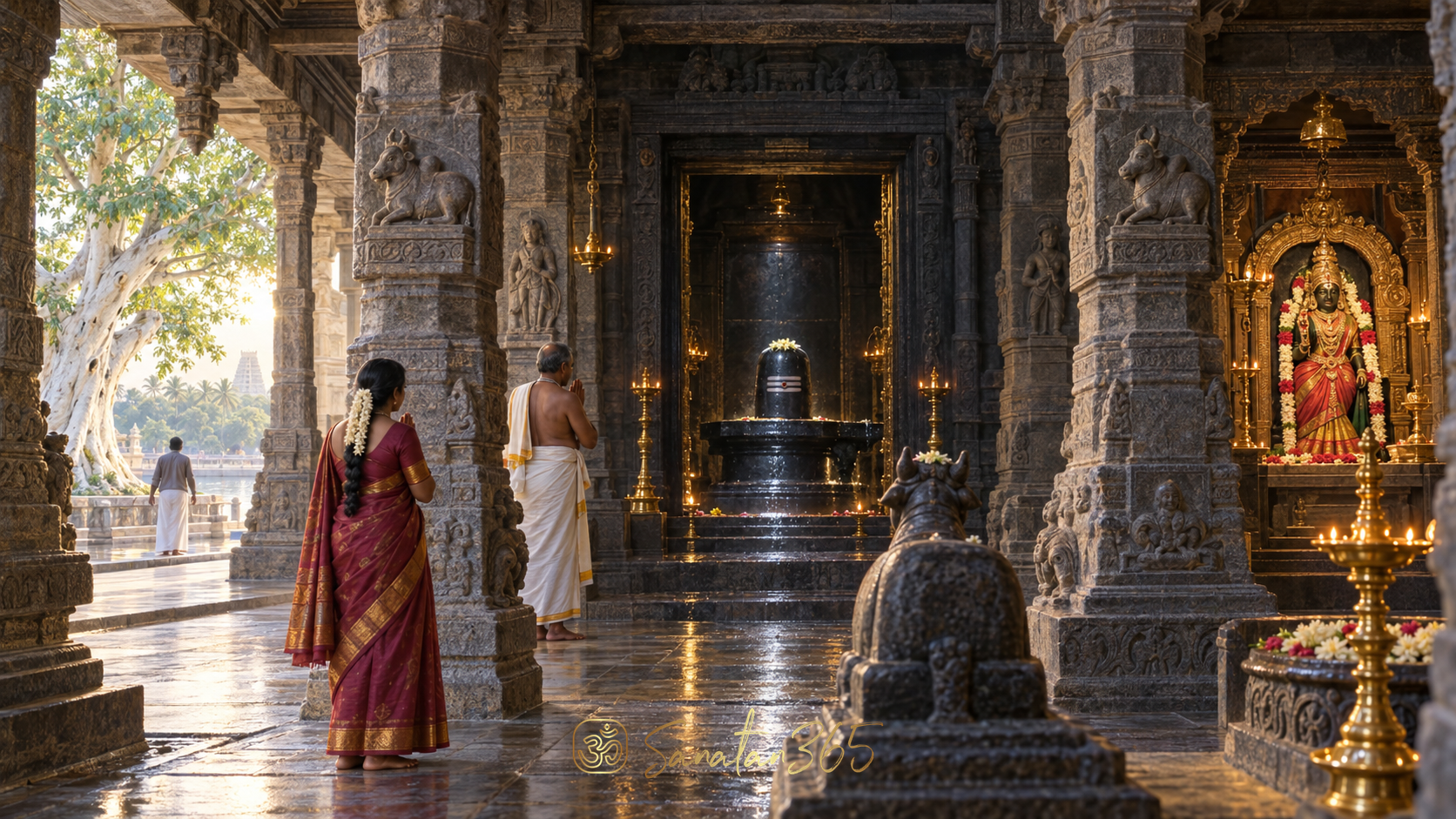 Temples
Jambukeswarar Temple: Water, Shiva, and Akilandeswari
Explore why Jambukeswarar Temple at Thiruvanaikaval is a sacred water-element Shiva shrine, and how to approach its living worship respectf…
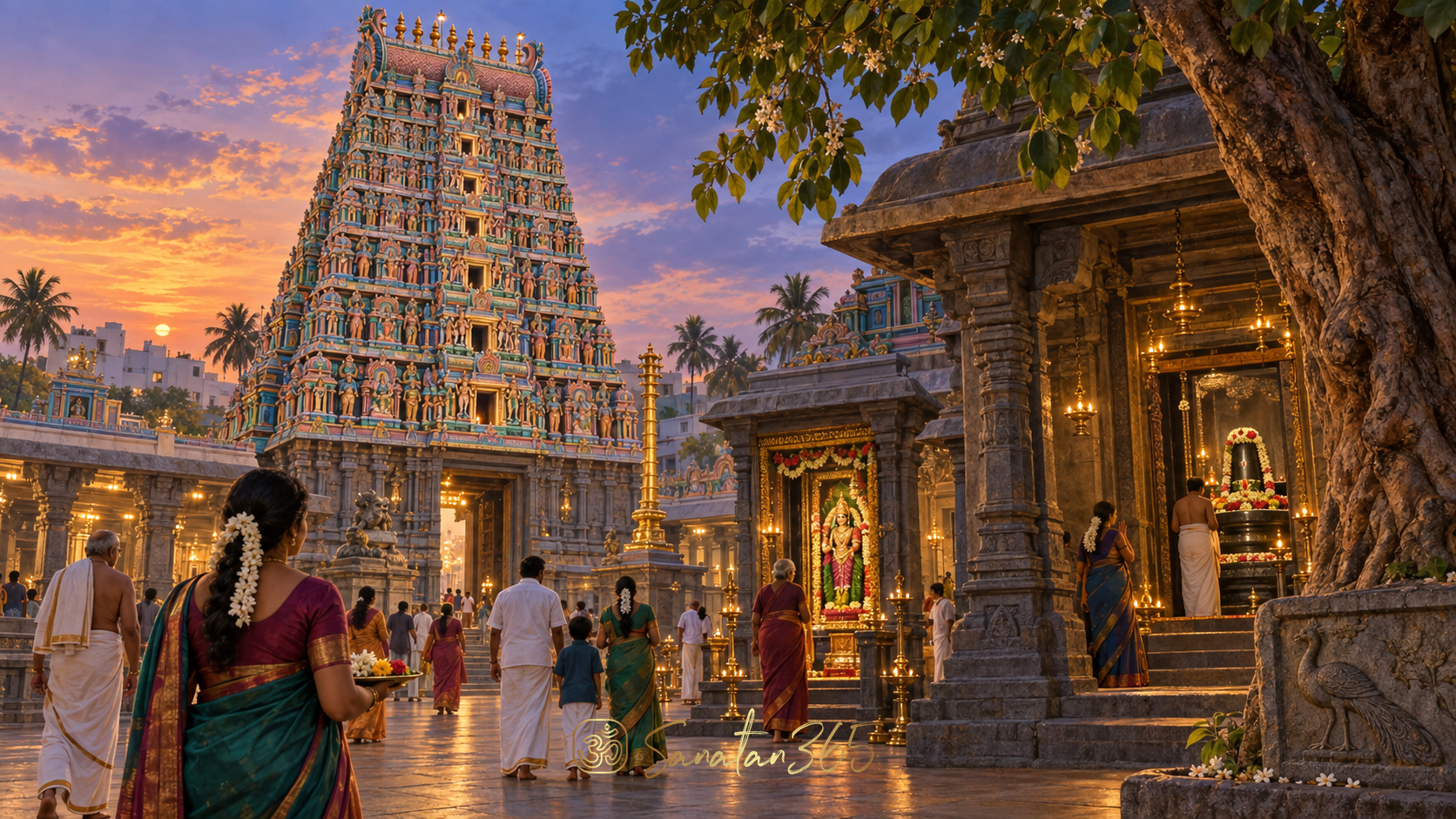 Temples
Kapaleeshwarar Temple Mylapore: Shiva, the Peacock Legend, and Living Devotion
Explore Kapaleeshwarar Temple in Chennai's Mylapore: its Shiva shrine, Parvati's peacock legend, Tamil Shaiva heritage, architecture, and r…
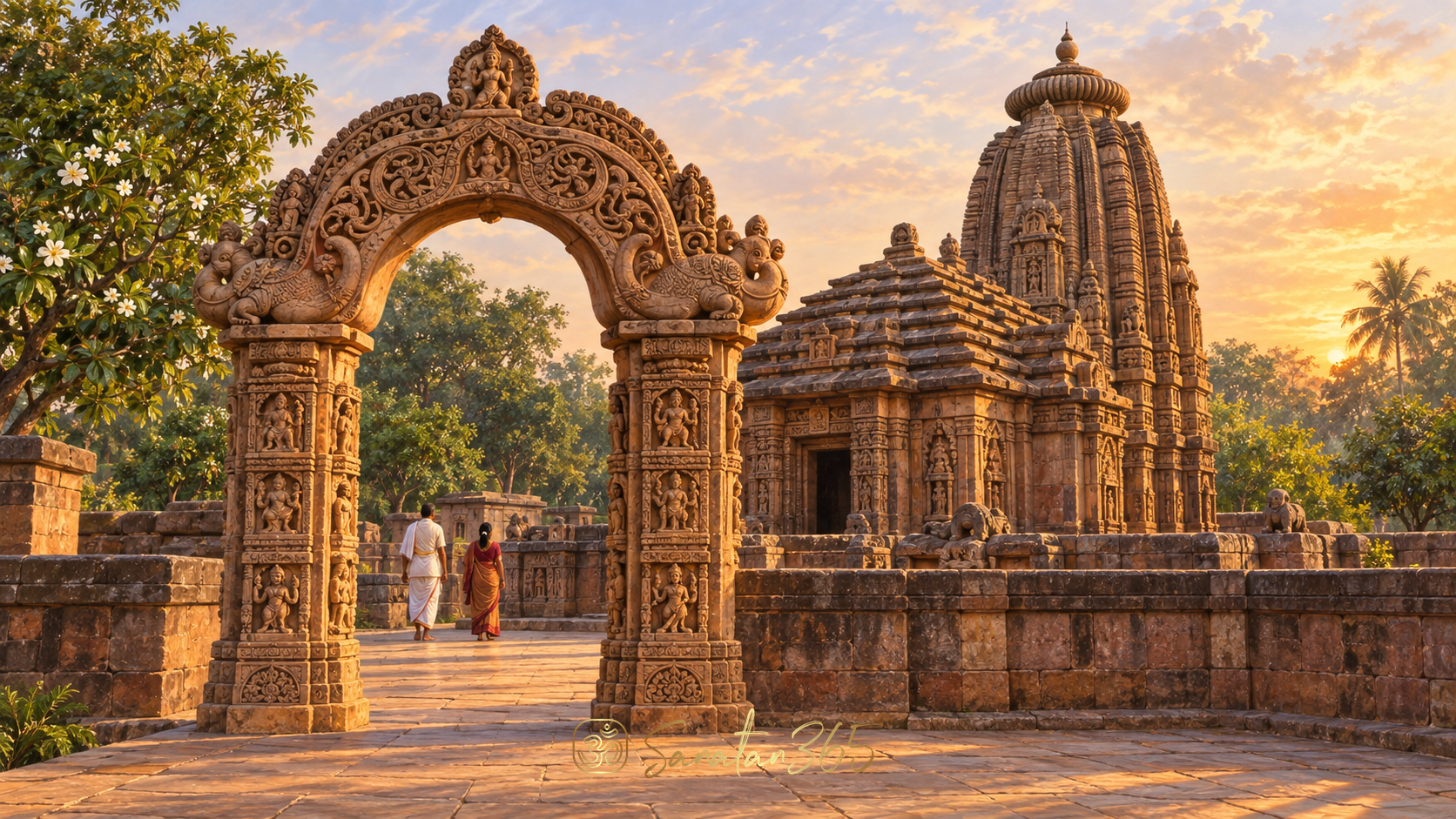 Temples
Mukteshvara Temple, Bhubaneswar: Shiva, Stone, and the Art of Arrival
Explore Mukteshvara Temple in Bhubaneswar through its sculpted torana, Kalinga architecture, Shiva devotion, and a thoughtful way to visit…

