Shri Ramchandra Kripalu Meaning: Rama Praise in Aarti
Follow the hymn from its appeal to the wandering mind to its closing request that Rama dwell in the lotus of the heart.
The first person addressed in this hymn stands close enough to hear it before anyone else does. The singer speaks to the mind.
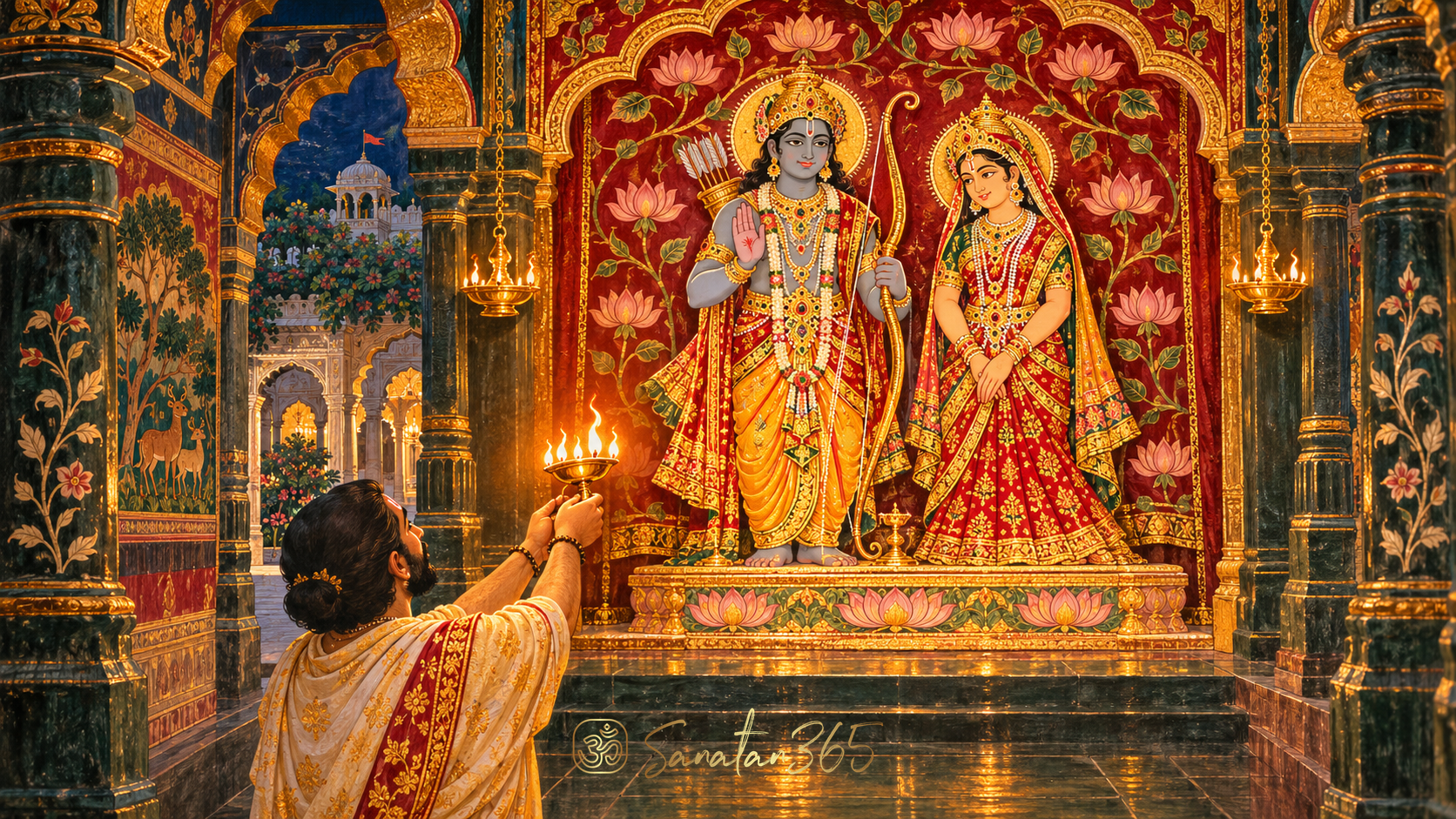
The Shri Ramchandra Kripalu meaning begins with an invitation to the mind to turn toward compassionate Rama (राम, Rāma). The hymn praises his beauty and strength, then asks him to dwell within the heart and overcome destructive impulses. It is a stuti (स्तुति, hymn of praise) that some communities sing during ārati (आरती, worship with offered light). The words and the gesture can be followed together.
What is the Shri Ramchandra Kripalu meaning?
In its opening, the hymn asks the mind to worship or lovingly attend to Rama. Kṛpālu (कृपालु, compassionate) tells the listener what quality is being named first. The following expression links Rama with the removal of the deep fear associated with worldly existence. The singer gives the mind a particular figure and a reason to turn toward him.
The Chinmaya Mission Raleigh-Durham bhajan book includes the hymn under a heading for Shri Ramchandra's aarti. The Columbia Hindu Students Organization bhajan book also presents it as Rama Aarti. These are examples of communities using the praise in the setting of offered light. The words themselves continue beyond any instruction for moving a lamp. They describe Rama and lead the singer toward a petition.
For a first hearing, the change in address is enough to follow. At the beginning the singer urges the mind to attend. Near the close the singer speaks to Rama and asks him to dwell in the heart. The description between those two addresses gives the prayer its shape. It explains who is being welcomed and what qualities draw the singer toward him.
A person hearing the song at a family shrine may first recognise its melody. On another occasion, the same person may notice the two addresses without losing the pleasure of the tune. Listening for a shift in the direction of speech makes a long prayer easier to follow. It gives the listener a way to remember the beginning and ending even before each image is familiar.
Key takeaway. The prayer begins by directing the mind toward compassionate Rama and closes by asking Rama to remain in the heart.
Rama aarti meaning and the address to the mind
The early words bhaju mana (भजु मन, O mind, worship or turn in devotion) can sound familiar enough to slip past during singing. Their meaning becomes clearer if the reader asks who is being called. The voice directs its own attention. This is a modest beginning for a hymn that will soon speak of great beauty and strength. Before its praise can unfold, there is a small act of noticing.
That address is helpful when several things are happening during worship. One person may hold the lamp. Another may be learning the words. A family member may have joined a little late and be listening from a doorway. The first line gives each a way into the hymn through attention, even though their places in the room and their familiarity with the melody differ.
There is also a difference between the words of the song and a reader's own application of them. The hymn asks the mind to worship Rama. A reader could use the opening as a moment to bring attention back to the act of singing. That is one ordinary use of the words. It does not require the reader to turn them into a separate technique.
The guide to how aarti offers light gives more context for the visible act. Someone following this hymn can notice how the offered light and the opening words both direct attention toward Rama. The lamp makes the focus visible in the worship space. The address to the mind asks the singer to give that same focus inward attention.
Key takeaway. The opening is an instruction the singer addresses to the mind, whether the person is leading the worship or listening quietly.
How does the lotus imagery in the Rama hymn work?
The opening stanza repeats a word for the lotus, kañja (कञ्ज, lotus). The image is associated in turn with Rama's eyes, face, hands and feet. In recitation, the recurrence gives the passage its rhythm. In meaning, it lets attention move across the figure through a linked series of comparisons.
A listener can follow only one of those features on the first hearing. On the next hearing, that person may hear how the same flower returns in a new place. The recurring word gives the listener a clue that the poet is still shaping the same description. The comparisons belong together even as they draw the gaze to different parts of Rama's form.
A second image gives the description another scale. The hymn compares Rama's complexion to a rain-laden cloud. The allusion does different work from the lotus comparisons. The cloud is a larger field of colour, while the lotus terms can mark features one at a time. Later the hymn remembers Rama with a bow and arrows, and praise includes strength as well as loveliness. A listener can let each image register before trying to gather them into one account.
The lotus returns toward the end with a different location. It is now the heart in which the poet asks Rama to dwell. Remembering the early lotus comparisons gives this last image greater force. The flower that helped the listener attend to the one being praised now gives the praise somewhere to arrive.
Key takeaway. The lotus first helps the listener picture Rama and later describes the heart where the poet asks him to stay.
How does Tulsidas’s closing prayer change the direction of praise?
The poem's final appeal asks Rama to abide in the heart and defeat kāma (काम, desire or craving in this context) and allied impulses pictured as a troublesome band. The request belongs to the poet's devotional language. It gives the earlier praise a practical moral direction through the wish for a different inward life.
The closing does not simply add another descriptive detail. It takes the qualities already praised and asks for their presence where the singer must live with choices and desires. An ordinary reader might consider a small occasion on which affection or reverence could shape an action. For example, a person who has sung patiently with others can carry that patience into the next household task. That is an application of the inward turn, rather than a prescribed illustration supplied by the hymn.
The final prayer also completes the movement of the opening address. The mind was first asked to turn toward Rama. In the final request, Rama is asked to come and stay. One movement gives the mind something to attend to. The other asks for a presence that can endure after the lamp is put away.
That continuity matters when the hymn is heard in a group. The strongest voice in the room may carry the tune while a quieter listener catches only the last image. The closing petition remains intelligible as a request. Returning to the opening on another day can help the listener hear how deliberate the transition was.
Key takeaway. The closing prayer asks for Rama's presence in the heart and for a change in the impulses the singer lives with.
How can a listener follow the Rama hymn during aarti?
A helpful first step is to listen for three points: the instruction to the mind, the repeated lotus comparisons, and the request at the end. These mark the main turns without requiring a beginner to memorise every verse. A printed version with a line-by-line meaning can be consulted afterward. The two songbooks above let readers see how the hymn is presented within actual community repertoires.
Following the words does not depend on finding one uniform pronunciation printout. A family or group may have a familiar way of singing the line. A songbook may divide the words differently or use another Roman spelling. Start with the group leading the worship, then use a printed edition to follow the sense. A learner who hears the opening clearly can match it to the line in context even when the printed separation between syllables looks different.
The article on evening aarti explains how the offered light may gather attention at the close of the day. The guide to praise through devotional singing gives a wider context for taking part in a sung prayer. A listener can use both contexts to understand this particular combination of words and light without assuming that all households use the same hymn at the same hour.
A small home example can make the distinction concrete. One family member follows the first stanza from a book while another offers the lamp. A child listens for the repeated lotus word and asks later where it returns. People have taken part in different ways, yet their next conversation can begin from one phrase they heard together. Reading the words afterward gives that moment a place in the whole prayer.
A listener using a printed translation might draw two short marks in the margin. The first goes beside the address to the mind, since it tells who is being urged to act. The second goes beside the final request, since there the speaker is asking something of Rama. Between those marks, the flower and cloud images can be read at a comfortable pace. This gives the reader a way to use a translation without reducing the song to a list of definitions.
The same approach works when an aarti includes more than one song. The name of a composition in a book can help the listener recognise where one piece ends and the next begins. A familiar image may recur in both, but the final promise or request of each song supplies its own closure. A person can listen first for that closure and then return to the individual words later.
Key takeaway. Follow who is being addressed and where the lotus returns. Those cues carry the opening praise into the final request.
FAQ
What does Shri Ramchandra Kripalu mean in the opening line?
It calls the mind to worship compassionate Shri Ramchandra, or Rama. The next part invokes his power to remove the deep fear of worldly existence. The opening then moves into a series of images that help the singer attend to the one being praised.
Is Shri Ramchandra Kripalu a stuti or an aarti?
As a composition it praises and petitions Rama, which is why it is commonly called a stuti. Songbooks from Chinmaya Mission Raleigh-Durham and Columbia's Hindu Students Organization also label it as Rama aarti. In those settings the hymn can accompany the offering of light.
Why is the lotus mentioned again at the end?
Early lotus comparisons describe Rama's form. At the close the poet asks Rama to dwell in the lotus of the heart. The return of the same image connects the praise of Rama's form with the inward request.
Does a listener need to sing every stanza to follow the meaning?
A beginner can start by listening. The address to the mind, the repeated lotus images and the final request offer three points of recognition. Once those are familiar, the listener can read the other descriptions between them and follow more of the hymn the next time it is sung.
About the author
Sanatan365 Editorial
Bringing Sanatan Dharma to modern seekers through authentic, scripture-grounded content.
Related in Aarti
 Aarti
Sai Baba Aarti Meaning: Refuge, Service and the Thirst for Grace
The Marathi hymn moves from seeking refuge to valuing service. Read its images carefully, including the thirsty bird that brings the prayer…
 Aarti
Trigunatmaka Traimurti Aarti Meaning: Singing to Gurudatta
Follow the Marathi Datta aarti from threefold form and the limits of speech to offering light, meeting the guru, and remembering the name.
 Aarti
Yuge Atthavis Aarti Meaning: Vitthal, the Brick, and the River
Read the Marathi Vitthal aarti through its standing deity, welcoming refrain, sacred river and gathering pilgrims, with clear limits on lit…

