Dwarkadhish Temple Meaning: Krishna, Dwarka, and Sacred Pilgrimage
Dwarkadhish Temple remembers Krishna as the responsible ruler of Dwarka. Explore its meaning, sacred geography, living worship, and respectful pilgrimage practice.
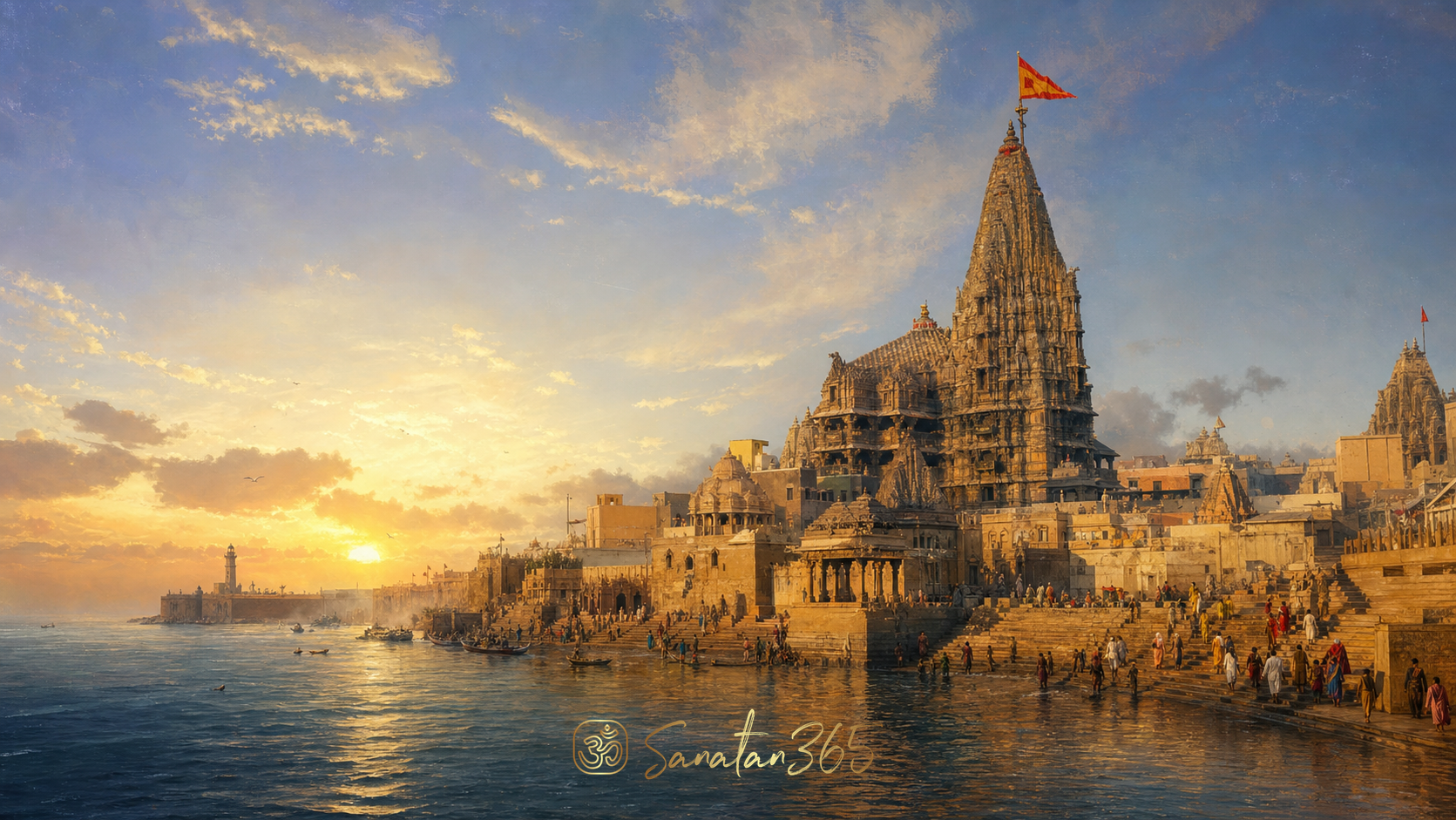
At India’s western edge, the flag above Dwarkadhish Temple meets the salt wind before a pilgrim sees the sanctum. That meeting of height, sea, and devotion reveals the temple’s central meaning: Lord Krishna is remembered here as Dwarkadhish, “Lord of Dwarka,” whose wisdom belongs not only to private prayer but also to public duty.
Dwarkadhish Temple is the principal Krishna shrine in Dwarka, Gujarat, where the Gomti River reaches the Arabian Sea. It is sacred because Dwarka is remembered as Krishna’s royal city and because the shrine belongs to major Hindu pilgrimage traditions. Its worship joins darshan (दर्शन, reverent seeing and being seen by the Divine), sacred geography, disciplined community life, and the lesson that power becomes worthy when it serves dharma (धर्म, sustaining moral and cosmic order).
What Is the Meaning of Dwarkadhish Temple?
The name Dwarkadhish combines Dwaraka with adhisha (अधीश, lord or sovereign). Krishna is therefore worshipped not only as the child of Gokul, the beloved of Vrindavan, or the teacher of the Bhagavad Gita, but as the ruler of Dwarka. Each form reveals a different devotional relationship. None needs to be treated as superior to another.
The royal title matters because Hindu sacred kingship is never merely about control. A ruler is measured by protection, restraint, justice, and responsibility. In the Mahabharata, Krishna does not seek a throne for himself; he counsels, negotiates, protects, and acts with careful attention to consequences. At Dwarka, that public dimension of Krishna’s life becomes the devotional foreground.
This makes the shrine especially relevant to householders, leaders, parents, and anyone carrying responsibility. The temple does not ask a pilgrim to escape ordinary duties. It invites a deeper question: can authority, skill, wealth, or influence be placed in service of something larger than the self?
The word Dwarka is commonly associated with dvara (द्वार, doorway or gateway). Devotion often interprets the city as a threshold: geographically between river and sea, narratively between pastoral Braj and royal responsibility, and spiritually between self-centred action and service. Etymological or symbolic readings should not be confused with archaeological proof, but they remain meaningful within living pilgrimage tradition.
Key takeaway: Dwarkadhish Temple remembers Krishna as a sovereign whose greatness lies in wise, protective, dharmic responsibility.
Why Is Dwarka Sacred in Krishna Tradition?
Krishna’s life is remembered across a network of sacred places. Mathura recalls his birth; Gokul and Vrindavan hold the tenderness of his childhood and youthful lila (लीला, divine play); Kurukshetra remembers the teaching of the Bhagavad Gita; Dwarka remembers settlement, governance, family, diplomacy, and mature duty.
Puranic and epic traditions describe Krishna establishing a fortified city by the western sea after leaving Mathura. The accounts carry theological, literary, and regional layers developed across centuries. Archaeology around modern Dwarka and the Gulf of Kachchh has prompted serious study as well as exaggerated popular claims. A responsible pilgrim can honour the scriptural city without declaring every underwater structure to be conclusive proof of a specific textual event.
The living city is itself powerful evidence of continuity in another sense: generations have prayed here, carried stories here, supported temples here, and mapped Krishna devotion onto this coast. Sacred geography is not only about dating stone. It is also about disciplined memory sustained by communities.
Dwarka stands at the confluence of the Gomti River and Arabian Sea. The official Gujarat Tourism guide describes the temple on a small rise above the river, its sculpted walls, tall spire, and long flag. The physical setting makes the city feel like an arrival and a departure at once. River water moves toward the ocean; pilgrims move toward the sanctum; prayers return them to life with a changed sense of scale.
For readers exploring wider sacred geography, the meaning of the Char Dham pilgrimage shows how distant shrines can form one spiritual map without erasing their regional identities.
Key takeaway: Dwarka is sacred through Krishna’s remembered life, its enduring worship community, and a coastal geography that embodies passage, responsibility, and return.
What Do the Temple’s Architecture, Flag, and Two Gates Signify?
Dwarkadhish Temple is also called Jagat Mandir, “Temple of the World.” The present monument bears the marks of renovation and patronage across time, so claims that every visible stone belongs to one ancient founding date should be avoided. Gujarat Tourism notes that tradition attributes the original shrine to Vajranabha, Krishna’s great-grandson, while the structure has been renewed more than once.
Its soaring shikhara (शिखर, temple tower or summit) draws the eye upward before attention moves inward. This is not an accident of devotional architecture. The exterior announces presence across the city and coast; the inner sanctum gathers that vastness into a concentrated encounter.
Three features shape the pilgrim’s experience:
- The sacred flag: A large flag flies above the shikhara and is renewed as part of the temple’s living service. It marks continuity, offering, and the visible presence of worship. Popular accounts attach many numerical and cosmic meanings to it; these should be presented as devotional tradition rather than universal historical fact.
- The Swarg Dwar: The “gate of heaven” is traditionally associated with entry. Svarga (स्वर्ग, heavenly realm) evokes ascent, aspiration, and the turning of attention toward the Divine.
- The Moksha Dwar: The “gate of liberation” is associated with departure. Moksha (मोक्ष, freedom from bondage and the cycle of rebirth) suggests that true pilgrimage should change how one re-enters the world.
The two gates need not be treated as mechanical guarantees of heaven or liberation. Their deeper teaching is ethical. One enters with longing, stands before the Divine, and leaves with responsibility. The movement becomes incomplete if reverence inside the temple does not mature into patience, truthfulness, and care outside it.
The nearby ghats and Gomti waters add another layer. Ritual bathing traditions vary, and water conditions or local rules may change. Pilgrims should follow current temple and civic guidance rather than assuming every customary act is always safe or permitted.
Key takeaway: The temple’s vertical tower, renewed flag, and named gates turn architecture into a disciplined movement from aspiration to transformed action.
How Does Darshan at Dwarkadhish Temple Unfold?
Darshan is often translated as “seeing,” but the English word is too passive. A devotee comes to see the sacred form and to become inwardly available to being seen. The encounter may last only moments, especially in a crowded temple, yet preparation can give those moments depth.
In the sanctum, Krishna is worshipped as Dwarkadhish. Temple rhythms may include opening ceremonies, adornment, food offerings, aarti, and periods when the doors close for service. Exact timings can change by season, festival, security needs, or temple administration, so travellers should check the temple’s current official information rather than relying on an old itinerary.
A simple darshan practice can include:
- Pause before joining the queue and settle the breath.
- Hold one clear intention, such as gratitude, courage in duty, or wise stewardship.
- Observe silence where requested and keep phones away when photography is restricted.
- Receive the brief sight of the murti without pushing for a perfect view.
- Offer mental prayer even when crowds make external ritual difficult.
- Leave space for older pilgrims, children, and people with mobility needs.
The Sanskrit word murti (मूर्ति, consecrated sacred form) does not mean that the limitless Divine is confined to stone. In temple practice, the form makes relationship possible: eyes can rest, hands can fold, offerings can be made, and memory can gather around a shared centre.
Krishna temples also show how devotion takes distinct regional forms. The Udupi Krishna Temple tradition centres another sacred history, visual practice, and institutional lineage. Visiting both reveals unity without uniformity.
Key takeaway: Dwarkadhish darshan becomes meaningful through inward preparation, respectful conduct, and willingness to carry Krishna’s teaching into responsibility.
Why Is Dwarka Part of Major Hindu Pilgrimage Traditions?
Dwarka belongs to the four-direction Char Dham pilgrimage traditionally associated with Badrinath in the north, Puri in the east, Rameswaram in the south, and Dwarka in the west. It is also honoured in Vaishnava traditions connected with the Divya Desams, the sacred Vishnu sites celebrated by the Tamil Alvars.
These overlapping maps show how Hindu pilgrimage works. A place can be rooted in Gujarat and still belong to a pan-Indian sacred imagination. It can carry Sanskritic, Gujarati, Vaishnava, monastic, household, and local histories simultaneously.
Pilgrimage is called tirtha-yatra (तीर्थयात्रा, a journey to a sacred crossing place). A tirtha is literally a ford or crossing. The deeper meaning of tirtha explains why the traveller’s inner crossing matters as much as distance covered.
Dwarka’s western position gives that idea unusual force. The land appears to end, but devotion does not. The sea interrupts ordinary routes and expands the horizon. Standing there, a pilgrim may recognize that spiritual maturity is less about possessing certainty and more about learning how to act faithfully before what cannot be controlled.
This is also why pilgrimage should not become a checklist. Completing a circuit has value, but the sacred cannot be reduced to collecting locations. A meaningful journey includes study, restraint, service, generosity, and space for local communities whose daily lives sustain the shrine.
Key takeaway: Dwarka is a western sacred crossing within several pilgrimage traditions, joining regional Krishna devotion to a wider Hindu map.
How Can a Pilgrim Visit Dwarka Respectfully?
Respect begins before arrival. Temple schedules, clothing expectations, security restrictions, local transport, and access arrangements can change. Confirm current information through official sources, especially around Janmashtami, Kartik, school holidays, or other high-volume periods.
A thoughtful pilgrimage plan includes:
- Choose time for stillness: Do not schedule every hour. Leave room to sit near the Gomti, attend aarti, or return for a second darshan.
- Dress and behave modestly: Follow posted temple norms. Avoid treating worshippers as visual scenery.
- Use authorized services: Confirm donation, flag offering, guide, and queue arrangements through official counters or recognised channels.
- Protect the coast: Carry reusable water bottles where permitted, avoid plastic offerings, and never leave cloth, food packaging, or ritual material in the river or sea.
- Respect claims and uncertainties: Distinguish scripture, local tradition, architectural history, and archaeological evidence instead of forcing them into one simplistic timeline.
- Support with discernment: Offer donations transparently and buy from local craftspeople without aggressive bargaining over small amounts.
- Carry the teaching home: Name one duty that will be performed with more patience, fairness, or steadiness after the visit.
Pilgrims may also visit nearby sacred sites according to time, health, and tradition, but there is no spiritual failure in choosing a slower, accessible itinerary. Elders, children, disabled travellers, and people managing health conditions should prioritize safety. Devotion is not measured by exhaustion.
The most honest offering may be a changed habit. Krishna as Dwarkadhish asks whether order can be created without hardness, whether influence can protect rather than dominate, and whether devotion can remain alive amid complex decisions.
Key takeaway: A respectful Dwarka pilgrimage protects people and place, honours living temple norms, and returns the traveller to duty with greater care.
Dwarkadhish Temple stands between river and sea, story and stone, royal memory and personal prayer. Its most enduring lesson is not that sacredness belongs only to a distant coast. It is that mature devotion must enter the places where decisions are made.
Key takeaway: To remember Krishna as Dwarkadhish is to ask that every form of responsibility be governed by wisdom, restraint, and service.
FAQ
What does Dwarkadhish mean?
Dwarkadhish means “Lord of Dwarka.” The title honours Lord Krishna as the ruler and protector of the sacred city of Dwarka.
Where is Dwarkadhish Temple located?
Dwarkadhish Temple is in Dwarka, in Gujarat’s Saurashtra region, near the meeting of the Gomti River and the Arabian Sea.
Why is Dwarkadhish Temple important?
The temple is important as a principal Krishna shrine, a major centre of living Vaishnava worship, and a destination within the Char Dham and other pilgrimage traditions.
What are Swarg Dwar and Moksha Dwar?
They are the temple’s traditionally named entry and exit gates, associated with heaven and liberation. Their devotional symbolism invites pilgrims to enter with aspiration and leave with transformed conduct.
What should a first-time visitor remember?
Check current official timings and restrictions, dress respectfully, follow queue guidance, avoid photography where prohibited, protect the river and coast, and approach darshan with patience rather than haste.
About the author
Sanatan365 Editorial
Bringing Sanatan Dharma to modern seekers through authentic, scripture-grounded content.
Related in Temples
 Temples
Lepakshi Veerabhadra Temple: Sacred Art, Architecture, and Devotion
Lepakshi's Veerabhadra Temple brings Vijayanagara architecture, Shaiva devotion, painted ceilings, carved pillars, and living sacred memory…
 Temples
Chennakeshava Temple Belur: Vishnu, Hoysala Art, and Living Worship
Chennakeshava Temple in Belur is both a living Vishnu shrine and a landmark of Hoysala sacred architecture. Its sculpted surfaces show how…
 Temples
Dhwaja Stambha Meaning: The Sacred Flagstaff Before a Hindu Temple
Dhwaja Stambha meaning explained through the sacred flagstaff's place in Hindu temple architecture, festival ritual, deity emblems, and the…