Udupi Krishna Temple: Darshan, Madhvacharya, and a Living Tradition
Explore Udupi Sri Krishna Matha through its distinctive window darshan, Madhvacharya's Dvaita legacy, the Ashta Mathas, Paryaya, and practical guidance for a reverent visit.
Udupi Krishna Temple: Darshan, Madhvacharya, and a Living Tradition
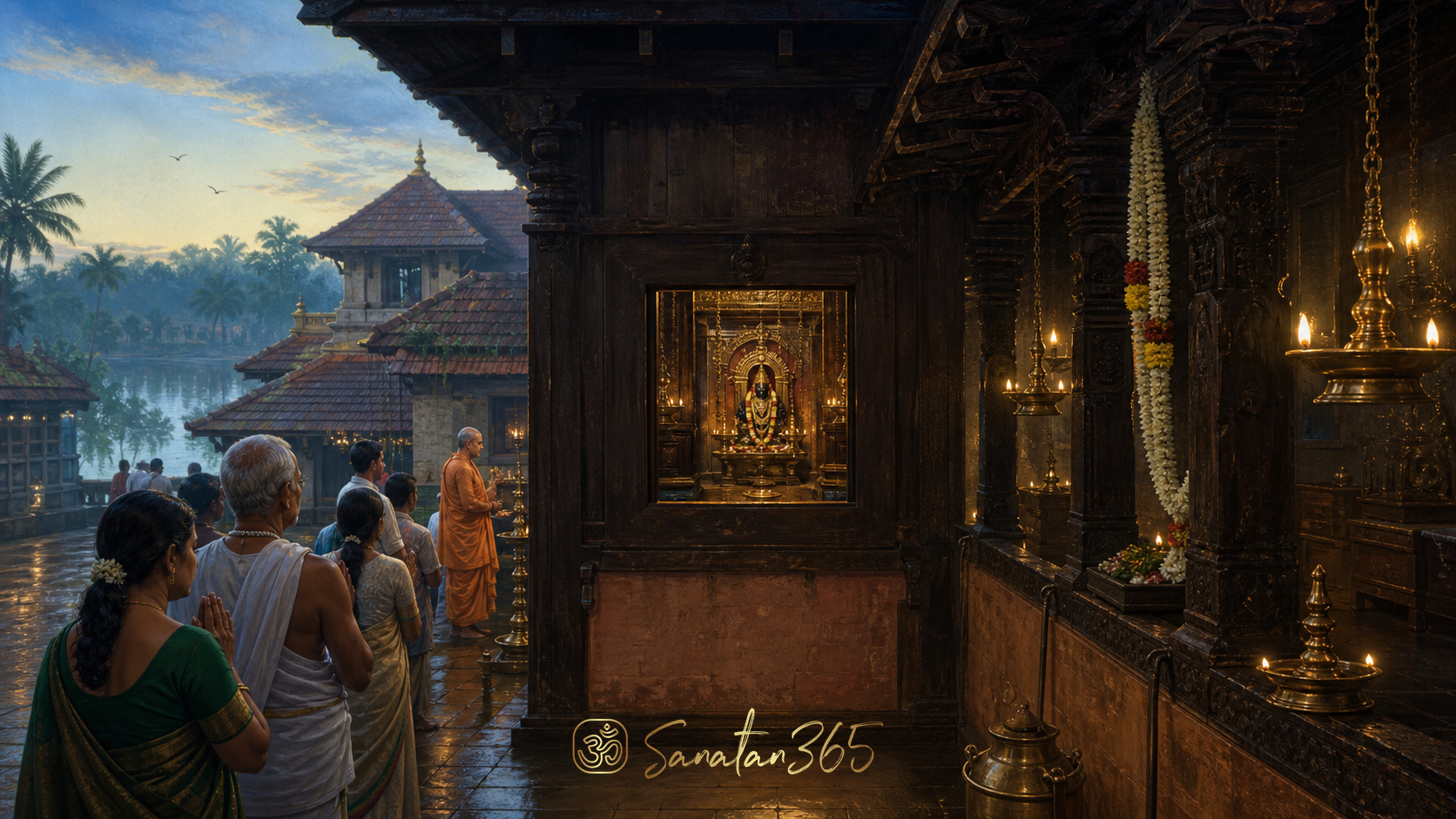
At Udupi, the sacred encounter is shaped by a window. Devotees do not simply enter, look, and leave; they approach a carefully preserved line of sight that turns seeing into attention.
The Udupi Krishna Temple, more precisely Sri Krishna Matha, is a major Vaishnava center in coastal Karnataka associated with Madhvacharya and the Dvaita Vedanta tradition. Its worship centers on Bala Krishna, the Divine as child Krishna. The temple is known for window darshan, the Ashta Mathas that share institutional responsibility, and Paryaya, the periodic transfer of worship administration. Together, these make Udupi not only a historic destination but a living discipline of devotion, study, food offering, music, and service.
Why Is Udupi Krishna Temple Spiritually Distinctive?
The word darshana (दर्शन, sacred seeing or an encounter with the Divine) means more than viewing an object. In Hindu practice, the devotee comes to see and to be seen. Udupi gives this principle an architectural form: the approach narrows attention toward Krishna through a sequence of openings rather than presenting the sanctum as an unrestricted spectacle.
The central form is Bala Krishna, Krishna as a child. This matters. Child Krishna gathers several devotional moods at once: affection, wonder, tenderness, responsibility, play, and surrender. A devotee may arrive seeking wisdom or protection, yet the form invites care as much as petition. Bhakti (भक्ति, loving devotion) becomes relational rather than abstract.
Udupi District's official tourism overview identifies the Krishna temple as the pilgrimage center for which the town is especially known. Yet the Matha is not meaningful only because it is old or famous. Its importance lies in continuity: daily worship, scriptural learning, monastic stewardship, music, feeding traditions, and pilgrim movement still meet around the deity.
This is also why a hurried checklist misses the temple's character. The most revealing details are not simply “sights.” They are practices: waiting for darshan, receiving prasada (प्रसाद, food or another offering received as Divine grace), observing a worship rhythm, and noticing how many people sustain one sacred day.
Key takeaway: Udupi's distinctiveness lies in a disciplined encounter with Bala Krishna, sustained by architecture, worship, learning, and service.
How Did Madhvacharya Shape Sri Krishna Matha Udupi?
Sri Krishna Matha is inseparable from Madhvacharya, the influential Vedanta teacher associated with Udupi and the articulation of Dvaita (द्वैत, “duality”) philosophy. Dvaita teaches a real distinction between the individual self, the world, and the Supreme. The relationship between devotee and Bhagavan is therefore not treated as a temporary illusion to be erased. Loving service, dependence on Divine grace, and knowledge of Vishnu's supremacy retain enduring meaning.
Temple tradition associates Madhvacharya with the installation of the Bala Krishna murti (मूर्ति, a consecrated sacred form) at Udupi. Accounts describe the image as having been recovered from a mass of gopichandana, sacred clay, carried by a ship. The precise details belong to the temple's sacred narrative and should be approached as tradition rather than reduced either to literal proof or casual folklore. What is historically clear is that Udupi became a powerful center of Madhva teaching, worship, and institutional life.
Madhvacharya's legacy is not confined to philosophical texts. At Udupi, ideas enter a daily ecosystem:
- Krishna is worshipped as the Supreme and intimately beloved.
- Study clarifies the devotee's understanding.
- Seva (सेवा, selfless service) gives devotion practical form.
- Food is prepared, offered, and shared as prasada.
- Teachers preserve and interpret a living lineage.
This integration keeps philosophy from becoming merely intellectual. Dvaita asks the devotee to recognize relationship: the self is not the whole, control is limited, gratitude is rational, and service is a truthful response to dependence on the Divine.
For modern visitors, this offers a useful correction. A temple need not be separated from thought, and philosophy need not be separated from tenderness. At Udupi, careful reasoning and child-Krishna devotion occupy the same sacred world.
Key takeaway: Madhvacharya's Udupi legacy joins Dvaita philosophy to daily Krishna worship, teaching, service, and shared sacred food.
What Are the Kanakana Kindi and the Udupi Krishna Darshan Windows?
The best-known feature of Udupi Krishna darshan is the western viewing tradition associated with Kanakana Kindi, “Kanaka's window.” Temple narratives connect it with Kanakadasa, the celebrated Kannada Haridasa poet-devotee. In the devotional account, Kanakadasa prayed from outside, and Krishna turned westward to grant him darshan. The story expresses a powerful bhakti conviction: sincere devotion reaches the Divine, while human barriers do not define Divine grace.
Visitors should distinguish the outer Kanakana Kindi from the inner Navagraha Kindi through which the murti is viewed. Popular summaries sometimes merge the two. The practical experience is a sequence: architecture frames the approach, the openings gather the gaze, and Krishna becomes visible within the sanctum's ritual context.
Kanakadasa's memory also places Udupi within the wider Haridasa tradition of Karnataka. Hari-dasa (हरिदास, servant of Hari or Vishnu) refers here to poet-saints whose Kannada compositions carried devotion and philosophical teaching into song. Their work helped make profound ideas singable, memorable, and available beyond formal scholastic spaces.
The window can therefore be read on three levels:
- Ritual: it is the established path of darshan.
- Architectural: it limits distraction and directs attention.
- Devotional: it recalls a tradition in which Krishna responds to sincere bhakti.
The deepest response is not to turn the window into a novelty. It is to let the physical limitation sharpen inward receptivity. When the view is brief, attention matters more. When the sightline is shared, patience becomes part of worship.
Key takeaway: Udupi's window darshan is both a physical practice and a devotional teaching about attention, grace, and the reach of sincere bhakti.
How Do the Ashta Mathas and Paryaya Keep the Tradition Alive?
Around Sri Krishna Matha stands a distinctive system of eight monasteries known as the Ashta Mathas (अष्ट मठ, “eight monastic institutions”). They are traditionally named Palimaru, Adamaru, Krishnapura, Puttige, Shirur, Sodhe, Kaniyoor, and Pejavara Mathas. Each preserves a branch of Madhva monastic life and participates in the stewardship of Krishna worship.
The visible expression of this shared responsibility is Paryaya (पर्याय, turn, succession, or rotation). At set intervals, responsibility for the worship and administration of Sri Krishna Matha passes from one Matha to another in an established sequence. The transition is marked publicly and ceremonially, drawing devotees to Udupi.
Paryaya is more than an administrative handover. It expresses a durable idea: sacred institutions outlive individual officeholders when responsibility is bounded, transmitted, and renewed. Authority is not presented as private possession. It is a temporary duty carried within lineage, rules, and communal memory.
The system also reveals how much coordination daily worship requires. Priests, monastics, cooks, musicians, scholars, support staff, donors, volunteers, and pilgrims all participate differently. The deity remains central, while stewardship moves. This creates continuity without pretending that continuity happens automatically.
For organizations far outside temple life, Paryaya offers a quiet lesson. Rotation can protect an institution when it is supported by preparation, explicit succession, shared standards, and reverence for a purpose larger than any one leader.
Visitors arriving near a Paryaya period should expect a more intense public atmosphere and should verify current schedules through official temple or district sources. Dates, routes, crowd controls, and access arrangements can change.
Key takeaway: The Ashta Mathas and Paryaya transform temple stewardship into a recurring discipline of succession, accountability, and continuity.
What Worship, Food, and Music Reveal About Daily Life at Udupi
Grand festivals attract attention, but a temple's theology is often clearest in its ordinary day. At Udupi, worship unfolds through repeated offerings and services to Krishna. The exact schedule should be checked with the Matha because timings and access can change, but the underlying rhythm is stable: awakening, bathing and adorning the murti, food offerings, lamp offerings, darshan, recitation, and rest.
Food has a particularly visible role. Naivedya (नैवेद्य, food offered to the deity) becomes prasada when received after offering. The movement from ingredients to offering to shared meal changes the meaning of eating. Food is not merely consumed; it is prepared with discipline, offered without ownership, and received with gratitude.
Udupi's culinary reputation is now global, but the sacred context should not be lost behind the restaurant label. The temple tradition links cooking with service to Krishna and hospitality to devotees. This does not make every modern “Udupi” menu a ritual artifact. It does remind visitors that cuisine can emerge from a devotional ethic of purity, care, seasonality, and sharing.
Music and recitation similarly carry theology into the senses. Karnataka's Haridasa compositions praise Hari while teaching dependence, humility, and remembrance. A sung name can reach people differently from an argument. The two are not enemies: music opens the heart, while teaching steadies understanding.
A respectful visitor can notice four forms of offering at work:
- Sight: lamps, adornment, and darshan.
- Sound: names, verses, bells, and devotional music.
- Food: naivedya prepared for Krishna and prasada shared.
- Labor: visible and invisible seva that sustains the whole rhythm.
Key takeaway: Udupi's daily life shows devotion becoming sensory and practical through worship, food, music, and service.
How Should a First-Time Visitor Prepare for Udupi Krishna Temple?
A meaningful visit begins before reaching the queue. Practical preparation reduces friction and makes room for attention.
Before arriving
- Check current information. Consult official temple channels or the Udupi District tourism page for current access guidance. Festival periods may change routes and waiting times.
- Dress modestly and simply. Follow posted requirements. Customs can be more specific than general travel advice.
- Carry little. Security and storage rules vary. A light visit is usually easier.
- Learn the basic terms. Knowing darshana, prasada, Matha, and Paryaya helps the setting become legible.
- Allow unhurried time. Udupi is a living worship center, not a backdrop arranged around a visitor's schedule.
During darshan
- Follow staff instructions and the movement of the queue.
- Keep phones and photography away wherever prohibited.
- Do not block another devotee's view.
- Let the window focus attention rather than fighting for a longer glimpse.
- Receive prasada respectfully if offered, and ask locally when unsure about procedure.
Beyond the central darshan
Notice the wider sacred complex and the presence of the Mathas without treating active monastic spaces as exhibits. If time allows, learn about Madhvacharya's teaching, Haridasa literature, and coastal Karnataka's devotional culture. The official Udupi Tourism portal can help with broader regional orientation.
Families can prepare children by explaining one simple idea: darshan is a meeting conducted with quiet attention. Children do not need a dense history lesson to participate respectfully. They can watch the lamp, notice Krishna's child form, fold their hands if comfortable, and receive the moment without pressure.
Those unable to travel can still study Udupi's meaning through reliable sources, devotional compositions, and temple updates. Physical pilgrimage has a particular value, but reverence should never be turned into competition over who can make the journey.
Key takeaway: A first visit becomes deeper through current information, modest conduct, light preparation, patience, and respect for living worship.
What Does Udupi Teach Beyond the Pilgrimage?
Udupi's most portable lesson is the discipline of relationship. Dvaita places relationship at the center of spiritual reality. Darshan trains the eyes toward relationship. Naivedya turns food into relationship. Seva turns effort into relationship. Paryaya turns authority into entrusted relationship.
Three practices can carry this insight into ordinary life:
- Create a clear line of attention. Just as the darshan window gathers the gaze, set aside a small, uncluttered time for prayer, japa (जप, meditative repetition of a sacred name or mantra), or scriptural reading.
- Offer before consuming. Pause before a meal with gratitude to the Divine, the earth, the cook, and every life involved. The form can follow one's family tradition.
- Treat responsibility as stewardship. Whether leading a home, team, or community effort, hold authority as a temporary duty rather than personal ownership.
None of these practices imitates the temple. They translate its principles carefully. A home is not a Matha, and a work rotation is not Paryaya. The comparison is useful only when differences remain clear.
The Udupi Krishna Temple endures because devotion has been given structure without being emptied of tenderness. A child form of Krishna stands at the center; around that center move scholarship, succession, cooking, singing, waiting, and service. The result is not static preservation. It is tradition renewed through faithful repetition.
Key takeaway: Udupi teaches that devotion lasts when loving attention is supported by disciplined service and responsible stewardship.
Conclusion
Sri Krishna Matha asks the visitor to look through a window, but its meaning opens outward. Madhvacharya's Dvaita legacy gives philosophical depth to relationship with the Divine. Bala Krishna gives that relationship tenderness. The Ashta Mathas and Paryaya give it institutional continuity. Food, music, and seva give it daily form.
Key takeaway: The Udupi Krishna Temple is best understood not as one famous sight, but as a living relationship with Krishna sustained by attention, learning, service, and shared responsibility.
FAQ
Why does Krishna face west at Udupi?
Udupi temple tradition connects Krishna's westward-facing darshan with the devotion of the poet-saint Kanakadasa. The account says Krishna turned to grant him darshan. Visitors view the sacred form through the established western window sequence.
What is Kanakana Kindi?
Kanakana Kindi means “Kanaka's window.” It is the outer viewing window associated with Kanakadasa's devotional memory. It should not be confused with the inner Navagraha Kindi through which the Krishna murti is viewed.
Who founded the Udupi Krishna Temple?
Sri Krishna Matha is traditionally associated with Madhvacharya, the major Vedanta teacher who established Udupi as a center of Dvaita philosophy and Krishna devotion. Temple tradition also credits him with installing the Bala Krishna murti.
What is Paryaya in Udupi?
Paryaya is the periodic rotation through which responsibility for Sri Krishna Matha's worship and administration passes among the eight associated Madhva monasteries, the Ashta Mathas. It is marked by a major ceremonial transition.
What should visitors wear at Udupi Krishna Temple?
Visitors should wear modest clothing and follow the temple's current posted rules. Because access requirements can change, verify them through official temple or district sources before traveling rather than relying only on old travel posts.
About the author
Sanatan365 Editorial
Bringing Sanatan Dharma to modern seekers through authentic, scripture-grounded content.
Related in Temples
 Temples
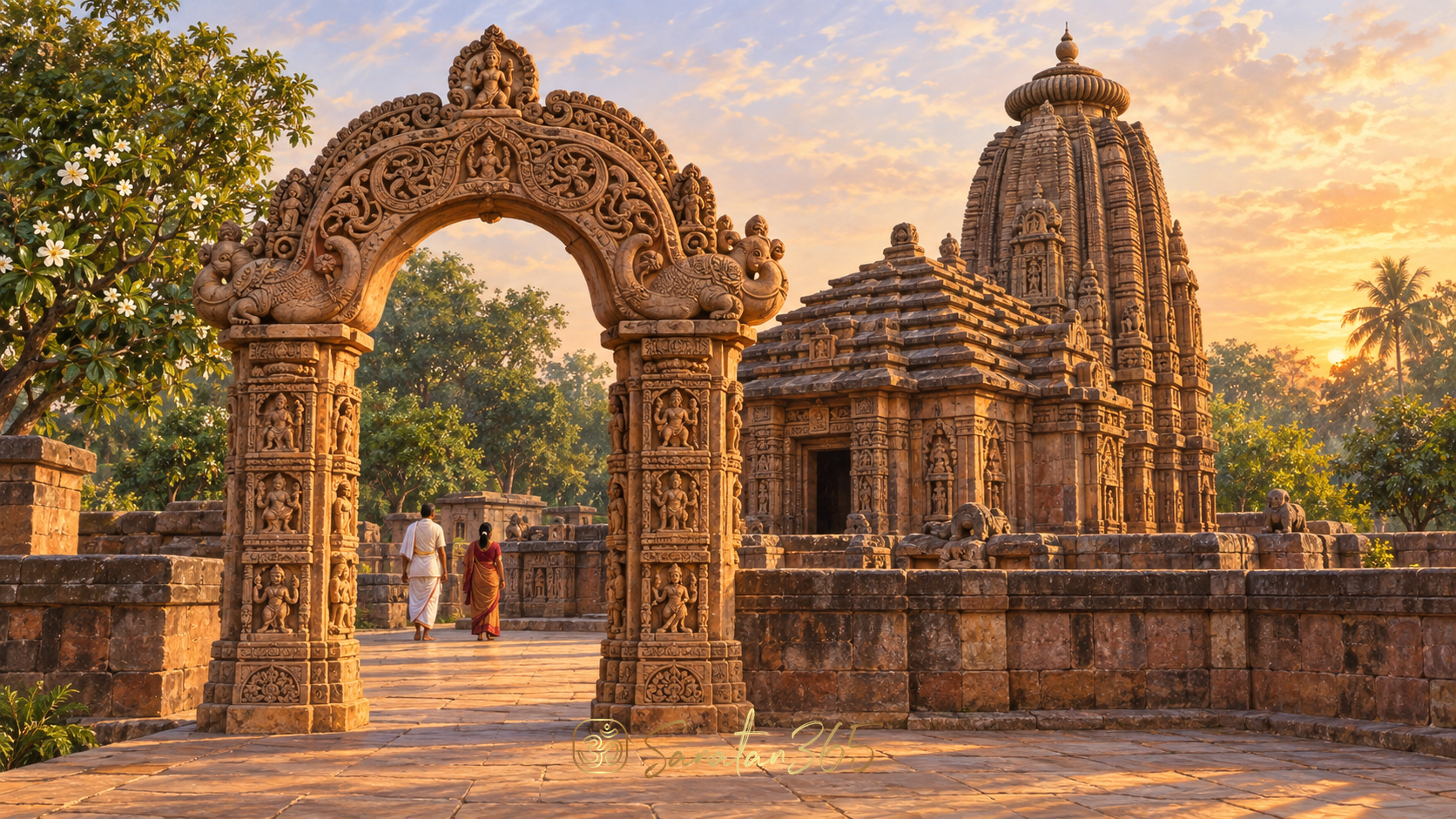
Mukteshvara Temple, Bhubaneswar: Shiva, Stone, and the Art of Arrival
Explore Mukteshvara Temple in Bhubaneswar through its sculpted torana, Kalinga architecture, Shiva devotion, and a thoughtful way to visit…
 Temples
Lepakshi Veerabhadra Temple: Sacred Art, Architecture, and Devotion
Lepakshi's Veerabhadra Temple brings Vijayanagara architecture, Shaiva devotion, painted ceilings, carved pillars, and living sacred memory…
 Temples
Chennakeshava Temple Belur: Vishnu, Hoysala Art, and Living Worship
Chennakeshava Temple in Belur is both a living Vishnu shrine and a landmark of Hoysala sacred architecture. Its sculpted surfaces show how…