Brahma Muhurta Meaning: A Gentle Hindu Morning Practice Before Sunrise
A careful guide to Brahma Muhurta meaning, timing before sunrise, scriptural and Ayurvedic context, and a realistic morning practice for modern families.
The most powerful hour of the morning is often the one before the household has begun asking for anything.
Brahma Muhurta meaning is the meaning of the sacred pre-dawn period traditionally used for prayer, meditation, mantra, study, and quiet self-reflection. A muhurta (मुहूर्त, a traditional unit of time) is commonly treated as 48 minutes, and Brahma Muhurta is often described as the 48-minute window that begins about 1 hour 36 minutes before sunrise and ends about 48 minutes before sunrise. Because sunrise changes by place and season, Brahma Muhurta is not one fixed clock time for every family.
Key takeaway: Brahma Muhurta is a flexible pre-sunrise discipline, not a rigid spiritual performance.
What Is Brahma Muhurta Meaning in Simple Words?
Brahma Muhurta meaning becomes clear when the two words are read together. Brahma here points toward sacred expansion, wisdom, and the creative intelligence associated with the dawn of awareness. Muhurta means a measured moment or period. In practical Hindu life, Brahma Muhurta is the quiet period before sunrise when the mind is considered especially fit for sattvic activity: prayer, japa, meditation, scriptural study, and gentle preparation for the day.
Many modern summaries describe Brahma Muhurta as beginning 1 hour 36 minutes before sunrise and lasting 48 minutes Wikipedia. That timing comes from the broader muhurta system, where each muhurta is 48 minutes and the night is divided into segments. Some traditions speak more generally of the last part of the night before dawn. For daily practice, the essential point is not mathematical anxiety. It is sacred attention before worldly noise.
This is why Brahma Muhurta has remained meaningful across temples, yoga lineages, Ayurvedic daily routine, and family practice. The body is rested. The phone has not yet taken over attention. The air is cooler. The mind has not yet gathered the full weight of tasks, messages, and reactions. In that window, even a short practice can feel cleaner.
The word sattva (सत्त्व, clarity, harmony, and luminous balance) helps explain the mood of the hour. Brahma Muhurta is treated as sattvic because it supports steadiness rather than stimulation. It invites a person to begin the day by remembering what is sacred before engaging what is urgent.
Key takeaway: Brahma Muhurta means a pre-dawn sacred window used to place clarity, remembrance, and dharma before the demands of the day.
What Is the Correct Brahma Muhurta Time?
The correct Brahma Muhurta time depends on local sunrise. A common calculation is simple: find the local sunrise, count back 1 hour and 36 minutes for the start, and count back 48 minutes for the end. If sunrise is 6:00 a.m., Brahma Muhurta is often calculated from 4:24 a.m. to 5:12 a.m. If sunrise is 5:35 a.m., the window shifts earlier. If sunrise is 7:10 a.m. in a winter diaspora location, it shifts later.
This matters because Hindu timekeeping is relational. It listens to sunrise, lunar days, seasons, and place. A family in Chennai, Varanasi, London, Toronto, Singapore, and Sydney will not always share the same pre-dawn clock rhythm. Local sunrise is the anchor.
Several Hindu and yoga resources describe the period as especially appropriate for meditation, worship, and other spiritual practices Art of Living. Ayurvedic daily-routine teachings also connect early rising with dinacharya (दिनचर्या, daily rhythm or daily conduct), the disciplined ordering of the day Art of Living Ayurveda. A careful practitioner should treat these as practice traditions, not as medical guarantees.
The practical question is: how exact should one be? For household life, exactness should serve sincerity. A monk, priest, or advanced practitioner may follow precise timings. A parent with an infant, a night-shift worker, an elderly devotee, or a student recovering from illness may need a gentler adaptation. Brahma Muhurta should not become another form of self-criticism.
A realistic approach:
- Check the local sunrise time.
- Wake near the Brahma Muhurta window when health and sleep allow.
- Keep the first 15 to 45 minutes quiet and sattvic.
- Avoid checking messages before practice.
- Let consistency matter more than heroic strictness.
Key takeaway: Brahma Muhurta is calculated from local sunrise, but its real purpose is to create a quiet beginning rooted in spiritual attention.
Why Is Brahma Muhurta Considered Good for Practice?
Brahma Muhurta is considered good for practice because it joins three conditions: quiet surroundings, a rested mind, and a symbolic threshold between night and day. Hindu practice often gives great value to thresholds. Dawn, dusk, new moon, full moon, festival days, and sankalpa moments all mark transitions. A transition is powerful because it is not yet fully formed. What is placed there can shape what follows.
In the pre-dawn hour, the mind has not yet been pulled outward. This makes it easier to perform japa (जप, repeated mantra remembrance), dhyana (ध्यान, meditation or steady contemplation), svadhyaya (स्वाध्याय, self-study or sacred study), and quiet prayer. Readers who want a deeper meditation foundation may also read Dhyana Meaning: Hindu Meditation as Steady Awareness, Not Empty Escape.
There is also an ethical dimension. Waking early is not only about spiritual feeling. It asks for restraint the night before. One cannot honor Brahma Muhurta while sleeping at midnight every day, scrolling endlessly, and then blaming the morning for being difficult. The practice begins earlier: lighter dinner, quieter evening, cleaner intention, and a small promise kept.
The Bhagavad Gita gives a useful rhythm for disciplined living. Krishna teaches moderation in food, recreation, effort, sleep, and wakefulness for the yogic path Bhagavad Gita 6.16-17. This is essential. Brahma Muhurta should not be used to glorify sleep deprivation. A balanced practitioner respects the body as an instrument of dharma.
For families, the hour can become a shared culture without becoming a command. Children may wake later but see a parent light a diya. A student may use the time for one shloka and quiet study. A grandparent may chant softly. A householder may sit for ten minutes before the kitchen, commute, and office begin.
Key takeaway: Brahma Muhurta works because it protects the first attention of the day and offers it to what is sacred.
How Can Beginners Practice Brahma Muhurta at Home?
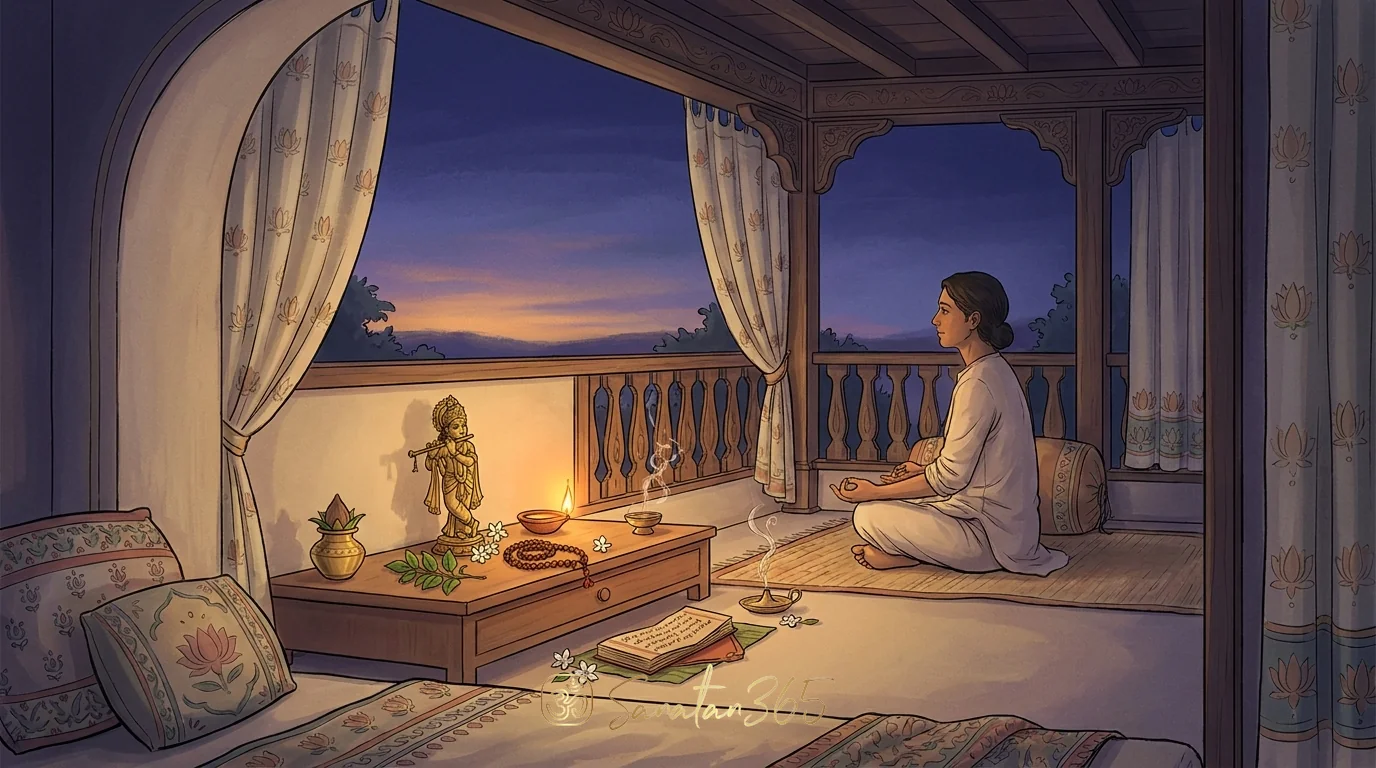
A beginner does not need a complex routine. The simplest Brahma Muhurta practice is to wake gently, wash the face, sit near the puja space, light a diya if safe, and give the first attention to prayer or silence. The goal is not to imitate someone else’s intensity. The goal is to make the morning spiritually clean.
Here is a 25-minute beginner rhythm:
- Wake and sit up slowly. Do not reach for the phone.
- Cleanse lightly. Wash the face, rinse the mouth, or bathe if that is your family practice.
- Make sankalpa. Offer a simple sankalpa (संकल्प, sacred intention): “May this day be guided by clarity, restraint, and devotion.” See also Sankalpa Meaning: Why Hindu Puja Begins with Sacred Intention.
- Light and remember. Light a diya safely, or simply sit before the altar with folded hands.
- Chant one mantra. Repeat a chosen mantra 11, 21, or 108 times. The Gayatri Mantra tradition is one well-known dawn practice; related context is in Gayatri Mantra Meaning: A Vedic Prayer for Clear Intelligence.
- Sit in silence. Let the breath settle for five minutes.
- Close with one action. Decide one dharmic action for the day: speak truthfully, avoid anger, help someone, study sincerely, or keep a promise.
This routine can be shortened to 10 minutes or expanded to an hour. It can include Sanskrit recitation, Vishnu Sahasranama, Shiva mantra, Devi stotra, Surya remembrance, scriptural reading, journaling, or silent meditation. Different families will choose differently.
The important discipline is to avoid turning Brahma Muhurta into spiritual productivity. It is not a contest to stack practices. If the heart becomes anxious about doing enough, return to one lamp, one mantra, one breath, and one sincere intention.
For people who live in apartments, shared rooms, or dormitories, quiet adaptation is enough. A mental diya, a silent mantra, headphones with a soft chant, or a small seat by the window can carry devotion without disturbing others. For diaspora families in colder climates, the ritual may look different from an Indian courtyard morning. The principle remains portable.
Key takeaway: Begin with a small routine that can survive real life: wake, cleanse, intend, chant, sit, and carry one dharmic action into the day.
What Should Be Avoided During Brahma Muhurta?
What should be avoided during Brahma Muhurta is anything that pulls the mind sharply into restlessness before it has found its center. The hour is easily lost to the same habits that consume the rest of the day.
Common things to avoid:
- checking messages, news, or social media immediately
- arguing about household tasks before prayer
- using the hour to feel superior to others
- forcing strict fasting or austerity without guidance
- making loud practice that disturbs family or neighbors
- sacrificing necessary sleep for spiritual image
- turning the practice into anxiety over exact minutes
The last point matters. Brahma Muhurta has timing, but timing is not the whole practice. A person may wake at exactly the right minute and spend it in irritation. Another may wake slightly later and sit with humility. The second practice may be spiritually cleaner.
Health also needs respect. Anyone with medical conditions, pregnancy, severe insomnia, depression, anxiety, or recovery needs should not treat early rising as a cure or as proof of devotion. Hindu practice is strong enough to include discernment. If a person needs professional help or medical sleep guidance, spiritual practice should support that care, not replace it.
Similarly, night-shift workers and caregivers should not feel excluded. Their “Brahma Muhurta principle” may be the first quiet moment after proper rest. Sacred discipline adapts when life duties are real. Dharma is not served by harming the body or neglecting dependents.
Key takeaway: Avoid restlessness, pride, and sleep deprivation; Brahma Muhurta should make the mind clearer and kinder, not harsher.
How Does Brahma Muhurta Shape the Rest of the Day?
Brahma Muhurta shapes the day by protecting the first act of attention. The first act matters because it teaches the mind what is primary. If the first act is reaction, the day begins in reaction. If the first act is remembrance, the day begins with a center.
This does not mean every day will become calm. Work pressure, family needs, traffic, school demands, illness, and grief may still come. The practice does not promise a problem-free life. It offers a steadier starting point from which to meet life.
A useful way to carry the practice forward is to choose one thread from the morning:
- If the morning was mantra, let speech be cleaner.
- If the morning was silence, pause before reacting.
- If the morning was study, apply one teaching.
- If the morning was gratitude, complain less.
- If the morning was aarti, keep the inner lamp alive. For related practice, see Aarti Meaning: Why Hindus Offer Light in Worship.
Over time, this is how Brahma Muhurta becomes more than a wake-up time. It becomes a training in priority. The person learns to meet the day from dharma before meeting it from habit. Even when the routine breaks, the memory of a clean morning can call the seeker back.
There is no need to romanticize the hour. Some mornings will be dull. Some will be sleepy. Some will be interrupted. Still, a modest practice repeated over months can change the texture of life. The house feels different when the day begins with a lamp, a mantra, and a quiet vow.
Key takeaway: Brahma Muhurta matters because it turns the first attention of the day toward dharma, and that first attention can quietly influence every later action.
FAQ
What is Brahma Muhurta meaning?
Brahma Muhurta meaning refers to the sacred pre-dawn period traditionally used for meditation, mantra, prayer, study, and quiet reflection. It is commonly understood as a 48-minute window before sunrise.
What time is Brahma Muhurta?
Brahma Muhurta is often calculated as beginning about 1 hour 36 minutes before local sunrise and ending about 48 minutes before sunrise. Since sunrise changes by location and season, the exact clock time varies.
Is Brahma Muhurta only for meditation?
No. Meditation is one common practice, but Brahma Muhurta can also be used for mantra japa, scriptural study, puja, sankalpa, journaling, or quiet prayer.
Can beginners wake later than Brahma Muhurta?
Yes. Beginners can start by waking 15 or 30 minutes earlier than usual and keeping that time sattvic. A steady small practice is better than a strict routine that collapses after two days.
Is waking in Brahma Muhurta required for every Hindu?
No. It is a respected practice, not a measure of spiritual worth. Health, age, work schedule, caregiving, pregnancy, and sleep needs should be considered with maturity.
Conclusion
Brahma Muhurta is not magic hidden in the clock. It is a sacred way to protect the first attention of the day. Wake before sunrise when possible, keep the practice gentle, honor sleep and health, and let one lamp, one mantra, one breath, or one sankalpa place dharma at the center before the world begins speaking.
Key takeaway: Brahma Muhurta is most valuable when it becomes a humble, repeatable discipline of beginning the day with clarity and devotion.
About the author
Sanatan365 Editorial
Bringing Sanatan Dharma to modern seekers through authentic, scripture-grounded content.
Related in Practices
 Practices
Kusha Grass Meaning: Why Darbha Has a Place in Hindu Rituals
Understand kusha or darbha grass, its traditional place in worship and ancestral rites, and how to approach varied customs with care.
 Practices
Bhuta Shuddhi Meaning: Purifying the Five Elements Within
Bhuta Shuddhi means the purification of the five elements: earth, water, fire, air, and space. In Hindu yogic and Tantric traditions, it is…
 Practices
Likhita Japa: Meaning and Practice of Writing a Mantra
Likhita japa turns mantra repetition into a written devotional discipline. Learn its meaning, how it differs from spoken and mental japa, a…

