
Tat Tvam Asi Meaning: What the Chandogya Upanishad Teaches
Tat Tvam Asi means That Thou Art, a Chandogya Upanishad teaching on the relationship between Atman and Brahman.
A father asks his learned son whether he has understood the one truth by which everything else becomes known.
Tat Tvam Asi meaning is usually given as "That Thou Art" or "You are That." In the Chandogya Upanishad, the phrase points to the relationship between Atman (आत्मन्, the Self) and Brahman (ब्रह्मन्, ultimate reality). It is not a slogan of ego. It is a teaching that the deepest Self is not separate from the sacred ground of existence. Britannica identifies tat tvam asi as a famous Upanishadic expression about the relation between the individual and the Absolute Britannica.
What Is Tat Tvam Asi Meaning in the Chandogya Upanishad?
Tat Tvam Asi comes from Sanskrit: tat (तत्, That), tvam (त्वम्, you), and asi (असि, are). The traditional translation, "That Thou Art," sounds old-fashioned in English, but its spiritual force remains direct. The "That" refers to the subtle essence behind all life. The "thou" or "you" refers not to the personality, social role, or restless mind, but to the inner Self.
The phrase appears in the Chandogya Upanishad, one of the principal Upanishads associated with the Sama Veda. It is spoken by the sage Uddalaka Aruni to his son Shvetaketu. Wisdom Library's translation of Chandogya Upanishad 6.9.4 preserves the famous formula as "Tat tvam asi" and places it in the teaching sequence where Uddalaka explains the subtle essence of reality to Shvetaketu Wisdom Library.
This is why the phrase is called a mahavakya (महावाक्य, great saying) in Vedanta. A mahavakya is not merely memorable language. It is a compact statement meant for contemplation, inquiry, and realization. The seeker returns to it again and again, not to win an argument, but to see more clearly what the Self is.
Key takeaway: Tat Tvam Asi means the deepest Self is rooted in the same ultimate reality that sustains all existence.
Why Does Uddalaka Teach Shvetaketu Through Simple Examples?
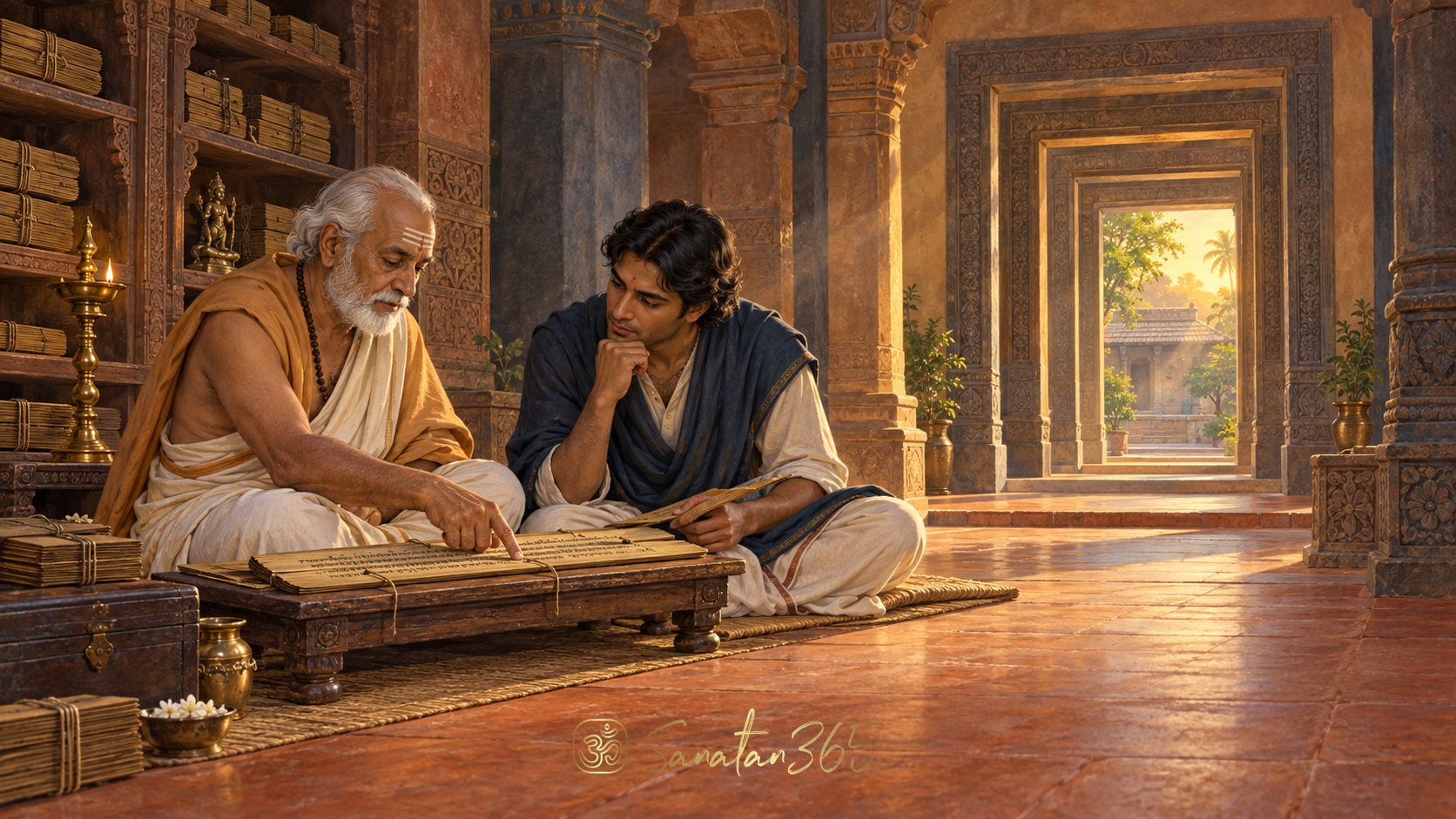
The Chandogya Upanishad does not present Tat Tvam Asi as a dry definition. It unfolds through a father-son dialogue. Shvetaketu returns from long study proud of his learning. Uddalaka does not shame him. He redirects him. The question is gentle but piercing: has Shvetaketu learned that by which the unheard becomes heard, the unthought becomes thought, and the unknown becomes known?
Uddalaka then teaches through images a student can feel. Clay and pots. Gold and ornaments. Iron and tools. A seed that seems empty but contains a vast tree. Salt dissolved in water, invisible but present everywhere in the vessel. These examples do two things at once: they humble intellectual pride and make metaphysics accessible.
The salt-water image is especially powerful. When salt dissolves, the eyes cannot see it, but the tongue can taste it in every part of the water. Uddalaka uses this to show how the subtle essence may be unseen yet deeply present. The real is not limited to what can be grasped by ordinary sight.
This teaching method matters for modern readers. The Upanishads are not asking seekers to collect abstractions. They invite disciplined seeing. The world of names and forms is real at the level of ordinary experience, but it also points beyond itself. Clay forms many pots; gold forms many ornaments; the one essence appears through many expressions.
Key takeaway: Uddalaka uses simple examples because the highest teaching must become visible in daily experience before it can become steady understanding.
How Do Atman and Brahman Shape Tat Tvam Asi Meaning?
Tat Tvam Asi becomes clear only when Atman and Brahman are understood carefully. Atman is not the ego, mood, biography, or body image. It is the witnessing Self, the innermost principle of conscious being. Brahman is not one object inside the universe. It is the ultimate reality by which the universe has being, order, and sacred depth.
In Advaita Vedanta, Tat Tvam Asi is read as a statement of non-duality: the true Self and Brahman are not ultimately separate. Other Vedanta traditions interpret the relationship with different philosophical nuance, emphasizing dependence, participation, devotion, or qualified unity. This diversity should be treated with respect. Sanatan Dharma has always held multiple serious ways of approaching truth.
The phrase therefore should not be flattened into "I am God" in a casual or inflated sense. That reading misses the discipline of the Upanishadic setting. Shvetaketu is not being told to magnify his ego. He is being taught to see through the ego. The teaching asks for humility, purity of mind, ethical steadiness, and contemplative attention.
This also connects with moksha (मोक्ष, liberation), the freedom that comes when the Self is no longer mistaken for passing identifications. For a wider view of liberation in Hindu life, see Moksha Meaning. Tat Tvam Asi is one doorway into that vision because it turns inquiry from outer possession toward inner recognition.
Key takeaway: Atman and Brahman make Tat Tvam Asi a teaching about sacred identity, not personal grandiosity.
Why Is Tat Tvam Asi Called a Mahavakya?
Tat Tvam Asi is called a mahavakya because it gathers a complete spiritual insight into a short statement. The phrase belongs to the Vedantic habit of using concentrated sentences for deep contemplation. A seeker may hear the teaching, reflect on it, question it, meditate on it, and gradually let it reshape their understanding of self and reality.
The word mahavakya combines maha (मह, great) and vakya (वाक्य, statement or sentence). The greatness does not come from length. It comes from depth. "Tat Tvam Asi" is great because it points beyond surface identity toward the unbroken ground of being.
Yet the phrase is not isolated from practice. In the Upanishadic tradition, hearing the teaching is only the beginning. Shravanam (श्रवणम्, listening), mananam (मननम्, reflection), and nididhyasanam (निदिध्यासनम्, sustained contemplation) are often described as stages by which knowledge matures. A person listens to scripture and teacher, reasons carefully, then abides with the insight until it becomes less borrowed and more inwardly clear.
This is where shraddha (श्रद्धा, living trust or faith) matters. Faith in the Hindu sense is not blind refusal to think. It is a respectful trust strong enough to keep practicing before the fruit is fully visible. For more on that quality, see Shraddha Meaning.
Key takeaway: Tat Tvam Asi is a mahavakya because it is short enough to remember and deep enough to contemplate for a lifetime.
How Can Modern Seekers Reflect on Tat Tvam Asi Without Misusing It?
Modern spiritual language often turns profound teachings into quick affirmations. Tat Tvam Asi deserves better. It can inspire confidence, but it is not a self-branding phrase. It can deepen dignity, but it should not become spiritual vanity. The Upanishadic mood is quiet, exacting, and transformative.
A respectful reflection can begin with three questions:
- What am I calling "I" right now: body, role, emotion, memory, or witnessing awareness?
- What changes in me, and what quietly knows those changes?
- Can I honor the same sacred essence in another person without erasing practical differences and responsibilities?
These questions keep the teaching grounded. If the Self is sacred, then daily conduct matters more, not less. Truthfulness, compassion, restraint, and service become natural tests of understanding. A person who repeats "You are That" but behaves with arrogance has not absorbed Uddalaka's lesson.
The teaching can also soften loneliness. It suggests that the deepest Self is not a sealed private object, cut off from the whole. This does not remove grief, duty, family, or effort from life. It gives them a larger frame. The seeker learns to act in the world while remembering that the visible surface is not the final measure of reality.
For readers drawn to layered models of the Self, the teaching also pairs well with the five-sheath vision of the Taittiriya Upanishad. See Pancha Kosha Meaning for a related way of distinguishing body, energy, mind, understanding, bliss, and the deeper Self.
Key takeaway: Tat Tvam Asi is practiced rightly when it produces humility, clarity, and reverence toward life.
What Does Tat Tvam Asi Teach About Daily Dharma?
Tat Tvam Asi can sound purely metaphysical, but its implications are practical. If the Self is deeper than passing identity, then daily life becomes a field of discernment. The seeker can ask: is this action coming from ego, fear, habit, or awareness?
In family life, the teaching encourages patience. One does not reduce another person to a temporary mood or mistake. In work, it encourages steadiness. Success and failure still matter, but they do not define the Self. In worship, it encourages reverence. The Divine is not only distant; sacred presence is also inwardly discoverable.
This does not mean ordinary boundaries disappear. Dharma still requires wise judgment. A parent must guide a child. A teacher must correct error. A community must protect dignity and safety. Non-dual insight should never be used to excuse harm, avoid responsibility, or flatten ethical difference. The Upanishadic seer is not careless. The seer is more awake.
A simple daily practice can help:
- Sit quietly for five minutes.
- Repeat "Tat Tvam Asi" slowly, without forcing emotion.
- Notice the body, breath, thoughts, and roles as changing experiences.
- Ask what silently knows these changes.
- End by resolving to treat one person with more patience that day.
This is not a replacement for formal study with a qualified teacher. It is a respectful entry point for contemplation.
Key takeaway: Tat Tvam Asi becomes daily dharma when insight into the Self changes how one speaks, acts, listens, and serves.
FAQ
What is the simple meaning of Tat Tvam Asi?
Tat Tvam Asi means "That Thou Art" or "You are That." In the Chandogya Upanishad, it teaches that the deepest Self, Atman, is connected with ultimate reality, Brahman.
Where does Tat Tvam Asi come from?
Tat Tvam Asi comes from the Chandogya Upanishad, especially the teaching dialogue in chapter 6 where Uddalaka Aruni instructs his son Shvetaketu about the subtle essence behind all existence.
Is Tat Tvam Asi an Advaita Vedanta teaching?
It is central to Advaita Vedanta, where it is read as a statement of non-duality between Atman and Brahman. Other Vedanta traditions interpret the relationship differently, and those interpretations deserve respectful treatment.
Does Tat Tvam Asi mean the ego is divine?
No. The phrase does not glorify the ego. It points beyond personality, pride, body, and mental fluctuation toward the deeper Self. Uddalaka teaches Shvetaketu humility, not self-importance.
How can a beginner reflect on Tat Tvam Asi?
A beginner can reflect by asking, "What in me changes, and what knows the change?" Then the phrase can be contemplated gently, alongside ethical living, study, humility, and guidance from trustworthy teachers.
Tat Tvam Asi's single key takeaway is this: the Upanishadic Self is not a small isolated ego, but the sacred depth through which life, truth, and awareness are known.
About the author
Sanatan365 Editorial
Bringing Sanatan Dharma to modern seekers through authentic, scripture-grounded content.
Related in Scriptures
 Scriptures
Tattva Bodha Meaning: Four Qualifications for Clear Self-Inquiry
A beginner-friendly reading of Tattva Bodha, its four qualifications, six inner disciplines, and careful distinction between preparation an…
 Scriptures
Nirvana Shatakam Meaning: Six Verses of Self-Inquiry
Read the six verses of Nirvana Shatakam as careful Advaita self-inquiry, understand Shivoham, and distinguish contemplative freedom from ne…
 Scriptures
Atharva Veda Meaning: Household Prayer and Cosmic Questions
The Atharva Veda brings household concerns, communal hopes, and questions about existence into sacred speech. Learn its scope and how to re…

