Tilak Meaning: Why Hindus Wear a Sacred Forehead Mark
A clear guide to tilak meaning in Hindu practice, including sandalwood, kumkum, vibhuti, Vaishnava marks, Shaiva tripundra, and daily ritual use.
A small mark on the forehead can carry a whole theology of belonging.
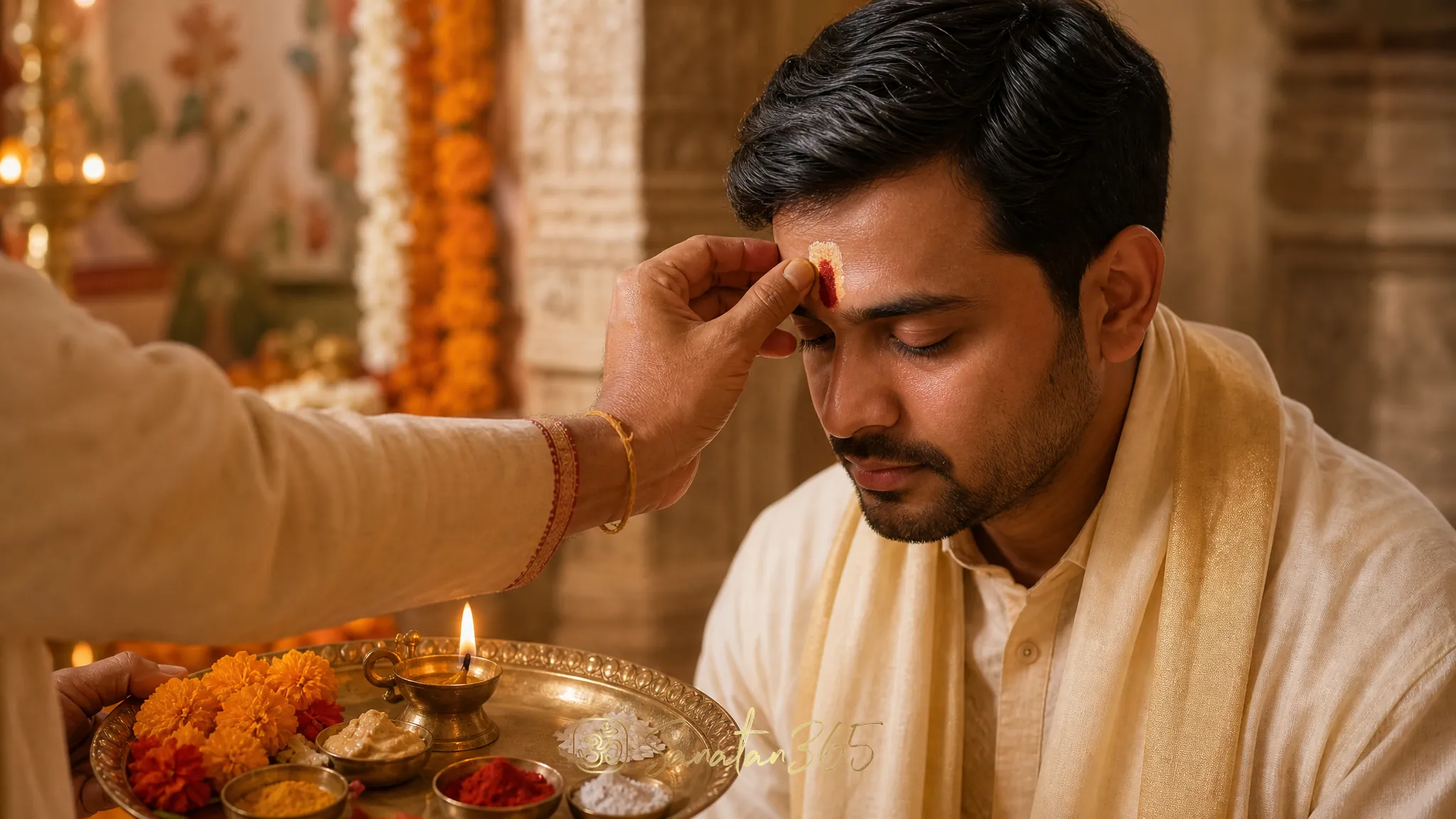
Tilak meaning begins with a simple definition: a tilak, or tilaka (तिलक, sacred mark), is a Hindu forehead mark applied during worship, blessing, initiation, festival, pilgrimage, or daily devotion. It may be made with sandalwood paste, kumkum (कुमकुम, red vermilion powder), vibhuti (विभूति, sacred ash), turmeric, clay, or other sacred substances. In Hindu life, the tilak can signal devotion, sect tradition, auspiciousness, humility, and the wish to carry puja (पूजा, worship) into ordinary action.
What is the Tilak meaning in Hindu ritual?
The most direct Tilak meaning is "sacred mark." Britannica describes tilak as a mark, generally on the forehead, that can indicate sectarian affiliation in Hinduism. That public meaning matters, but it is only one layer. In lived practice, tilak is also a blessing received, a vow remembered, and a visible sign that the body is not separate from worship.
A tilak is often placed between the eyebrows or above them, a region many Hindu and yogic traditions associate with attention, inner seeing, and spiritual focus. Devotees may receive it after darshan (दर्शन, sacred seeing), after aarti (आरती, offering of light), during vrata (व्रत, vow or observance), before travel, at weddings, on festival mornings, or at the close of home puja. In these moments, the forehead becomes a place where memory and intention meet.
The mark says: "May the mind remain aligned." It does not make a person holy by appearance alone. It asks the person to live in a way that honors what the mark represents.
This is why tilak belongs with other embodied Hindu practices such as aarti, pradakshina, and sankalpa. Each practice uses the body to train attention. The lamp is moved, the feet circle, the hands fold, the forehead receives a mark. Devotion becomes physical, not only mental.
Key takeaway: Tilak turns worship into a visible reminder that thought, speech, and action should remain aligned with dharma.
Why do Hindus wear tilak on the forehead?
Hindus wear tilak on the forehead because the head is associated with identity, thought, and direction. A sacred mark placed there becomes a reminder that the mind should not wander without discipline. It also makes devotion visible, especially after visiting a temple or completing a ritual.
In many homes, a parent or elder places tilak before a child leaves for an exam, a wedding guest receives tilak as welcome, and a devotee receives tilak after touching the feet of a guru or elder. In these settings, the mark is not only personal. It is relational. Someone gives a blessing, and someone receives it.
The mark can also signal sampradaya (सम्प्रदाय, spiritual lineage or tradition). A Vaishnava devotee may wear a vertical U-shaped mark associated with Vishnu or Krishna devotion. A Shaiva devotee may wear horizontal lines of vibhuti associated with Shiva. A Shakta devotee may wear red kumkum linked with Devi worship and auspicious power. These forms do not exhaust Hindu diversity, and regional practice varies widely, but they show how tilak can express belonging without needing a speech.
There is also a daily psychology to the practice. When a devotee applies tilak after bathing, before japa (जप, mantra repetition), or after puja, the hand pauses at the forehead. The moment is brief, but it interrupts carelessness. It asks: what should guide the mind today?
In diaspora families, tilak can be especially meaningful because it makes inherited practice visible in a world where many sacred habits become private. A child may first learn tilak as a festival mark, then later understand it as identity, blessing, and discipline.
Key takeaway: Hindus wear tilak because it makes devotion, lineage, blessing, and mindful conduct visible on the body.
What are the main types of Hindu forehead mark?
There is no single Hindu forehead mark used by everyone. Tilak is a family of marks shaped by region, deity, lineage, material, occasion, and personal practice.
Common forms include:
- Sandalwood tilak: Chandan (चन्दन, sandalwood paste) is cooling, fragrant, and often associated with purity, calmness, and Vishnu or Krishna worship.
- Kumkum tilak: Kumkum is red and auspicious, often used in Devi worship, household puja, weddings, and welcome rituals.
- Vibhuti or bhasma: Sacred ash is strongly associated with Shiva, renunciation, impermanence, and the burning away of ego.
- Haldi or turmeric: Haldi (हल्दी, turmeric) is linked with auspiciousness, fertility, blessing, and domestic ritual life.
- Gopi chandan or sacred clay: Many Vaishnava traditions use clay marks to honor Vishnu, Krishna, or the body as a temple of the Divine.
- Bindi: Britannica notes that bindi is a forehead mark worn in South Asian religious and cultural contexts, often by women, with meanings that may include auspiciousness, social identity, and beauty. It is related to but not identical with every form of tilak.
These materials matter because Hindu ritual rarely treats matter as spiritually empty. A flower, lamp, water, ash, sandal paste, rice grain, or red powder can become a carrier of sacred attention. The substance is not magic by itself. It is made meaningful by mantra, offering, tradition, and intention.
Regional variation is also important. A family in Maharashtra may mark a guest differently from a family in Tamil Nadu, Bengal, Gujarat, Karnataka, or Uttar Pradesh. Temple priests may apply tilak according to the deity of the temple. A household may combine sandalwood and kumkum in a style inherited from grandparents. Hindu practice is both shared and local.
Key takeaway: Tilak is not one fixed design; it is a living ritual language shaped by material, lineage, region, and intention.
How do Vaishnava tilak and Shaiva tripundra differ?
Vaishnava tilak and Shaiva tripundra are two of the most recognizable sectarian forms. They are not merely decorative differences. They point to different devotional lineages and theological imaginations within Sanatan Dharma.
Vaishnava tilak is often vertical, commonly shaped like a U, V, or paired lines, depending on the sampradaya. It may be made with sandalwood paste, clay, or other sacred substances. Many devotees understand the mark as honoring Vishnu, Krishna, or Narayana, and as remembering the body as a temple. The central space or line can also carry lineage-specific meaning.
Shaiva tripundra (त्रिपुण्ड्र, three horizontal marks) is usually made with vibhuti or sacred ash. The three lines are associated with Shiva and are often interpreted through triads: the three gunas (गुण, qualities of nature), the three fires, the three syllables of Om, the three states of experience, or the burning away of ignorance. Exact explanations vary by text and lineage, but the ash consistently points toward impermanence and purification.
There are also Shakta, Smarta, Ganapatya, regional, temple-specific, and family-specific forms. Some devotees wear tilak daily. Others wear it on festival days, after temple visits, or during specific vows. Some marks are bold and public; others are small and domestic.
The right way to read these marks is with humility. A tilak may reveal a tradition, but it does not reveal the full depth of a person's devotion. Hindu identity is not a costume, and spiritual maturity cannot be measured by the size of a mark.
Key takeaway: Vaishnava and Shaiva tilaks differ in shape, substance, and theology, but both make the body a bearer of sacred memory.
What does tilak teach about the body and devotion?
Tilak teaches that the body is part of spiritual practice. Hindu ritual does not usually divide worship into "inner" and "outer" as if the outer were unimportant. The body bows, bathes, chants, fasts, lights lamps, walks around temples, receives prasad (प्रसाद, blessed offering), and wears marks.
This matters because human beings learn through repetition. A thought can be forgotten quickly. A repeated gesture becomes habit. When tilak is applied with awareness, it trains the devotee to begin again. The mark is small, but it can hold a large sankalpa (संकल्प, sacred intention): may this mind remember what is sacred.
Tilak also protects devotion from becoming vague. A person may say, "I believe in dharma," but daily life tests that belief through impatience, speech, money, family duty, desire, and pride. A mark on the forehead quietly asks whether the day's conduct matches the morning's prayer.
This is why the practice should be approached without vanity. A tilak worn to appear superior contradicts its own meaning. A tilak worn with humility can become a discipline. It says that the forehead, the place associated with thought and identity, has been offered.
For families, teaching tilak can be gentle. Children do not need a heavy lecture. They can learn that sandalwood cools the mind, kumkum marks auspiciousness, vibhuti reminds us that ego turns to ash, and sacred marks help us remember God before we rush into the day.
Key takeaway: Tilak makes devotion embodied by turning a small forehead mark into a daily discipline of remembrance.
How can someone apply tilak respectfully?
Tilak practice should follow the tradition, temple, family, or guru from which one receives it. Still, a few simple principles help beginners and diaspora families approach it respectfully.
First, use clean materials. Sandalwood paste, kumkum, turmeric, vibhuti, or sacred clay should be kept respectfully, not mixed with casual cosmetics or placed where people step. Second, apply it after bathing or after puja when possible. Third, pause for a brief prayer rather than treating the mark as a rushed decoration.
A simple home approach may look like this:
- Wash the hands.
- Sit or stand calmly near the puja space.
- Touch a small amount of the chosen substance with the ring finger or thumb, depending on family custom.
- Apply the mark gently to the forehead.
- Remember the deity, mantra, elder, or intention connected with the practice.
- Let the mark guide conduct for the day.
Temple etiquette also matters. If a priest offers tilak, receive it with respect. If a temple has a specific tradition, follow that tradition while there. If visiting a community different from one's own, avoid mocking, correcting, or casually imitating marks without understanding. Hindu diversity deserves careful attention.
For non-Hindus attending a Hindu ceremony, receiving tilak as a welcome blessing is usually an act of hospitality, not forced conversion. If unsure, ask respectfully. For Hindus reconnecting with practice, it is acceptable to begin modestly: a small sandalwood or kumkum mark after puja can become meaningful when done consistently.
Key takeaway: Tilak is best applied with clean materials, humility, lineage awareness, and a clear intention to live more consciously.
FAQ
What is the basic Tilak meaning?
Tilak meaning refers to a sacred Hindu mark, usually placed on the forehead, that can express blessing, devotion, lineage, auspiciousness, and mindful intention after worship or before important activity.
Is tilak the same as bindi?
Tilak and bindi are related forehead marks, but they are not always the same. Tilak often refers to a ritual or sectarian mark applied in worship, while bindi commonly refers to a dot or decorative mark worn in South Asian religious and cultural contexts, especially by women.
Why is tilak applied between the eyebrows?
Tilak is often applied between or above the eyebrows because that area is associated in Hindu and yogic traditions with attention, inner seeing, and mental focus. The mark reminds the wearer to guide thought toward dharma.
What is vibhuti tilak?
Vibhuti tilak is a sacred ash mark strongly associated with Shiva worship. It often appears as horizontal lines called tripundra and can symbolize purification, impermanence, and the burning away of ego.
Can Hindus wear tilak every day?
Yes. Many Hindus wear tilak daily after bathing, puja, mantra practice, or temple worship. Others wear it mainly during festivals, vows, pilgrimages, weddings, or family rituals. Practice varies by region, lineage, and household.
Tilak is one of Hinduism's smallest visible practices, yet it holds a complete discipline: receive blessing, remember lineage, offer the mind, and let worship shape conduct. The single key takeaway is simple: a tilak is not just a mark on the forehead; it is a reminder that the mind itself should become a place of worship.
About the author
Sanatan365 Editorial
Bringing Sanatan Dharma to modern seekers through authentic, scripture-grounded content.
Related in Rituals
 Rituals
Samavartana Meaning: Returning Home After Sacred Study
Samavartana marks the completion of traditional study through a ceremonial bath and return. Its lasting question is how learning becomes re…
 Rituals
Vidyarambham Meaning: First Letters, Learning, and Reverence
Explore Kerala’s ceremony of beginning letters, its Vijayadashami setting, rice-writing customs, and the meaning of a gentle first step int…
 Rituals
Ganga Aarti Meaning: Why Lamps Are Offered to the River
Why devotees offer light to the Ganga, what the public ceremony in Varanasi expresses, and how visitors can participate with care.

