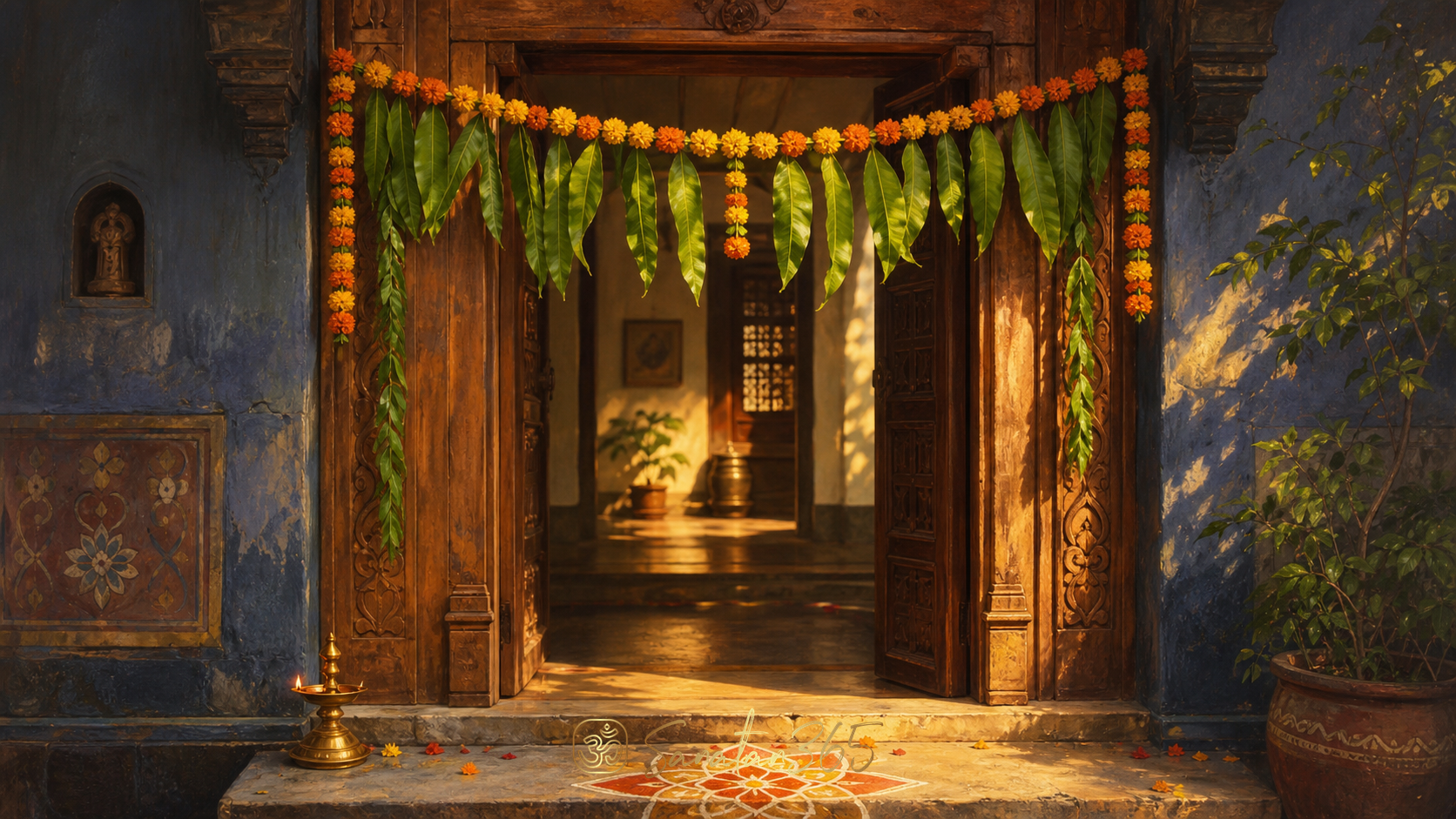
Toran Meaning: Why Hindu Homes Adorn the Doorway
A toran turns the threshold into a sign of welcome, auspiciousness, and mindful preparation. Learn its meaning, regional forms, and a respectful way to make one.
A toran is more than a decoration placed above a door. It marks the threshold as a place of welcome, auspicious intention, and transition from the outer world into the home.
The simplest toran meaning is this: it is a hanging garland or ornamental band fixed across an entrance, traditionally made from leaves, flowers, cloth, beads, or regional craft materials. In Hindu homes, it announces that the space has been prepared with care for family, guests, worship, or celebration. Fresh mango leaves and marigolds are familiar forms, but the tradition is remarkably diverse across India.
What Is the Toran Meaning in Hindu Tradition?
The word torana (तोरण, an ornamental gateway or arch) appears in South Asian architectural and artistic vocabulary as well as in domestic custom. Monumental stone gateways at sacred sites and a modest leaf garland over a family doorway differ greatly in scale, yet both draw attention to the act of crossing a boundary. Encyclopaedia Britannica describes the architectural torana as a ceremonial gateway, while modern household usage commonly shortens the word to toran.
At home, the toran makes an ordinary entrance visibly intentional. A doorway already has a practical function: it separates and connects. The toran adds a cultural message to that function. It says that those who enter should encounter cleanliness, hospitality, beauty, and an atmosphere suited to respectful living.
The Hindu American Foundation's overview of Hindu doorway decorations describes torans as colorful hangings commonly made with mango leaves and marigolds, associated with auspicious welcome and a protected domestic atmosphere. Such meanings belong to living tradition rather than one universal rulebook. A family may explain its toran through devotion to Goddess Lakshmi, through inherited regional custom, through festival memory, or simply through the dharmic discipline of preparing a home well.
This is why no single explanation should be presented as the only correct one. Hindu practice often carries several layers at once: devotional, aesthetic, seasonal, familial, and local.
Key takeaway: A toran marks the doorway as a cared-for threshold where welcome, order, and sacred attention meet.
Why Are Mango Leaves and Marigolds Used in a Toran?
Fresh materials make the toran feel alive. Mango leaves remain green for a useful period after cutting, have a distinctive shape, and appear widely in Hindu ceremonial life. They are also used around the kalasha, the sacred full vessel, linking leaves with abundance, water, continuity, and auspicious preparation.
Marigolds bring dense color and practical durability. Their yellows and oranges carry the visual warmth of flame, sunlight, celebration, and hospitality. In many homes, mango leaves provide the strong green rhythm while marigold blossoms add brightness. Other available leaves and flowers may be used according to climate, family custom, and season.
The materials matter, but symbolism should not turn into false science. Claims that a mango-leaf toran purifies all indoor air, cures illness, or creates guaranteed prosperity go beyond what responsible cultural explanation can support. Its strongest meaning is visible and ethical: someone gathered, arranged, and hung natural materials to make the entrance worthy of the occasion.
Freshness also carries a quiet lesson. Leaves dry. Flowers fade. The toran therefore expresses anitya (अनित्य, impermanence) without needing a lecture. Beauty is prepared, enjoyed, and then respectfully renewed or returned to the earth. The practice asks householders to notice when a sacred decoration has become neglected.
That rhythm resembles other domestic observances. A kolam drawn at the threshold may be remade as part of daily renewal; a toran may be refreshed for a festival or ceremony. Neither practice treats beauty as a permanent possession. Both turn care into a repeated action.
Key takeaway: Leaves and flowers join auspicious symbolism with the discipline of freshness, care, and renewal; they do not promise magical or medical results.
Why Is the Doorway Spiritually Important?
A threshold is a small place with a large psychological role. People pause there, remove footwear, greet hosts, carry offerings, welcome elders, and begin a visit. During a wedding, griha pravesh (गृह प्रवेश, ceremonial entry into a home), puja, or festival gathering, the entrance can become the first ritual frame encountered by every guest.
Hindu domestic practice often treats the entrance as a zone of readiness. The floor is cleaned. A lamp may be placed safely nearby. A rangoli or kolam can define the ground. The toran completes the upper edge, so the guest passes through a field of deliberate care rather than an anonymous opening.
This visual grammar does not mean outsiders are impure or unwelcome. That exclusionary reading contradicts the hospitality at the heart of the practice. The doorway should support atithi satkara (अतिथि सत्कार, honoring a guest), not suspicion. The traditional teaching Atithi Devo Bhava asks householders to recognize the dignity of the guest while still keeping wise and practical boundaries.
The toran therefore faces in two directions. Toward the street, it offers beauty and welcome. Toward the home, it reminds residents to make their conduct match the entrance. A carefully decorated door paired with harsh speech, disorder, or disregard for guests would preserve the symbol while missing its substance.
Key takeaway: The sacredness of the doorway is fulfilled through hospitable conduct, not decoration alone.
How Does the Toran Vary Across India?
There is no single national toran design. Regional forms reveal how a shared threshold idea adapts to language, ecology, craft, and occasion.
- In Maharashtra and Gujarat, toran and bandhanwar may refer to leaf, flower, bead, textile, mirror-work, or embroidered door hangings used for festivals and weddings.
- In Tamil Nadu, thoranam may be made from mango leaves; tender coconut-leaf decorations are also seen around ceremonies and public celebrations.
- In Karnataka, Andhra Pradesh, and Telangana, mango-leaf festoons are often called torana or thorana and appear for Ugadi, weddings, pujas, and housewarmings.
- In Bengal and eastern India, doorways may combine floral or leaf arrangements with alpana (আলপনা, ritual floor painting) and other local signs of welcome.
- In diaspora homes, reusable fabric, felt, bead, or metal torans may be more practical when fresh leaves are unavailable or local harvesting rules must be respected.
These forms should not be ranked as more or less authentic simply because one uses fresh foliage and another uses textile. Authenticity lives in honest context: What is available? What did the family inherit? What is safe for the building? Is the object treated respectfully? Does its making support living craft rather than disposable imitation?
The monumental history of the torana also broadens the picture. Architectural gateways frame entry at Hindu, Buddhist, and Jain sacred sites across South Asia. The domestic toran is not merely a miniature stone gateway, but both forms demonstrate a long cultural instinct: passage deserves form, beauty, and awareness.
Key takeaway: Regional variety is part of the tradition's strength; the essential act is to honor the threshold with locally meaningful care.
How Can a Family Make and Hang a Toran Respectfully?
A toran can be simple. The aim is not to produce a luxury object but to prepare the entrance thoughtfully.
- Choose the occasion and material. Fresh mango leaves and flowers suit many festivals, while cloth or beadwork can serve as a reusable option. Use what is lawful, safe, and locally available.
- Clean the entrance first. Decoration should follow basic care. Wipe the doorframe, clear obstructions, and ensure the floor is safe.
- Prepare a secure cord. Natural cotton thread is traditional and compostable. Reusable cord is also appropriate. Avoid loose wire or sharp fasteners where people may touch them.
- Arrange with balance. Leaves may be folded or tied at intervals, with blossoms or small textile elements between them. The center can hang slightly lower, but it should not obstruct heads, doors, fans, sprinklers, or accessibility equipment.
- Hang it with intention. A family may recite a brief prayer, remember the Divine, or simply express gratitude for the home and those who will enter it. Elaborate ritual is not required.
- Maintain and remove it respectfully. Replace decaying fresh material. Compost untreated leaves and flowers where possible. Remove thread, plastic, staples, and synthetic decorations before returning organic matter to soil.
If mango leaves are purchased, families can ask whether branches were harvested without damaging the tree. Never strip leaves from public, temple, or private trees without permission. When natural material is scarce, a well-made reusable toran is more responsible than wasteful consumption performed in the name of tradition.
Fire safety also matters. Keep dry leaves and cloth away from open diyas, candles, electrical heat, and cooking flames. In apartment buildings, follow fire-code and common-area rules. Dharma includes responsibility for other residents, workers, animals, and shared property.
Children can help sort flowers, count leaf bundles, or create paper patterns under supervision. The activity becomes a way to teach that ritual beauty is made through service, patience, and cleanup—not merely bought and displayed.
Key takeaway: A respectful toran is safe, sustainable, well maintained, and matched to the household's real circumstances.
What Does a Toran Teach Beyond Festivals?
The toran offers a compact philosophy of home. It asks three practical questions.
First: What are we inviting in? The traditional answers—auspiciousness, devotion, prosperity, good relationship—become meaningful when translated into conduct. Prosperity includes stewardship. Devotion includes attention. Welcome includes listening.
Second: What atmosphere are we creating? A household is shaped by repeated choices: how people speak, share food, care for elders and children, handle conflict, and greet visitors. The toran cannot create harmony by itself, but it can become a recurring prompt to practice it.
Third: Can beauty remain responsible? A decoration may honor artisans, natural materials, and inherited craft. It may also become disposable plastic, excessive consumption, or careless waste. The dharmic question is not whether ornament is allowed; it is whether beauty is joined to awareness.
This makes the toran relevant even outside a major festival. A small reusable hanging can mark a prayer room, study space, family gathering, new home, or season of renewal. Its value is not measured by size. A single strand, carefully made and responsibly kept, can carry more meaning than an elaborate entrance assembled without thought.
Key takeaway: The toran turns an everyday doorway into a reminder that the quality of a home begins with intention and is completed through conduct.
Conclusion
The enduring toran meaning lies in its ability to make a threshold speak. Leaves, flowers, thread, cloth, and craft announce that the home has paused to prepare: for the Divine, for celebration, for family, and for the guest.
The tradition remains alive because it is adaptable. A family can use fresh mango leaves, regional flowers, handcrafted textile, or a reusable design while preserving the deeper principles of welcome, auspicious attention, safety, and responsible care.
Key takeaway: A toran is not a guarantee of good fortune; it is a beautiful commitment to make the doorway—and the life within it—worthy of welcome.
FAQ
What is a toran?
A toran is a decorative hanging placed across a doorway or entrance. In Hindu homes it commonly uses mango leaves, marigolds, cloth, beads, or regional craft materials to express welcome, auspiciousness, and thoughtful preparation.
Why is a toran hung on the main door?
The main door is the threshold between public and domestic space. Hanging a toran marks that passage as cared for and welcoming, especially during festivals, weddings, pujas, and housewarming ceremonies.
Is a mango leaf toran compulsory?
No. Family and regional customs differ. Fresh mango leaves are widely used, but flowers, coconut leaves, cloth, beads, metal, paper, or other reusable materials may be appropriate depending on availability, safety, and tradition.
When should a toran be replaced?
Fresh torans should be replaced when leaves or flowers dry, decay, shed excessively, or become unsafe. Reusable torans should be cleaned and checked for loose parts before festivals or ceremonies.
How should an old toran be disposed of?
Separate natural material from thread, wire, staples, plastic, or synthetic ornaments. Untreated leaves and flowers can be composted where local rules permit. Reusable pieces should be cleaned, repaired, and stored respectfully.
About the author
Sanatan365 Editorial
Bringing Sanatan Dharma to modern seekers through authentic, scripture-grounded content.
Related in Rituals
 Rituals
Samavartana Meaning: Returning Home After Sacred Study
Samavartana marks the completion of traditional study through a ceremonial bath and return. Its lasting question is how learning becomes re…
 Rituals
Vidyarambham Meaning: First Letters, Learning, and Reverence
Explore Kerala’s ceremony of beginning letters, its Vijayadashami setting, rice-writing customs, and the meaning of a gentle first step int…
 Rituals
Ganga Aarti Meaning: Why Lamps Are Offered to the River
Why devotees offer light to the Ganga, what the public ceremony in Varanasi expresses, and how visitors can participate with care.