Trishula Meaning: What Shiva's Three-Pronged Symbol Teaches
The trishula is Shiva's three-pronged sacred symbol. Its meanings connect time, the gunas, cosmic functions, disciplined power, and freedom from inner confusion.
Three points rise from one shaft: the trishula turns complexity into a single, unforgettable form.
The Trishula meaning begins with its Sanskrit name, triśūla (त्रिशूल, “three-pointed spear”): tri means three, and śūla means a sharp point or spear. Best known as Lord Shiva's sacred emblem, the trishula represents divine power that governs rather than glorifies destruction. Its three prongs are interpreted through several Hindu triads, including creation, preservation, and dissolution; past, present, and future; and the three gunas, or qualities of nature. These readings do not compete. Together, they show Shiva as the still awareness capable of holding change without being ruled by it.
Key takeaway: The trishula is a symbol of integrated power: three forces arise, move, and return within one sacred reality.
What Is the Trishula Meaning in Hindu Tradition?
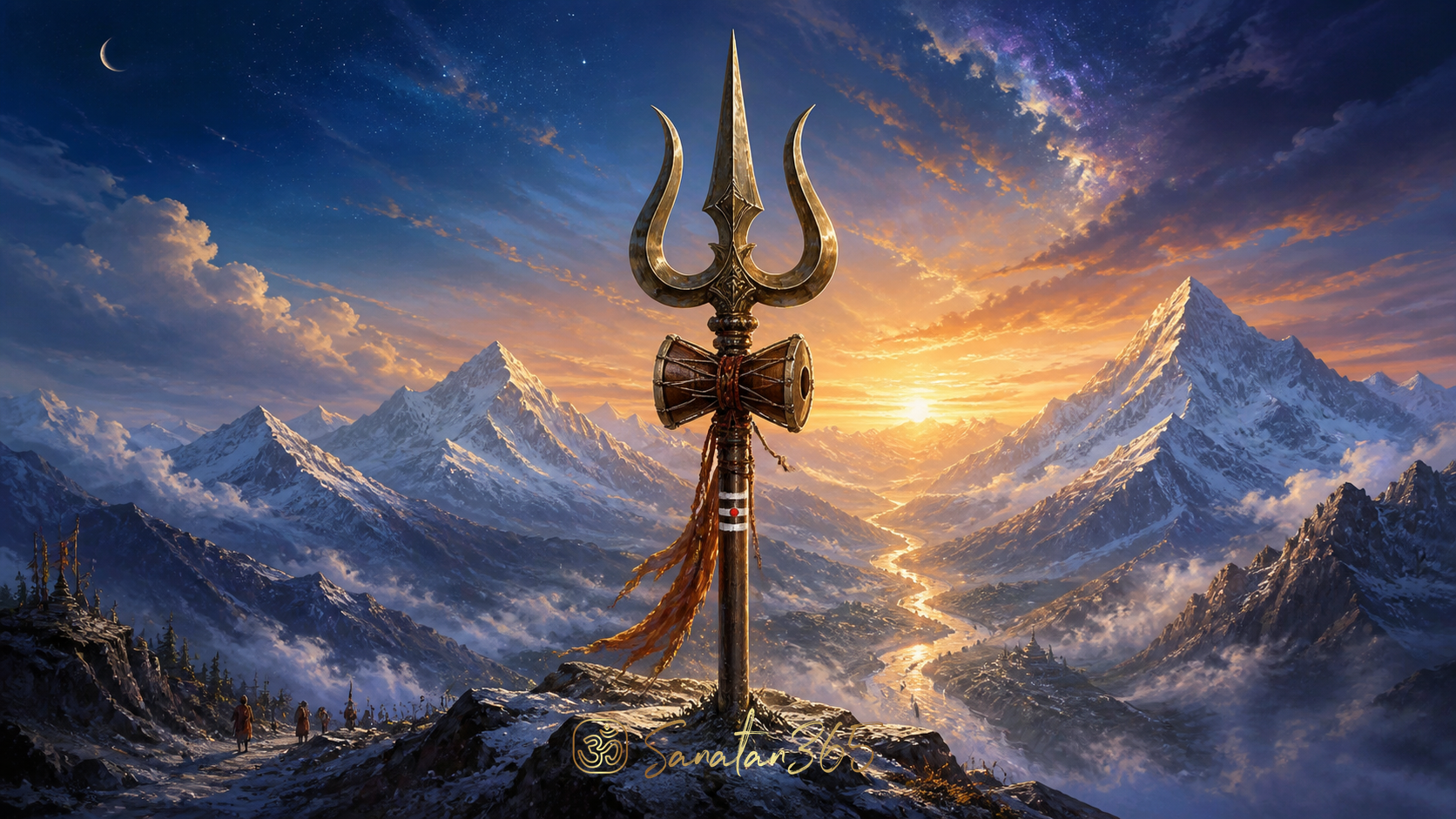
The word trishula combines tri (त्रि, three) and shula (शूल, spear, point, or thorn). In art, it appears as a long central shaft crowned by three blades. The central point is usually straight, while the side points curve outward. This balanced geometry makes the symbol instantly recognizable on temple towers, beside Shiva lingas, in procession standards, and in images of Lord Shiva.
The trishula is a weapon in sacred stories and iconography, but reducing it to a weapon misses its deeper role. Hindu divine weapons are often ayudhas (आयुध, sacred implements) that reveal a deity's function. Vishnu's chakra expresses ordered protection; Durga's many implements express coordinated shakti; Shiva's trishula expresses mastery over forces that appear divided.
Shiva is closely associated with transformation and dissolution. Dissolution here is not meaningless violence. A seed coat must break for a plant to emerge. A false certainty must end before knowledge can deepen. A harmful habit must be interrupted before disciplined freedom is possible. The trishula therefore points toward the power to pierce avidya (अविद्या, ignorance) and end patterns that keep consciousness bound.
The symbol also protects sacred space. A trishula near a shrine or carried in a procession marks a place and act as belonging to the Divine. Devotees approach it with reverence, sometimes offering flowers, water, sandal paste, or a thread according to family and regional custom. Such gestures are not directed toward metal as an ordinary object; they honor what the consecrated form represents.
Museum collections help establish the trident as a long-standing feature of Shiva's visual identity. The Metropolitan Museum of Art's Shiva works show how South Asian artists have used divine attributes to make Shiva recognizable across materials and centuries. Britannica's overview of Shiva likewise identifies the trident among his principal attributes.
Key takeaway: In Hindu tradition, the trishula is both Shiva's sacred implement and a visual teaching about protection, transformation, and freedom from ignorance.
Why Does Shiva's Trishula Have Three Prongs?
The three prongs invite interpretation because Hindu thought repeatedly uses groups of three to explain experience. No single explanation exhausts the symbol. A devotee may contemplate one triad during worship and another while studying philosophy.
Creation, preservation, and dissolution
One familiar reading connects the points with srishti (सृष्टि, creation), sthiti (स्थिति, preservation), and samhara (संहार, dissolution). Every formed thing passes through these movements. A day begins, continues, and ends. A relationship is established, sustained, and sometimes transformed. Civilizations, bodies, thoughts, and stars all participate in emergence, duration, and change.
The shaft uniting the three points matters. It suggests that these functions are not three unrelated powers. They belong to one cosmic order. Shiva's relationship with dissolution therefore cannot be separated from renewal. What ends creates space for what must begin.
Past, present, and future
The points are also read as the three divisions of time: past, present, and future. Human attention is easily scattered among regret, immediacy, and anticipation. Shiva, called Mahakala in an important stream of devotion, is understood as the reality beyond and governing time. The trishula can therefore remind a seeker to learn from the past, act rightly now, and prepare responsibly for the future without becoming imprisoned by any one of them.
The three gunas
A third interpretation connects the prongs with the three gunas (गुण, qualities or strands of prakriti): sattva, rajas, and tamas. The Bhagavad Gita's fourteenth chapter explains sattva as clarity and harmony, rajas as restless activity and attachment, and tamas as inertia and obscuration. All embodied experience contains their shifting mixture.
The trishula does not ask a person to hate one guna and worship another. Tamas permits rest but can harden into negligence. Rajas enables action but can become compulsion. Sattva brings lucidity but can still become an attachment to goodness or knowledge. Spiritual maturity means recognizing these forces, refining them, and ultimately not mistaking them for the deepest Self.
Key takeaway: The three prongs hold many Hindu triads, while their single base teaches that apparent divisions remain rooted in one order.
How Does Trishula Meaning Connect to Consciousness?
Another contemplative reading associates the three points with waking, dreaming, and deep sleep. The Mandukya Upanishad examines these three states and then points toward turiya (तुरीय, “the fourth”), the non-dual awareness that is not confined to any state. A reliable translation is available through the Vedanta Society of Southern California.
In the waking state, awareness meets the outward world through senses and action. In dreaming, the mind creates an inward world from impressions. In deep sleep, ordinary distinctions subside, though the person later knows, “I slept.” Each state changes. The contemplative question is: what makes the changing states knowable?
The trishula offers an image for this inquiry. Three points stand distinct, but one shaft supports them. In the same way, waking, dream, and deep sleep differ, yet consciousness is the continuity by which their succession can be recognized. The symbol does not replace the Upanishad's careful teaching, but it can make the question memorable.
This reading also prevents a shallow interpretation of Shiva's power. Mastery is not merely power over outward enemies. It includes steadiness across inner conditions. Pleasure does not have to produce carelessness. Difficulty does not have to erase discernment. Tiredness does not have to become spiritual guilt. A seeker learns to see states as states and respond according to dharma.
Readers exploring this inner steadiness may also find value in Pratyahara as the yogic gathering of the senses and Sakshi Bhava as witness consciousness. Both practices clarify how attention can become less reactive without withdrawing from responsibility.
Key takeaway: As a contemplative symbol, the trishula can represent the changing states of experience held within an awareness that is not reduced to them.
Is the Trishula Only a Symbol of Lord Shiva?
The trishula is most strongly identified with Shiva, but it is not restricted to his iconography. Forms of Devi, especially Goddess Durga, may also carry a trishula. In Devi imagery, the implement expresses shakti (शक्ति, divine power) confronting forces that threaten dharma. Its presence does not make one deity's path superior to another; it shows how sacred attributes can carry related meanings within different devotional forms.
Shiva's trishula is often paired with the damaru (डमरु, small hourglass drum). The pairing is visually and philosophically powerful. The drum evokes rhythm, vibration, language, and manifestation. The trishula evokes discrimination, order, and transformation. One calls form into rhythm; the other cuts through confusion. Together they suggest that sacred life requires both creative expression and disciplined clarity.
Regional forms vary. Himalayan shrines may place a trishula against rock or snow as a sign of Shiva's austere presence. Village shrines may use a simpler iron form. Temple sculpture in Tamil Nadu, Karnataka, Odisha, and elsewhere integrates the emblem into distinct artistic grammars. Processions may carry it upright as a standard. Household altars may include a small trishula beside a Shiva linga.
These differences should be approached with humility. Hindu practice is not standardized into one mandatory visual or ritual form. A custom meaningful in one region may be absent in another. The common thread is reverence, not uniformity.
The trishula should also not be treated as decorative aggression. Wearing or displaying a sacred symbol carries responsibility. It should not be used to threaten, demean, or claim superiority. Shiva's emblem points toward mastery of anger and ego, not their public performance.
Key takeaway: Shiva is the trishula's primary divine association, while Devi traditions and regional practices reveal its wider sacred life.
What Can Shiva's Trident Teach in Daily Life?
A sacred symbol becomes useful when it changes conduct. The trishula can guide a simple three-part daily reflection without pretending that an image is a shortcut to spiritual realization.
- See clearly. Name the forces active in the moment. Is the mind clear, restless, or dull? Is a decision being driven by dharma, fear, vanity, or habit? Honest naming is the first point of discernment.
- Choose firmly. Once the ethical direction is clear, act without endless inner bargaining. Shiva's symbolism reminds the seeker that some patterns must be interrupted, not endlessly negotiated.
- Release cleanly. After responsible action, let the mind loosen its demand to control every result. This is not indifference. It is disciplined freedom from compulsive replay.
The three points can also frame time. From the past, take the lesson rather than the chain. In the present, take the duty rather than the distraction. For the future, take wise preparation rather than anxious fantasy.
During Shravan, Maha Shivaratri, or an ordinary Monday Shiva practice, a devotee may sit before a respectful image of the trishula and ask three questions:
- What confusion needs to be seen?
- What responsibility needs to be sustained?
- What attachment needs to be released?
The answers should remain concrete. “Release ego” is too broad if it produces no change. “Listen without interrupting in today's family conversation” is actionable. “Respect time” is vague; “complete the promised work before taking on something new” is dharmic and measurable.
For further context on Shiva's sacred markings, Tripundra meaning in Shiva worship explores the three lines of vibhuti and their lesson of impermanence. Dakshinamurti as Shiva the silent teacher offers another dimension of Shiva's symbolism: knowledge communicated through stillness rather than force.
Key takeaway: The trishula can become a daily discipline of clear seeing, firm ethical action, and responsible release.
How Should a Trishula Be Honored at Home or in a Temple?
Respect begins with context. In a temple, devotees should follow the shrine's established customs and the guidance of priests. A consecrated object is not handled casually for photographs or rearranged for convenience. If offerings are permitted, they should be made cleanly and without obstructing others.
At home, a small trishula may be placed respectfully near a Shiva linga or image according to family tradition. The area should be kept clean. Simple worship may include a lamp, flowers, water, mantra, or silent reflection. There is no need to multiply ritual objects if care and consistency are absent.
Common safety matters too. A metal trishula may have sharp points. It should be stable and kept where children or pets cannot be injured. Outdoor installation should respect property, local rules, and the environment. Devotion is not diminished by practical responsibility; responsibility is part of dharma.
The symbol should never become a substitute for conduct. A home cannot become more Shaiva merely by displaying a larger emblem. Patience, truthfulness, restraint, hospitality, and care for vulnerable people reveal whether worship is entering life.
Key takeaway: Honor the trishula through cleanliness, local custom, physical safety, and conduct worthy of the symbol.
FAQ
What is Trishula meaning in simple words?
Trishula means “three-pointed spear” in Sanskrit. It is Lord Shiva's sacred trident and symbolizes his mastery over forces such as creation, preservation, dissolution, time, and the three gunas.
What do the three points of Shiva's trident represent?
Common interpretations include creation, preservation, and dissolution; past, present, and future; sattva, rajas, and tamas; and waking, dreaming, and deep sleep. Hindu symbols can sustain several complementary meanings.
Is a trishula the same as a trident?
“Trident” is the closest English description of its three-pronged shape. “Trishula” carries the fuller Sanskrit and sacred context of the emblem in Hindu tradition.
Why does Goddess Durga also carry a trishula?
Durga's trishula expresses divine shakti used to protect dharma and overcome destructive forces. Sacred attributes can appear across related deity traditions while retaining a distinct devotional context.
Can a trishula be kept at home?
Many Hindu households keep a small trishula near a Shiva image or linga according to family custom. It should be treated respectfully, kept clean and stable, and placed safely away from children because its points may be sharp.
The single key takeaway: Shiva's trishula gathers many sets of three into one sacred form, teaching that true power sees clearly, protects responsibly, transforms what must end, and remains rooted in a unity deeper than division.
About the author
Sanatan365 Editorial
Bringing Sanatan Dharma to modern seekers through authentic, scripture-grounded content.
Related in Deities
 Deities
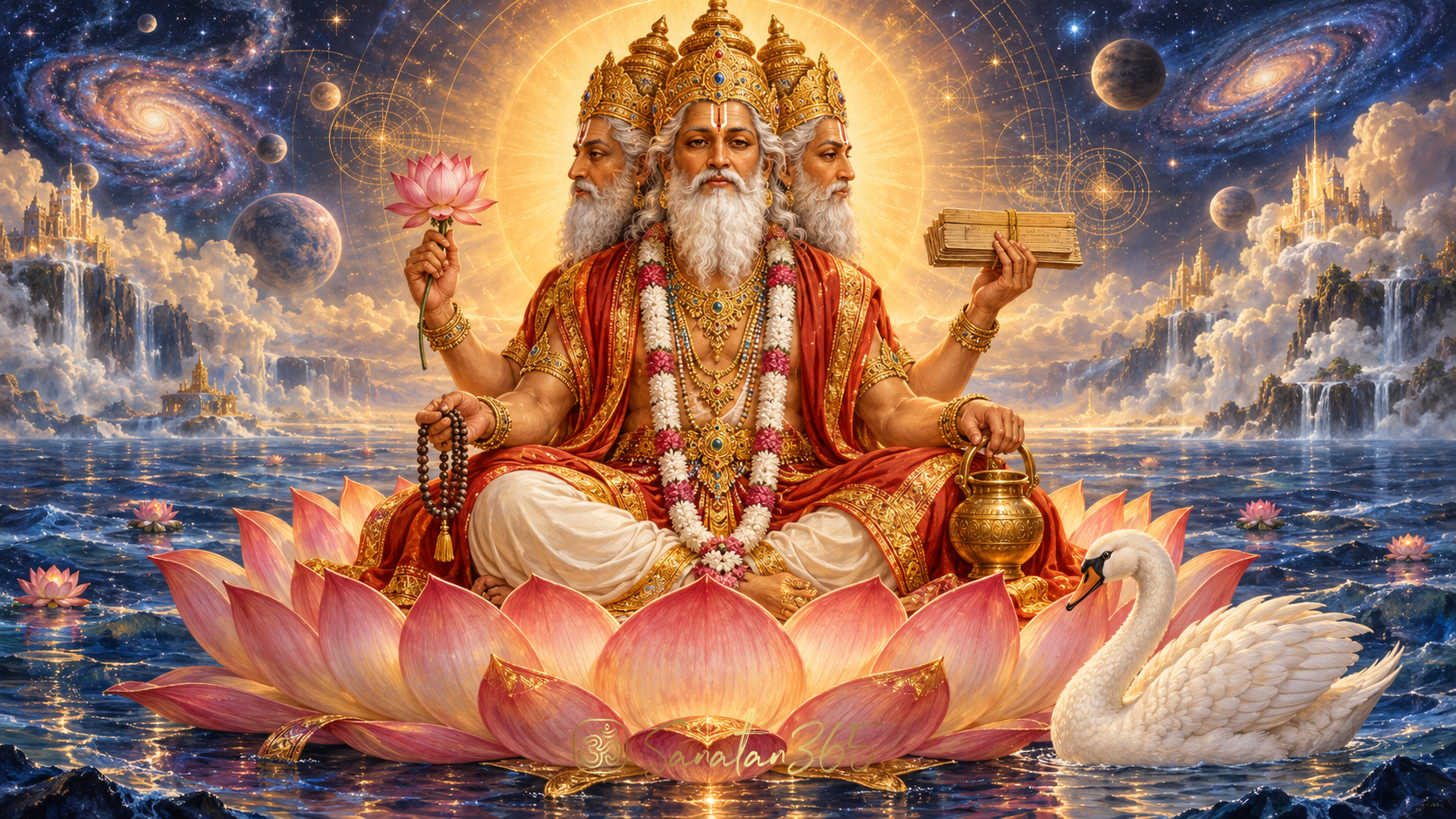
Brahma Deva Meaning: Four Faces, Creation, and Sacred Knowledge
Understand Brahma, the Hindu creator deity, through his four faces, lotus imagery, sacred knowledge, and a careful distinction from Brahman…
 Deities
Ushas, the Vedic Goddess of Dawn: Light, Renewal, and Time
Ushas, the Vedic goddess of dawn, appears in the Rigveda as radiant light that awakens life, calls beings to activity, and reveals both ren…
 Deities
Chitragupta Meaning: Divine Records and Ethical Accountability
Chitragupta is remembered as the divine keeper of karmic records in Yama's court. His symbolism connects writing, memory, justice, and ethi…