
Vajrasana Meaning: The Thunderbolt Pose as a Supported Seat
Explore Vajrasana as a kneeling yoga seat, its thunderbolt name, practical supports, changing historical usage, and a respectful alternative to forcing the body.
A posture named after a thunderbolt need not feel like a test of endurance.
Vajrasana meaning begins with two Sanskrit words: vajra (वज्र, thunderbolt or diamond) and asana (आसन, seat or posture). In common contemporary yoga teaching, Vajrasana (वज्रासन, the thunderbolt seat) means kneeling with the lower legs folded underneath and the buttocks resting on the heels. It can provide a seat for quiet attention, but it is not comfortable or suitable for every body. Its name has also described different seated arrangements in historical texts.
The useful question is therefore not how long someone can tolerate it. It is how a particular seat can become clear, supported and unforced, and when another seat would serve better.
Vajrasana meaning: why is a kneeling seat called a thunderbolt?
The English names thunderbolt pose and diamond pose translate the first part of the compound in different ways. Both preserve an association with firmness. Neither requires a practitioner to harden the body or treat discomfort as spiritual achievement. A word's symbolic force is not an instruction to stiffen the knees.
For a beginner, the simplest description is often the best: a kneeling seat. The thighs rest over the lower legs, the torso rises above the pelvis, and the hands can rest lightly on the thighs. Unlike a standing posture, it does not require continuous balance on the feet. Unlike a crossed-leg seat, it folds the legs backward rather than across one another.
Those distinctions matter more than an impressive name. A person who finds cross-legged sitting awkward may be curious about kneeling. Another person may find kneeling much less accessible. Neither response indicates greater or lesser seriousness about yoga. Shape, past injury, available movement and the surface underneath all affect the experience.
The comparative Sanskrit and yoga references collected by Wisdom Library also show why a single English label cannot explain every occurrence of the word. Vajrasana belongs to a history of teaching in which names and bodily descriptions did not always remain identical across texts and lineages.
A respectful reading keeps two things together: the living practice taught today and the particular source being discussed. It does not need to claim that every modern detail has been unchanged since the earliest Sanskrit literature.
There is room for symbolism without exaggeration. The diamond can suggest clarity; the thunderbolt can suggest decisiveness. As personal reflections, those images may help someone approach sitting with care. They are not evidence that the posture produces invulnerability, extraordinary powers or a guaranteed change in health.
Key takeaway: The name points toward firmness, but useful firmness is compatible with support, sensitivity and the freedom to choose another seat.
What changes when the seat is built from the ground upward?
The defining feature of contemporary Vajrasana is the relationship between the seat and the heels. The top surfaces of the feet generally face the floor, with the toes extending backward. The knees bend and the pelvis lowers toward the heels. The torso is upright, rather than folded onto the thighs.
This is a description, not a demand that every reader reproduce the shape. A medically reviewed overview of Vajrasana describes this basic arrangement and also notes that knee and other existing concerns can make the pose inappropriate. Its list of possible health benefits should not be read as a promise or a reason to override discomfort.
For someone already comfortable kneeling, a gentle exploration can proceed in a simple order:
- Prepare the surface. Use a firm, comfortably padded mat or folded blanket rather than a hard, slippery floor.
- Begin with support nearby. Keep the hands available on the floor or a stable support while moving, instead of dropping the body's weight backward.
- Lower only as far as comfortable. Notice whether the feet, ankles or knees object before the pelvis reaches the heels.
- Let the trunk rise naturally. Avoid pushing the ribs forward, pulling the shoulders rigidly back or forcing a military straightness.
- Leave easily. Shift forward with the hands supported, release the folded legs slowly and change position before strain develops.
A teacher can assess details that prose cannot see. Instructions about bringing the knees together, separating the heels or placing the toes should not become mechanical rules applied against an individual's comfort. Small differences in placement may matter, and sometimes the appropriate difference is not kneeling at all.
The hands need no special flourish. Resting them on the thighs can keep the posture simple. The face can remain relaxed and the eyes softly open. Natural breathing is enough; this introductory seat does not call for breath retention, forceful breathing or any advanced internal technique.
Someone watching from the outside may focus on the line of the spine. The person sitting has more information: pressure at the ankles, an urge to brace the jaw, a foot beginning to tingle, or an inability to leave the position smoothly. Those observations are more useful than matching a photograph.
For a different arrangement of the legs, the article on Sukhasana as a supported, easy seat offers a useful comparison. The purpose of comparing seats is to find an appropriate base, not to rank them.
Key takeaway: Build the posture from contact with the ground, and let comfort and an easy exit matter more than a prescribed outline.
How can supports change the kneeling position?
A support is not an apology for an incomplete pose. It changes the distance between the pelvis and the lower legs, the amount of folding required, or the pressure against the floor. That makes it a practical tool, not a symbol of progress or failure.
Different supports do different jobs. A folded blanket underneath the shins can soften contact with the ground. A suitable firm cushion or stable yoga support beneath the pelvis may reduce how far someone needs to lower. A teacher may suggest a different arrangement for the ankles. No prop makes a painful position automatically safe.
A useful test is whether the support makes the experience simpler. If it wobbles, encourages a person to lean awkwardly, or requires elaborate effort to remain balanced, it may not be helping. A large pile of soft cushions can collapse unevenly. The aim is stable support appropriate to the person, not the greatest possible height.
For supported Vajrasana, consider three distinct questions:
- Is the contact with the floor comfortable?
- Is the amount of knee and ankle folding appropriate?
- Can the body enter, remain and leave without strain?
These questions prevent a common mistake: solving one discomfort while ignoring another. Extra padding may soften a hard floor without changing how much the knees bend. Raising the pelvis may alter the fold without making the tops of the feet comfortable. A qualified teacher can help distinguish those issues.
Pain, numbness, tingling or a feeling of being trapped are reasons to release the position, not signals to persevere. People with injury, recent surgery, joint limitations or uncertainty about kneeling should seek individual guidance from an appropriate healthcare professional before attempting it. This is general educational information, not rehabilitation advice.
A chair is a complete alternative for quiet sitting. Feet can rest on the floor or a firm support, hands can settle comfortably, and attention can be given to the same simple activity. Choosing a chair does not remove the possibility of reverence, reflection or disciplined practice.
This matters in family settings as much as in a yoga class. An older relative, a child and an experienced practitioner need not sit identically to share a moment of quiet. Accommodation allows participation; imitation can exclude it.
Key takeaway: A support should reduce unnecessary demand. If kneeling still does not suit the body, changing the seat is the sensible continuation of the practice.
Did every historical text mean the same Vajrasana?
No. Reading a modern posture name back into every older source can produce a misleading history.
The Hatha Yoga Pradipika (हठयोगप्रदीपिका, “Light on Hatha Yoga”), a traditional manual of bodily and contemplative discipline, describes Siddhasana (सिद्धासन, accomplished seat) and then lists Vajrasana among its alternative names at 1.39 (following its description at 1.37–38). The described arrangement is not simply the familiar modern seat on the heels. The textual passages and comparative references are reproduced in the linked Wisdom Library entry.
The Gheranda Samhita (घेरण्डसंहिता, “Gheranda's Compendium”) gives another description at 2.12, placing the feet to either side of the seated area. That wording requires its own interpretation; it should not be silently replaced with a modern classroom photograph. The difference is enough to caution against claiming one universal shape from the name alone.
This is not a reason to distrust present-day teachers. It is a reason to identify what a teacher or book actually means. A contemporary class can use Vajrasana consistently for kneeling on the heels while a historical study explains that earlier authors used the term differently. Both discussions can be accurate within their stated contexts.
The distinction between Vajrasana and Virasana also depends on teaching context. Virasana (वीरासन, hero pose) commonly names a modern kneeling arrangement with the pelvis between the feet rather than resting on the heels. That does not make it an interchangeable substitute. It changes the arrangement of the legs and should not be attempted by forcing the feet apart to reach the floor.
Related names can be even more confusing. Supta Vajrasana (सुप्तवज्रासन, reclining thunderbolt pose) refers to a reclining variation in some teaching systems. Adding a backward bend is not a routine next step for someone learning the basic seat. A shared word does not make an advanced variation the natural destination of every beginner.
For readers exploring the eight limbs of yoga, this historical care offers a wider lesson. Yoga cannot be reduced to a catalogue of fixed shapes detached from instruction, purpose and context. Names help organize learning, but the name alone does not teach the body.
Key takeaway: Ask which text, lineage and bodily arrangement is meant. Historical variation deserves explanation, not an invented story of perfect uniformity.
How can a brief seated practice remain attentive rather than competitive?
A modest beginning needs no duration contest. If kneeling is appropriate and comfortable, the practitioner can settle briefly, notice contact with the support, and allow ordinary breathing. The moment can end while the body still feels willing to leave easily.
This approach differs from timing a performance. Counting minutes can be useful in some learning settings, but a timer should not prevent responding to the body. There is no spiritual prize for remaining motionless while sensation becomes unpleasant. Changing position deliberately can express greater care than holding a pose stubbornly.
For Vajrasana for beginners, a clear sequence is enough: prepare, enter gently, observe, release. Afterward, notice whether the support and surface were suitable. If the main memory is discomfort, adjust the arrangement with guidance or choose a different seat next time. Do not turn that observation into a judgment about personal discipline.
The same discernment applies to online claims. A photograph cannot show how the person feels, what preparation occurred, or whether the posture is appropriate for the viewer. A caption promising guaranteed digestion, disease prevention or effortless concentration is not a substitute for evidence and individual advice. This guide makes no such therapeutic promise.
In homes across India and the diaspora, floor sitting can feel familiar to some people and entirely unfamiliar to others. Familiarity is not universal suitability. Respecting a cultural practice includes making room for actual bodies, different ages and the practical conditions of a shared room.
There is also no need to make every quiet seat look devotional. A person may sit before study, pause after a yoga lesson or simply learn the arrangement with a teacher. Where a practice is part of worship, its meaning comes from that devotional context, not from claiming the knees must be folded in one approved way.
Tadasana (ताडासन, mountain pose) offers another example of this approach. The broader principle explored in Tadasana and standing awareness is similar: an ordinary-looking shape can invite careful observation. Its value does not depend on becoming visually impressive.
Key takeaway: Vajrasana is most useful as an appropriate seat for attention, not as proof of toughness. Support and intelligent choice belong inside the practice.
FAQ
What is the literal meaning of Vajrasana?
Vajra means thunderbolt or diamond, and asana means seat or posture. Vajrasana is therefore commonly translated as thunderbolt pose or diamond pose. In contemporary yoga classes, it usually refers to kneeling with the buttocks resting on the heels.
Must the buttocks touch the heels?
That contact describes the familiar unsupported form, but it should never be forced. A teacher may suggest a stable support beneath the pelvis. If the knees or ankles remain uncomfortable, a different seat can serve better than pursuing contact at any cost.
Is Vajrasana the same as Virasana?
Not usually in modern instruction. Vajrasana commonly places the seat on the heels; Virasana commonly places it between the feet. Historical naming varies, so check the actual description. Neither posture should be forced, and one is not automatically a safe substitute for the other.
How long should a beginner stay in Vajrasana?
There is no universal duration suitable for everyone. Begin only if kneeling is appropriate, keep the exploration brief, and leave before strain. Pain, numbness or tingling are reasons to release promptly. Individual instruction matters more than meeting an online time target.
Does Vajrasana guarantee better digestion or health?
No posture guarantees a health outcome. Traditional recommendations and modern research need careful interpretation, and yoga is not a replacement for medical care. The purpose of this guide is to explain the name, seat and responsible approach, not to prescribe treatment.
About the author
Sanatan365 Editorial
Bringing Sanatan Dharma to modern seekers through authentic, scripture-grounded content.
Related in Wellness
 Wellness
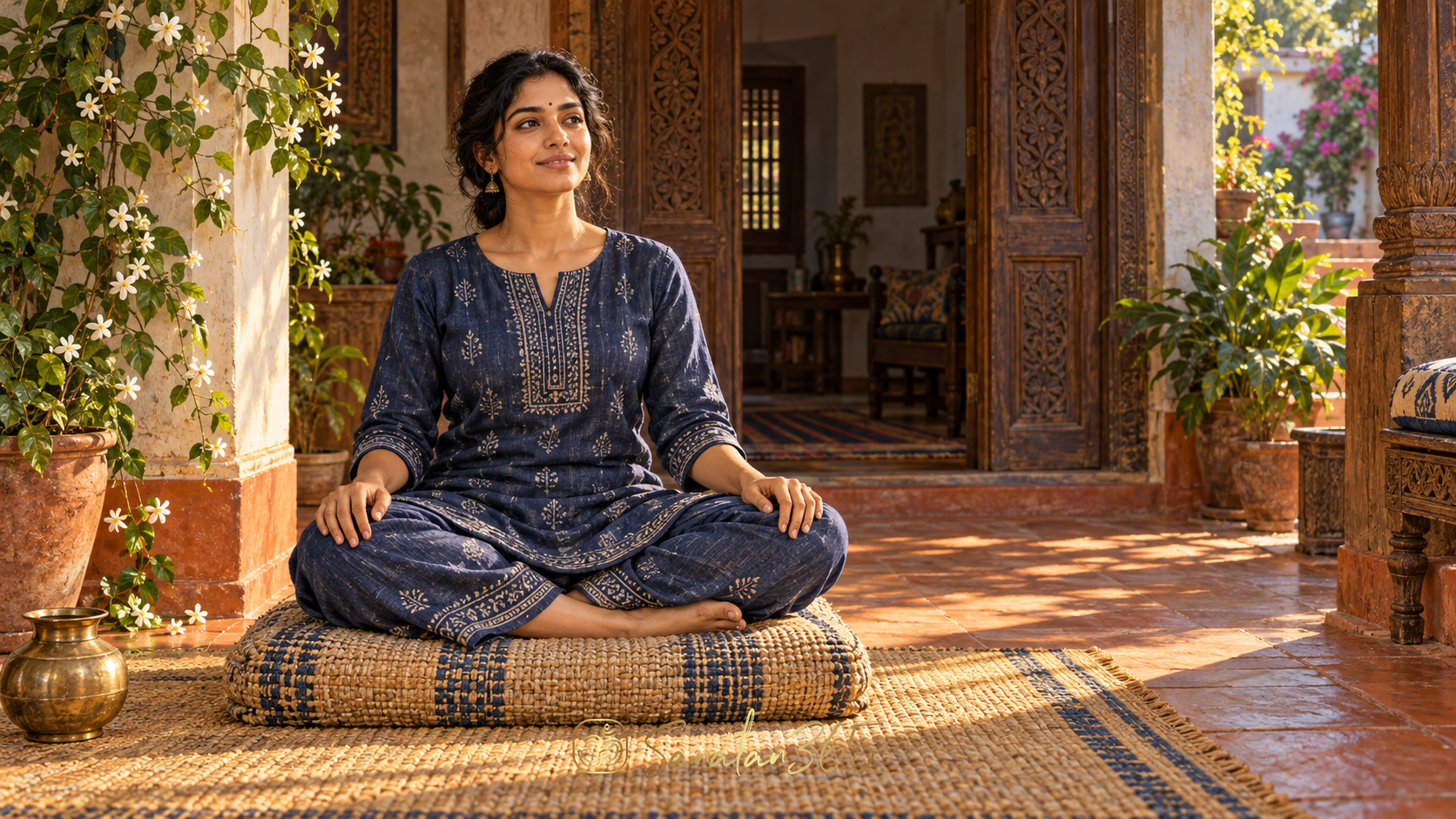
Sukhasana Meaning: Finding Ease in a Supported Seat
Sukhasana is a simple cross-legged yoga seat, not a test of flexibility. Learn its meaning, practical supports and the value of choosing st…
 Wellness
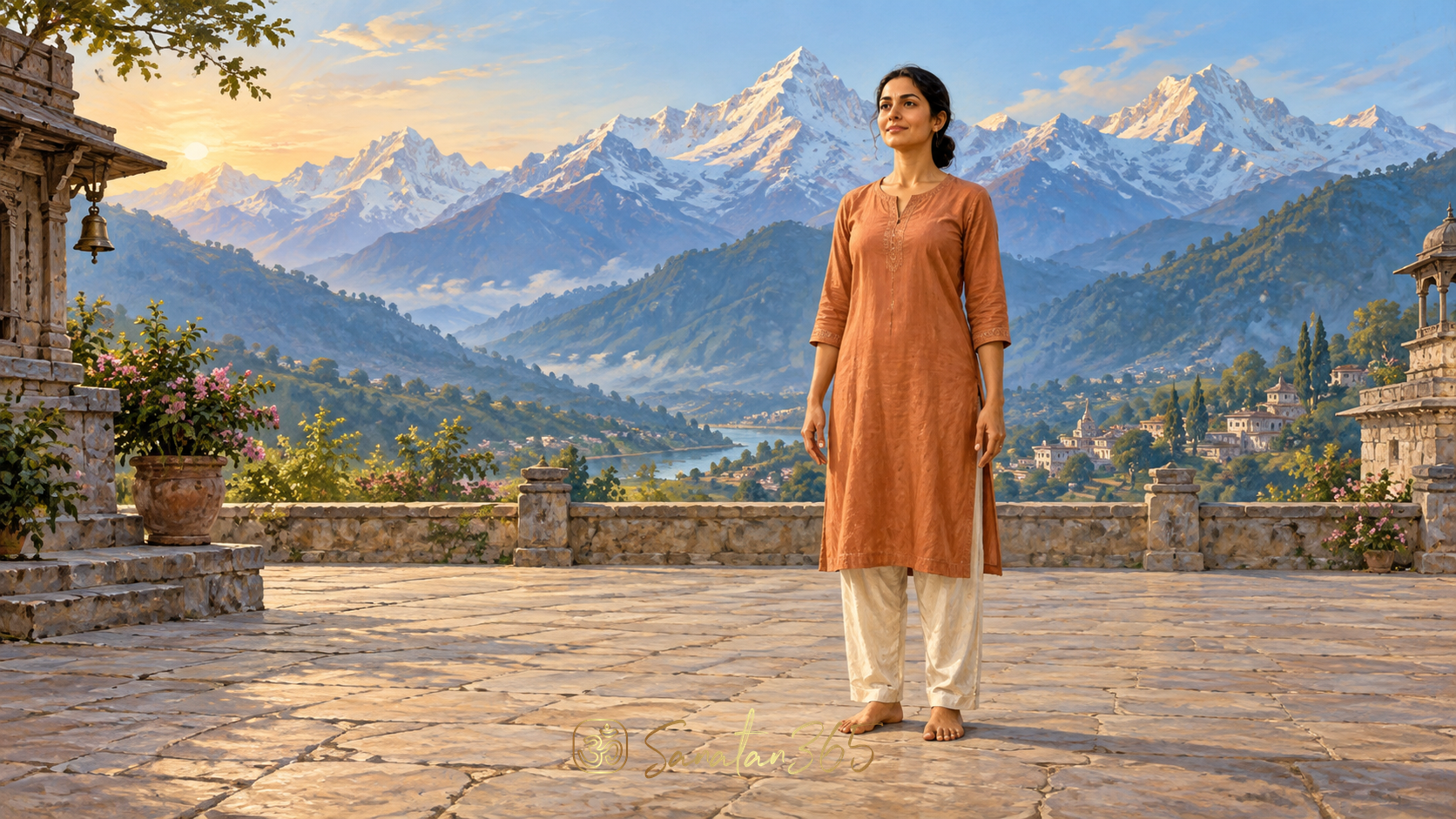
Tadasana Meaning: Mountain Pose and the Art of Standing Well
Why a simple standing posture deserves careful attention, how Mountain Pose differs from the raised-arm Palm Tree version, and how to pract…
 Wellness
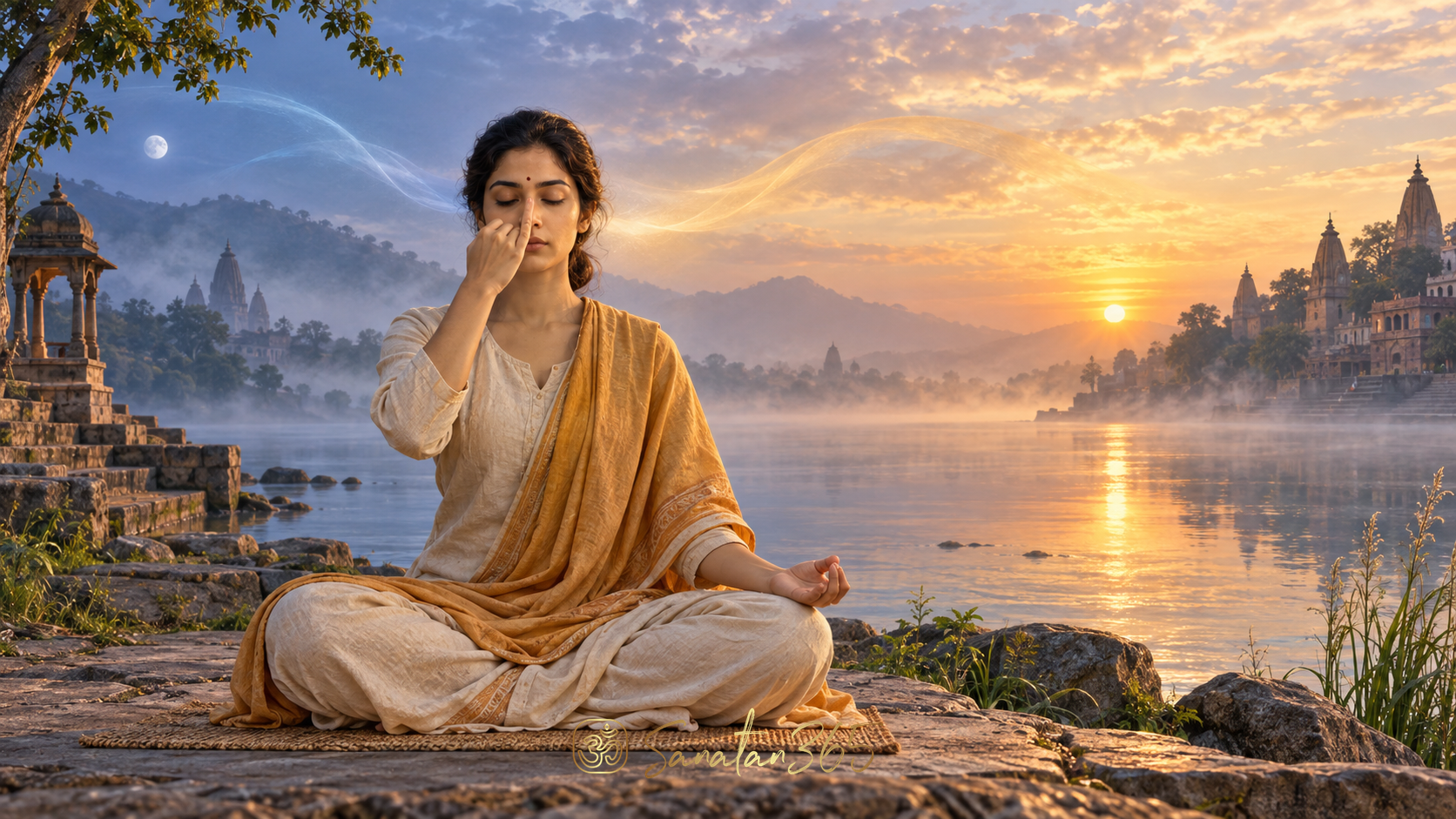
Nadi Shodhana Pranayama: Meaning and a Gentle Practice
Nadi Shodhana is alternate-nostril breathing practiced with steady attention. Its deeper yogic purpose is preparing breath and mind for cla…

