Achamana Meaning: The Hindu Purification Ritual Before Puja
Achamana is the mindful sipping of water before Hindu worship. Learn its meaning, purpose, common forms, regional variation, and respectful home practice.
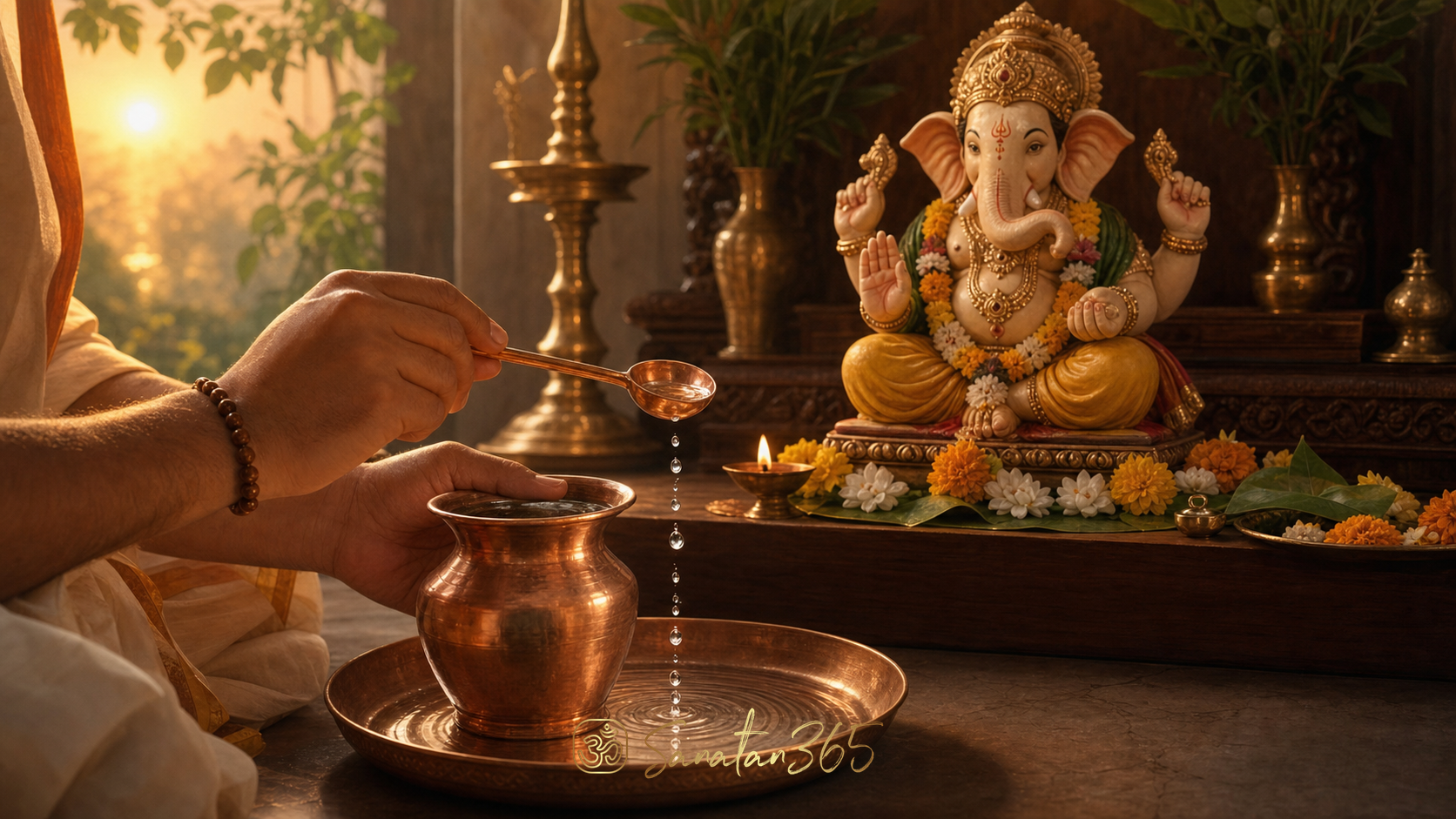
A few drops of water mark one of Hindu worship's quietest thresholds. Achamana means the mindful sipping of clean water, usually with sacred remembrance, to prepare body, speech, and attention before puja or another religious act. It is not ordinary drinking and not a claim that water mechanically removes moral fault. The ritual turns a familiar element into a deliberate pause: the worshipper settles, remembers the Divine, and approaches sacred action with cleanliness and care.
The Sanskrit term is ācamana (आचमन, ritual sipping or purification with water). Forms differ across families, regions, temples, and sampradaya (सम्प्रदाय, a living religious lineage). Some use three small sips with divine names; others follow a longer sequence of mantras and touches. The respectful starting point is therefore simple: understand the purpose, use safe water, and follow one's inherited or taught method without declaring it universal.
What Is the Achamana Meaning in Hindu Worship?
The central Achamana meaning is preparation through water, remembrance, and restraint. Hindu ritual often begins by distinguishing ordinary activity from sacred attention. A lamp is lit, the hands are cleaned, the mind forms a sankalpa (संकल्प, prayerful intention), and water may be sipped in a prescribed way. Achamana belongs to this grammar of beginning.
The action joins three dimensions:
- Physical readiness: clean, potable water refreshes the mouth before recitation or worship.
- Ritual readiness: a prescribed gesture marks entry into puja, mantra, study, or another sacred duty.
- Inner readiness: divine names and measured movement interrupt haste and gather attention.
In many traditions, three small sips evoke purification of body, speech, and mind, although the accompanying interpretation and mantras vary. The number should not be detached from the tradition that teaches it. The deeper principle is more stable than any one script: sacred speech deserves a clean mouth, a steady breath, and an attentive mind.
Water carries broad sacred significance throughout Hindu practice. It cleans, sustains, receives offerings, and recalls rivers such as Ganga. Yet Achamana does not require a dramatic quantity. Its power lies precisely in restraint. A few drops can remind the worshipper that purity is not display; it is the quality of presence brought to the next action.
Key takeaway: Achamana prepares physical conduct and inner attention so worship begins deliberately rather than automatically.
Why Is Purification Before Puja Important?
Purification before puja does not mean that the human body or daily life is inherently impure. It recognizes that people arrive at worship carrying distraction: unfinished conversations, hurried meals, irritation, fatigue, or scattered thought. Ritual preparation creates a compassionate boundary around sacred time.
The Encyclopaedia Britannica overview of puja describes Hindu worship as a sequence of offerings made to a deity with the care traditionally shown to an honored guest. Achamana supports that ethic of hospitality. Before welcoming the sacred presence, the worshipper composes themselves.
This is why external and internal cleanliness belong together. Washing hands while speaking harshly misses the point. Repeating a purification mantra while wasting water also misses it. Achamana becomes meaningful when it encourages:
- clean hands, vessel, and drinking water;
- measured speech rather than careless recitation;
- humility before inherited practice;
- awareness that ritual should improve conduct;
- gratitude for water as shared life.
The ritual may also precede japa (जप, meditative mantra repetition), scriptural recitation, a fire ceremony, sandhya prayers, or certain life-cycle rites. Its placement announces that what follows should not be performed casually. The related practice of Nitya Puja shows how small acts of preparation give daily worship continuity without requiring elaborate display.
Key takeaway: Purification before puja creates a clean and attentive threshold, but its completion is ethical speech and responsible action.
How Is the Achamana Ritual Commonly Performed?
There is no single sequence that overrides family or lineage instruction. Vaishnava, Shaiva, Smarta, Vedic, and temple traditions may use different divine names, hand positions, numbers of sips, and concluding touches. Anyone formally initiated into a practice should follow the method taught by their guru, priest, elder, or authorized text.
A simple descriptive outline helps a beginner understand what they may observe:
1. Prepare safe water and a clean vessel
Potable water is placed in a clean cup, panchapatra (पञ्चपात्र, a small ritual water vessel), or another appropriate container. A small spoon called an uddharani may be used. Regional names for these objects differ.
2. Sit steadily and quiet the mind
The worshipper sits in a clean place, faces the shrine according to household custom, and takes a calm breath. Achamana is not meant to be rushed between unrelated tasks.
3. Take very small sips
A few drops are placed in the right palm or taken from a spoon and sipped, often three times. The amount is symbolic and modest, not a mouthful. Specific fingers and palm areas may be prescribed in traditional manuals; beginners should learn these details from a trustworthy living source instead of copying an isolated diagram.
4. Remember the Divine through mantra
Some households recite names of Vishnu, such as Achyuta, Ananta, and Govinda. Other traditions use different names or Vedic formulas. The variation is legitimate. Mantras should be learned carefully, with attention to pronunciation and meaning.
5. Complete the taught sequence
Longer forms may include touching parts of the body while reciting divine names, rinsing the hands, or performing marjana (मार्जन, ritual sprinkling). These extensions should not be improvised as though every custom were interchangeable.
For a beginner without a family method, the safest practice is to ask the officiating temple or household elder. If no instruction is available, one may simply wash the hands, sit quietly, offer a prayer, and begin puja. Reverence does not require pretending to know a liturgy one has not learned.
Key takeaway: A common Achamana ritual uses clean water, tiny measured sips, sacred remembrance, and a lineage-specific sequence learned with humility.
Which Mantras and Traditions Are Used in Achamana?
Achamana reveals Hindu unity through diversity. The shared act is recognizable, while its liturgical form carries the theology of a particular community.
In many Vaishnava settings, worshippers recite names of Lord Vishnu while sipping water. Some South Indian traditions distinguish shorter and fuller forms, with a sequence of Vishnu's names accompanying sips and ritual touches. In Smarta and Vedic household practice, formulas may be tied to the rite that follows. Shaiva practitioners may use a sequence authorized by their own lineage.
These are not competing attempts to produce the one “correct” Achamana. A mantra locates the action inside a relationship: the worshipper remembers the Divine through the names, scripture, and discipline received from a tradition. Swapping formulas casually can erase that context.
Three principles help readers approach the diversity responsibly:
- Do not rank traditions. One form is not spiritually superior merely because it is longer.
- Do not mix sequences for novelty. Learn one coherent method from a reliable teacher.
- Do not treat pronunciation as theatre. Slow, sincere learning is better than fast imitation.
Readers developing mantra discipline may find the guide to Japa meditation useful. Japa and Achamana are distinct practices, but both show how repetition becomes sacred when supported by attention, pronunciation, and conduct.
Key takeaway: Achamana mantras vary because living Hindu lineages preserve different yet coherent ways of remembering the Divine.
How Can Achamana Be Practiced Safely at Home?
The first rule is practical: use only water that is safe to drink. Sacred intention does not make contaminated water potable. Travelers, children, older adults, pregnant people, and anyone with swallowing or medical restrictions should adapt responsibly. A symbolic touch, prayer, or the method recommended by a trusted priest may be more suitable when sipping is unsafe.
A respectful home checklist is straightforward:
- Wash the hands and clean the vessel before use.
- Use fresh potable water in a modest quantity.
- Keep ritual water separate from vessels used for cleaning.
- Take only the tiny amount prescribed; do not gulp.
- Learn mantras from a reliable source and ask what they mean.
- Do not share a sipping vessel in ways that create hygiene risks.
- Empty leftover plain water respectfully, without waste.
- Follow household, temple, or lineage instructions when they differ from a generic guide.
Parents can explain the ritual without frightening children. Achamana is not punishment for being “dirty” or a threat that prayer will fail after a mistake. It is a pause that teaches care. A child may first learn to wash their hands, sit calmly, say one divine name, and handle water without spilling. Technical detail can follow with age and guidance.
Diaspora households can use a clean local vessel and ordinary potable water. Imported objects are not necessary for sincerity. The ritual's integrity comes from cleanliness, understanding, and continuity, not from expensive accessories.
Key takeaway: Safe Achamana uses potable water, good hygiene, tiny quantities, age-appropriate teaching, and the guidance of one's actual tradition.
What Does Achamana Teach Beyond the Ritual?
The ritual's smallest gesture contains a demanding lesson: speech should be prepared before it is released. Water touches the mouth, divine names enter awareness, and only then does recitation begin. In daily life, that sequence can become a discipline of pausing before speaking.
Achamana can therefore prompt several reflections:
- Is the next sentence truthful and necessary?
- Is the mind present, or merely repeating familiar words?
- Is water being treated as sacred beyond the prayer room?
- Does worship make conduct gentler and more accountable?
- Can a small repeated practice reshape a hurried day?
The answer is not guaranteed by performing the rite. Ritual offers a structure; the worshipper must carry its meaning into action. A person may sip water perfectly and still speak carelessly. Another may know only a simple prayer yet approach others with remarkable purity of intention. Hindu practice at its best refuses to separate sacred form from dharmic conduct.
Achamana also corrects the idea that spiritual depth must always look grand. Much of religious life is built from small thresholds: washing, sitting, lighting, offering, listening, and beginning again. The meaning of Sankalpa explores another such threshold, where intention is named before ritual action unfolds.
Key takeaway: Beyond puja, Achamana teaches a pause before speech, gratitude for water, and the alignment of sacred form with everyday conduct.
FAQ
What is Achamana?
Achamana is a Hindu purification practice in which a worshipper mindfully sips a very small amount of clean water, usually with divine remembrance, before puja, mantra, study, or another sacred act.
Why is water sipped three times in Achamana?
Many traditions prescribe three small sips and connect them with divine names or the purification of body, speech, and mind. The exact interpretation and mantra sequence vary, so practitioners should follow their family or lineage method.
Can a beginner do Achamana at home?
Yes, but a beginner should learn the specific form from a priest, elder, guru, or reliable tradition-specific source. Without instruction, washing the hands, using safe water, sitting quietly, and offering a sincere prayer is preferable to improvising a complex sequence.
Is Ganga water required for Achamana?
No. Clean potable water is the essential practical requirement. A household may use Ganga water according to tradition only when it is safely stored and suitable for the prescribed use.
What if someone cannot safely sip water?
Health and safety come first. The person can ask a trusted priest about an authorized symbolic adaptation, or simply prepare through clean hands, prayer, and attentive remembrance. A ritual should never be used to pressure someone into an unsafe act.
Achamana begins with almost nothing: a clean vessel, a few drops, a remembered name, and a pause.
Key takeaway: Its deepest purification is the movement from haste to attention, from careless speech to sacred responsibility.
About the author
Sanatan365 Editorial
Bringing Sanatan Dharma to modern seekers through authentic, scripture-grounded content.
Related in Practices
 Practices
Shaucha Meaning in Yoga: Cleanliness Without Harsh Purity Rules
Explore shaucha as a yogic observance: its scriptural setting, outer and inner dimensions, daily practice, and why cleanliness must never b…
 Practices
Kusha Grass Meaning: Why Darbha Has a Place in Hindu Rituals
Understand kusha or darbha grass, its traditional place in worship and ancestral rites, and how to approach varied customs with care.
 Practices
Bhuta Shuddhi Meaning: Purifying the Five Elements Within
Bhuta Shuddhi means the purification of the five elements: earth, water, fire, air, and space. In Hindu yogic and Tantric traditions, it is…