Anjali Mudra Meaning: Why Folded Hands Become a Sacred Offering
Anjali Mudra is more than a greeting. Explore how folded hands express reverence, gather attention, and turn an ordinary moment into an offering.
Two empty hands can become a complete offering when they meet with attention.
Anjali Mudra meaning begins with a simple gesture: the palms join, the fingers point upward, and the hands rest near the heart. In Hindu practice, this gesture can express reverence, greeting, prayer, gratitude, surrender, or focused presence. The Sanskrit word añjali (अञ्जलि, an offering made with cupped or joined hands) carries the sense of honouring and presenting; mudrā (मुद्रा, a meaningful gesture or seal) describes a bodily form that communicates and directs intention. Together, Anjali Mudra turns the hands into a visible statement: this moment deserves undivided respect.
What Is the Anjali Mudra Meaning in Hindu Practice?
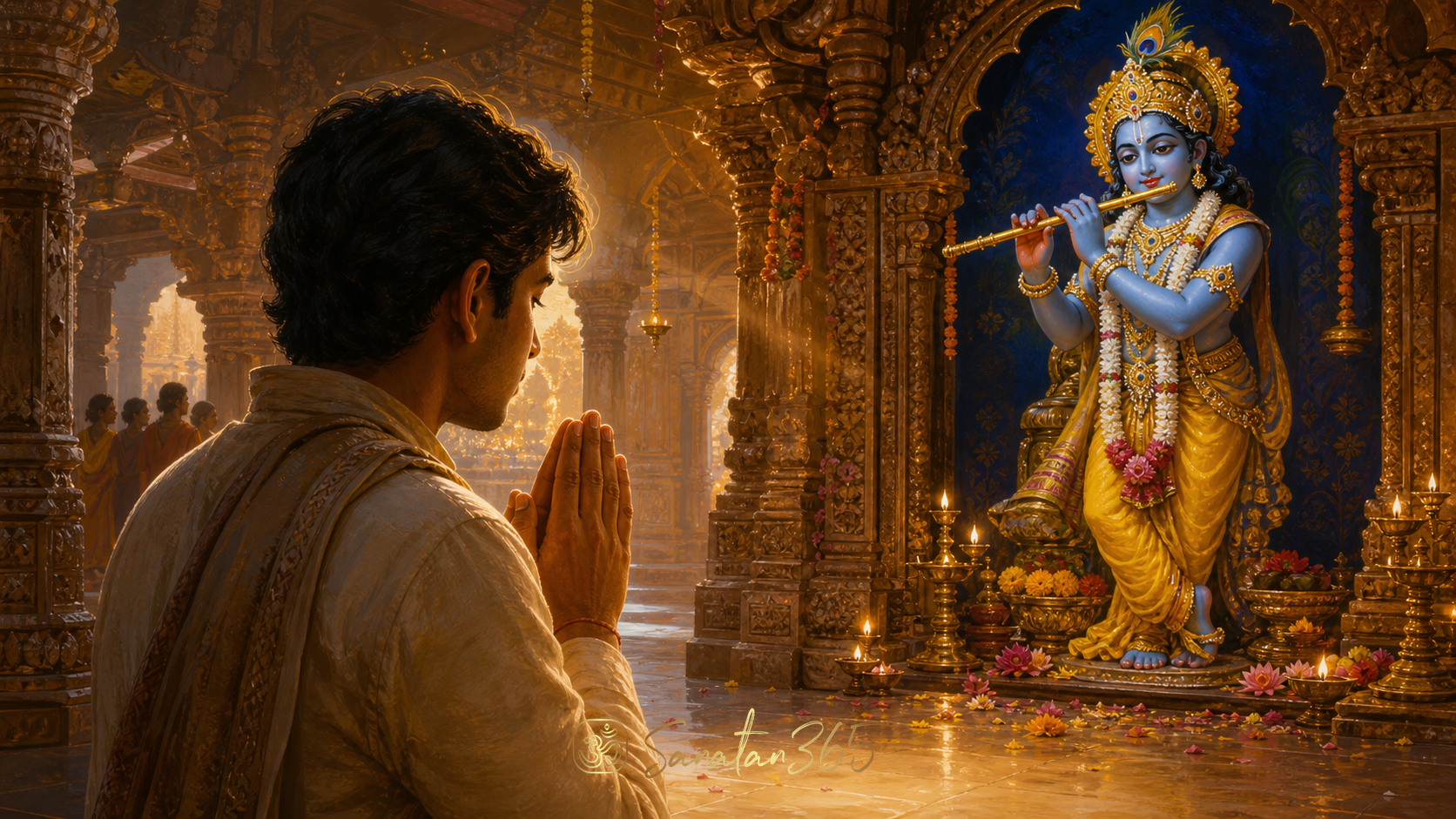
Anjali Mudra is often translated as the prayer gesture, salutation seal, or gesture of reverence. None of those translations is wrong, but each captures only one use. A devotee may bring the palms together before a murti (मूर्ति, a sacred embodied form used in worship), while entering a temple, greeting an elder, beginning a recitation, receiving darshan (दर्शन, the reverential seeing of the Divine), or expressing thanks after worship.
The gesture does not require the hands to hold flowers, food, or a lamp. The hands themselves form a symbolic vessel. This is why anjali can also refer to a double handful: the joined palms create a small space capable of holding water or an offering. Even when that space is empty, it can hold attention, gratitude, and intention.
The gesture appears across Hindu life in several related settings:
- In puja, it accompanies invocation, prayer, and respectful leave-taking.
- In temple worship, it marks readiness to receive darshan without grasping.
- In yoga, it is commonly called Anjali Mudra or Pranamasana and helps establish a centered beginning or ending.
- In classical dance, joined hands can communicate salutation, divinity, respect, or narrative meaning according to context.
- In everyday greeting, the same form often accompanies namaste or namaskara.
The folded hands Hindu meaning therefore depends partly on context. It is not a mechanical sign with only one definition. Its underlying grammar, however, is remarkably consistent: two active hands pause, meet, and become one deliberate form.
Key takeaway: Anjali Mudra is not merely a social greeting; it is a versatile sacred language of reverence, offering, and attentive presence.
Why Do Folded Hands Symbolize Reverence?
Hands are instruments of action. They build, carry, point, defend, take, give, and shape the world. Folding them changes their normal function. For a moment, the hands stop manipulating anything outside themselves. Action becomes attention.
This pause helps explain why the gesture feels naturally humble. Open palms show that nothing is concealed. Joined palms withdraw the impulse to seize or control. Upright fingers lend the form a sense of aspiration, while the placement near the chest connects the gesture with inward sincerity. These meanings should not be treated as a single ancient code fixed in every text; they are interpretive insights that arise from the gesture's form and its living devotional use.
The Bhagavad Gita offers a helpful principle for understanding why a small act may carry profound devotional weight. Krishna says that a leaf, flower, fruit, or water offered with devotion is accepted from the devoted person (Bhagavad Gita 9.26). The verse does not specifically prescribe Anjali Mudra, but it places emphasis on bhakti (भक्ति, loving devotion) rather than material grandeur. Joined hands embody that same principle: the visible form is modest, while the quality of attention gives it depth.
There is also a relational meaning. Reverence is not self-erasure. It is the decision to meet a person, teaching, place, or sacred presence without reducing it to personal use. Anjali Mudra makes that decision visible. Before a deity, it can say, “I come with devotion.” Before a teacher, “I am ready to listen.” Before another person, “I recognise your dignity.”
This is why the gesture can remain meaningful even when no words are spoken. It creates a brief ethical space between impulse and response.
Key takeaway: Folded hands symbolize reverence because they transform the body's main instruments of action into a form of restraint, openness, and offering.
How Is Anjali Mudra Different from Namaste?
The gesture and the spoken greeting are closely related, but they are not identical. Namaste (नमस्ते, “salutations to you”) is a verbal expression derived from namas, meaning bow, homage, or salutation, and te, meaning “to you.” Anjali Mudra is the physical gesture of joined palms. They frequently appear together, which is why people often use the terms interchangeably.
Yet Anjali Mudra can occur without the word namaste. A devotee may silently join the hands during aarti, before a sacred text, or on seeing a temple tower. Likewise, a person may say namaste without performing the gesture. The difference is useful because it protects both words from becoming vague symbols detached from their actual roles.
The placement of the hands can also carry contextual nuance. At heart level, the gesture is common for greeting and prayer. Raised toward the forehead or above the head, it may communicate heightened reverence in some devotional or artistic settings. Customs vary across regions, lineages, temples, and performance traditions; there is no need to rank one form as spiritually superior.
Readers exploring the wider greeting can also see the meaning of Namaste in Sanskrit and spiritual life. Anjali Mudra is best understood as the bodily form that may accompany that greeting while also serving many other sacred purposes.
Key takeaway: Namaste is primarily a spoken salutation; Anjali Mudra is the joined-palm gesture that may accompany it or stand alone in worship and reflection.
How Do You Practise Anjali Mudra with Attention?
The outward shape is easy. The inward quality benefits from patience. No elaborate ritual is required, and the gesture should never cause strain.
- Choose a steady posture. Sit or stand comfortably, with the spine naturally upright rather than rigid.
- Bring the palms together gently. Let the fingers align upward. Avoid pressing so hard that the shoulders tense.
- Place the hands near the heart. The thumbs may lightly touch the breastbone. Keep the elbows relaxed.
- Soften the breath. Take one unforced inhalation and exhalation. The aim is presence, not breath control.
- Name the intention silently. It may be gratitude, greeting, prayer, apology, remembrance, or readiness to listen.
- Pause before lowering the hands. Let the gesture end deliberately rather than dropping it automatically.
For those with wrist, finger, or shoulder limitations, the palms do not need to meet fully. A respectful approximation, one hand near the heart, or a mental gesture of reverence can preserve the intention. Spiritual dignity is not measured by physical range of motion.
When used before home worship, Anjali Mudra can follow simple preparation such as washing the hands, settling the space, and forming a clear sankalpa, or sacred intention. During temple worship, it can accompany quiet darshan without blocking others or turning the moment into a performance. At the end of practice, it can seal gratitude before returning to ordinary activity.
The gesture becomes shallow only when performed without attention while the mind remains occupied with display, haste, or judgment. Even then, the remedy is not self-criticism. It is simply to begin again and allow one honest breath to meet the form.
Key takeaway: Anjali Mudra becomes a practice when its simple shape is joined with ease, a clear intention, and a brief pause of genuine attention.
Where Does the Gesture Appear Across India and Beyond?
Joined palms are recognisable across India, yet their setting and spoken accompaniment vary. Namaste is common in many Hindi-speaking contexts; namaskaram is widely heard in parts of South India; pranam and related forms carry their own regional and relational tones. Temple etiquette, household customs, and styles of greeting differ without cancelling the shared gesture.
In Bharatanatyam and other Indian classical dance traditions, the joined-palm form is commonly identified as Anjali Hasta. Dance texts and teaching lineages give gestures precise uses, and performers learn meaning through disciplined context rather than treating every joined-palm pose as generic prayer. In yoga communities worldwide, Anjali Mudra often opens or closes a class. Its global reach can be meaningful when teachers explain its Sanskrit name and cultural setting instead of presenting it as an invented wellness pose.
Diaspora families may use the gesture to keep several layers of belonging together. A child may fold the hands before a home shrine, greet a grandparent, and begin a cultural performance with the same familiar shape. The settings change, but the repeated movement teaches that reverence belongs not only to ceremonial occasions but also to relationships and learning.
The gesture is also practical in a crowded temple or during a distant darshan. It requires no object and very little space. That simplicity helps it travel across languages, regions, and generations.
For comparison, Abhaya Mudra expresses fearlessness and protection, while Anjali Mudra expresses offered attention and reverence. The contrast shows how Hindu visual culture allows hands to communicate distinct spiritual qualities rather than one vague idea of holiness.
Key takeaway: Regional words and customs vary, but joined palms remain a widely shared form through which devotion, respect, and cultural memory can travel.
What Can Anjali Mudra Teach Modern Life?
Modern communication rewards speed. Replies arrive before listening is complete, greetings become automatic, and hands remain busy with devices even during conversation. Anjali Mudra offers a small counter-practice: stop, gather, recognise.
Its lesson can be applied without placing the gesture everywhere or using it theatrically. Before a difficult conversation, one silent breath with the hands joined can interrupt defensiveness. Before study, it can acknowledge the teacher and the subject. Before eating, it can become gratitude for the many lives and forms of labour that made the meal possible. After receiving help, it can deepen a spoken thank-you.
The gesture also teaches unity without sameness. Two palms remain distinct, yet they meet in balance. Devotional interpretation often sees this as a reminder that apparent divisions can be held within a deeper wholeness: action and contemplation, individual and community, giver and receiver. Such symbolism is most helpful when it leads to conduct. A person who folds the hands reverently but treats others carelessly has preserved the sign while losing its ethical demand.
This is the real test of Anjali Mudra. Does the pause make the next action more truthful, patient, or kind? If so, the gesture has moved from etiquette into sadhana (साधना, disciplined spiritual practice).
Key takeaway: The modern value of Anjali Mudra lies in its ability to create a pause in which recognition can shape the action that follows.
Conclusion
Anjali Mudra shows how Sanatan practice can place immense meaning inside an ordinary human movement. The hands join; action pauses; attention becomes an offering. In a temple, home, yoga practice, classroom, or greeting, the form invites reverence without demanding spectacle.
Its depth does not depend on pressing the palms perfectly or displaying spiritual seriousness. It depends on whether the gesture gathers a scattered mind and opens a respectful relationship with what stands before it.
Key takeaway: Anjali Mudra becomes sacred when joined hands carry joined attention: body, intention, and conduct meeting in one honest offering.
FAQ
What does Anjali Mudra mean?
Anjali Mudra is the gesture of joining the palms, usually near the heart, to express reverence, greeting, prayer, gratitude, or offering. Anjali refers to an offering or joined handful, while mudra means a meaningful gesture or seal.
Is Anjali Mudra the same as Namaste?
Not exactly. Namaste is a spoken salutation meaning “salutations to you,” while Anjali Mudra is the physical gesture of joined palms. They often appear together, but either can be used without the other.
Why are the hands placed near the heart?
Heart-level placement is a common and comfortable form associated with sincerity and inward attention. Other placements may be used in particular devotional, regional, yogic, or dance contexts.
Can someone practise Anjali Mudra without being Hindu?
Yes. The gesture can be used respectfully by any seeker. Respect includes learning its Sanskrit name, recognising its roots in Indian and Hindu traditions, and avoiding shallow or commercial misrepresentation.
What if someone cannot press both palms together?
Full contact is not required. The hands may remain slightly apart, one hand may rest near the heart, or the gesture may be held inwardly. Intention and respect matter more than physical range.
About the author
Sanatan365 Editorial
Bringing Sanatan Dharma to modern seekers through authentic, scripture-grounded content.
Related in Practices
 Practices
Upasana Meaning: Why Worship Is a Practice of Drawing Near
Upasana means drawing near to the Divine through sustained attention. Explore how sacred symbols, daily worship and inward recollection bel…
 Practices
Shaucha Meaning in Yoga: Cleanliness Without Harsh Purity Rules
Explore shaucha as a yogic observance: its scriptural setting, outer and inner dimensions, daily practice, and why cleanliness must never b…
 Practices
Kusha Grass Meaning: Why Darbha Has a Place in Hindu Rituals
Understand kusha or darbha grass, its traditional place in worship and ancestral rites, and how to approach varied customs with care.