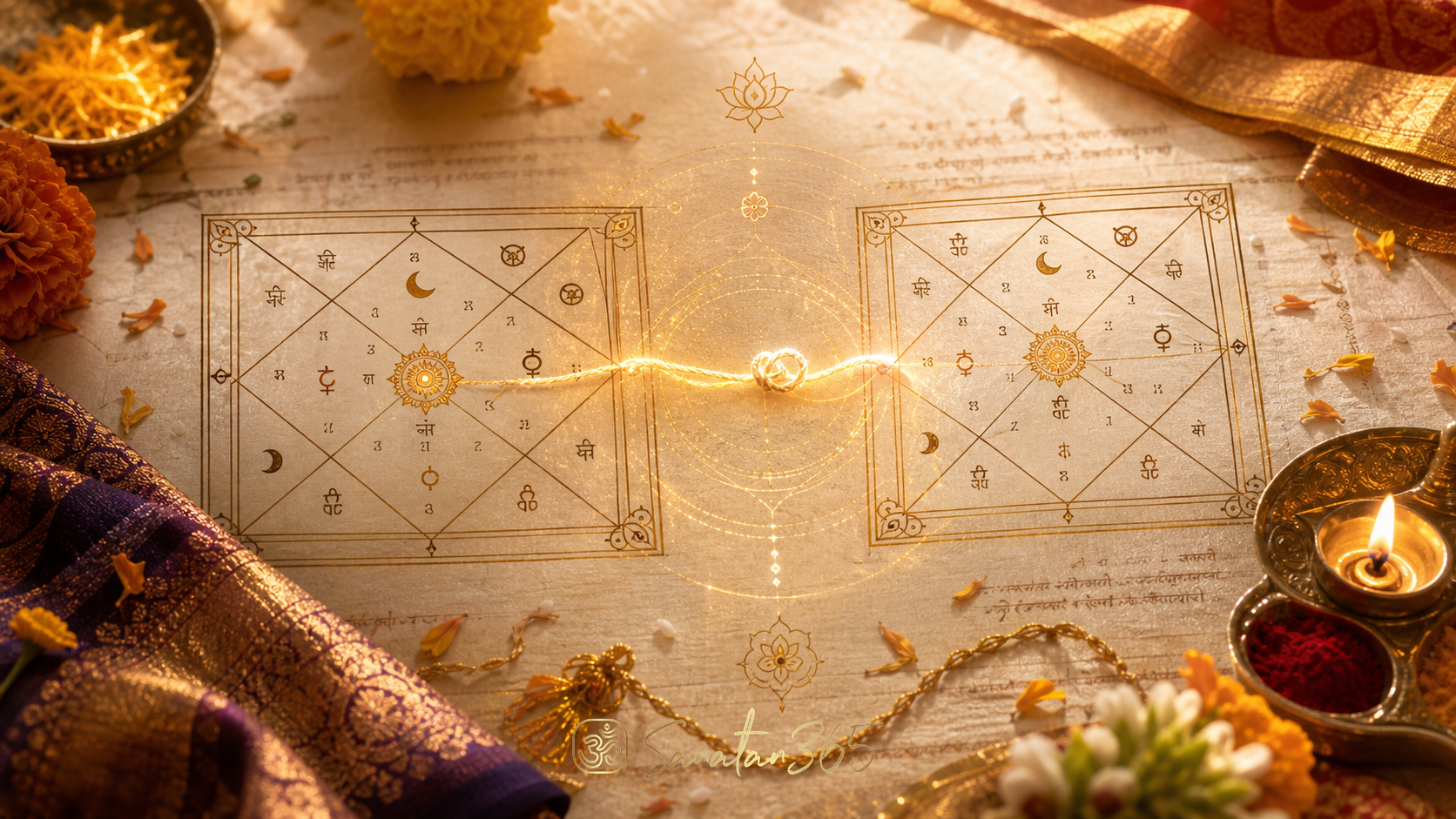
Kundali Matching Meaning: Guna Milan, Compatibility, and Dharma
A clear guide to Kundali matching, Guna Milan, Ashtakoota, Manglik checks, and how families can read compatibility with maturity and faith.
A marriage chart is not meant to replace wisdom, consent, family dialogue, or lived character.
Kundali matching meaning is the Hindu astrology practice of comparing two birth charts before marriage to understand compatibility, shared temperament, possible friction points, and the dharmic responsibilities of married life. In many families it is called Kundali Milan (कुंडली मिलान, horoscope matching) or Guna Milan (गुण मिलान, matching of qualities). Its most familiar method, Ashtakoota (अष्टकूट, eight-factor matching), compares eight areas of compatibility and gives a score out of 36. The deeper purpose is not fear. It is a thoughtful pause before two lives are joined.
What Is Kundali Matching Meaning in Hindu Marriage?
Kundali matching meaning begins with the word kundali (कुंडली, birth chart), the astrological map drawn from the date, time, and place of birth. In marriage contexts, two kundalis are compared to see how the couple's lunar signs, nakshatras (नक्षत्र, lunar mansions), planetary placements, and key relationship factors interact.
The practice is especially common in arranged marriage settings, but its purpose is wider than social approval. Hindu marriage, or vivaha (विवाह, sacred marriage), is traditionally understood as a samskara (संस्कार, life refinement or sacred rite), not only a private contract. A Hindu wedding includes rituals that emphasize shared values, fidelity, mutual respect, and righteous living, as the Hindu American Foundation wedding primer explains. Kundali matching belongs to that larger cultural habit of asking, "Can these two people build a stable dharmic household together?"
In beginner language, the chart comparison asks three practical questions:
- Are the temperaments likely to cooperate?
- Are there strong stress patterns that need awareness?
- Does the match support long-term harmony, family duty, and emotional steadiness?
Key takeaway: Kundali matching is a compatibility lens, not a final verdict on love, marriage, or destiny.
How Does Guna Milan Work in Kundali Matching Meaning?
Guna Milan is the most recognized part of Kundali matching meaning because it gives a visible score. The traditional Ashtakoota system compares eight kootas (कूट, categories or factors). Drik Panchang's Kundali Match guide notes that Ashtakoota matching assigns points to eight personality and compatibility factors, and the final result is based on the total score from those factors.
The eight kootas are usually presented like this:
- Varna, worth 1 point, often linked with spiritual temperament and ego compatibility.
- Vashya, worth 2 points, linked with influence, cooperation, and mutual responsiveness.
- Tara, worth 3 points, linked with birth star harmony and general well-being.
- Yoni, worth 4 points, linked with instinctive and intimate compatibility.
- Graha Maitri, worth 5 points, linked with mental friendship between the Moon sign lords.
- Gana, worth 6 points, linked with temperament and behavioral nature.
- Bhakoot, worth 7 points, linked with emotional, family, and prosperity patterns.
- Nadi, worth 8 points, linked with health, progeny, and subtle vitality in traditional matching.
The total is 36. Many families treat 18 or more as a basic acceptable threshold, but responsible astrologers rarely stop there. A score can look good while other chart factors need attention. A score can also look modest while deeper analysis shows maturity, mutual respect, and workable patterns.
Guna Milan is best understood as a first diagnostic layer. It is like reading the index of a book before studying the chapters. The score can guide discussion, but it cannot fully describe two people.
Key takeaway: The 36-point Guna Milan score is useful, but it is only one part of serious Kundali matching.
What Should Beginners Know About Ashtakoota and the 36 Gunas?
Ashtakoota (अष्टकूट, eightfold matching) is popular because it gives structure to a complex subject. Each koota highlights a different relationship dimension, and the weighting moves from lighter surface compatibility to more sensitive traditional concerns. Nadi receives 8 points, Bhakoot receives 7, and Gana receives 6, which is why families often become alert when those areas show dosha (दोष, imbalance or affliction).
For a beginner, the safest way to read the score is in layers:
- Below 18: traditionally considered weak and usually examined carefully.
- 18 to 24: acceptable in many families, but not automatically strong.
- 25 to 32: generally viewed as supportive, provided no serious dosha is ignored.
- 33 to 36: considered very strong by score, though the full chart still matters.
These ranges are cultural conventions, not divine guarantees. A couple with a high score still needs patience, communication, shared values, and family maturity. A couple with a lower score may need deeper review rather than instant rejection.
This is where beginner and advanced readings differ. A beginner asks, "How many gunas matched?" An advanced reading asks, "Which gunas matched, which ones did not, and what do the complete charts say about temperament, emotional regulation, health, family expectations, finances, and dharma?"
For readers new to birth charts, it helps to first understand the base chart through Kundali Meaning: How a Vedic Birth Chart Maps Karma, Dharma, and Time, the ascendant through Lagna Meaning in Kundali: Ascendant, Houses, and Birth Time, and the marriage-linked divisional chart through Navamsa Chart Meaning: D9, Marriage, Dharma, and Inner Strength.
Key takeaway: A mature Kundali matching reading studies the pattern behind the number.
Why Are Manglik Dosha, Nadi, and Bhakoot Treated Carefully?
Some terms in marriage matching create anxiety because they are repeated without context. The most common are Manglik Dosha, Nadi Dosha, and Bhakoot Dosha.
Manglik Dosha (मांगलिक दोष, Mars-related affliction) is traditionally considered when Mars occupies certain houses in a chart. Drik Panchang's Mangal Dosha reference describes the common rule of checking Mars from the Lagna chart, Moon chart, and Venus chart. In marriage matching, this is read as a sign of strong Martian energy that may require balance in temperament, timing, or remedial practice.
Nadi Dosha arises when the Nadi factor in Ashtakoota matching is considered incompatible. Since Nadi carries 8 points, families often treat it seriously. Traditional interpretations connect it with health, lineage, and subtle vitality.
Bhakoot Dosha concerns the relationship between the Moon signs of the two charts. It is often associated with emotional flow, household harmony, and prosperity patterns.
The important point is that dosha does not mean doom. A dosha is a signal for careful interpretation. Many traditions also study cancellation factors, chart strength, matching from the Navamsa, dasha periods, and the lived maturity of the couple. The word dosha should lead to better questions, not panic.
A careful family might ask:
- Is the dosha severe or mild?
- Are there cancellation factors?
- Does the overall chart support stability?
- Are both people emotionally mature and willing to grow?
- Has the astrologer explained the reasoning clearly?
Key takeaway: Doshas should be interpreted with context, compassion, and complete chart analysis.
How Should Families Use Kundali Matching Without Fear?
Kundali matching becomes harmful when it is used as a rigid weapon. It becomes helpful when it is used as a thoughtful mirror.
A good reading should never insult a person, create shame, or make sweeping claims about worthiness. It should also never override consent. Sanatan Dharma's deeper view of marriage honors dharma, artha, kama, and moksha: righteous life, livelihood, love, and spiritual growth. A chart can support discernment, but the human beings must still speak honestly.
Families can use Kundali matching more wisely by following a balanced approach:
- Treat the chart as one input, not the only input.
- Ask the astrologer to explain each concern in plain language.
- Do not reduce the couple to a score.
- Consider health, values, temperament, finances, family expectations, and emotional maturity.
- Avoid fear-based remedies or pressure.
- Make sure both families and the couple understand what is being decided.
There is also a diaspora context. Many Hindu families outside India want to preserve tradition while living in societies where marriage decisions are more individual. Kundali matching can still be meaningful there if it becomes a respectful conversation rather than a command.
Key takeaway: The dharmic use of Kundali matching is clarity with compassion, not fear with pressure.
What Is the Difference Between Basic and Advanced Kundali Matching?
Basic matching often means entering two birth details into a tool and reading the Guna Milan score. This is useful for orientation. It can show the Ashtakoota score, note possible doshas, and identify obvious compatibility flags.
Advanced matching goes further. It studies:
- The strength of the 7th house, which relates to marriage and partnership.
- The 7th lord and its dignity, aspects, and associations.
- Venus and Jupiter, traditionally important for relationship harmony.
- The Moon for emotional compatibility and daily mental rhythm.
- The Navamsa or D9 chart for marriage depth.
- Dasha timing, which may show when relationship themes become active.
- Family, health, livelihood, and spiritual orientation.
Advanced matching also distinguishes between compatibility and perfection. No chart is perfect. Every relationship carries lessons. The question is whether the couple has enough support, maturity, and shared dharma to work with those lessons.
This is why a serious reading should avoid absolute predictions. Astrology can describe tendencies. It should not make guaranteed claims about divorce, death, wealth, children, or suffering. The wiser reading is humble: "Here are the patterns. Here are the strengths. Here are the areas requiring patience."
Readers who want the broader astrology frame may also find Rashi Meaning in Hindu Astrology: Moon Sign, Zodiac, and Inner Pattern helpful.
Key takeaway: Advanced matching studies the whole relationship pattern, not only the Guna Milan total.
Can Kundali Matching Support Modern Couples?
Yes, if it is practiced with maturity. Modern couples may not want a purely traditional gatekeeping process, but many still value a sacred framework before marriage. Kundali matching can support them by naming differences before they become conflicts.
For example, one chart may show a person who needs emotional reassurance, while another shows independence and direct speech. That does not mean the match must fail. It means the couple should learn how each person receives love, handles stress, and repairs conflict. Another chart may show strong career ambition in both people. That can become shared strength if they plan time, household roles, and family expectations clearly.
The best modern use of Kundali matching is not "Will this marriage be perfect?" A better question is, "What should we understand before we make sacred promises?"
This keeps astrology aligned with dharma. The chart becomes a guide for responsibility, not a substitute for responsibility.
Key takeaway: Kundali matching can help modern couples discuss compatibility, timing, and responsibility before marriage.
FAQ
What is Kundali matching meaning in simple words?
Kundali matching meaning is the comparison of two Vedic birth charts before marriage. It studies compatibility through Guna Milan, nakshatra matching, doshas, and deeper chart factors so families can understand harmony and possible challenges.
Is Guna Milan enough for marriage compatibility?
No. Guna Milan is an important first layer, but it is not enough by itself. A complete reading also studies the 7th house, Navamsa chart, doshas, planetary strengths, timing, family context, and the couple's maturity.
How many gunas should match in Kundali Milan?
Many traditions treat 18 out of 36 gunas as a basic acceptable threshold. Higher scores are usually considered more supportive, but the quality of the match matters more than the number alone.
Does Manglik Dosha always block marriage?
No. Manglik Dosha should be interpreted carefully with the full chart. Astrologers may look for cancellation factors, matching patterns, and the strength of both charts before giving guidance.
Should modern couples still use Kundali matching?
Modern couples can use Kundali matching as a reflective tool if it is respectful, consent-based, and free from fear. It should support dialogue, not replace personal judgment or shared values.
Marriage joins two people, two families, and two paths of responsibility. Kundali matching is most valuable when it helps everyone enter that promise with clearer eyes and a steadier heart.
Key takeaway: A Kundali can guide marriage discernment, but dharma is lived through mutual respect, truthfulness, patience, and shared commitment.
About the author
Sanatan365 Editorial
Bringing Sanatan Dharma to modern seekers through authentic, scripture-grounded content.
Related in Kundali
 Kundali
Atmakaraka Meaning: The Soul Significator in Jaimini Astrology
Atmakaraka means the significator of the self or soul in Jaimini astrology. It is identified through a planet's relative degree within its…
 Kundali
Ashtakavarga Meaning: How Bindus Help Read Planetary Support
Ashtakavarga is a classical Jyotisha method that maps planetary support across the twelve signs through bindus. Learn what the scores mean,…
 Kundali
Vimshottari Dasha Meaning: Mahadasha, Antardasha, and the 120-Year Cycle
A grounded guide to Vimshottari Dasha: how the birth nakshatra starts the sequence, how Mahadasha and Antardasha work, and how to read plan…

