Ayana Meaning: Uttarayana, Dakshinayana, and the Sun’s Two Courses
Understand the two solar half-years, why solstice dates and sidereal calendar markers differ, and how to read an ayana entry without fear or confusion.
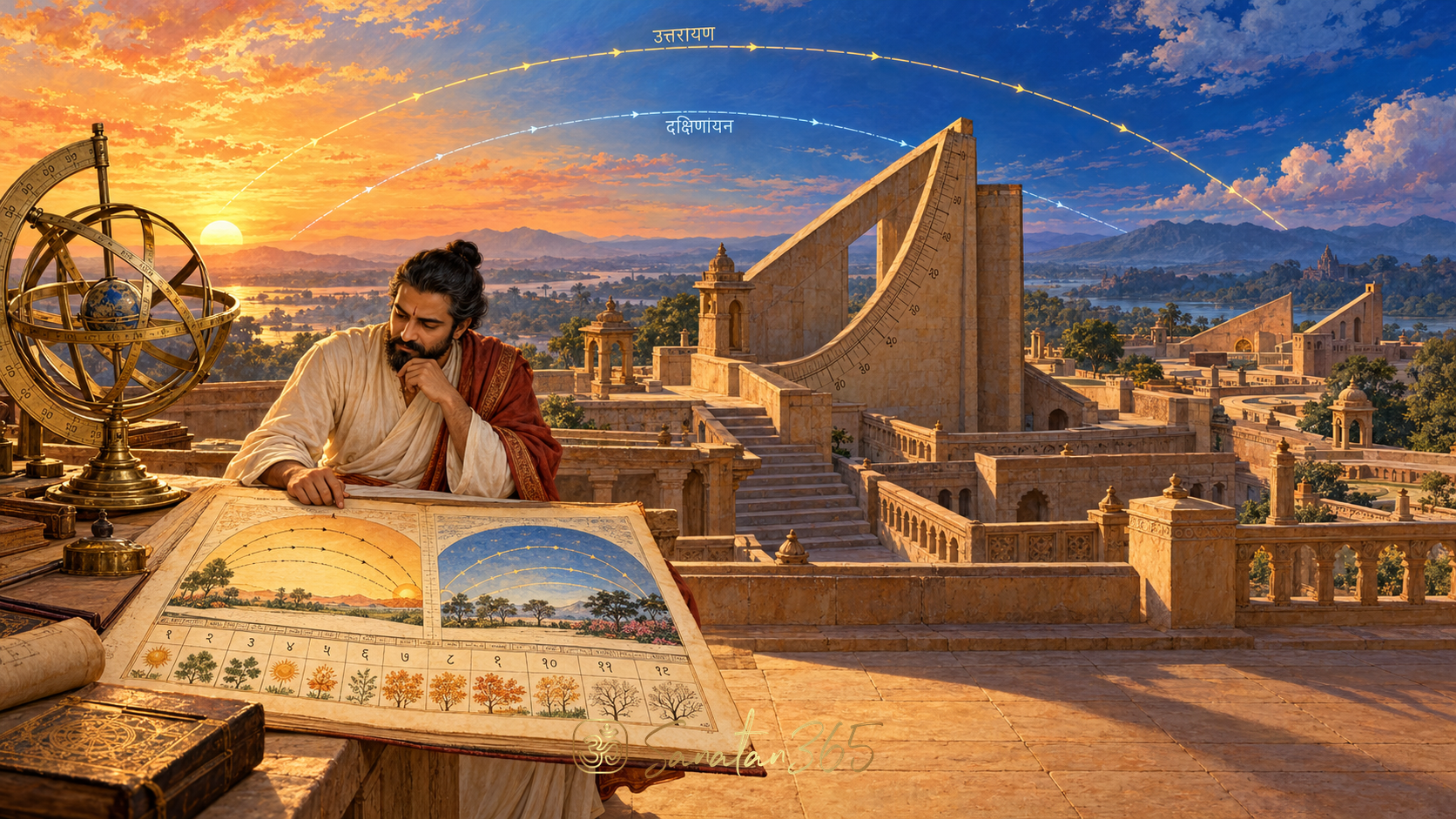
A calendar can give two different beginnings for the Sun’s northern course without describing two different Suns. Ayana meaning is a course or movement; in Hindu calendrical discussion, ayana (अयन, course) commonly names one of the year’s two solar half-cycles. Uttarayana (उत्तरायण, northward course) and Dakshinayana (दक्षिणायन, southward course) can refer to apparent solar motion measured from the solstices, while sidereal calendar usage associates them with particular solar ingresses. The essential first question is therefore not “Which date is wrong?” but “Which reference is this calendar using?”
That distinction turns an apparently contradictory entry into something readable. It also allows sacred observance and careful astronomical description to stand beside each other, without making either carry a claim it does not make.
Ayana meaning: what does the Hindu calendar describe?
An ayana is a large division of the solar year, not a lunar day or a weekday. Its vocabulary points toward direction: northward and southward. These words describe a recurring annual pattern, rather than a journey that carries the Sun physically around the Earth.
A useful calendar has more than one scale. A day locates a particular morning; a lunar fortnight follows a phase of the Moon; an ayana places the reader within a broader solar cycle. Confusion arises when one scale is treated as though it were another.
A panchang (पञ्चाङ्ग, five-limbed almanac) may include solar-year information alongside its five principal daily elements. An ayana entry is contextual information, not an additional lunar phase. Readers wanting that wider structure can begin with the five limbs of a panchang.
The most helpful habit is to name what an entry measures. “Northward course” is a description that still needs a reference point. Does the publisher mean the seasonal turning of apparent solar position, or a division marked by entry into a sidereal zodiac sign? The label alone does not settle that question.
Key takeaway: An ayana describes the broad solar half-year; identifying its reference system makes the entry useful.
What actually moves northward or southward?
The ordinary sight of sunrise can make “northward movement” sound like a change in the Sun’s daily east-to-west passage. The annual pattern is different. Across the year, the Sun’s apparent position shifts north or south relative to the celestial equator, the projection of Earth’s equator onto the sky.
Earth’s tilted axis and its orbit around the Sun produce this changing seasonal geometry. The tilt is not a switch that reverses every six months. Rather, Earth’s changing position in its orbit alters which hemisphere leans more toward the Sun. NASA’s explanation of the solstices illustrates this relationship and the opposite seasons experienced in the two hemispheres.
At the December solstice, the Sun reaches its southernmost annual position. Its subsequent apparent course is northward until the June solstice. After the June turning point, the apparent course is southward until December. These are the solstice-based northern and southern half-cycles.
There are two useful cautions here:
- Northward does not mean that the Sun remains north of the celestial equator throughout the half-year. It describes the direction of change.
- Southward does not mean that every place immediately becomes colder. Local climate and the hemisphere of residence matter.
An observer need not stare at the Sun to understand this pattern. A calendar diagram, an astronomy animation or a safely observed pattern of shadows can make the geometry clearer. Looking directly at the Sun is unnecessary and unsafe.
Key takeaway: The two courses concern annual apparent solar position, not a reversal of daily sunrise and sunset.
Why can Uttarayana and Makara Sankranti have different dates?
Here the distinction between seasonal and stellar reference systems becomes practical. In solstice-based usage, the northern course begins at the December turning point. In sidereal calendar usage, Uttarayana is associated with Makara Sankranti (मकर संक्रान्ति, the Sun’s ingress into the sign Makara).
A sankranti (संक्रान्ति, passage or ingress) is an entry into a zodiac sign. A solstice is a turning point in the Sun’s apparent north-south position. These are different definitions, so readers should not assume that their dates must coincide.
Drik Panchang’s winter-solstice explanation explicitly distinguishes “Tropical Uttarayana” at the winter solstice from “Sidereal Uttarayana” beginning at Makara Sankranti. The page is valuable precisely because it names the two conventions rather than silently merging them.
“Tropical” here means connected with the seasonal reference of equinoxes and solstices. It does not mean a hot climate. “Sidereal” means referenced to the stars, as used in the relevant zodiac framework. The longer-term difference between seasonal and sidereal coordinates is explained in the discussion of ayanamsha and the two zodiac reference systems.
The similar-looking words deserve care. Ayana names a course or half-cycle in this context. Ayanamsha names an angular offset between zodiac reference systems. One is not simply an alternative spelling of the other.
Neither distinction requires dismissing a family’s festival vocabulary. A household may call Makara Sankranti “Uttarayan” as an established observance name. That cultural usage need not serve as a technical statement that the astronomical solstice occurs that day.
Key takeaway: A solstice and a sidereal solar ingress are different events; shared devotional vocabulary does not make their definitions identical.
How does Dakshinayana complete the solar cycle?
Dakshinayana provides the other half of the picture. In the seasonal reference, it is the southward apparent course following the June solstice. In the corresponding sidereal convention, its beginning is associated with Karka Sankranti (कर्क संक्रान्ति, the Sun’s ingress into the sign Karka). Drik Panchang’s companion summer-solstice explanation makes that distinction explicitly.
Thinking in a pair prevents a common mistake: making one half-year the whole subject and treating the other as an interruption. The solar cycle contains both directions. A turning point is not a failure of the previous course; it belongs to the pattern.
The vocabulary can be organized without mixing its categories:
| Question | Solstice-based reference | Sidereal calendar reference |
|---|---|---|
| What marks the northern course? | December solstice | Makara ingress in the associated convention |
| What marks the southern course? | June solstice | Karka ingress in the associated convention |
| What is being distinguished? | Apparent north-south solar turning | Entry into named sidereal zodiac signs |
This table explains definitions, not a universal prescription for ritual scheduling. A particular calendar may follow a particular convention; an observance may require additional local rules. Both deserve to be read on their own terms.
Key takeaway: Understanding both ayanas makes the whole annual cycle clearer and keeps seasonal turning points distinct from zodiac ingresses.
How should a reader check an ayana entry?
Suppose a family calendar lists Uttarayana in January while an astronomy page describes the northern solar turn in December. A hurried comparison can turn that difference into an argument. A slower reading begins with the headings and explanatory notes.
A reliable sequence is:
- Identify the event. Is the page reporting a solstice, a solar ingress or a festival observance?
- Find the stated convention. Look for tropical, sidereal or an explanatory definition. If none is given, the label alone may be insufficient.
- Check the year and location. A familiar annual observance is not a substitute for the current calendar entry.
- Separate the instant from its local date. One astronomical event can fall on different civil dates in different time zones.
- Read ritual timing separately. A calendar’s observance rules may involve more than the instant of an astronomical event.
This is also why a screenshot stripped of its city, year and publisher notes can be misleading. It removes information needed to understand what the date means. Sharing the full context is more useful than circulating a confident correction based only on a heading.
The process resembles reading a map legend before comparing two routes. Different coordinates are not automatically an error, but an unidentified coordinate system can make a correct number confusing.
For ordinary household planning, the practical result is modest: use one trusted local calendar consistently, understand its vocabulary and consult the relevant temple or family tradition for an actual observance. Calendar literacy supports practice; it need not become a debate at every gathering.
Key takeaway: Check the definition, year, location and observance notes before deciding that two calendar entries disagree.
What changes for families in the Southern Hemisphere?
A family in Chennai and a family in Melbourne share the same planet and the same solstice instant. They do not share the same seasonal experience. June is associated with summer in the Northern Hemisphere and winter in the Southern Hemisphere; December reverses that relationship, as NASA’s solstice account explains.
For this reason, “June solstice” and “December solstice” are often clearer global labels than “summer” and “winter” without a named hemisphere. The astronomical northward or southward description does not reverse merely because the observer lives in Australia. The local season does.
India also contains considerable climatic variation. A solar half-year is not a six-month weather forecast for every region. Monsoon patterns, altitude and local conditions cannot be reduced to one calendrical word.
Diaspora readers therefore benefit from keeping two kinds of context visible: the convention used by the Hindu calendar and the environment of the place where they live. Preserving a religious observance does not require pretending that local summer is winter. Nor does recognizing a different local season require abandoning inherited calendar language.
Key takeaway: The solar course is a global astronomical pattern; local seasons and civil dates depend on where the reader lives.
Can sacred time be understood without fear?
A calendar can organize attention without becoming a verdict on a person’s worth. Naming an ayana does not, by itself, establish whether a particular project will succeed, whether someone is spiritually advanced or whether ordinary responsibilities should be postponed.
Some traditions attach particular ritual meanings to different parts of the year. Those meanings should be understood within their teaching and observance context, not converted into guaranteed predictions. A broad label is not a complete auspicious-time calculation, much less a substitute for practical judgment.
A thoughtful family conversation might begin with three questions: What does this calendar actually say? What does the relevant custom ask of us? What responsibilities still need to be met today? Those questions leave room for devotion, careful reading and ordinary care for others.
The deeper gift of the two courses may be attentiveness to recurrence. Light changes, days lengthen or shorten, and another turning point eventually arrives. Reading that pattern accurately can deepen wonder without turning it into anxiety.
Key takeaway: Sacred calendar language can encourage attention and reverence without promising outcomes or generating fear.
FAQ
What is the simplest Ayana meaning?
Ayana means a course or movement. In Hindu calendar discussion, it commonly refers to the northern or southern solar half-year. The intended reference system should be checked when interpreting its beginning.
Are Uttarayana and Makara Sankranti always the same event?
No. Solstice-based Uttarayana refers to the northward solar course beginning at the December solstice. Sidereal usage associates Uttarayana with Makara Sankranti. Their names may overlap in cultural practice, but their technical definitions differ.
Does Dakshinayana mean that the Sun changes its daily direction?
No. The southward course concerns the annual change in apparent solar position relative to the celestial equator. It does not mean that the Sun begins rising in the west.
Does Uttarayana mean summer everywhere?
No. The direction of apparent solar movement and the local season are different matters. Northern and Southern Hemisphere seasons are opposite, and climate also varies by region.
Can an ayana label predict whether an undertaking will succeed?
An ayana label alone cannot establish that. Ritual timing belongs to the relevant calendar and tradition, while real-world decisions also require practical information, responsible planning and attention to other people.
About the author
Sanatan365 Editorial
Bringing Sanatan Dharma to modern seekers through authentic, scripture-grounded content.
Related in Astrology
 Astrology
Choghadiya Meaning: Why Day and Night Have Different Slots
Choghadiya divides daylight and night separately. Follow a worked example to see why one slot need not last ninety minutes, then learn how…
 Astrology
Abhijit Muhurat Meaning: How the Midday Window Is Calculated
See why Abhijit Muhurat moves with local daylight and learn to check the eighth segment in a panchang without assuming a fixed clock time.
 Astrology
Paksha Meaning: Shukla and Krishna Lunar Fortnights
Learn how Shukla and Krishna Paksha divide the lunar month, why a tithi needs its fortnight, and how different month names can describe the…

