Panchang Meaning: How Hindu Time Is Read Through Five Limbs
Panchang is the Hindu almanac that reads time through tithi, vara, nakshatra, yoga, and karana. Here is a clear guide to what the five limbs mean and how seekers use them with wisdom.
One ordinary-looking date can carry many kinds of time.
The Panchang meaning is simple at the surface: panchang (पञ्चाङ्ग, pancha-anga, "five limbs") is the traditional Hindu almanac that reads a day through five measures: tithi, vara, nakshatra, yoga, and karana. Together, these limbs help families, priests, astrologers, and seekers understand festival dates, vrat observances, daily worship, and muhurat, the carefully chosen time for an important action. A Panchang is not meant to create fear about time. At its best, it teaches a more attentive relationship with time.
The modern calendar says, "Friday, May 29." The Panchang asks a subtler question: what is the quality of this moment?
What Is The Panchang Meaning In Hindu Tradition?
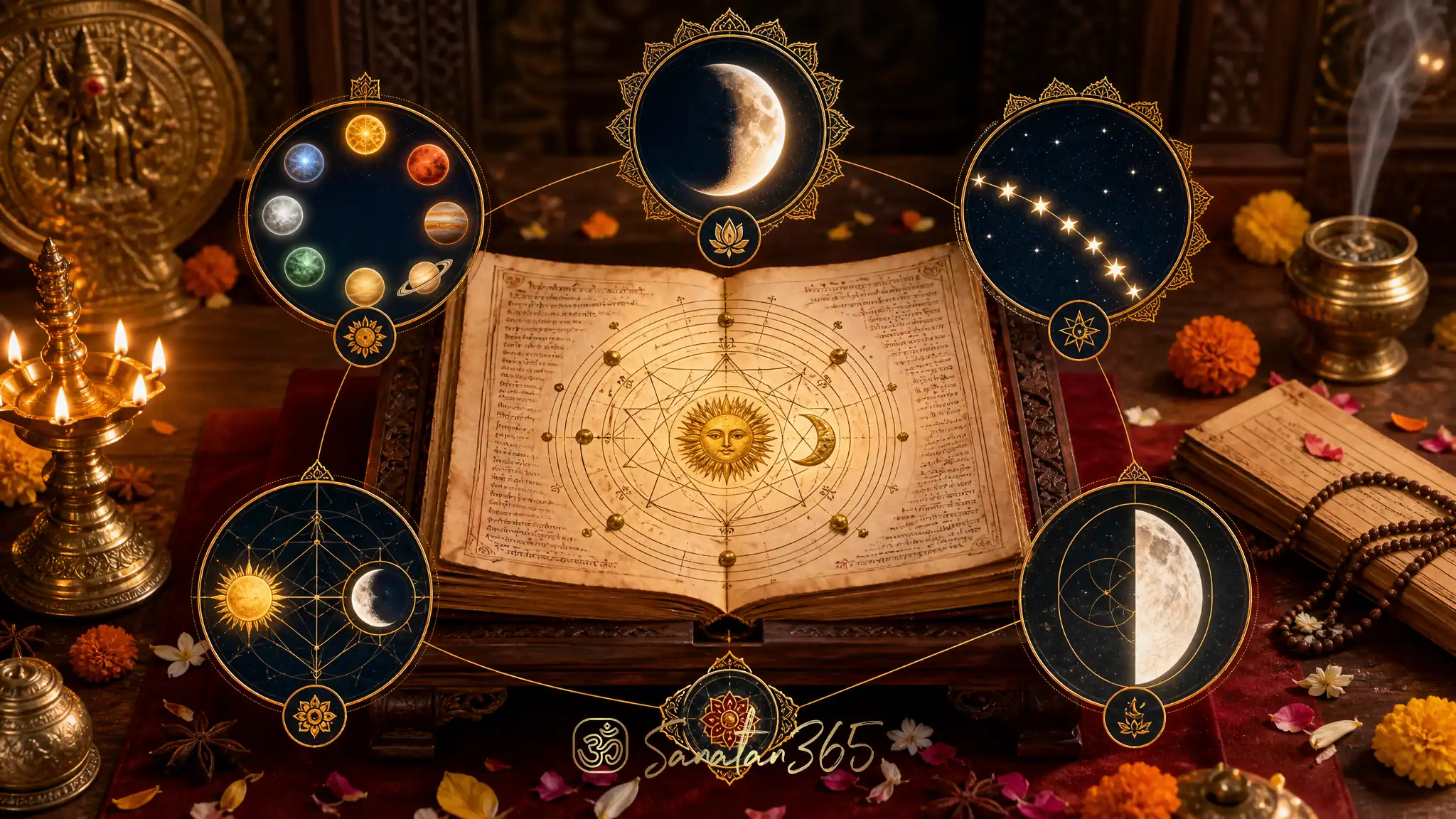
The word panchang comes from two Sanskrit roots: pancha (पञ्च, five) and anga (अङ्ग, limb or part). A Panchang, also called Panchanga or Panchangam in many regions, is therefore a "five-limbed" way of reading time. The five limbs are tithi (तिथि, lunar day), vara (वार, weekday), nakshatra (नक्षत्र, lunar mansion), yoga (योग, a Sun-Moon combination), and karana (करण, half of a tithi).
Key takeaway: Panchang meaning is not only "Hindu calendar"; it is a five-part spiritual and astronomical lens for understanding the quality of time.
The Panchang sits inside the larger Jyotisha (ज्योतिष, sacred astronomy and astrology) tradition. It is used to calculate festivals, observe Ekadashi, plan samskaras, identify vrata timings, and choose muhurat (मुहूर्त, auspicious time window). Contemporary Panchang guides often explain the five limbs as Sun-Moon based measures that are location-sensitive, because sunrise, moonrise, tithi endings, and festival observance can vary by place. Modern guides such as Dekho Panchang and Kalmanas also stress that Panchang depends on geography, not only on a printed date.
This location sensitivity explains a common confusion for diaspora families. A festival may appear on one date in India and another date in California, London, or Sydney. That is not usually a contradiction. It reflects the fact that Hindu sacred time is calculated through the living sky as seen from a particular place. Beginner-friendly Panchang explainers such as Dekho Panchang's five-limb guide and Kalmanas's Panchang overview make the same practical point: location matters.
In daily life, the Panchang has three gentle uses:
- It helps devotees observe sacred days with accuracy.
- It helps households choose supportive windows for important actions.
- It reminds seekers that time is not only a number, but a rhythm.
That third point matters. A Panchang can be misused when people treat it as a rigid permission system. The wiser use is reflective. It encourages awareness, humility, and alignment.
Why Does The Panchang Meaning Begin With Tithi?
Tithi (तिथि) is the lunar day. It is measured by the angular relationship between the Sun and the Moon, which is why it does not always match the civil date. A tithi can begin or end at any clock time. Sometimes one tithi stretches across parts of two calendar days. Sometimes a civil day can contain the end of one tithi and the beginning of another.
Key takeaway: Tithi is central to Panchang meaning because Hindu festivals and vrats usually follow lunar time, not midnight-to-midnight calendar time.
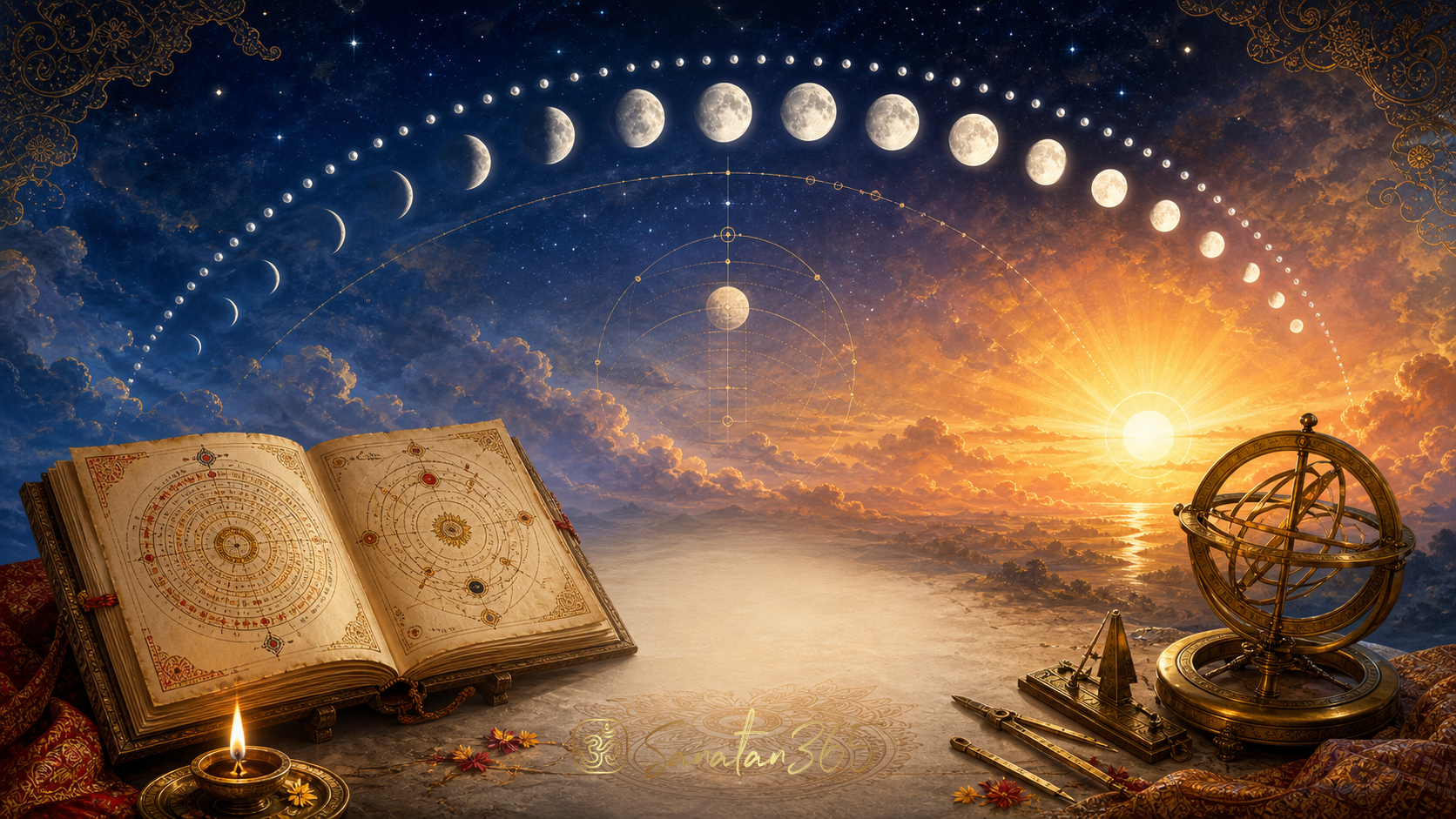
The lunar month is divided into two pakshas (पक्ष, fortnights). Shukla Paksha is the waxing half, when the Moon grows toward fullness. Krishna Paksha is the waning half, when the Moon moves from fullness toward newness. Each paksha has fifteen tithis, from Pratipada through Purnima or Amavasya depending on the half; standard references on the Hindu calendar describe this broader lunisolar structure.
This is why sacred observances such as Ekadashi, Pradosh, Purnima, and Amavasya are tithi-based. Ekadashi means the eleventh tithi, not simply "the eleventh day of the month." A devotee checking Ekadashi timing is really asking: when is the eleventh lunar day active for my location and observance rule? For a festival-linked example, see Padmini Ekadashi 2026: The Rare Adhik Maas Vrat for Vishnu Devotion.
Tithi gives a day its devotional frame. Some tithis are associated with fasting, some with ancestor remembrance, some with worship of a particular deity, and some with beginnings or completions. A family may not need to master every technical rule, but even a basic awareness of tithi changes how one sees the calendar. It makes the Moon part of spiritual life again.
For a modern seeker, the practical use is straightforward:
- Check the tithi before planning a vrat or festival observance.
- Use local Panchang data, especially outside India.
- Remember that the tithi ending time may matter more than the English date.
- Ask a qualified priest or trusted calendar for major samskaras rather than guessing.
This is precision without panic. Tithi invites care.
How Do Vara And Nakshatra Shape The Day?
Vara (वार) means weekday. In a Panchang, the weekday is not a minor label. Each vara carries a planetary association and a devotional mood: Ravi-var for Sunday, Soma-var for Monday, Mangala-var for Tuesday, Budha-var for Wednesday, Guru-var or Brihaspati-var for Thursday, Shukra-var for Friday, and Shani-var for Saturday.
Key takeaway: Vara gives the day a broad devotional tone, while nakshatra adds a more precise lunar texture.
This is why many households connect Monday with Shiva worship, Tuesday or Saturday with Hanuman devotion, Thursday with guru remembrance, and Friday with Devi or Lakshmi worship in different regional traditions. These associations are not meant to trap the day into one meaning. They create a recurring rhythm of remembrance.
Nakshatra (नक्षत्र) means a lunar mansion or star-field segment through which the Moon is understood to move. Classical Hindu astronomy and astrology use twenty-seven nakshatras. Each has its own symbolic quality, deity association, and suitability for certain activities. The earlier Sanatan365 article on Nakshatra Meaning: How Hindu Astrology Reads the Moon’s Sacred Map explored this lunar map in more detail; a Panchang uses that map every day.
In practical terms, nakshatra refines the day. If tithi says what lunar phase is active, nakshatra says what kind of sky-field the Moon is occupying. Some nakshatras are traditionally seen as supportive for learning, travel, worship, marriage, healing, construction, or contemplative work. Others may be treated with more caution for certain actions.
This is also where regional practice becomes important. A Tamil Panchangam, a North Indian Panchang, a Bengali Panjika, and a diaspora temple calendar may present the same cosmic data through different ritual priorities. The underlying five-limb structure remains recognizable, but local practice shapes how people use it.
For daily life, a simple approach works well:
- Let vara guide regular devotional habits.
- Let nakshatra matter most for events that truly need timing care.
- Avoid turning every ordinary task into a muhurat decision.
- Use the Panchang to deepen awareness, not to outsource judgment.
That balance keeps the Panchang humane.
What Are Yoga And Karana In The Five Limbs Of Panchang?
Yoga (योग) in the Panchang is not the same as yoga in the common sense of posture, meditation, or union. Here it refers to a calculated relationship based on the longitudes of the Sun and Moon. Traditional Panchang systems list twenty-seven yogas, each with a name and quality.
Key takeaway: Yoga and karana are the less familiar limbs of Panchang, but they add subtle timing detail beyond tithi, vara, and nakshatra.
Karana (करण) means half of a tithi. Since each tithi is divided into two karanas, karana works as a finer time marker. Traditional muhurat selection often considers karana along with the other limbs, especially for ceremonies, agreements, journeys, and ritual undertakings.
Many casual readers stop at tithi and nakshatra because those are easiest to understand. That is natural. But the full Panchang is five-limbed for a reason. Yoga and karana prevent the reading of time from becoming too broad. They add texture.
Think of it this way:
- Tithi tells the lunar day.
- Vara tells the weekday rhythm.
- Nakshatra tells the Moon's star-field.
- Yoga tells a combined solar-lunar quality.
- Karana gives a finer action-oriented subdivision.
Together, they create a layered reading. No single limb should be used in isolation for serious timing decisions. A priest choosing a wedding muhurat, for example, may examine tithi, nakshatra, vara, yoga, karana, lunar month, planetary conditions, family tradition, and local sunrise. A household choosing a simple day for extra japa may need far less complexity.
The goal is proportion. Not every decision needs a full electional astrology analysis. Yet knowing that yoga and karana exist helps readers respect the sophistication of the Panchang tradition.
How Can Modern Seekers Read A Panchang Without Fear?
A Panchang can look intimidating at first. The page may include sunrise, sunset, moonrise, rahu kala, gulika kala, yamaganda, abhijit muhurat, choghadiya, paksha, masa, samvat, and several regional notes. For a beginner, the best entry is the five limbs.
Key takeaway: Start with tithi, vara, nakshatra, yoga, and karana; then add other timing details only when they are relevant.
Here is a practical, low-anxiety way to read a daily Panchang:
- Check your location first. Panchang timing changes by geography.
- Read the tithi and when it ends.
- Note the nakshatra and its ending time.
- Look at the vara for devotional rhythm.
- Read yoga and karana as supporting details.
- For major life events, consult a qualified priest or astrologer.
- For daily worship, keep the practice sincere and steady.
The last point is vital. A person should not postpone devotion because they do not understand every calculation. A diya lit with shraddha (श्रद्धा, reverent trust) has value. A mantra repeated with attention has value. A morning namaste before a home altar has value.
The Panchang helps align action with time, but Dharma is not reduced to timing. The Bhagavad Gita repeatedly emphasizes steadiness, clarity, and sincerity in action. Time supports practice; it does not replace the heart of practice.
This is especially useful for diaspora families. Children may ask why Diwali, Ekadashi, or Janmashtami dates differ from school calendars or online sources. The Panchang gives a beautiful answer: Hindu time listens to the Sun, Moon, location, and tradition together. It is not random. It is relational.
How Does Panchang Meaning Connect Time, Dharma, And Daily Life?
The deeper Panchang meaning is that time is sacred when we learn to meet it consciously. Hindu tradition does not treat time as a blank container. Kala (काल, time) is powerful, rhythmic, and worthy of respect. A Panchang teaches that every day has a pattern, and every pattern can become a doorway into dharma.
Key takeaway: Panchang wisdom turns the calendar from a schedule into a spiritual practice of attention.
This does not mean every moment is either lucky or unlucky. That shallow reading makes people anxious. The fuller view is more mature: certain actions harmonize better with certain rhythms. A farmer watches seasons. A musician listens for tala. A devotee watches tithi. A family honors festival timing. A seeker learns to act with awareness.
This is why Panchang study can support modern life without becoming superstition. It trains the mind to ask better questions:
- Is this a day for beginning, completing, fasting, remembering, studying, or resting?
- Does this observance depend on local tithi timing?
- Is this decision important enough to need a proper muhurat?
- Am I using timing wisdom to support dharma, or to avoid responsibility?
That final question keeps the tradition honest. Panchang is not a substitute for ethical action. A poorly chosen act does not become dharmic because the time is favorable. A good act done with humility still carries spiritual weight even when life does not allow perfect timing.
The five limbs therefore teach both precision and surrender. Precision says: pay attention to the structure of time. Surrender says: do the right thing with reverence when the moment arrives.
FAQ
What is the Panchang meaning in simple words?
Panchang means "five limbs." It is the Hindu almanac that reads a day through tithi, vara, nakshatra, yoga, and karana. These five measures help determine festival timings, vrat observances, daily worship rhythms, and auspicious time windows.
What are the five limbs of Panchang?
The five limbs are tithi (lunar day), vara (weekday), nakshatra (lunar mansion), yoga (Sun-Moon combination), and karana (half of a tithi). Together they create a layered reading of time.
Why do Panchang dates differ by location?
Panchang calculations depend on local sunrise, tithi endings, Moon position, and other time-sensitive factors. Because the sky is observed from a specific place, a festival or vrat date can differ between India and diaspora locations.
Is Panchang only for astrology?
No. Panchang is used in Jyotisha, but it also supports ritual life, festival observance, vrata timing, temple calendars, household worship, and cultural continuity. It is both astronomical and devotional.
Should beginners check Panchang every day?
Beginners can start gently by checking tithi, vara, and nakshatra. Daily devotion does not require mastering every calculation. For major ceremonies or exact muhurat selection, it is better to consult a qualified priest or trusted Panchang source.
The Panchang meaning is ultimately this: time can be read with reverence. Its five limbs do not ask seekers to fear the calendar. They invite us to live with attention, rhythm, and dharma.
About the author
Sanatan365 Editorial
Bringing Sanatan Dharma to modern seekers through authentic, scripture-grounded content.
Related in Astrology
 Astrology
Rahu Kalam Meaning: Timing, Calculation, and Thoughtful Practice
Rahu Kalam is a daily interval traditionally treated as unsuitable for beginning important worldly undertakings. Learn how it is calculated…
 Astrology
Muhurta Meaning: How Hindu Tradition Chooses an Auspicious Time
Muhurta is the Hindu discipline of choosing a fitting time for a meaningful action by considering the Panchanga, the purpose of the act, an…
 Astrology
Tithi Meaning: How the Hindu Lunar Day Shapes Sacred Time
Learn what a tithi is, how the Sun-Moon angle creates 30 lunar days, why festival dates shift, and how to read Shukla and Krishna Paksha wi…

