Choghadiya Meaning: Why Day and Night Have Different Slots
Choghadiya divides daylight and night separately. Follow a worked example to see why one slot need not last ninety minutes, then learn how to read the table.
A Choghadiya slot can be shorter in the day and longer that same night. The difference can be understood with a little arithmetic.
Choghadiya meaning refers here to a traditional system of named time divisions used when considering an auspicious beginning. Caughaṛiyā (चौघड़िया, commonly written Choghadiya) divides local daylight into eight equal parts and the following night into eight more. Because daylight and night can have different lengths, their slots can differ too. Reading the table begins with the place, date and solar boundaries behind its times.
What is Choghadiya meaning?
Choghadiya gives a reader a named sequence of time windows. A table combines two kinds of information: the boundaries of each window and its traditional name. Understanding how the boundaries are formed helps the reader approach the names with more care.
Drik Panchang’s explanation of Choghadiya describes eight divisions for daytime and eight for nighttime. Its published tables also show that the name sequence depends on the weekday and differs between day and night.
The wider pañcāṅga (पञ्चाङ्ग, five-limbed almanac), commonly called Panchang, supplies a broader setting for reading sacred time. The guide to the five limbs of a Panchang introduces that setting. Choghadiya is one particular table a reader may encounter alongside other calendar information.
A familiar phrase such as “about an hour and a half” is useful only as a rough orientation. It should not replace the actual boundaries printed for a chosen place and date. The worked example below will deliberately produce daytime slots of eighty-five minutes and nighttime slots of ninety-five minutes.
Those figures are illustrative. They have not been calculated for a real city or date, and they are not a recommendation for when to begin an activity. Their purpose is to make the method visible.
Imagine a learner looking at a calendar with a family member. Before asking which row has a favourable name, the learner asks where the first time came from. That question opens the structure of the whole table. It turns a list of numbers into a sequence whose beginning and ending can be understood.
Key takeaway: Read Choghadiya as named windows built from local day and night boundaries. A rough ninety-minute description does not determine every slot.
How is the day Choghadiya calculation made?
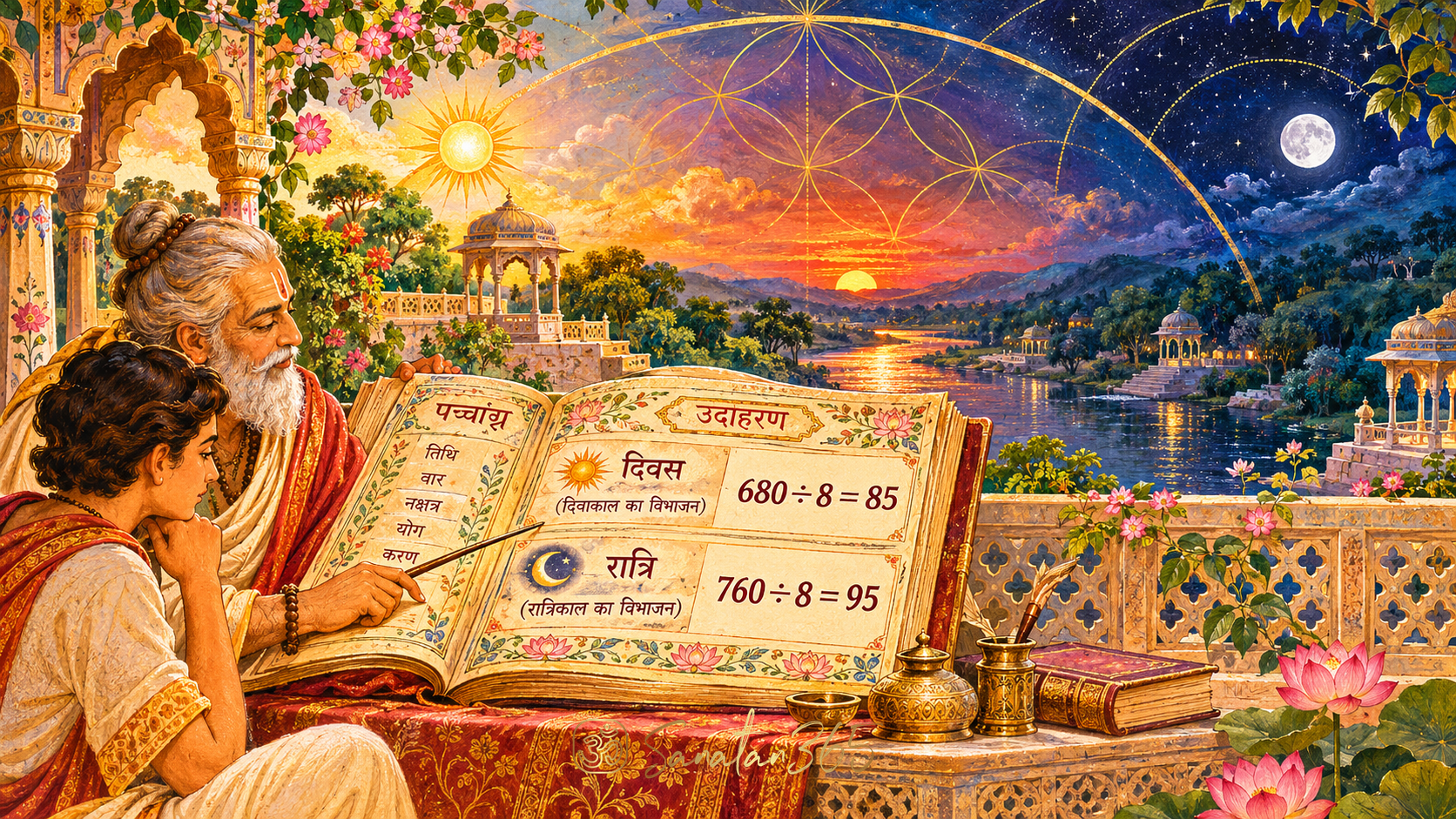
Begin with the interval from local sunrise to local sunset. Divide that duration into eight equal parts. Starting at sunrise, add one part at a time until the eighth part ends at sunset.
For this teaching example only, choose the following boundaries:
- Sunrise: 06:20
- Sunset: 17:40
- Daylight duration: 11 hours 20 minutes, or 680 minutes
The slot calculation is therefore:
680 ÷ 8 = 85 minutes.
The first slot begins at 06:20. Adding eighty-five minutes gives 07:45. Adding another eighty-five minutes gives 09:10. Continuing in the same way produces the following illustrative table.
| Day slot | Start | End |
|---|---|---|
| 1 | 06:20 | 07:45 |
| 2 | 07:45 | 09:10 |
| 3 | 09:10 | 10:35 |
| 4 | 10:35 | 12:00 |
| 5 | 12:00 | 13:25 |
| 6 | 13:25 | 14:50 |
| 7 | 14:50 | 16:15 |
| 8 | 16:15 | 17:40 |
There are two easy checks. The end of each row should meet the start of the next. The final boundary should return to the chosen sunset, 17:40. Together those checks show that the entire daylight interval has been divided, with no gap left over.
The rows have numbers rather than traditional names because this is an arithmetic exercise. No weekday has been assigned to the example. A real table needs the appropriate name sequence as well as the calculated boundaries.
A learner can test the result by multiplication: eight slots of eighty-five minutes make 680 minutes. This reverses the calculation and checks the total. It is a useful habit when copying times from a page into a notebook.
Now consider what would happen if every slot were forced to ninety minutes. Eight such slots would total 720 minutes, forty minutes more than the example’s daylight. The last row would overshoot sunset. The mismatch is visible without needing to debate the traditional names.
A second small exercise shows why a calculation may produce seconds. Suppose another hypothetical daylight interval lasts 677 minutes. Dividing by eight gives 84.625 minutes, which is eighty-four minutes and 37.5 seconds. The decimal part of a minute must be multiplied by sixty to express it as seconds.
If a learner rounds that duration down to eighty-four minutes and repeatedly adds the rounded value, the eight rows total only 672 minutes. Five minutes have been lost from the original interval. Rounding every slot up to eighty-five minutes produces 680 minutes, adding three minutes instead. This is a mathematical reason to retain precision while working out boundaries.
For a published calendar, follow the times actually displayed and its stated convention. A personal worksheet can show the unrounded calculation beside a neatly rounded display time. Keeping those two roles distinct helps the learner understand a small discrepancy without inventing another time division.
Key takeaway: Divide the actual sunrise-to-sunset duration by eight. Then check that the eight adjoining rows end exactly at the sunset used.
Why does night Choghadiya need a separate calculation?
Night begins at sunset and continues to the next sunrise. Its duration must therefore be calculated from that second interval. Reusing the daytime slot length would leave the nighttime table with the wrong ending.
Continue the same hypothetical exercise:
- Sunset: 17:40
- Next sunrise: 06:20 on the following civil date
- Night duration: 12 hours 40 minutes, or 760 minutes
The nighttime slot calculation becomes:
760 ÷ 8 = 95 minutes.
The next sunrise has deliberately been chosen at the same clock time as the earlier sunrise to keep this example simple. A real calculation should use the actual next sunrise supplied for its place and date.
| Night slot | Start | End |
|---|---|---|
| 1 | 17:40 | 19:15 |
| 2 | 19:15 | 20:50 |
| 3 | 20:50 | 22:25 |
| 4 | 22:25 | 00:00 next day |
| 5 | 00:00 next day | 01:35 next day |
| 6 | 01:35 next day | 03:10 next day |
| 7 | 03:10 next day | 04:45 next day |
| 8 | 04:45 next day | 06:20 next day |
The civil-date change occurs inside the nighttime sequence. It does not by itself start another set of eight night slots. In this example the fourth slot ends at midnight, and the fifth continues the sequence toward sunrise.
Some published tables represent after-midnight hours using numbers above twenty-four. A printed time of 25:30 in that convention means 01:30 on the next civil date. A reader should first check the publisher’s notation, since the same information can also be shown with an explicit “next day” marker.
The weekday and sunrise-to-sunrise guide offers related background on why calendar reading can involve more than a midnight boundary. Here the immediate task is to keep the night rows attached to the correct sunset and next sunrise.
Finally, compare the two totals in the exercise. Daylight used eight eighty-five-minute slots; night used eight ninety-five-minute slots. Each sequence divides its own interval correctly. Their difference is a consequence of the chosen durations.
Key takeaway: Calculate night from sunset to the next sunrise. Carry the civil date correctly through midnight while keeping the eight-slot sequence intact.
How should a reader understand the seven Choghadiya names?
The rows in an actual table carry traditional names. The common English spellings can vary, especially Char or Chal and Kaal or Kal. Learning to recognise the labels helps when moving between printed and digital calendars.
The familiar set can be read as follows. These brief glosses explain the names, not outcomes promised to a reader.
- Amrit, from amṛta (अमृत), nectar.
- Shubh, from śubha (शुभ), auspicious.
- Labh, from lābha (लाभ), gain.
- Char, from cara (चर), moving.
- Rog, from roga (रोग), illness.
- Kaal, from kāla (काल), time, also associated with death.
- Udveg, from udvega (उद्वेग), agitation.
The presence of seven names in an eight-row sequence can initially seem confusing. A name may recur within a sequence. The number of available labels and the number of divisions are answering different questions.
A reader can see this directly by following one weekday column in a published table. Count the eight rows first, then read the names in order. Separating the two operations prevents a repeated label from being mistaken for an extra time division.
The ePanchang day and night chart provides an example of a publisher displaying those named rows. Such a page must be read with its displayed place and date; a saved or cached view should not be assumed to show today’s schedule.
Traditional favourable and unfavourable classifications belong to the interpretive system. They do not make a label a personal diagnosis or a guarantee about what will happen. A person’s name, worth or future is not being established by the colour of one calendar row.
The sources also show that a name is only part of time selection. Drik Panchang notes additional overlapping periods that its users consider. A reader therefore needs to understand what the particular table includes before treating a favourable-looking row as a complete answer.
Key takeaway: Keep the eight divisions distinct from their seven possible names. Read each label within the publisher’s traditional classification and the wider context of the table.
How can a family read a local Choghadiya table carefully?
A shared calendar becomes easier to discuss when everyone is looking at the same information. Start by naming the place and civil date shown on the page. Then identify whether the question concerns the daytime table or the night following that day’s sunset.
A small reading checklist can help:
- Confirm the selected city or locality and its time zone.
- Confirm the displayed date, including the date of any after-midnight time.
- Identify the sunrise, sunset and next sunrise behind the table.
- Read the start and end of the relevant row, along with its name.
- Check the publisher’s notes about notation and any overlapping periods.
This is a way to read information accurately, rather than a universal ritual prescription. A family following a particular calendar tradition can ask its knowledgeable guide how that tradition uses the table.
Suppose one relative sends a screenshot without its heading. The named row may be visible while the location is missing. Asking for the full heading is a useful next step. It recovers information needed to interpret the times, rather than making an assumption from the familiar label.
The same care helps when travelling. A screenshot saved for one city remains a record of that city’s selected calculation. Before using a table elsewhere, open the intended location and date again. Record the setting beside any times copied into a message.
For an important ceremony, a family can discuss the broader muhūrta (मुहूर्त, an auspiciously selected time) with its officiant. The article on how Hindu tradition approaches auspicious timing introduces that larger subject. A quick table reading and a complete ceremonial decision have different scopes.
Ordinary responsibilities and necessary care should continue with sound judgement. This educational explanation does not advise delaying essential action or promise a result from a chosen window. Its purpose is to improve understanding of a traditional calendar practice.
A learner can finish by recreating the illustrative arithmetic on a blank page. Write the three solar boundaries, calculate the two durations and divide each by eight. If the eight day rows meet sunset and the eight night rows meet next sunrise, the central idea has become clear.
The lasting takeaway is to connect every named window with the local interval from which it was formed. Place, date, duration and notation give the table its readable structure.
Key takeaway: Check the full setting before interpreting a row. Accurate reading begins with the location, date and boundaries, then moves to the traditional label.
FAQ
What is Choghadiya meaning in simple terms?
It is a traditional system of named time windows. Daylight and the following night are each divided into eight equal parts.
Is every Choghadiya exactly ninety minutes?
No. Each slot is one eighth of its daytime or nighttime interval. Its duration can therefore vary with the local solar boundaries.
Why are the day and night slots different in the example?
The hypothetical daylight lasts 680 minutes and the night 760 minutes. Dividing each by eight gives eighty-five and ninety-five minutes respectively.
Can the example’s times be used for today?
No. They are teaching values for no particular place or date. A real table must be checked for the intended locality, date and calendar method.
About the author
Sanatan365 Editorial
Bringing Sanatan Dharma to modern seekers through authentic, scripture-grounded content.
Related in Astrology
 Astrology
Abhijit Muhurat Meaning: How the Midday Window Is Calculated
See why Abhijit Muhurat moves with local daylight and learn to check the eighth segment in a panchang without assuming a fixed clock time.
 Astrology
Ayana Meaning: Uttarayana, Dakshinayana, and the Sun’s Two Courses
Understand the two solar half-years, why solstice dates and sidereal calendar markers differ, and how to read an ayana entry without fear o…
 Astrology
Paksha Meaning: Shukla and Krishna Lunar Fortnights
Learn how Shukla and Krishna Paksha divide the lunar month, why a tithi needs its fortnight, and how different month names can describe the…

