Paksha Meaning: Shukla and Krishna Lunar Fortnights
Learn how Shukla and Krishna Paksha divide the lunar month, why a tithi needs its fortnight, and how different month names can describe the same day.
A lunar date can be correct and still be incomplete: the same numbered day returns twice in a month.
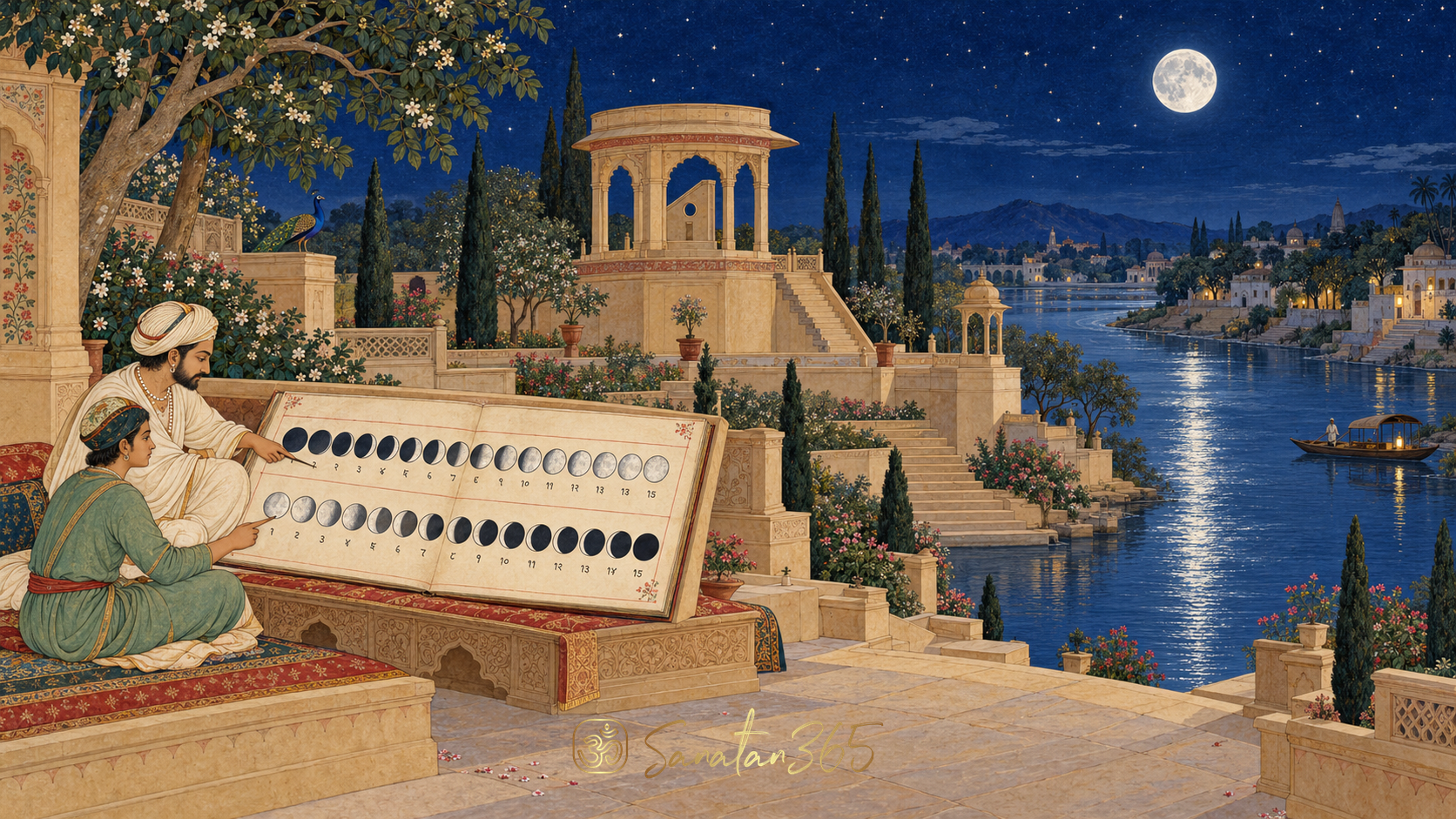
Paksha meaning is “side” or “half” in this calendar context. A paksha (पक्ष, lunar fortnight) is one of the two halves of a Hindu lunar month. Shukla Paksha (शुक्ल पक्ष, bright fortnight) follows the waxing Moon toward fullness; Krishna Paksha (कृष्ण पक्ष, dark fortnight) follows its waning toward new moon. Each contains fifteen tithis (तिथि, lunar days). Knowing the fortnight prevents a common mistake: treating two dates with the same tithi name as the same observance.
This is calendar literacy before it is interpretation. A bright fortnight does not certify a fortunate life, and a dark fortnight does not condemn a person or an undertaking. The first task is simply to locate a date accurately.
Paksha meaning: what makes a lunar fortnight?
The word “fortnight” is useful, but it needs one qualification. Here it means fifteen lunar days, not a rigid block of fourteen or fifteen midnight-to-midnight dates. A tithi belongs to the changing relationship between the Sun and Moon; a civil date belongs to the clock and calendar used for ordinary appointments.
Swami Shantananda's explanation of the lunar fortnights explicitly describes fifteen tithis in each paksha and distinguishes the waxing and waning halves. That is the essential structure. The terminology identifies which half of the monthly cycle is being counted, rather than giving an additional weekday.
The distinction becomes clearer if the month is imagined as two journeys through a numbered sequence. The first runs through the bright half to Purnima (पूर्णिमा, the full-moon lunar day). The other runs through the dark half to Amavasya (अमावास्या, the new-moon lunar day). Those names refer to the culminating tithis, not to an instruction to infer an exact astronomical instant from the Moon's appearance.
Neither journey is measured by counting sunsets after a casually observed crescent. Clouds, buildings, viewing time and the Moon's position can make visual estimates unreliable. A published almanac supplies calculated boundaries, while the sky gives a beautiful but less precise introduction to the cycle.
The guide to tithi and the Hindu lunar day explains the smaller unit. For this article, the crucial relationship is simple: a tithi identifies a position within a fortnight; the paksha identifies which fortnight is meant. Together they carry more information than either alone.
Key takeaway: A paksha is a half-month of fifteen tithis, not a fixed collection of civil dates.
How do Shukla Paksha and Krishna Paksha differ?
“Shukla” means bright or white; “krishna” here means dark. These are descriptions of the lunar half-cycle. In this expression, Krishna Paksha is a calendar term, not a statement that the fortnight belongs exclusively to Lord Krishna.
The practical comparison has three parts:
- Shukla Paksha: the waxing half, following new moon and culminating in Purnima.
- Krishna Paksha: the waning half, following full moon and culminating in Amavasya.
- Both: fifteen tithis, an ordered lunar sequence, and a place within a living calendar tradition.
The waxing half suggests increasing illumination; the waning half suggests decreasing illumination. That distinction does not make the Moon itself physically grow and shrink. It describes the changing lit portion seen from Earth. Nor should a stylized drawing of a crescent be treated as a universal directional diagram: the apparent orientation depends on where and when it is viewed.
The Siddha Yoga explanation associates the bright fortnight with growth and the dark fortnight with contemplation. Such associations can support reflection, but they should remain identified as interpretive meanings. They are not a scientific forecast of a reader's temperament, relationships or success.
A common difficulty is the leap from “dark fortnight” to “bad fortnight.” The very source that explains the two halves describes a sacred ancestral observance within Krishna Paksha. Its account concerns Pitru Paksha (पितृ पक्ष, fortnight dedicated to the ancestors), a particular annual observance, not every waning fortnight of the year. Ordinary Krishna Paksha and that specific observance are therefore not interchangeable names.
There is room for reverence without fear. A household may follow particular inherited rules for a ceremony while still recognizing that calendar labels are not moral rankings of time or people. Learning the vocabulary should make participation more thoughtful, not make ordinary life feel threatening.
Key takeaway: Bright and dark distinguish lunar phases; neither term is a verdict on a person's worth or future.
Why does the same tithi name appear twice?
Consider Panchami (पञ्चमी, fifth lunar day). There is a fifth tithi in the bright fortnight and another in the dark fortnight. “Panchami” alone therefore leaves out half the address. “Shukla Panchami” and “Krishna Panchami” are different positions in the lunar month, even though both contain the number five.
The same principle applies to Ekadashi (एकादशी, eleventh lunar day) and the other recurring ordinal names. A reference to an eleventh day needs its fortnight, month and relevant observance context before it becomes a usable calendar instruction. Simply copying a number from a family message is not enough.
A clear date note can be assembled in layers:
- Civil date and year: the appointment date someone can enter in an ordinary diary.
- Lunar month and calendar convention: the month name as used by the chosen almanac.
- Paksha: bright or dark fortnight.
- Tithi: the named lunar day, with its beginning or ending time when needed.
- Location and observance: the city and the specific calendar rule used for the event.
These layers answer different questions. The tithi's ending time says when a lunar interval ends. It is not automatically the recommended hour for a ceremony. The weekday says which day of the seven-day cycle is being used. It does not replace the lunar date. The explanation of vara and weekday boundaries explores that separate distinction.
For example, an imagined note saying “Shukla Panchami ends at 14:10” tells a reader which fifth tithi is meant and when that interval finishes in the displayed time zone. It does not establish the date of a real festival. That would require a real year, locality, month and the relevant observance rule. This example is deliberately a reading exercise, not a timing recommendation.
A tithi can also cross midnight. Consequently, changing the civil date does not necessarily mean changing the tithi or paksha at that instant. The correct response is to read the interval carefully, rather than assume every lunar label resets at 00:00.
Key takeaway: A repeated tithi name needs its paksha, just as a repeated street name needs its town.
Why can Amanta and Purnimanta month names differ?
Two relatives may read different month names for the same waning fortnight without either having misplaced the Moon. The difference may be the boundary used to group the fortnights into named months.
Amanta (अमान्त, ending with new moon) reckoning closes the lunar month at Amavasya. Its month pairs a bright fortnight with the dark fortnight that follows it. Purnimanta (पूर्णिमान्त, ending with full moon) reckoning closes the month at Purnima. Its month pairs a dark fortnight with the bright fortnight that follows it.
The educational notes accompanying this Hindu calendar explain both month-ending systems, with Telugu and Gujarati calendars as Amanta examples and North Indian lunar usage as a Purnimanta example. These are useful introductions, not permission to assume that every calendar in an entire region follows one identical system.
The grouping can be pictured without memorizing all the month names:
- Amanta grouping: bright half → dark half → new-moon month-end.
- Purnimanta grouping: dark half → bright half → full-moon month-end.
In the ordinary corresponding month sequence, the bright fortnight has the same month name in both systems. The intervening dark fortnight can carry different month labels because one system has already crossed its month-end and the other has not. This is a change in naming boundaries, not a second physical lunar cycle.
The distinction is especially helpful in a family whose members use calendars from different parts of India. A relative may identify an observance through a familiar regional month label; another may recognize its tithi and fortnight but see another month heading. Before declaring a conflict, compare the full entry and calendar convention.
This explanation does not mean every disagreement about festival dates is merely a month-name difference. Locations, time zones and observance rules can produce other differences. Intercalary months also require their own calendrical explanation. The responsible approach is to diagnose the particular discrepancy, not force every case into one simple answer.
For readers in Chennai, Kolkata or the diaspora, another distinction matters: solar regional month names and lunar month names are not always interchangeable. A calendar can display both. Checking the heading is more reliable than guessing the system from the language printed on the page.
Key takeaway: Different month-end conventions can rename a waning fortnight without changing its tithis or the Moon itself.
How can a household read the fortnight without fear?
A useful first habit is to read one complete date line slowly. Start with the place and civil date, then find the lunar month, paksha and tithi. Only after those are clear should a reader look for an observance time. This keeps a calendar from turning into an unexplained list of auspicious and inauspicious labels.
A second habit is to keep calculations and observance decisions distinct. The India Meteorological Department's Rashtriya Panchang description explains its calculated calendrical data, including lunar days and Moon phases. Such data provides a foundation; the particular religious observance still needs the appropriate rule and community context.
For a family invitation, clarity can be very ordinary: include the civil date, city, local time, full lunar label and the temple or household calendar being followed. This is more helpful than forwarding a cropped image in which the location or month convention has disappeared.
For a child learning the calendar, two labelled sequences can show why “fifth” occurs twice. Looking at the Moon together can then connect the vocabulary with observation. The aim is curiosity, not a test of belief or a claim that an outdoor glance can replace the almanac.
For an adult comparing two applications, first align the location, date, time zone and month system. Then compare tithi intervals. A difference in the displayed month name may have a simple explanation; a difference in the event date may require checking an observance rule. Neither requires an immediate conclusion that one family tradition is inferior.
The broader introduction to the five limbs of a panchang places these details within the almanac as a whole. Paksha is a useful lunar-half label, not a sixth item added to that traditional list of five limbs.
Key takeaway: Read the whole calendar entry before drawing a conclusion from a single label.
The lasting value of paksha is precision joined with attention. It teaches a reader to notice which half of a cycle is being named, which convention supplies the month, and which information is still missing. That small discipline can make shared observances clearer and more welcoming.
FAQ
What is the simplest paksha meaning?
Paksha means a side or half of the lunar month in this context. A lunar month has a bright, waxing fortnight called Shukla Paksha and a dark, waning fortnight called Krishna Paksha. Each contains fifteen tithis.
Is Krishna Paksha the same as Pitru Paksha?
No. Krishna Paksha is the general term for each waning lunar fortnight. Pitru Paksha names a particular annual period associated with ancestral remembrance. The names should not be used interchangeably for every month.
Does a paksha always last fifteen ordinary days?
Not as a fixed midnight-to-midnight count. It consists of fifteen lunar days, whose boundaries do not have to coincide with civil days. Use the almanac's calculated intervals rather than adding fifteen dates mechanically.
Why can the same day have different lunar month names?
Amanta and Purnimanta calendars end the lunar month at different points, new moon and full moon respectively. A waning fortnight can therefore receive different month labels. Compare the full date and convention before assuming an error.
Which paksha is better for spiritual practice?
Neither label establishes the worth of a person's practice. Particular observances may have specific traditional rules, but daily prayer, learning and responsible conduct need not become a competition between bright and dark fortnights. Follow a trusted calendar for the ceremony actually being observed.
About the author
Sanatan365 Editorial
Bringing Sanatan Dharma to modern seekers through authentic, scripture-grounded content.
Related in Astrology
 Astrology
Choghadiya Meaning: Why Day and Night Have Different Slots
Choghadiya divides daylight and night separately. Follow a worked example to see why one slot need not last ninety minutes, then learn how…
 Astrology
Abhijit Muhurat Meaning: How the Midday Window Is Calculated
See why Abhijit Muhurat moves with local daylight and learn to check the eighth segment in a panchang without assuming a fixed clock time.
 Astrology
Ayana Meaning: Uttarayana, Dakshinayana, and the Sun’s Two Courses
Understand the two solar half-years, why solstice dates and sidereal calendar markers differ, and how to read an ayana entry without fear o…

