
Dashamsha Chart Meaning: Why D10 Starts in Two Places
The same degree can map to different D10 signs. Learn to check the starting sign and count the right number of three-degree segments.
Two planets can be the same distance into their signs and still land in different signs in D10. To see why, find out where each count begins.
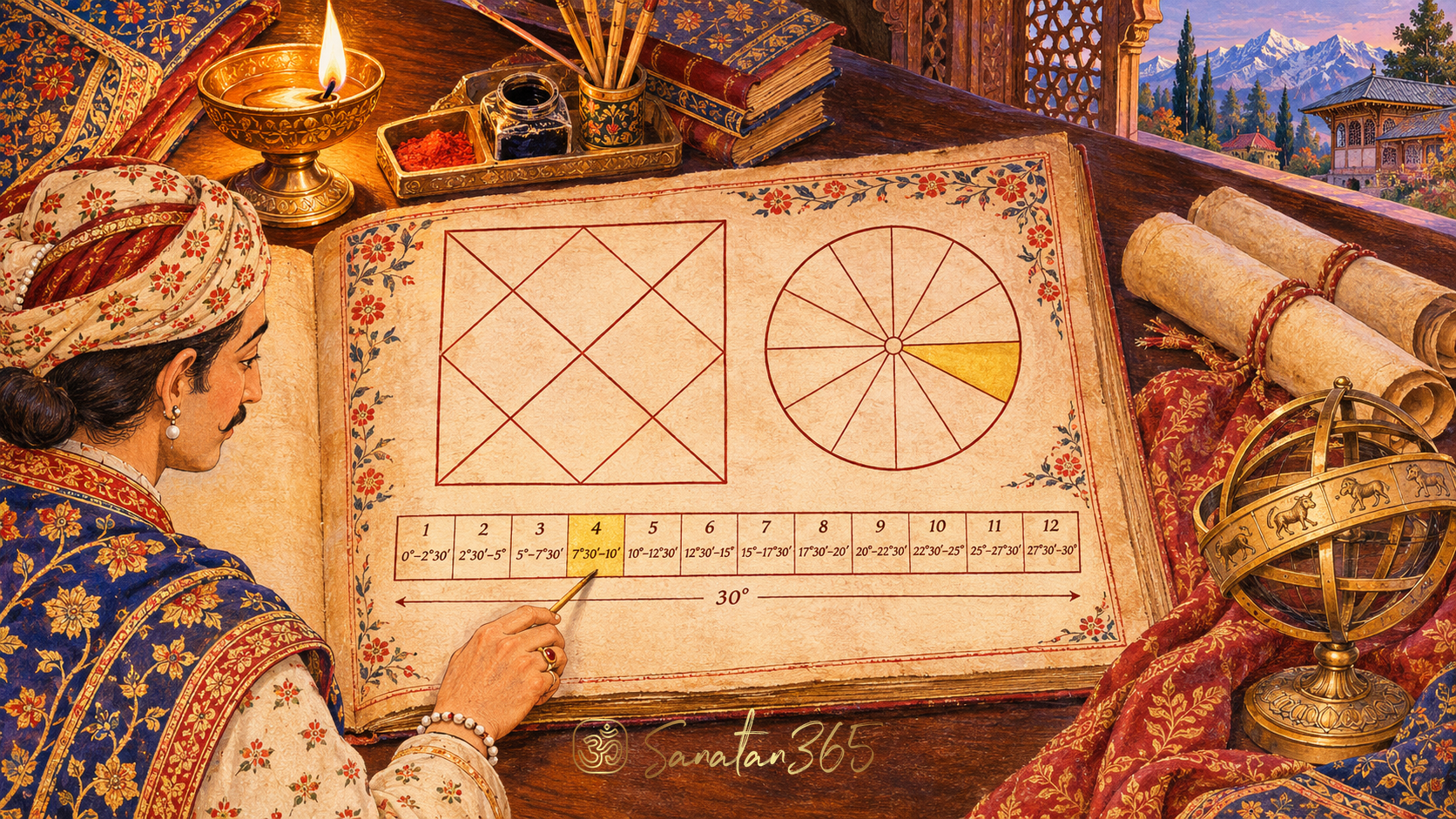
The Dashamsha chart meaning starts with a division into tenths. Daśāṃśa (दशांश, tenth part) is the D10 divisional chart in traditional Indian astrology. Divide each zodiac sign into ten portions of three degrees. Find which portion a position occupies, then count from a starting sign that depends on whether the original sign is odd or even.
What is the Dashamsha chart meaning?
A birth chart places a planet within a rāśi (राशि, zodiac sign). The thirty degrees of that sign give a way to locate the planet more precisely than the name of the sign does. The D10 method takes that position and assigns it a sign in another chart. The letter and number identify a tenfold division. They do not name the tenth house of the birth chart.
The Santhanam translation of Brihat Parashara Hora Shastra gives the rule and a table in chapter 6. In the rule, every sign is divided into ten equal parts. A position in the first three degrees of a sign belongs to its first part. A position starting at three degrees and before six belongs to the second. That pattern continues to the last three degrees.
These divisions answer only the first part of the question. A reader still needs to know what zodiac sign to assign to the part just found. Treat each part as a place in a sequence. The first part gets the starting sign. The second gets the next sign, and so on. The sign assigned to the first part is the detail that changes between odd and even source signs.
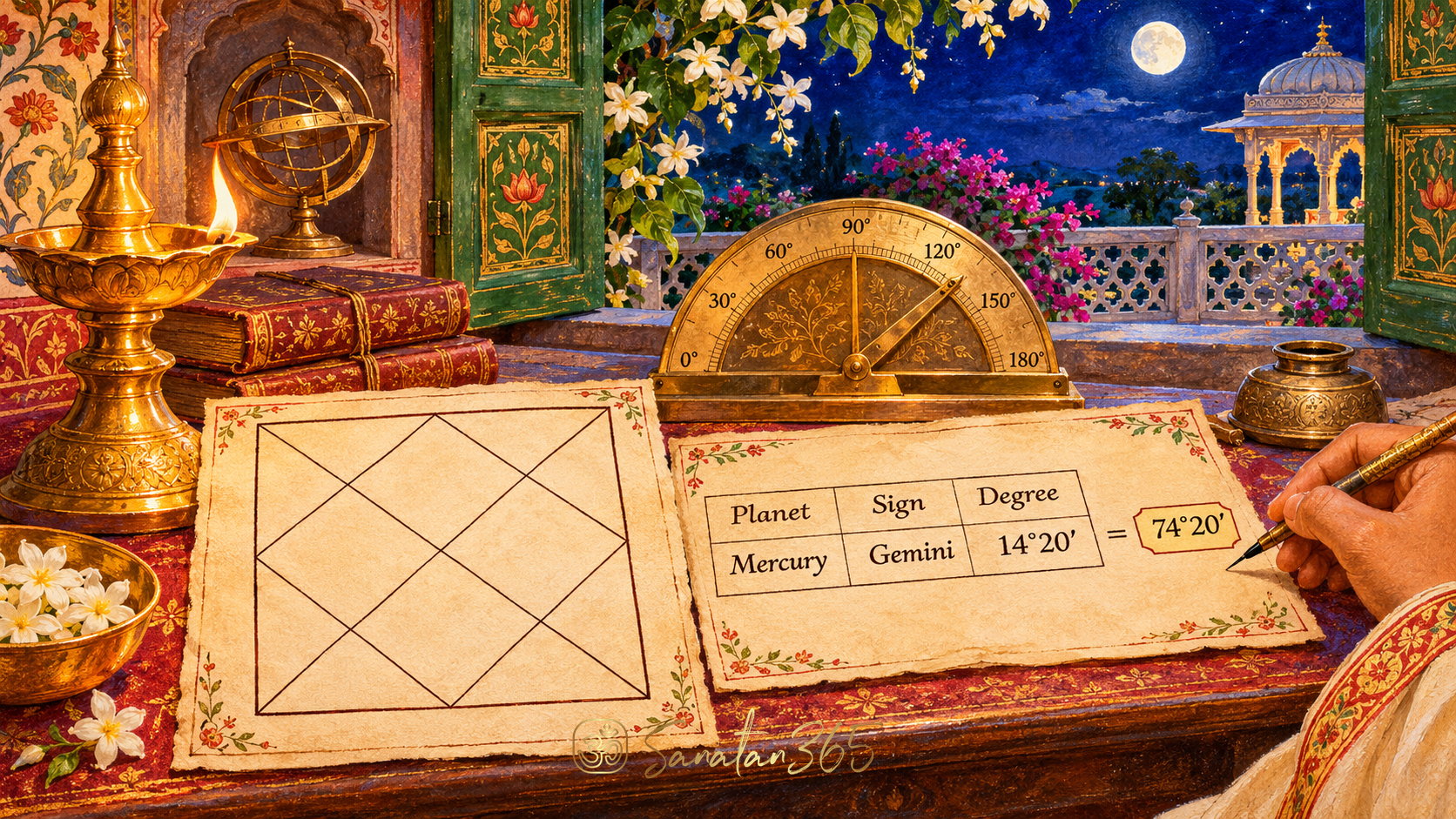
It is useful to write the two steps on separate lines while checking a chart. One line can say “third part of the original sign.” The other can give the resulting D10 sign. This keeps the three-degree measurement from being mistaken for a sign number. The guide to reading planetary degrees explains how to establish the starting position before dividing it.
Key takeaway. First find the part of the original sign. Then use a separate count to assign the D10 sign.
How does the D10 starting sign rule work?
The twelve signs are numbered in zodiac order. Aries is first and Taurus is second. Gemini is third and Cancer fourth. A sign is odd or even according to this number. The degree within the sign plays no role in deciding which start rule applies.
For an odd source sign, begin from that same sign. Its first three-degree part maps to itself. The second part maps to the next sign in zodiac order. With Aries as the source, the sequence begins Aries, Taurus, Gemini. The same idea works with another odd source sign. For example, Leo starts its sequence at Leo and then advances to Virgo.
For an even source sign, begin at the ninth sign counted inclusively from the source. With Taurus as the source, count Taurus as one. Gemini is two, Cancer three, Leo four, Virgo five, Libra six, Scorpio seven, Sagittarius eight and Capricorn nine. Capricorn is therefore the starting sign for the first part of Taurus. The remaining parts are assigned in ordinary forward zodiac order from there.
Inclusive counting matters twice. In the Taurus example, the source sign itself counted as one in finding the starting sign. Then the starting sign counts as one when assigning the first part. A calculation that moves nine signs forward to find the starting point would be one too far. So would a calculation that moves three signs forward to find the third part. Three signs in an inclusive count means the starting sign and two further steps.
A related chart can use a different assignment rule even though the input is the same longitude. The guide to the D12 chart and its twelve parts gives an example. Before borrowing a shortcut, establish which division chart is being calculated.
Key takeaway. Odd signs start at themselves. Even signs start at their ninth sign, counted from the source as one.
How does a D10 worked example change between Aries and Taurus?
Take an illustrative position of seven degrees and fifteen minutes within a sign. The first part ends at three degrees. The second ends at six degrees. Seven degrees and fifteen minutes is between six and nine, which makes it part three. The example uses a position within the sign, with no need for any person's birth data.
First put the position in Aries. Aries is odd, so the first part is assigned to Aries. Count Aries, Taurus and Gemini. Part three is Gemini. The input is Aries at seven degrees and fifteen minutes and the result is a Gemini placement in the D10 sign calculation.
Now put the same degree in Taurus. The part number stays three because the distance into the sign stayed the same. Taurus is even, so the first part is assigned to Capricorn. Count Capricorn, Aquarius and Pisces. Part three is Pisces. The calculation proceeds forward even though it uses the even-sign starting rule.
A compact worksheet can record four fields for either position. Write the original sign, the position within it, the part number and the D10 sign. Try doing this before looking at a software chart. If the chart agrees, the worksheet explains why. If it differs, the worksheet shows whether to recheck the sign and position, the part boundary, or the sequence that begins at the starting sign.
There is a useful test with a higher part number too. In the Taurus sequence, Pisces is third, and Aries follows it in fourth place. The fact that the count passed the final sign in the zodiac is no obstacle. The sequence wraps around and continues. The fourth part of Taurus here maps to Aries, while the fourth part of the earlier Aries example maps to Cancer.
Key takeaway. Seven degrees and fifteen minutes is part three in both examples. Aries maps to Gemini and Taurus maps to Pisces under this rule.
Why do D10 chart boundaries require precise degrees?
Each segment begins at a multiple of three degrees. In the worked convention here, the lower boundary belongs to the new part. Two degrees and fifty-nine minutes is in the first part. Exactly three degrees is in the second. The interval reaches forward to the next boundary, where the following part starts.
The chart display can hide that distinction. A rounded display may show three degrees for a value a few seconds below it. If a placement looks surprising, look for the unrounded position rather than inferring where the chart put the boundary. At the end of a sign, a position exactly thirty degrees from its beginning is already at zero degrees of the next sign. The next sign supplies the new odd or even rule.
For readers using full zodiac longitude, find the position within the original sign first. For example, thirty-seven degrees and fifteen minutes from the start of Aries is seven degrees and fifteen minutes within Taurus. It does not form a thirteenth three-degree part of a sign. Treating the absolute longitude and the within-sign position as separate values prevents that error.
When comparing two charts, begin by checking that the source positions match before interpreting the D10 result. The systems may display different precision or use different defaults. A person comparing them can preserve one exact input and ask for the calculation rule used. The article on the D9 chart gives another example of how a divisional chart depends on its own assignment method.
One useful check is to hold the source sign steady while moving the degree. Keep Taurus and compare a point at eight degrees and fifty-nine minutes with a point at nine degrees exactly. The first position is still in part three, assigned to Pisces. The second falls at the beginning of part four, assigned to Aries. Here the source remains even, so the starting sign stays Capricorn throughout. The result changes because the part number changed. This example lets the reader isolate the effect of a boundary before considering the extra change that occurs when the source sign itself changes.
A second check starts at zero degrees. At exactly zero in Taurus, there are no completed three-degree segments in the new sign. The position belongs to part one, so Capricorn is the result. A worksheet that reports part zero has confused the number of completed segments with the number of the current part. A worksheet that reports Taurus has probably carried over the odd-sign start. The two errors look different once each step has a label.
Key takeaway. Read the unrounded within-sign position and identify its part before comparing two D10 results.
What does the traditional connection with work mean?
The chapter on the use of divisions in Brihat Parashara Hora Shastra associates Dashamsha with authority or position. That gives context for why readers today encounter the D10 in discussions of vocation or public responsibility. The calculation described here produces a chart placement. Discussing how someone interprets that placement is a further step.
This distinction gives beginners a manageable starting point. If a place in the chart has been assigned incorrectly, the person can find that out through the same procedure regardless of any eventual interpretation. If the assignment is correct, that establishes agreement with the calculation used. It does not supply evidence by itself for what job someone will take or whether an application will succeed.
A reader can therefore practise with made-up positions. Compare a pair of points on either side of a boundary, or compare the same within-sign position in one odd and one even sign. In either case, explain any change in the result with the two pieces of the rule. A reader who can do that has learned something concrete about this traditional chart even before looking at a full set of placements.
Key takeaway. The traditional theme of position gives D10 its context. Its starting-sign rule gives readers a calculation they can check.
FAQ
What does D10 mean in a birth chart?
D10 is the tenfold divisional chart. Each thirty-degree sign is divided into ten parts of three degrees. The calculation assigns a new sign to a planet or point based on the original sign and the part containing its position.
What is the first D10 sign for Taurus?
It is Capricorn in the rule used here. Taurus is even, and Capricorn is ninth when Taurus itself is counted as one. The second part starts the next step in zodiac order and is assigned to Aquarius.
What happens at exactly nine degrees within a sign?
It is the start of the fourth part under the boundary convention illustrated here. The earlier parts cover the intervals starting at zero, three and six degrees. Use the sign assigned to the fourth part for the resulting placement.
Is the D10 the same as the tenth house?
The tenth house is one place within a chart. The D10 is a whole divisional chart computed from the source positions. Its tenfold division and its traditional association with position are the relevant distinctions when hearing the two terms together.
About the author
Sanatan365 Editorial
Bringing Sanatan Dharma to modern seekers through authentic, scripture-grounded content.
Related in Kundali
 Kundali
Dwadashamsha Chart Meaning: How D12 Is Calculated
Follow a worked Taurus example to see how the D12 divides a sign into twelve equal parts and why the traditional chart is associated with p…
 Kundali
Planet Degrees in Kundali: Reading a Position Before Interpreting It
Learn to read a planet’s sign, degree, minute and second as an address, then check the entry before turning to interpretation.
 Kundali
Asta Graha Meaning: Reading Combust Planets Without Fear
Understand combustion in a birth chart through angular distance, solar glare and the difference between a traditional condition and a verdi…

