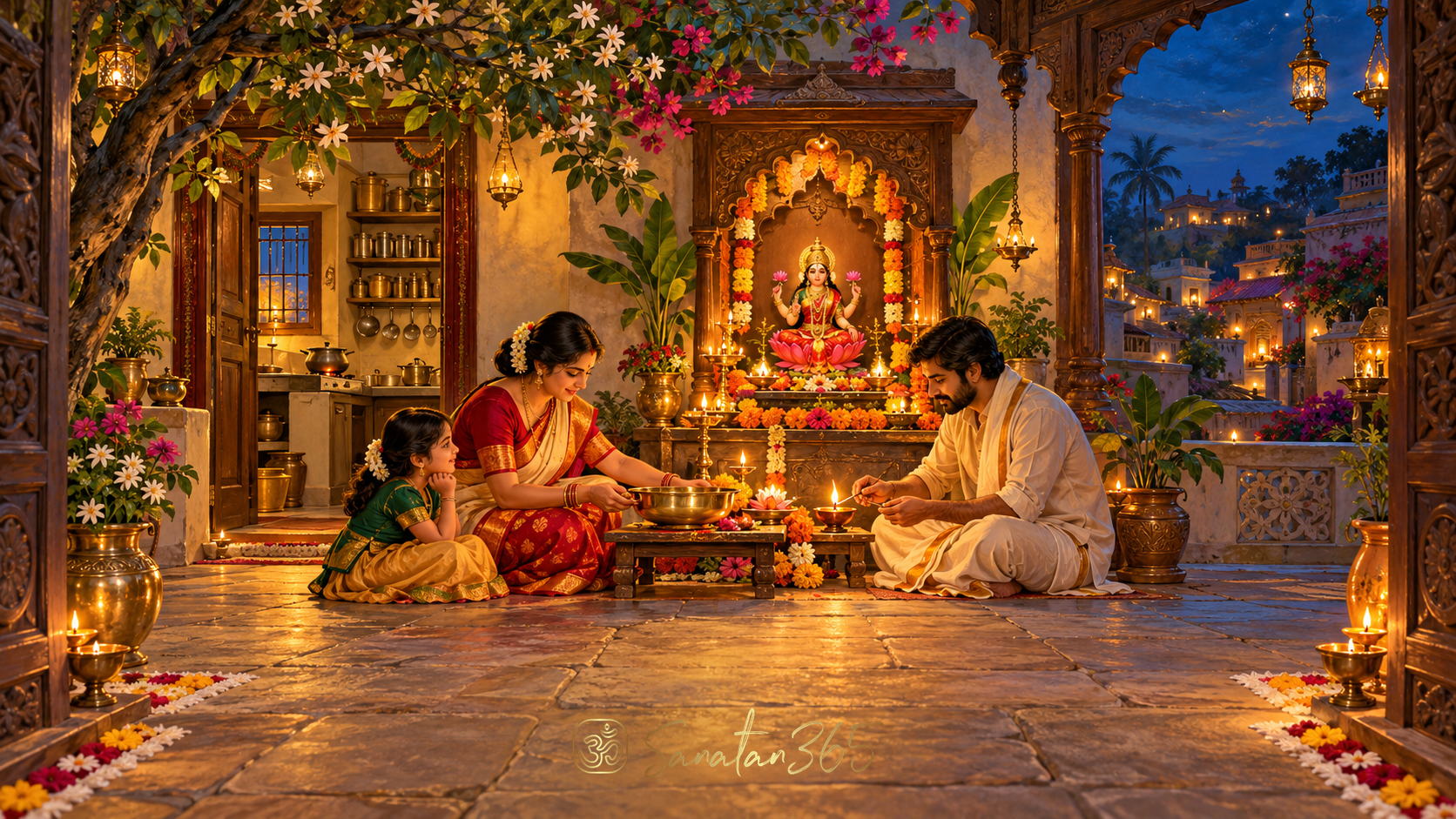
Dhanteras 2026: Date, Puja Timing, and Meaningful Home Preparation
Prepare for Dhanteras on 6 November 2026 with city-specific puja timing, a simple household plan, and an understanding of its devotional meaning beyond shopping.
A brass bowl can carry a family's gratitude. It does not need to carry a promise of sudden wealth.
Dhanteras 2026 falls on Friday, 6 November, in the New Delhi calendar. Also called Dhantrayodashi (धनत्रयोदशी), the observance joins dhana (धन, wealth or resources) with trayodashi (त्रयोदशी, the thirteenth lunar day). Many households worship Lakshmi and Kubera, prepare lamps, and mark the beginning of their Diwali observances. The practical starting point is simple: check the date and evening worship window for the family's actual city, prepare a modest place of worship, and let gratitude guide any purchases.
This is a guide to that particular evening, not a universal ritual prescription. Customs differ, and neither an expensive purchase nor a perfectly staged home measures the sincerity of devotion.
When is Dhanteras 2026, and which timing applies to your home?
For New Delhi, Drik Panchang's Dhanteras calendar gives 6 November 2026, with an evening puja window of 6:02 PM to 7:57 PM, local time. Puja (पूजा) means reverential worship. The page identifies the relevant Trayodashi lunar day as beginning at 10:30 AM on 6 November and ending at 10:47 AM on 7 November.
Those are three different pieces of information: the civil date of the observance, the span of the lunar day, and a recommended worship window. A lunar day can extend across two civil dates without making both evenings interchangeable. Reading only the ending date of Trayodashi can therefore create confusion.
The same source places its recommended puja during pradosha (प्रदोष), the period after sunset, in conjunction with Vrishabha lagna (वृषभ लग्न), the Taurus ascendant used in this traditional timing calculation. These terms explain the calendar's method; they do not establish a guarantee that a particular hour produces wealth.
A three-step local calendar check
- Select the city where the worship will take place. Delhi's times should not be copied to Mumbai, Bengaluru, London, or Toronto.
- Confirm the year and time zone. A forwarded screenshot may preserve last year's date or another city's clock.
- Follow one trusted local calendar or temple's guidance. If two recommendations differ, ask which regional practice and calculation each follows rather than combining unrelated windows.
For diaspora households, local sunset and the local calendar matter. There is no need to convert a Delhi clock reading mechanically and assume the resulting hour is the correct local observance. For the wider sequence of celebrations, consult the separate Diwali 2026 family calendar guide.
Key takeaway: Keep the verified date, the lunar-day span, and the local worship window distinct; use the city's own calendar for the final plan.
What does Dhantrayodashi honour beyond a shopping custom?
The name puts wealth into view, but wealth can be approached as something entrusted to a household rather than merely accumulated. Food, useful objects, skilled work, shared shelter, and the capacity to welcome another person all give resources a human purpose. This is a reflective reading of the occasion, not a claim that every family interprets it identically.
Drik Panchang describes Lakshmi and Kubera worship on Dhantrayodashi and notes the day's association with Dhanvantari. Lakshmi is revered through auspiciousness and prosperity; Kubera is associated with the guardianship of wealth. Their presence in the observance need not turn prayer into a contract for material returns. A request for blessing can sit beside honest work, responsible use, and generosity.
Dhanvantari's traditional association with Ayurveda (आयुर्वेद), the traditional Indian system of medicine, belongs to the day's wider devotional setting. That remembrance is not a promise of healing from worship or a substitute for medical care. This article focuses on household observance rather than treatments, health regimens, or predictions.
The distinction between holding resources and using them well is explored further in the article on Kubera and responsible guardianship. For Dhanteras itself, the useful question is more immediate: what would make this household's resources more thoughtfully cared for this week?
A family might repair a vessel already in use, clean the place where meals are shared, thank the person who prepares them, or set aside something useful to give. These are suggested contemporary reflections, not additional compulsory rites. They keep the festival connected with ordinary acts of care without pretending to replace inherited worship.
Key takeaway: Let the wish for prosperity include the quality of its use; devotion is not an invoice demanding a financial result.
How can a household prepare a simple evening puja?
Begin with the practice the family actually follows. A priest-led ceremony, a household prayer, and a brief observance in a small rented room need not have identical arrangements. The following is an adaptable preparation plan, not a claim to prescribe one scriptural procedure for everyone.
Before the evening
Choose a clean, stable surface for the family's image or murti (मूर्ति, sacred form) of the deity being worshipped. If Lakshmi and Kubera are part of the inherited observance, prepare that established focal point. Avoid building an elaborate display merely because a social-media photograph looks impressive.
Gather the items already used in the home: a lamp, flowers where appropriate, water, and a simple food offering if that is customary. The offering is often called naivedya (नैवेद्य), food presented reverentially to the Divine. What is suitable varies with household and temple traditions. Follow familiar guidance rather than assembling a supposedly universal shopping list.
Agree on a manageable time, especially when family members work late, children have school, or an elder needs rest. Preparing beforehand prevents the chosen evening window from becoming a race through shops and household chores. Make room for people to participate without requiring everyone to perform the same task.
During the observance
A simple sequence may include the following, adapted to family custom:
- Settle together and state a quiet intention of gratitude and responsible care.
- Light the lamp safely before the chosen sacred focal point.
- Offer the prepared flowers, water, or food according to the household's practice.
- Recite a familiar prayer, or listen respectfully while someone leads it.
- Close with thanks and share the offering in the customary way.
Aarti (आरती), the reverential offering of light, may form part of the closing worship. It is not necessary to invent a new mantra, pronunciation rule, or numerical promise for this article. A short prayer understood and offered attentively can be more useful than a long text copied without context.
Keep flames away from curtains, loose clothing, and crowded doorways; supervise children and never leave a burning lamp unattended. Where open flames are prohibited, respect the building's rules and ask a trusted religious guide about a suitable alternative. Safety is part of care for the people sharing the home.
After the prayer
Leave time for a meal or a conversation, not only a photograph. A child might ask why an ordinary bowl has been placed near the worship space; an elder might explain a family custom. These exchanges preserve the meaning of the evening more effectively than demanding identical performance from everyone.
A small closing action can make the intention concrete: store the worship items carefully, share food appropriately, or decide which useful task the household will complete tomorrow. Such actions are optional ways of carrying gratitude forward, not conditions for receiving divine favour.
Key takeaway: Prepare a clear focal point, familiar offerings, and enough unhurried time; simplicity does not make an observance less worthy.
How can purchases remain useful rather than compulsory?
Purchasing metal vessels or precious metals is a familiar Dhanteras custom in many communities. It is a custom with regional and family expressions, not evidence that every devotee must make the same purchase. A calendar's auspicious timing should not be turned into pressure to spend beyond one's means.
A useful distinction is between an object with a purpose and an object bought to quiet anxiety. A needed cooking vessel can enter daily life. A duplicate bought only because someone warns that not buying will bring misfortune may create strain without adding meaning. This is a question of household judgment, not investment advice or a prediction about metals and prices.
Before buying, a family can ask:
- Will this item be used, cared for, or passed on meaningfully?
- Is the cost comfortable within what the household has already set aside?
- Is the seller clear about the material, price, and conditions?
- Would repairing or cleaning something already owned serve the same practical need?
- Is everyone comfortable with the decision, without comparison or embarrassment?
These questions do not dismiss the pleasure of a festive purchase. They make room for pleasure without declaring consumption sacred by itself. A carefully chosen gift, a simple utensil, or no new purchase can each fit different circumstances. The article offers no rule that an amount spent determines a blessing received.
Children deserve special clarity here. “Some families buy a useful new object today” explains a custom. “We must buy gold or something bad will happen” teaches fear. The first leaves room for gratitude, family history, and differing means; the second can confuse devotion with financial pressure.
The same restraint applies online. Viral lists of supposedly forbidden colours, substances, or objects often circulate without a clear source or regional context. Before changing a familiar practice, ask where the claim comes from and whether a trusted guide actually teaches it. A forwarded instruction is not automatically an obligation.
Key takeaway: Let a purchase express usefulness and gratitude if it fits the household; do not make spending a test of devotion.
Which regional and family differences deserve respect?
Dhanteras is often described as the opening of five-day Diwali festivities, but the wider celebration is not experienced identically across India. Different communities give different weight to neighbouring days, deities, stories, and household customs. A North Indian description should not be presented as the only authentic pattern for every home.
Even the lunar month name can differ between calendar systems, while the relevant dark-fortnight lunar day remains the point of reference. That is another reason to use a city-specific calendar and family guidance rather than assume a difference in wording means someone is celebrating incorrectly.
Drik Panchang also notes Yama Deepam (यमदीपम्), the lamp observance associated with Yama, on the same Trayodashi. Whether and how a family observes it should follow its own guidance. The traditional devotional association should not be stated as a guaranteed prevention of death or harm. If a household places a lamp outside, a safe surface and supervision remain essential.
The most respectful family plan therefore allows both continuity and explanation. Ask what the household has traditionally done, what each action means to those doing it, and what needs adapting to the present home. An elder's remembered practice can be honoured without turning it into a command for every other family.
For someone joining the observance for the first time, a gentle invitation is sufficient: watch, ask, help arrange the space, or share the meal. No one needs to claim expertise to participate respectfully. Likewise, a person who cannot attend at the preferred time should not be frightened with predictions of loss or exclusion.
The evening's final measure is not the number of objects displayed. It is whether the home has made room for reverence, honest explanation, and care. A lamp can mark that intention; the next day's conduct gives it continuing substance.
Key takeaway: Keep local timing and inherited customs in context, welcome sincere participation, and never rank families by expenditure or ritual display.
FAQ
What is the date of Dhanteras 2026?
Drik Panchang lists Friday, 6 November 2026, for New Delhi. Confirm the observance and timings for the actual city, especially outside India. A lunar day crossing midnight does not by itself mean the following evening is equally appropriate.
What is the Dhanteras puja timing for New Delhi in 2026?
The cited calendar gives 6:02 PM to 7:57 PM on 6 November, local New Delhi time. Do not apply that window universally; select the local city and follow a trusted calendar or temple's guidance.
Is buying gold necessary on Dhanteras?
Buying gold or other useful objects is a custom in many households, not a measure of devotion. Avoid financial pressure or promises of guaranteed prosperity. A simple observance can centre on prayer and gratitude without an expensive purchase.
Can a family perform a simple Dhanteras puja at home?
Yes. Follow the household's established practice with a prepared sacred focal point, familiar offerings, attentive prayer, and safe lamp use. Ask a trusted priest or elder when a specific ritual detail is unfamiliar rather than combining unsourced instructions.
Is Dhanteras the same as the main Diwali Lakshmi Puja?
They are related observances, but not the same calendar event. Dhanteras falls on Trayodashi; the main Diwali Lakshmi Puja is associated with Amavasya (अमावस्या), the new-moon lunar day. Follow the separate local date and timing for each.
About the author
Sanatan365 Editorial
Bringing Sanatan Dharma to modern seekers through authentic, scripture-grounded content.
Related in Festivals
 Festivals
Govardhan Puja 2026: Date, Annakut, and a Thoughtful Offering
Prepare for Govardhan Puja on 10 November with a clear local calendar, an understanding of Annakut, and an offering shaped by gratitude rat…
 Festivals
Diwali 2026 Date: Planning a Thoughtful Family Celebration
Plan Diwali 2026 with the verified main date, regional calendar differences and a practical family preparation checklist.
 Festivals
Sharad Purnima 2026: Date, Moonlight Traditions, and Kojagara Puja
Sharad Purnima falls on 25 October 2026. Understand the two-date calendar question, moonlight and kheer customs, and regional Kojagara Laks…

