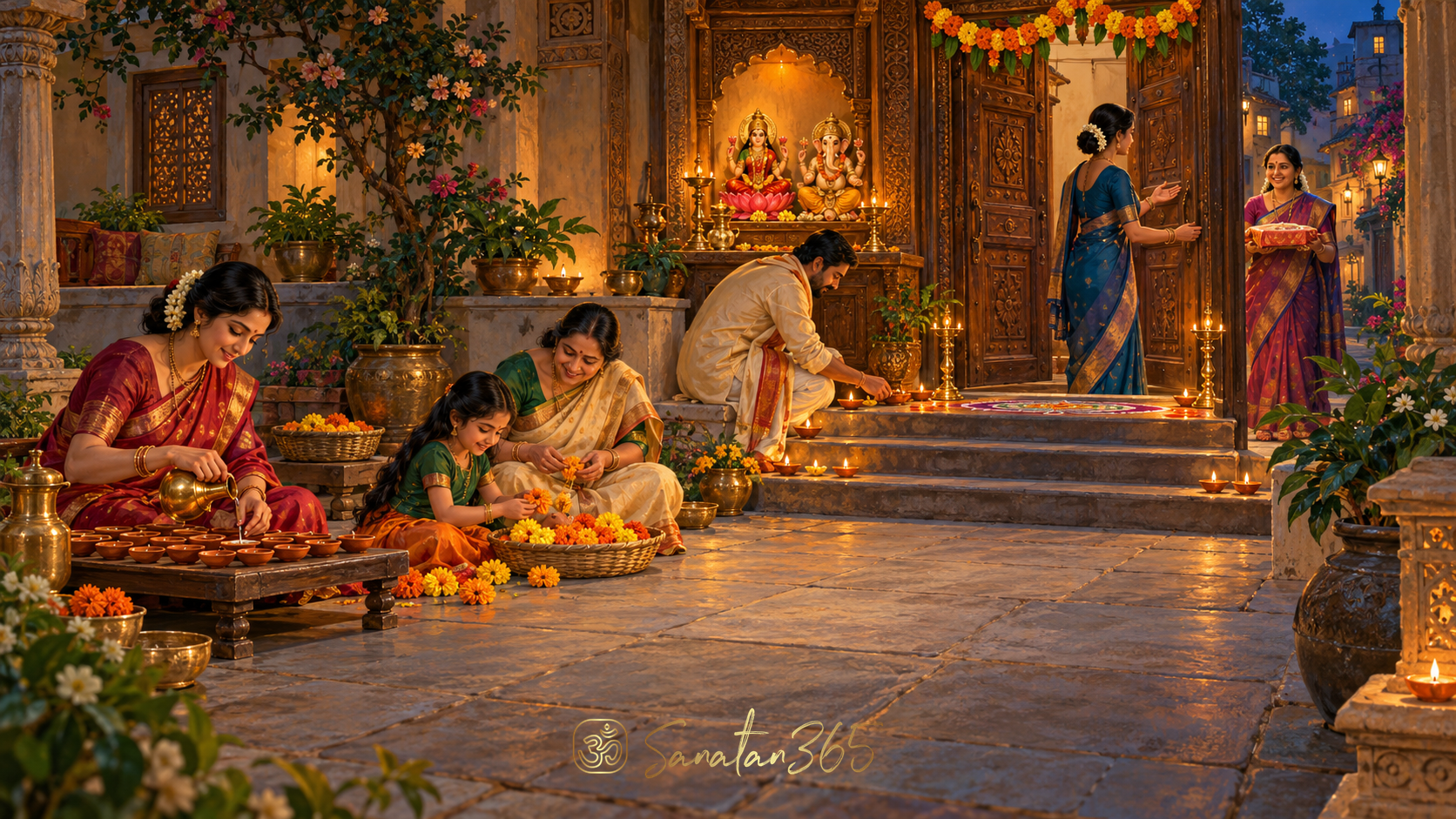
Diwali 2026 Date: Planning a Thoughtful Family Celebration
Plan Diwali 2026 with the verified main date, regional calendar differences and a practical family preparation checklist.
One festival can fill several calendar squares. That is the first useful thing to remember before planning Diwali.
The main Diwali 2026 date is Sunday, 8 November, when Lakshmi Puja is listed for New Delhi by Drik Panchang. Diwali, also called Deepavali (दीपावली, a row of lamps), includes observances whose sequence differs across regions and households. A sound preparation plan therefore begins with three decisions: confirm the date for the family's tradition, check worship timings for the actual city, and share the practical work before the celebration arrives.
This is an advance-planning guide, not a replacement for a household's inherited worship practice. Its purpose is to make room for devotion, welcome and attention without turning the days before Diwali into a competition in purchases or perfection.
What is the Diwali 2026 date?
For New Delhi, Drik Panchang places Lakshmi Puja on Sunday, 8 November 2026. Its evening worship window is 5:54–7:50 pm IST. These are a named city's timings, not a universal appointment for every household in India or abroad. The 2026 Lakshmi Puja calendar explicitly asks readers to select their city before recording a time.
Puja (पूजा, worship through reverent offerings) can be a familiar family ceremony or a simpler observance guided by someone knowledgeable in that tradition. The calendar helps locate the occasion; it does not measure the sincerity of the people gathered around the lamp.
The same New Delhi source gives Amavasya (अमावस्या, the new-moon lunar day) from 11:27 am on 8 November to 12:31 pm on 9 November. This explains why a lunar observance cannot always be understood by looking only at a midnight-to-midnight date. The relevant lunar day can cross two civil dates, while a particular rite is associated with a particular part of that interval.
A family planning message can therefore be precise without being complicated: “Our main evening celebration is on Sunday, 8 November; we will confirm our local worship window separately.” That is more useful than forwarding an unexplained screenshot with several times highlighted.
For a household in New Delhi, the example above supplies an initial reference. For a household in Mumbai, Chennai, London or Toronto, start with the correct location rather than copying it. A time-zone conversion alone is not a substitute for a location-specific calendar calculation.
Key takeaway: Mark 8 November for the main New Delhi Diwali observance, then confirm the date and timing appropriate to the actual place and tradition.
Why does the Diwali calendar extend beyond one evening?
The familiar description of a five-day festival is a helpful introduction, not a rule that every observance must occupy five consecutive, separate civil dates. Drik Panchang's 2026 Diwali Puja Calendar shows a wider sequence from 5 to 11 November for New Delhi, including observances associated with particular regional traditions.
Its calendar places Dhanteras on 6 November, Naraka Chaturdashi and the main Lakshmi Puja observance on 8 November, Govardhan Puja on 10 November, and Bhaiya Dooj on 11 November. These are calendar references for the selected location, not instructions that every household must observe each occasion in the same manner.
Dhanteras is associated with the festival's opening preparations and auspicious observances. Naraka Chaturdashi has particular importance in several Deepavali traditions, including Tamil observance. Govardhan Puja and Annakut, the offering of an abundance of food, carry their own devotional emphasis. Bhaiya Dooj centres a sibling relationship in the communities that observe it. Learning the names should clarify the family's practice, not add compulsory tasks to it.
The calendar's accompanying explanation notes that Maharashtra's festivities can begin earlier with Govatsa Dwadashi, while Gujarat has its own extended sequence. These differences are not errors that need to be flattened into one national household timetable. They are a reason to ask a better question: which observances belong to this family's living tradition?
A household bringing together relatives from different regions can make a short shared list. One person may value an early-morning Deepavali custom; another may be organising an evening Lakshmi worship. Recording both avoids treating one person's familiar practice as the only legitimate form.
There is no need to resolve every regional difference in a group chat. Identify the observance, the place and the source, then ask a trusted elder, priest or local temple where clarification is needed. Shared understanding is a better foundation than hurried correction.
Key takeaway: The festival's unity does not require identical calendars or identical household customs.
How should families check local Lakshmi Puja timing?
Begin with the full location, year and observance. A screenshot that omits any of these may be accurate somewhere and still be unsuitable for the family using it.
Three terms commonly appear in calendar explanations. A tithi (तिथि) is a lunar day, defined by the changing angular relationship of the Sun and Moon. A muhurta (मुहूर्त) is an auspicious time interval selected for a particular purpose. Pradosha (प्रदोष) is the period around evening after sunset discussed in this Lakshmi Puja calendar. These terms describe different things; they should not be read as interchangeable labels for one clock time.
Drik Panchang explains its evening Lakshmi Puja selection through the presence of Amavasya during the relevant evening period and its chosen astrological conditions. That is the source's traditional calculation method, not a promise of a financial result. Worship need not be presented as a transaction in which a perfectly timed action guarantees wealth.
A practical verification sequence is:
- Open the calendar for 2026 and select the actual city.
- Check that the page concerns Lakshmi Puja, rather than another observance in the Diwali sequence.
- Read the date beside the window, particularly when a time crosses midnight.
- Confirm any family-specific practice with a trusted local authority.
- Save one agreed reference and stop circulating competing unlabelled screenshots.
For diaspora families, the local community temple may also have an organised service schedule. That schedule can be useful for attendance, but distinguish it from a household's chosen worship window. A public service must accommodate people and practical arrangements as well as ritual considerations.
If work, travel or caregiving makes a preferred window difficult, seek appropriate guidance rather than making a fear-based decision. A family should not be told that a calendar difficulty makes its devotion worthless. The purpose here is careful preparation and informed observance, not anxiety about an irreversible mistake.
Key takeaway: A trustworthy timing note names the year, city, observance and date, and avoids guaranteed-outcome claims.
What can be prepared in the ten days before Diwali?
Preparation becomes gentler when it is divided into small decisions. The following is a suggested household plan, not a scriptural prescription or a checklist by which one family should judge another.
First, agree on the shape of the celebration
About a week or more beforehand, decide who will be present, which observances matter to the household and what the family can reasonably manage. Include travel and meal arrangements. A modest celebration planned together can be more welcoming than an elaborate one maintained by one exhausted person.
Set a spending limit before buying decorations or gifts. Reverence does not depend on replacing usable objects. Check the lamps, trays, cloths and decorations already available; repair or clean what can serve again. Make only then a short list of what is genuinely missing.
Share tasks explicitly. One person can check the calendar, another arrange food, another prepare the doorway, and another contact relatives who may not be able to attend. Children can help in age-appropriate ways without being given responsibility for open flames or hot vessels.
Then, prepare the space and materials
Clean in manageable sections rather than making the entire home an overnight project. Pay particular attention to the area where people will gather, the worship space and clear walking routes. Do not let decoration make the entrance difficult for an older relative, a wheelchair user or someone carrying a child.
For households that make rangoli, the sacred threshold patterns can be planned at a scale suited to the available space. The meaning of rangoli as an art of welcome offers a useful reminder: beauty can invite participation rather than demand technical perfection.
Choose food quantities around the actual gathering. Ask guests about dietary needs before preparing shared sweets or meals. A covered container and a clear ingredient note can be a more thoughtful gift than an oversized assortment that no one can comfortably use.
Finally, leave time that is not assigned
On the preceding day, confirm the agreed calendar reference, check practical arrangements and finish what can be done without rushing. Keep some time free before worship. Otherwise, the moment intended for gathered attention becomes another deadline between deliveries and photographs.
An optional final check is short:
- Is the gathering time clear to everyone?
- Are the worship materials appropriate to this household's practice?
- Is the lamp area stable and away from loose fabric?
- Is someone responsible for food and for helping guests?
- Is there room to participate without being photographed?
The strongest preparation plan leaves people able to be present. It does not fill every available minute.
Key takeaway: Share the work early, reuse thoughtfully and protect a little unhurried time around worship.
How can a household keep light, welcome and care at the centre?
The festival's lamps carry an immediately recognisable image: light made visible within ordinary life. A diya (दीया, an earthen lamp) is small enough to hold, yet a row of lamps can change the feeling of an entire threshold. Its symbolism need not become a claim that one evening removes every difficulty.
The practical care of a lamp belongs alongside its devotional meaning. Place open flames on stable, heat-resistant surfaces, away from curtains and loose clothing; keep them supervised and out of children's reach. Where flames are unsuitable, a non-flame light can provide decoration without being represented as a substitute for every tradition-specific ritual offering.
Welcome is equally concrete. Ask what would make an older relative comfortable. Invite a neighbour without assuming they share every practice. Make space for someone who wants to observe quietly. These gestures let the celebration's warmth extend beyond the best-lit corner of the room.
Lakshmi's association with prosperity can also prompt reflection on how resources are used. The article on Goddess Lakshmi's lotus, owl and coins explores that symbolic language in more detail. Here, a modest practical question is enough: does this celebration express care in how money, food, time and effort are shared?
Such reflection does not turn a festival into a moral examination. It simply reconnects preparation with its purpose. A purchase can be useful; an offering can be reverent; a gift can be generous. None requires comparison with a neighbour's expenditure or a promise that the household will receive a particular reward.
A family might close its planning conversation by choosing one quiet intention: to share work fairly, visit someone who cannot travel, avoid waste, or listen carefully during worship. That intention should be achievable and voluntary. It is a way of bringing the celebration into daily conduct, not adding another standard to fail.
Key takeaway: Thoughtful light, considerate welcome and responsible use of resources make preparation serve the celebration rather than overwhelm it.
FAQ
Is Diwali on 8 or 9 November in 2026?
Drik Panchang lists the main New Delhi Lakshmi Puja observance on Sunday, 8 November 2026. The lunar day continues into 9 November, and some associated observances appear on other dates. Check the actual city and named observance instead of treating every date in the sequence as the same event.
What is the Lakshmi Puja 2026 time for New Delhi?
The cited Drik Panchang page gives 5:54–7:50 pm IST on 8 November for New Delhi. This is a location-specific example. Other cities and traditions require their own checked reference; simply converting this window to another time zone is not sufficient.
Must every family celebrate all five days in the same way?
No single household plan represents all regional traditions. Follow the observances meaningful to the family, seek informed guidance where necessary and distinguish inherited practice from optional preparation suggestions. A shorter celebration need not be described as inferior.
What is the most useful first step in Diwali preparation?
Agree on the date, local reference and people involved before shopping. Then share the work, check what can be reused and choose a manageable gathering. The aim is not a perfect display but a home in which devotion and welcome have time to be felt.
About the author
Sanatan365 Editorial
Bringing Sanatan Dharma to modern seekers through authentic, scripture-grounded content.
Related in Festivals
 Festivals
Govardhan Puja 2026: Date, Annakut, and a Thoughtful Offering
Prepare for Govardhan Puja on 10 November with a clear local calendar, an understanding of Annakut, and an offering shaped by gratitude rat…
 Festivals
Dhanteras 2026: Date, Puja Timing, and Meaningful Home Preparation
Prepare for Dhanteras on 6 November 2026 with city-specific puja timing, a simple household plan, and an understanding of its devotional me…
 Festivals
Sharad Purnima 2026: Date, Moonlight Traditions, and Kojagara Puja
Sharad Purnima falls on 25 October 2026. Understand the two-date calendar question, moonlight and kheer customs, and regional Kojagara Laks…

