Kubera Meaning: Wealth, Guardianship, and Responsibility
Explore Kubera’s role as guardian of wealth and the north, his place among the yakshas, and what his imagery can teach about responsible abundance.
A treasury is not the same thing as a life well lived. Kubera’s image brings that distinction into view: wealth may be gathered, but it must also be held with care.
Kubera meaning in Hindu tradition centres on the deity of wealth, king of the yakshas (यक्ष, yakṣa, nature-associated divine beings), and guardian of the north. Also written Kuber or Kuvera, he is associated with treasures, earthly abundance, and divine custodianship. Understanding him involves more than asking for riches. His identity, sacred geography, and artistic attributes open a deeper question: what does it mean to be responsible for what has been entrusted to someone?
What Is the Kubera Meaning in Hindu Tradition?
Kubera (कुबेर, Kubera) is a divine name, not a Sanskrit word that can simply be translated as “get rich.” It is more accurate to explain his traditional roles than to assign the name an attractive but uncertain word-for-word meaning.
Britannica’s account of Kubera identifies him as the god of wealth and king of the yakshas, associated with the earth, mountains, minerals, jewels, and riches more broadly. It also describes his role as a treasurer for the gods. These associations place abundance in a larger sacred world rather than reducing it to personal purchasing power.
The distinction matters because a modern reader may hear “wealth” and think only of money in an account. Kubera’s associations include treasures within the earth. A jewel has a history before it becomes an ornament; a store of resources exists before an individual claims it. His imagery can therefore invite reflection on the sources of prosperity as well as its possession.
Who are the yakshas?
The yakshas belong to a varied field of South Asian sacred beings associated with nature, vitality, and abundance. They should not automatically be translated as either harmless fairies or evil demons. Such labels flatten a more complex tradition.
A Cleveland Museum of Art description of Kuvera explains the yakshas as nature divinities connected with the life-giving forces that produce abundance. The particular work it discusses is a drawing after a Buddhist sculpture from Bharhut, so it should not be presented as a universal Hindu ritual image. Its value here is narrower: it helps clarify the longstanding relationship between yaksha imagery and the natural foundations of wealth.
Kubera’s leadership among these beings makes his identity richer than that of a divine banker. Nature, treasure, protection, and kingship meet in the same figure. That combination gives the reader a way to approach his imagery without assuming that every detail is an instruction for obtaining money.
Key takeaway: Kubera is understood through his divine responsibilities, not through a promise that his name produces riches.
Why Is Kubera a Guardian Rather Than Wealth Itself?
Kubera is one of the dikpalas (दिक्पाल, dikpāla, guardians of the directions), with the north as his traditional direction. The related term lokapala (लोकपाल, lokapāla) means a guardian of the world. Britannica places this directional role alongside his association with treasure, rather than treating it as an unrelated detail.
A guardian has a place within an ordered whole. The north does not become the only direction that matters because Kubera protects it. Likewise, his association with wealth does not make material possession the only good worth pursuing. Sacred responsibility is distributed; a single power is understood through its relationship with others.
Traditional accounts locate Kubera’s splendid city, Alaka, in the Himalayan sacred landscape on or near Mount Kailash. This is sacred geography: the setting of a divine abode in religious narrative. It is not a claim that an ordinary visitor can locate a physical treasury by following a map or a compass.
What does a treasury imply?
A treasury holds something that must last beyond a passing impulse. Its contents may serve a household, a community, or a larger undertaking. This provides a useful modern reflection on Kubera, although it should be named as an interpretation rather than quoted as an ancient commandment.
Consider the difference between possessing a resource and caring for it. A person may own a useful tool but neglect it until it breaks. A community may receive a donation yet fail to account for its use. In each case, possession is real, but custodianship is weak. The language of guardianship asks what happens after something has been acquired.
Hindu reflection on the four goals of life offers a wider setting for this question. Material means have a place, but they are considered alongside ethical responsibility and other dimensions of human fulfilment. Kubera’s identity can be approached within that breadth without making him a symbol of either limitless consumption or rejection of all comfort.
A northern placement in traditional iconography is also not evidence that arranging a room in one direction will determine someone’s future income. Sacred associations deserve accurate explanation without being converted into guaranteed predictions.
Key takeaway: Kubera’s guardianship places wealth within responsibility and relationship, rather than making possession an end in itself.
How Do Artists Make Kubera Recognisable?
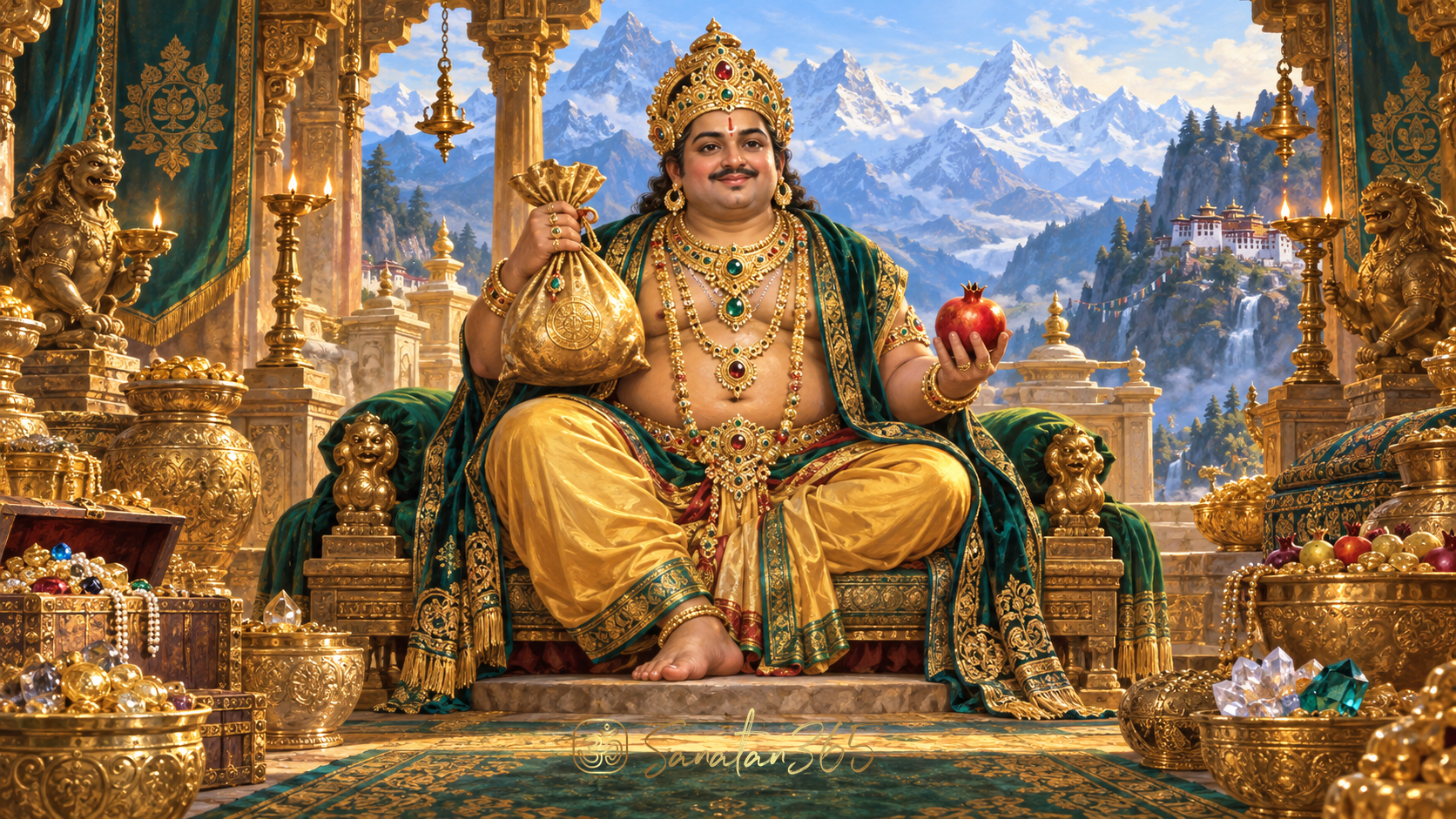
Kubera is often represented as a richly adorned, full-bodied figure. Britannica notes the money bag and pomegranate among his familiar attributes, while also recording variations in his physical portrayal. The safest approach is to read an individual image carefully instead of expecting every work to follow one checklist.
Jewellery and a money container identify abundance directly. They establish the deity’s sphere through objects the viewer can recognise. The pomegranate, when present, offers another visual association with plentifulness through its many seeds. That is a reasonable symbolic reading, not a rule requiring every fruit in every image to carry precisely the same meaning.
His substantial body should be described respectfully. Sacred art uses bodily forms to communicate presence, character, and power; a devotional figure is not an invitation to mock human appearance. Nor should a viewer assume that size alone tells the whole story of a deity’s identity.
Read the whole image
A useful sequence for looking at a Kubera image is:
- Check the identification. Read the temple description or museum label before relying on a single object.
- Notice the attributes. Look for a bag, vessel, fruit, ornaments, or other items actually present.
- Observe the setting. A directional guardian, a freestanding deity, and a narrative character may be presented differently.
- Keep regional context. Material, period, and local artistic tradition can change the composition.
- Distinguish observation from interpretation. “He holds a bag” is not the same kind of statement as “the bag teaches restraint.”
This discipline protects both reverence and accuracy. It prevents a modern illustration from being treated as a photograph of one universally fixed form. It also leaves room for the creativity through which artists have made divine qualities visible.
Names and related imagery appear in more than one South Asian religious tradition. A collection label may therefore place an object in a context different from the Hindu account being studied. Respecting that context does not require a comparison of spiritual paths. It simply means identifying the work honestly and avoiding the assumption that similar names make every image interchangeable.
A thoughtful reader can appreciate beauty while asking modest questions: what is visible, what does the source identify, and where does interpretation begin? Those questions make an encounter with sacred art more attentive, not less devotional.
Key takeaway: Kubera’s attributes suggest abundance, but the identification and context of each image matter more than a rigid visual formula.
How Are Kubera and Lakshmi Different?
Kubera and Goddess Lakshmi are both associated with prosperity, but they are not two names for the same deity. Kubera’s characteristic identity joins wealth, yaksha kingship, and northern guardianship. Lakshmi’s devotional imagery brings its own associations with auspiciousness, flourishing, beauty, and generous abundance.
A simple distinction is useful if it remains flexible: Kubera is frequently understood as a lord or custodian of treasure, while Lakshmi represents a broader field of auspicious prosperity. This is a guide to their commonly recognised roles, not a claim that every regional tradition divides them in exactly the same way.
The lotus, coins, and other symbols of Lakshmi deserve to be understood on their own terms. Reading both deities carefully expands the subject rather than turning devotion into a choice between competitors. Neither figure needs to be diminished for the other to be honoured.
Households may encounter the two names together in devotional practice, but that does not create one universal procedure. Local teachers, family customs, and established temple traditions can differ. A general article about meaning cannot responsibly replace those settings with a compulsory shopping list, a fixed ritual count, or a promised result.
The same care applies to contemporary phrases such as “wealth activation.” Such language can sound definite while leaving its claim unexamined. A prayer may express gratitude, aspiration, trust, or a request for support. None of those meanings requires an assurance that a specified amount of money will follow.
This allows the subject to remain spiritually substantial. Material stability matters to families, and a wish for enough is not something to ridicule. Yet a person’s wealth is not a reliable measure of devotion or moral worth. The absence of prosperity should never be used to accuse someone of praying incorrectly.
Key takeaway: Kubera and Lakshmi have distinct, respected identities; devotion to prosperity is not a competition or a guarantee of material outcomes.
What Can Guardianship Teach About Using Resources?
The image of a guardian offers a practical question: “What deserves care because it has been placed in these hands?” This is a contemporary ethical reflection inspired by Kubera’s role, not a secret technique, scriptural quotation, or financial strategy.
Resources include more than money. A shared workspace contains equipment. A home contains food, books, and objects received from earlier generations. A volunteer group depends on time and reliable records. Each can be treated as something to preserve and use well, rather than something that becomes valuable only when displayed.
Three ordinary forms of care
Account for what is held. Clear records can express respect for everyone who contributed. In a community setting, knowing where a resource went matters more than appearing generous in public. Responsibility becomes visible through accuracy and follow-through.
Repair before replacing automatically. An object that still serves a purpose deserves consideration before being discarded. This is not a command to keep everything forever. It is a pause that recognises labour, materials, and the difference between genuine need and momentary novelty.
Let useful things serve. A book that is never opened, equipment that is never maintained, or a promised contribution that is never delivered can remain technically possessed but practically unavailable. Guardianship asks whether a resource is doing the good for which it was kept.
The tradition of dana (दान, dāna, giving) adds another dimension. Hindu giving and its ethical meaning concern the quality and purpose of an offering, not merely its visibility. Sharing within one’s circumstances can coexist with care for dependants and existing responsibilities. Devotional reflection need not become pressure to spend beyond one’s means.
For a family conversation, the question can be kept concrete: which shared object needs attention this week, and who will look after it? For a community, the equivalent may be an honest update on the use of donated materials. Small acts make an abstract value observable.
There is room for beauty and enjoyment here. Guardianship does not require suspicion of every ornament, celebration, or comfortable home. It asks whether enjoyment remains connected with gratitude, proportion, and consideration for others. The contrast is not between having nothing and having everything. It is between careless possession and thoughtful use.
The single lasting lesson is this: abundance becomes more meaningful when care grows alongside it. Kubera’s image can hold that question before the viewer without being reduced to either a prosperity formula or an argument against material life.
Key takeaway: Treating resources as a responsibility gives sacred symbolism a practical expression in accuracy, maintenance, gratitude, and thoughtful sharing.
FAQ
Who is Kubera in Hindu tradition?
Kubera is the deity of wealth, king of the yakshas, and guardian of the north. He is associated with treasures and earthly abundance, and is often described as a treasurer for the gods.
What is the difference between Kubera, Kuber, and Kuvera?
These are forms of the same divine name encountered in different transliterations and language contexts. The spelling alone does not indicate a different deity. The surrounding tradition and image description remain useful guides.
Why does Kubera hold a money bag or fruit?
Such attributes help identify his association with wealth and abundance. Images vary, and not every portrayal includes the same objects. A museum or temple description should guide the reading of a particular work.
Is Kubera the same as Goddess Lakshmi?
No. Both are associated with prosperity, but they have distinct divine identities and imagery. Kubera’s wealth, yaksha kingship, and northern guardianship differ from Lakshmi’s characteristic associations with auspicious flourishing.
Does worshipping Kubera guarantee wealth?
No guaranteed material outcome can responsibly be promised. Devotion can express gratitude and aspiration while encouraging reflection on responsible conduct. It does not remove uncertainty, replace practical responsibility, or determine a person’s worth.
About the author
Sanatan365 Editorial
Bringing Sanatan Dharma to modern seekers through authentic, scripture-grounded content.
Related in Deities
 Deities
Savitr Deva Meaning: Golden Hands and the Rhythm of Life
Meet Savitr, the Vedic divine impeller whose golden hands set life in motion and whose hymns honour rest as well as activity.
 Deities
Indra Deva Meaning: The Vajra, Rain, and Responsible Power
Indra links the thunderbolt and released waters with a demanding question: what is strength for? Read his Vedic imagery and later lessons w…
 Deities
Agni Deva Meaning: Sacred Fire and the Divine Messenger
Meet Agni as the Vedic priest and messenger, read the first Rig Veda hymn, and understand sacred fire without reducing a living deity to a…

