Govardhan Puja 2026: Date, Annakut, and a Thoughtful Offering
Prepare for Govardhan Puja on 10 November with a clear local calendar, an understanding of Annakut, and an offering shaped by gratitude rather than comparison.
A festival offering begins before the first dish reaches its place. It begins with deciding what the household can prepare, whom the meal will nourish, and what the act is meant to remember.
Govardhan Puja 2026 falls on Tuesday, 10 November, in the New Delhi calendar. Pūjā (पूजा, reverential worship) honours the sacred through attentive offering. At this festival, Annakūṭa (अन्नकूट, “mountain of food”), commonly called Annakut, gives gratitude a visible form. A thoughtful preparation starts with the correct local date and a manageable offering, rather than assuming that every family must reproduce a large temple display.
With a week to prepare, there is room to understand the occasion, agree on responsibilities, and leave space for worship itself.
When is Govardhan Puja 2026, and which timings apply?
Drik Panchang's New Delhi listing gives 10 November 2026, with a morning worship window of 6:40–8:50 a.m. IST. The relevant tithi (तिथि, lunar day) is Pratipadā (प्रतिपदा, the first lunar day). It begins at 12:31 p.m. on 9 November and ends at 2:00 p.m. on 10 November in that listing.
These are New Delhi details. A household elsewhere should check its own city and the guidance of the community whose practice it follows. For diaspora families, an Indian timetable copied into a different time zone is especially easy to misunderstand. A calendar is most useful when its location travels with its numbers.
Start with a complete calendar entry
Write down the festival name, date, city and source together. If a family is attending a community celebration, add the organizer's actual programme time separately. An event's opening hours and a calendar's worship window answer different questions; neither should be silently substituted for the other.
Avoid relying only on a remembered phrase such as “the day after Diwali.” The festival's placement follows the lunar calendar, and a convenient summary does not replace the current local listing. The family's broader Diwali preparation plan can hold the surrounding dates, while the Govardhan entry keeps this occasion clear.
This is also a good moment to settle travel, work and school arrangements. Knowing who will be present makes the rest of the preparation more realistic. A smaller gathering with attention is easier to organize than an imagined full household that never quite becomes available.
Key takeaway: Save the date with its city and source, then distinguish worship guidance from the timing of a particular community event.
What does Annakut remember about food and shelter?
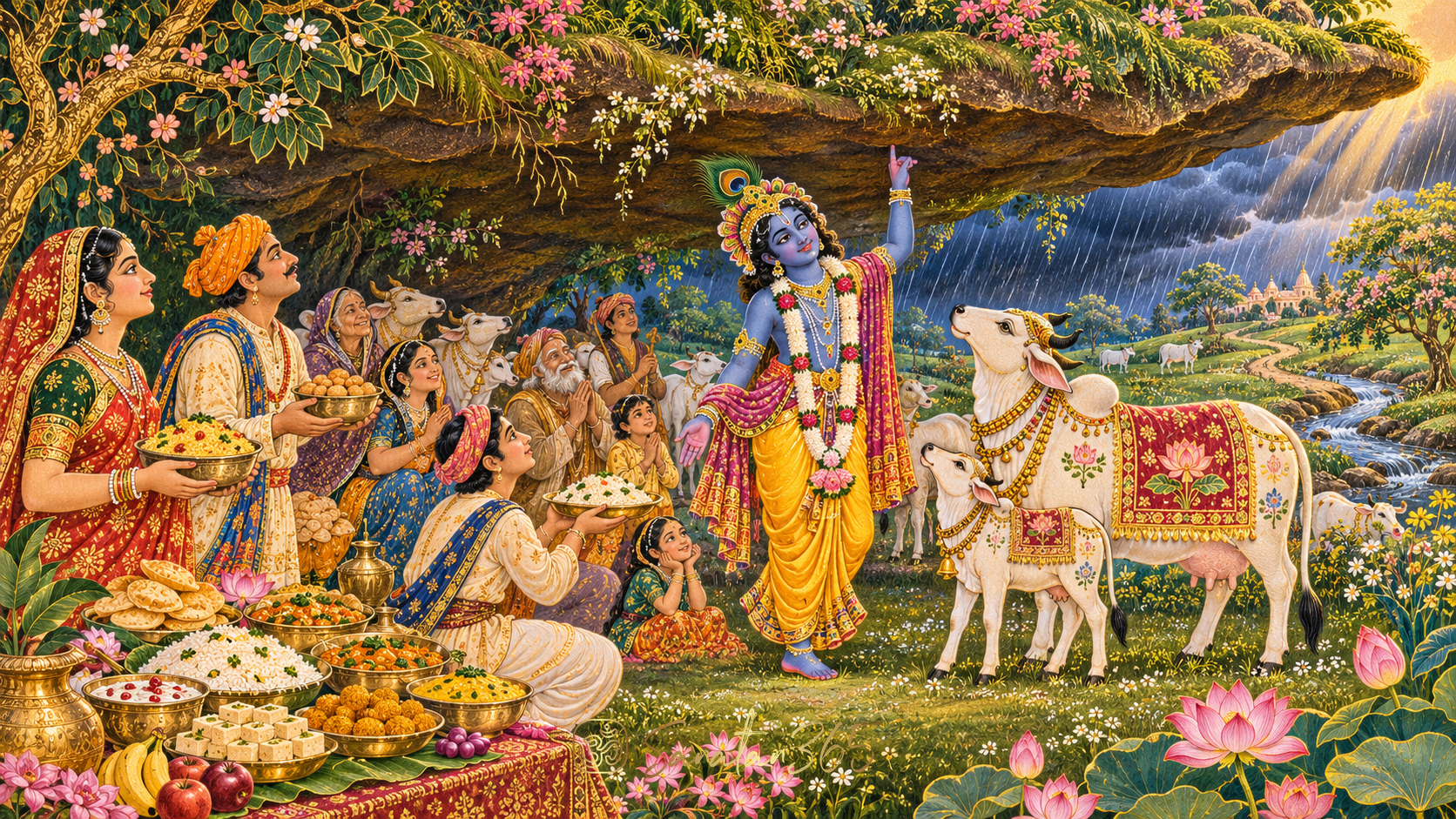
The BAPS account of Annakut describes food offered in gratitude and recalls Krishna lifting Govardhan to shelter villagers from rain. The same account places Annakut within its New Year celebration. These are devotional associations, not a claim that every Hindu community observes an identical New Year or follows the same festival programme.
The sheltering hill offers a powerful image for reflection. Food reaches a household through relationships that can become almost invisible: cultivation, water, transport, cooking, care and the work of people whose names the eater may never know. An offering can interrupt the habit of treating all of that nourishment as an isolated personal possession.
This reflection does not require assigning a modern policy message to every detail of a sacred narrative. It asks a more immediate question: what sustains this meal, and how can the household acknowledge it? A family may find that the answer includes both prayer and ordinary courtesy toward those doing the work.
Let abundance mean more than a photograph
An arrangement of many dishes can be beautiful. Beauty can invite attention, express affection and draw a community into shared preparation. The difficulty begins when the photograph becomes the measure of the worship and the people making it disappear behind the result.
For a household, meaningful abundance might include enough time to sit together, enough food to share, and enough consideration that one person is not exhausted while everyone else celebrates. These are practical ways of approaching the occasion, not a new ritual rule or a ranking of families by how they observe it.
The scale of a temple celebration need not become a private test. A large institution may coordinate many volunteers, kitchens and visitors. A family has different capacities. Learning from the spirit of an offering does not require reproducing its size.
Key takeaway: Let the offering make relationships visible: the sacred remembrance, the people preparing the meal, and those who will receive it.
How can a household plan its offering without competition?
Begin with what the family already knows how to offer within its tradition. Questions about prescribed ingredients, ritual sequence or a particular vow belong with the appropriate priest, teacher or experienced family guide. The following is a preparation framework for organizing the work; it is not a universal worship procedure.
Choose a scope before choosing more dishes
Agree on a manageable menu, the number of people expected, and who will prepare each part. A familiar dish made carefully is often easier to coordinate than several unfamiliar preparations attempted for the first time on a crowded morning. There is no need to turn the day into an examination of culinary skill.
If a family custom includes a particular number of offerings, clarify what that means with someone who actually knows the custom. Do not infer from a large display seen online that every household is obliged to meet the same count. This article does not prescribe a required number or authorize changing a formal commitment without guidance.
Keep a short written list. Alongside ingredients, include the less visible necessities: clean serving utensils, suitable containers, space for the arrangement, and someone to help restore the kitchen afterward. These details protect the time that would otherwise be spent searching for things while everyone is waiting.
Remember the movement from offering to receiving
Food presented to the Divine is often discussed as naivedya (नैवेद्य, food offered in worship); received afterward, it is prasāda (प्रसाद, grace or a gracious gift), commonly called prasad. The distinction between offering and receiving deserves attention, without turning this festival guide into a replacement for a family's own practice.
A useful household question is therefore not only “What will be arranged?” but “What happens after the offering?” Plan who will serve, where people can sit, and how food will be shared. If guests are coming, communicate the meal arrangements clearly rather than expecting them to guess.
Children can help with tasks suited to their age and ability: making a list, placing clean non-breakable items, welcoming relatives, or thanking the people who cooked. Participation need not mean standing near heat or handling a crowded serving area. The purpose is inclusion in the care surrounding worship.
Key takeaway: Choose a realistic scope, make responsibilities visible, and plan the receiving and sharing as carefully as the display.
What changes between a home offering and a community celebration?
A home and a community venue share the possibility of reverent attention, but they organize it differently. A household can adjust its pace through direct conversation. A public gathering needs instructions that strangers can understand and volunteers can carry out consistently.
BAPS describes devotees preparing vegetarian offerings and attending the first ārati (आरती, worship with offered light) of its New Year celebration. That is a named community's account. A visitor should still consult the actual local organizer for the programme, participation rules and arrangements, rather than treating a general cultural description as an event ticket or timetable.
Ask before bringing food to a shared event
An offer of help becomes more helpful when it fits the receiving community's plan. Before preparing something for a public offering, ask whether contributions are being accepted, what the local requirements are, and when delivery is useful. A well-meant surprise can create extra work if a kitchen is already organized around a different arrangement.
For those volunteering, agree on a specific task and a realistic period of availability. Setting up, guiding visitors, serving and cleaning are different forms of work. Clear handovers allow the gathering to continue without leaving one person responsible for everything once the visible celebration has ended.
For visitors, patient attention can be part of participation. Follow the venue's directions, keep passageways clear, and ask before photographing the offering or the people around it. A photograph may be permitted and welcome; permission should come from the actual setting rather than an assumption made elsewhere.
Leave room for different circumstances
Some families will attend a large celebration. Others may offer worship quietly at home or arrange a brief observance around work, travel or care responsibilities. The practical question is how to prepare honestly within those circumstances while respecting the tradition being followed.
Avoid making another household's scale the subject of comparison. Someone else's offering does not reveal the whole of their means, obligations or devotional life. The festival can bring people into relationship without making every arrangement look the same.
Key takeaway: A shared celebration works through coordination; a household observance works through a scope its members can sustain.
How can gratitude continue after the festival meal?
The clearest preparation is often the kind that anticipates the end. Decide who will help clear the space, how shared utensils will be returned, and how usable food will be handled responsibly. Avoid preparing excess simply to make the arrangement look larger. If food is being distributed through an organization, follow its actual arrangements rather than improvising a public donation without checking what it can receive.
These suggestions concern considerate organization, not a promise that a particular menu guarantees prosperity or that a larger offering earns greater favour. A devotional act loses something when it is treated as a transaction whose result can be purchased through quantity.
Thank the people behind the occasion
After a gathering, appreciation can be specific. Thank the person who shopped, the relative who arrived early, the volunteer who served, and the people who remained to clean. A general statement about gratitude becomes more convincing when it reaches someone who actually did the work.
A family can invite each member to name one contribution they noticed. This is not a test requiring a correct religious answer. It is a way to see the occasion more fully. A child may remember a grandparent's patient explanation; an adult may notice that someone quietly took over a tiring task.
The meaning of prasad in worship also invites reflection on how a gift is received. Care does not end at the moment an offering is completed. The way it is served, shared and acknowledged belongs to the same field of attention.
Make one manageable commitment
Rather than promising a transformed household overnight, choose one action that can continue: thank a regular cook, share meal preparation more fairly, or keep a better count before buying for the next gathering. The action should fit the people involved and be agreed upon, not imposed as a new standard by the most enthusiastic person.
Govardhan's sheltering image can remain a gentle reminder of interdependence. A household does not stand alone, and neither does a meal. Preparing with care, offering with attention and receiving without comparison allow that reminder to take a practical form.
Key takeaway: Let the festival's gratitude continue in ordinary acts of consideration after the arrangement has been cleared.
FAQ
What is the Govardhan Puja 2026 date?
Drik Panchang lists Tuesday, 10 November 2026, for New Delhi. Its morning worship window is 6:40–8:50 a.m. IST. Check the calendar for the city where the observance will take place and confirm any community programme separately.
What does Annakut mean?
Annakut means “mountain of food.” It names an abundant devotional food offering. In preparing a household observance, the meaning is better understood through gratitude and attention than through an unsupported assumption that every home must reproduce a temple's scale.
Does every family need to prepare fifty-six dishes?
This guide sets no required food count. If a household follows a specific inherited practice or formal commitment, clarify it with a knowledgeable guide. A number encountered in a photograph or an online list should not be turned automatically into an obligation for everyone.
Can the New Delhi timings be used outside India?
They should not be copied as universal timings. Location, local calendar guidance and the actual organizer's programme all matter. Save the city with the calendar entry so that a timetable is not separated from the place to which it applies.
About the author
Sanatan365 Editorial
Bringing Sanatan Dharma to modern seekers through authentic, scripture-grounded content.
Related in Festivals
 Festivals
Dhanteras 2026: Date, Puja Timing, and Meaningful Home Preparation
Prepare for Dhanteras on 6 November 2026 with city-specific puja timing, a simple household plan, and an understanding of its devotional me…
 Festivals
Diwali 2026 Date: Planning a Thoughtful Family Celebration
Plan Diwali 2026 with the verified main date, regional calendar differences and a practical family preparation checklist.
 Festivals
Sharad Purnima 2026: Date, Moonlight Traditions, and Kojagara Puja
Sharad Purnima falls on 25 October 2026. Understand the two-date calendar question, moonlight and kheer customs, and regional Kojagara Laks…

