Dhanvantari Meaning: Ayurveda, Amrita, and the Ethics of Healing
Lord Dhanvantari is revered as the divine physician and a source of Ayurvedic wisdom. His appearance with amrita links healing with disciplined knowledge, service, balance, and reverence for life rather than guaranteed cures.
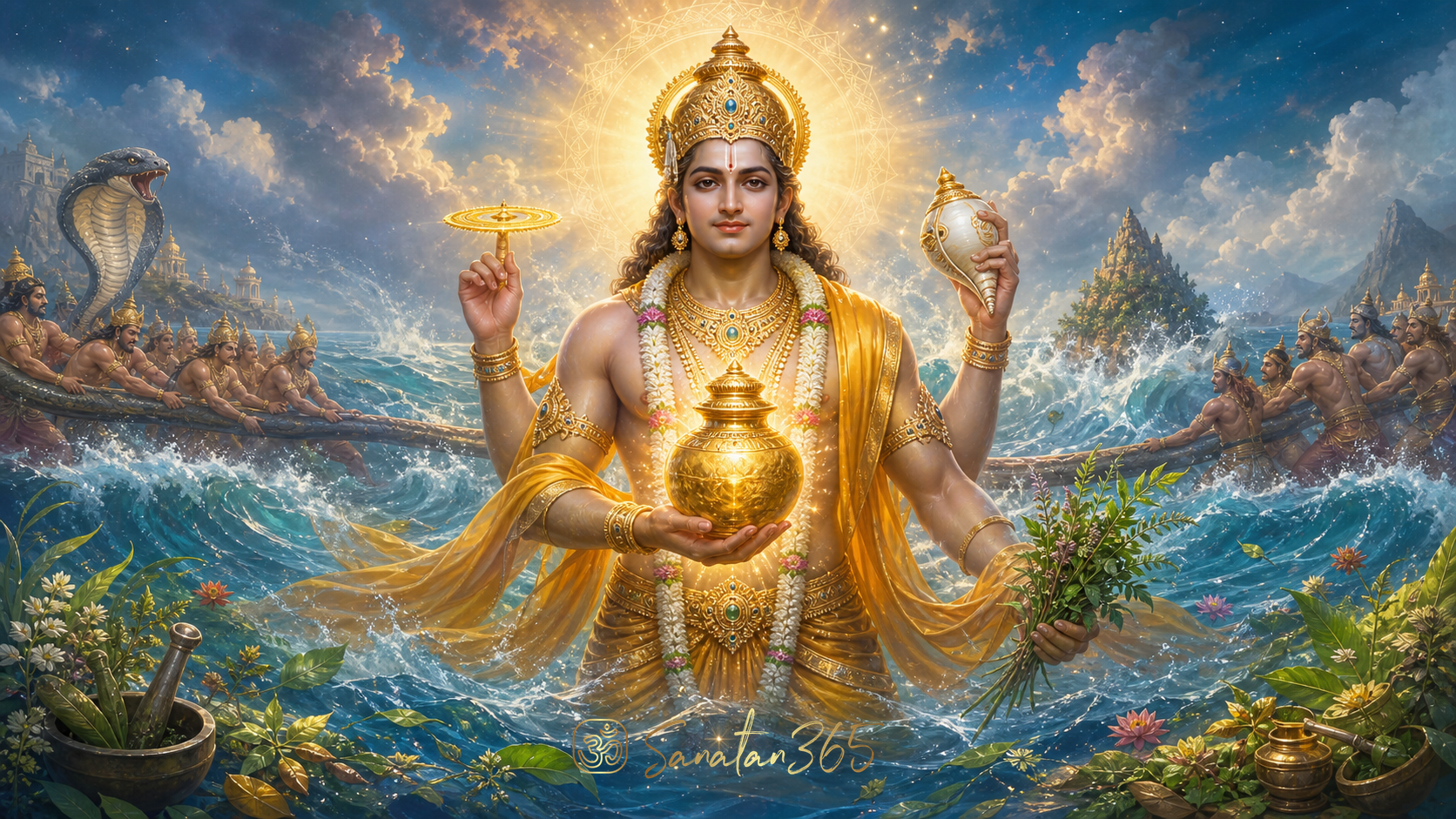
A divine physician steps from the churning cosmic ocean carrying not a weapon of conquest, but a vessel associated with life and renewal.
Dhanvantari meaning begins with this image. Lord Dhanvantari is revered in Hindu tradition as the divine physician and as a source of Ayurveda, the classical Indian knowledge system concerned with life, health, balance, and care. In the Bhagavata Purana, he appears during the Samudra Manthana carrying amrita (अमृत, amṛta, the nectar of immortality). His story does not promise that devotion will remove every illness. It presents healing as sacred work requiring knowledge, discipline, compassion, and wise limits.
This distinction matters. Dhanvantari can inspire reverence for the body and gratitude for those who care for it, while qualified medical guidance remains essential whenever someone is ill, injured, or in distress.
What Does Dhanvantari Meaning Reveal in Hindu Tradition?
The name Dhanvantari is inseparable from the Hindu understanding that sustaining life is a form of sacred responsibility. He is widely honoured as deva vaidya (देव वैद्य, deva vaidya, physician of the devas) and is associated with Lord Vishnu, the preserver. The Bhagavata Purana describes him as appearing from the ocean with a broad chest, yellow garments, ornaments, and a vessel filled with amrita; the next verse identifies him with Vishnu and with medical knowledge (Bhagavata Purana 8.8.32–34).
This scriptural setting gives Dhanvantari's role a larger horizon. Healing is not merely the removal of an unpleasant symptom. It belongs to preservation: protecting life, restoring the conditions in which duty can be performed, and helping a person participate in family and community with steadiness.
Ayurveda (आयुर्वेद, āyurveda, “knowledge of life”) likewise addresses more than a single remedy. Its classical traditions consider food, routine, environment, constitution, season, conduct, and treatment within an integrated account of well-being. Modern institutions such as the All India Institute of Ayurveda combine education, clinical care, and research, showing that a living medical tradition also depends on training, standards, evaluation, and accountability.
Dhanvantari therefore represents several linked ideals:
- Knowledge should serve life.
- Care should be guided by discernment, not fear.
- A healer carries responsibility as well as skill.
- Prevention, treatment, recovery, and compassion all matter.
- Reverence for tradition must coexist with honesty about evidence and limits.
He is worshipped across regions, particularly among Ayurveda practitioners and on Dhanteras, yet the devotional meaning is broader than professional identity. Every household that cares for a sick family member, every practitioner who studies carefully, and every patient who seeks help without shame participates in an ethic of preserving life.
Key takeaway: Dhanvantari represents healing knowledge placed in the service of life, not a guarantee that illness will never occur.
Why Does Dhanvantari Appear with Amrita?
The setting is the Samudra Manthana, the churning of the cosmic ocean. Devas and asuras cooperate in an immense effort to obtain amrita. Before the nectar appears, the churning releases both treasures and danger. The story's sequence is important: what preserves life is not obtained without labour, instability, difficult consequences, and the need for moral discernment.
In the Bhagavata Purana, Dhanvantari emerges holding the amrita kalasha (अमृत कलश, amṛta kalaśa, vessel of nectar). The symbol is sometimes reduced to a simple equation: nectar equals a cure for death. Hindu narrative is more demanding. The appearance of amrita immediately creates a crisis over who will possess and distribute it. Power without right judgment can intensify conflict rather than end it.
The vessel can therefore be read through four connected meanings.
Life is precious
The nectar expresses the desire to preserve life. That desire is not treated as trivial. Hunger for health, time, and continued relationship is deeply human. Dhanvantari holds this longing with dignity.
Healing requires a suitable container
Amrita does not appear as an uncontrolled flood. It is held in a kalasha (कलश, kalaśa, sacred vessel). A vessel suggests measure, containment, preparation, and responsible handling. In practical care, good intention also needs a container: proper training, correct dosage, hygienic practice, informed consent, reliable follow-up, and referral when a case exceeds one's competence.
Knowledge must be distributed ethically
The struggle over amrita asks who should control life-giving power and under what conditions. Modern readers need not force the story into a literal medical rule to recognize the ethical question. Medicines, expertise, time, and healthcare access are powerful resources. Their distribution reveals the values of a society.
Immortality is not a marketing claim
Amrita belongs to sacred narrative and symbolism. It should never be used to promise that a herb, ritual, mantra, supplement, or commercial treatment will make someone invulnerable. Dhanvantari devotion is diminished, not strengthened, when his vessel becomes an excuse for medical exaggeration.
The cosmic-ocean story also places Dhanvantari beside other Vishnu-related themes of preservation and restored order. Readers interested in that pattern can explore Varaha's rescue of the Earth, where protection again requires decisive, embodied care.
Key takeaway: The amrita vessel honours life's preciousness while reminding us that healing power needs disciplined, ethical stewardship.
How Is Dhanvantari Connected with Ayurveda?
Dhanvantari is not simply a later decorative emblem placed on Ayurveda. He stands within multiple layers of Hindu and medical memory. Puranic tradition presents his cosmic emergence. The Sushruta Samhita, a foundational Sanskrit medical compendium especially associated with surgery, places its teaching within a lineage connected with Divodasa of Kashi, identified in tradition with Dhanvantari. A modern historical overview in the medical literature describes the text as belonging to the Dhanvantari tradition while also recognizing the complexity of its transmission (PMC review of the Sushruta tradition).
These layers should be handled carefully. Sacred lineage expresses the authority, responsibility, and continuity of healing knowledge. Historical scholarship asks different questions about manuscripts, dates, authors, redaction, and institutional development. Respect does not require collapsing those two modes into one simplistic biography.
What does the Dhanvantari connection contribute to Ayurveda today?
It makes study a moral discipline
If healing knowledge is sacred, careless practice is not merely a technical error. It is a failure of responsibility. Students must learn accurately, practitioners must stay within their competence, and institutions must protect patients through standards.
It joins prevention and treatment
Ayurveda's name places āyus (आयुस्, āyus, life or lifespan) at the centre. Traditions of daily routine, seasonal adaptation, diet, rest, and conduct sit beside diagnosis and therapy. Dhanvantari can thus symbolize attentive maintenance as well as intervention during illness.
It honours the healer-patient relationship
Clinical knowledge is applied to a particular person, not an abstract condition. Listening, observation, clarity, and trust matter. Compassion alone cannot replace competence, but competence without humane attention is incomplete.
It encourages responsible integration
Many people today use more than one system of care. Responsible integration requires that every practitioner knows when collaboration or referral is necessary. Emergency symptoms, serious infection, injury, pregnancy complications, severe mental distress, and worsening chronic illness require timely qualified care. Devotion, dietary practice, yoga, or Ayurveda may support a person's spiritual and health routine, but they should not be used to delay urgent assessment.
This balanced view protects both patients and tradition. It avoids two errors: dismissing a long intellectual heritage as superstition, or treating every traditional claim as automatically proven in every modern clinical context. The Ministry of Ayush's work in education and research, including preservation of classical manuscripts, shows why living traditions need both continuity and critical study (Ministry of Ayush).
Key takeaway: Dhanvantari's link with Ayurveda calls for rigorous learning, compassionate care, appropriate referral, and honesty about what is known.
What Do Dhanvantari's Four Hands and Symbols Mean?
Sacred images communicate through attributes. Dhanvantari is commonly depicted with four arms, though forms vary across temples, regions, manuscripts, and modern art. The most consistent attribute is the vessel of amrita. Other depictions may include a shankha (शङ्ख, śaṅkha, conch), chakra (चक्र, cakra, discus), medicinal herbs, a scripture, or a leech associated with a historical therapeutic practice.
Variation should not be mistaken for error. Hindu iconography often preserves a stable identity while allowing regional and theological emphasis. The symbols can be understood without pretending that every image uses the same fixed arrangement.
The amrita kalasha: life held with care
The vessel is both promise and responsibility. It evokes restoration and longevity, yet its closed form implies that valuable knowledge must be handled with measure.
The conch: the call to awakened attention
The conch is closely associated with Vishnu. Its sound marks sacred beginning and summons attention. In a healing context, it can suggest the first act of care: noticing what is happening rather than denying it.
The discus: clarity that cuts through disorder
The chakra is another Vishnu attribute. It can signify protection, order, and discerning intelligence. Healing often requires this clarity: distinguishing symptom from cause, helpful measure from harmful excess, and qualified advice from persuasive misinformation.
Herbs or a medical text: knowledge of substances and methods
Medicinal plants point toward pharmacological knowledge, ecology, cultivation, and careful preparation. A book signifies transmission through study. Neither symbol licenses casual self-prescription. A plant can be potent, interact with medicines, or be unsuitable for a particular person.
The leech: historical specificity rather than embarrassment
Some images show a leech, reflecting the place of leech therapy in classical surgical practice. The attribute reminds viewers that medicine develops through concrete methods, observation, and technical lineages. It should be understood historically and clinically, not copied without trained supervision.
Together, these attributes make Dhanvantari visually distinctive. He is not portrayed as an abstract wish for wellness. He holds instruments of preservation, knowledge, discernment, and practical care.
Key takeaway: Dhanvantari's symbols portray healing as an ordered discipline of attention, knowledge, protection, and measured action.
How Can Devotees Honour Dhanvantari Responsibly?
Dhanvantari devotion can be simple. No single regional custom needs to be imposed on every family. A person may offer a clean lamp, water, flowers, or a quiet prayer before his image, according to household and lineage practice. The value lies in reverence joined with responsible conduct.
A thoughtful observance might include five steps:
- Begin with gratitude. Remember the people and systems that protect life: family caregivers, nurses, physicians, therapists, pharmacists, researchers, sanitation workers, and emergency responders.
- Set a truthful intention. Pray for clarity, courage, relief, skilled care, and the strength to follow good advice rather than demanding a guaranteed outcome.
- Offer light or water. A lamp can represent clear attention; water can represent life and careful replenishment. If an offering becomes prasad, receive it with the same reverence described in the meaning of prasad.
- Take one responsible health action. Keep an appointment, organize medicines safely, ask a qualified professional a question, support a caregiver, rest appropriately, or learn basic first aid.
- Close with service. Donate blood if medically eligible, help someone reach care, reduce stigma around seeking help, or contribute to a trustworthy health cause.
Some devotees recite Dhanvantari mantras. Pronunciation and form may vary, so a practitioner should follow a trusted teacher or family tradition rather than treating a mantra as a commercial formula. Recitation can steady attention and express devotion. It is not a substitute for diagnosis, emergency response, prescribed treatment, or mental-health support.
The same principle applies to Dhanteras and Ayurveda Day observances. Buying an object is not the heart of Dhanvantari's message. A more faithful remembrance asks whether knowledge is being used responsibly, whether caregivers are supported, whether treatment is accessible, and whether claims about healing are truthful.
For someone currently facing illness, devotion may offer meaning, courage, companionship, and a language for hope. Those are real human needs. Yet hope becomes safer when paired with professional care and trusted loved ones. Anyone with alarming symptoms or a medical emergency should contact local emergency services or a qualified clinician promptly.
Key takeaway: The most responsible Dhanvantari devotion joins prayer with truthful claims, qualified care, practical follow-through, and service to others.
Dhanvantari Meaning for Modern Life
Dhanvantari's image speaks powerfully in an age saturated with wellness promises. He does not emerge holding a slogan. He carries a vessel whose value immediately demands wisdom about use and distribution.
That makes his symbolism especially relevant to three modern pressures.
First, health information now travels faster than clinical judgment. A dramatic testimonial can reach millions before evidence is checked. Dhanvantari's chakra can be remembered as discernment: pause, verify the source, look for conflicts of interest, and ask whether a claim distinguishes spiritual support from medical treatment.
Second, care work is often invisible. Families, nurses, attendants, and community workers may sustain recovery through repetitive acts that attract little prestige. Dhanvantari's association with preservation gives dignity to this patient labour.
Third, fear can make people vulnerable to absolute promises. Sacred language should never be used to shame the ill or suggest that disease proves insufficient faith. Bodies are subject to vulnerability. A compassionate tradition meets suffering with care, not blame.
The deepest Dhanvantari meaning may therefore be ethical: life is precious, knowledge carries duty, and healing must never become an excuse for deception. Devotion does not eliminate uncertainty. It can help a person meet uncertainty with steadier attention, gratitude, courage, and the willingness to seek appropriate help.
Key takeaway: In modern life, Dhanvantari calls seekers to protect hope from exaggeration and to make care more truthful, skilled, and compassionate.
FAQ
Who is Lord Dhanvantari?
Lord Dhanvantari is revered as the divine physician in Hindu tradition and is closely associated with Ayurveda. The Bhagavata Purana presents him emerging during the churning of the cosmic ocean with a vessel of amrita and identifies him with Vishnu and medical knowledge.
What is the meaning of Dhanvantari's amrita pot?
The amrita pot represents the preciousness and preservation of life. It also suggests that healing power must be contained, measured, and used ethically. It should not be interpreted as a promise that any ritual or remedy guarantees immortality or a cure.
Is Dhanvantari a form of Vishnu?
Yes, important Vaishnava sources associate Dhanvantari with Lord Vishnu. His role fits Vishnu's preserving function, expressed here through healing knowledge and the protection of life.
Can Dhanvantari prayer replace medical treatment?
No. Prayer may offer spiritual comfort, courage, and focused intention, but it does not replace qualified diagnosis, emergency care, prescribed treatment, or professional mental-health support. Devotion and responsible medical care can coexist.
How is Dhanvantari honoured on Dhanteras?
Customs vary. Devotees may offer a lamp, water, flowers, prayer, or mantra and express gratitude for healing knowledge and caregivers. A meaningful observance can also include a practical act of health responsibility or service.
Lord Dhanvantari stands at the meeting point of sacred story and disciplined care. He emerges from turbulence carrying amrita, yet the story does not end with possession of the vessel. It asks how life-giving knowledge will be handled.
Key takeaway: To honour Dhanvantari is to treat life as sacred, healing knowledge as a responsibility, and compassionate, qualified care as an expression of dharma.
About the author
Sanatan365 Editorial
Bringing Sanatan Dharma to modern seekers through authentic, scripture-grounded content.
Related in Deities
 Deities
Ushas, the Vedic Goddess of Dawn: Light, Renewal, and Time
Ushas, the Vedic goddess of dawn, appears in the Rigveda as radiant light that awakens life, calls beings to activity, and reveals both ren…
 Deities
Chitragupta Meaning: Divine Records and Ethical Accountability
Chitragupta is remembered as the divine keeper of karmic records in Yama's court. His symbolism connects writing, memory, justice, and ethi…
 Deities
Varuna Deva Meaning: Rta, Waters, and Cosmic Order
Discover Varuna Deva's Vedic role as guardian of rta, his bond with waters, and what his hymns teach about truth, accountability, and mercy.

