Varaha Avatar Meaning: Vishnu, Earth, and the Restoration of Dharma
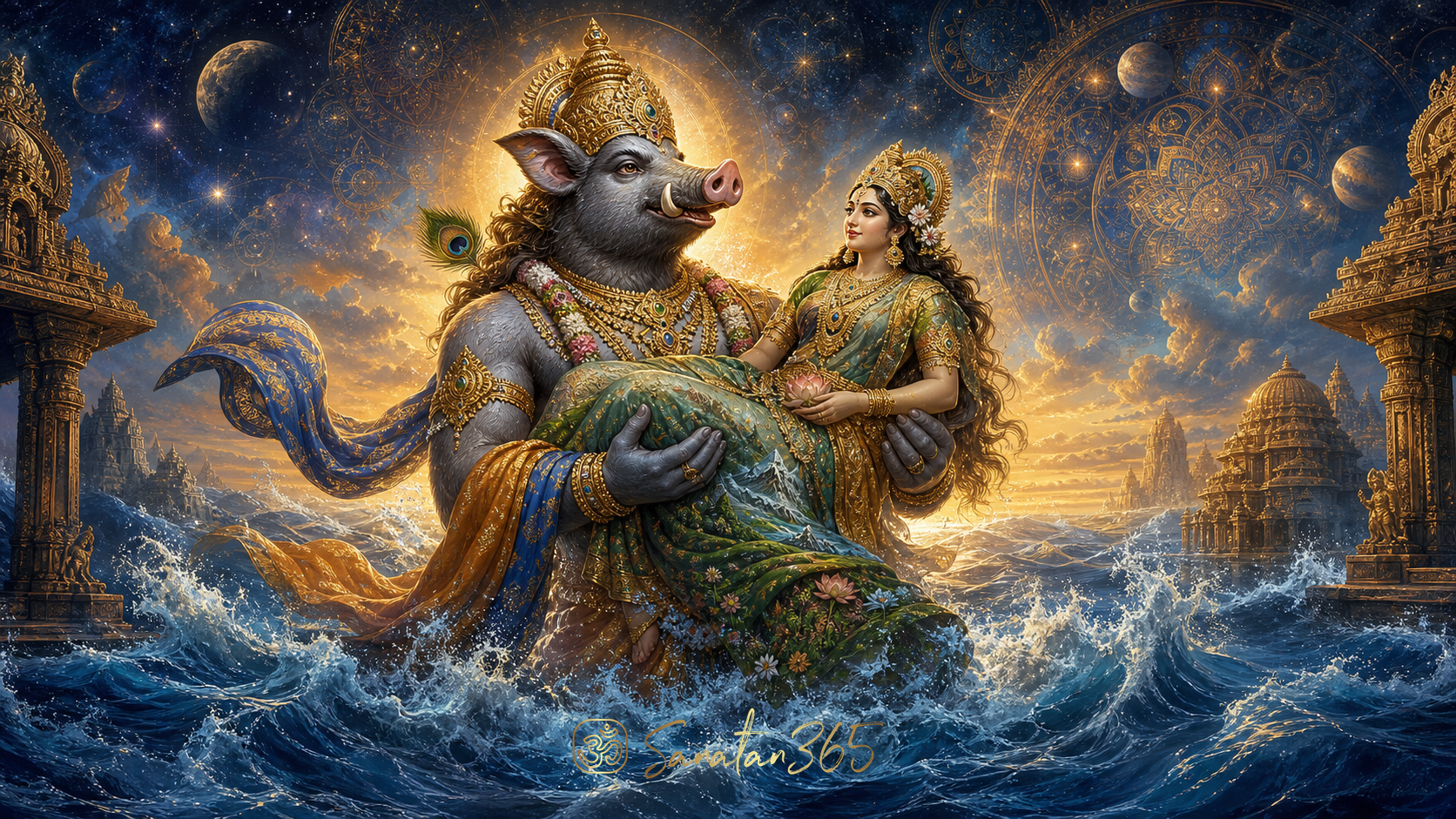
Varaha, Vishnu's boar avatar, raises Bhudevi from the cosmic waters. The story joins divine courage, the dignity of Earth, and the restoration of dharma without reducing a profound sacred image to a simple fable.
A deity with the head of a wild boar lifts the Earth above a boundless ocean. The image is startling because it refuses to separate spiritual majesty from the strength needed to enter mud, darkness, and danger.
The Varaha avatar meaning begins with rescue and restoration. Varaha (वराह, “boar”) is a form of Lord Vishnu who descends when Bhudevi (भूदेवी, “Earth Goddess”) has been carried beneath the cosmic waters. He raises her, defeats the force that has displaced her, and restores the world to its rightful order. The story teaches that dharma is not preserved through distance from the world, but through courageous action within it.
What is Varaha avatar meaning in Hindu tradition?
Varaha is traditionally counted among the Dashavatara (दशावतार, “ten descents”) of Vishnu. An avatara (अवतार, “descent”) is the Divine taking an embodied form suited to a particular crisis. In Varaha's case, the crisis is cosmic: Earth itself has lost its stable place.
The narrative appears in several sacred texts, with variations in sequence, scale, and emphasis. The Vishnu Purana describes Vishnu assuming the boar form and raising Earth from the waters. The Bhagavata Purana, especially Book 3, presents a dramatic account in which Varaha rescues Earth and confronts the asura Hiranyaksha. These tellings should be read as living scriptural traditions rather than forced into one flattened chronology.
Three ideas anchor Varaha's significance:
- Divine response: Vishnu does not remain an observer when creation is thrown out of balance.
- Earth's dignity: Bhudevi is not inert property. She is sacred presence, worthy of reverence and protection.
- Restored order: Rescue is completed by re-establishing stability, so that life and duty can continue.
Varaha therefore represents more than victory over a demon. He reveals protection as the work of placing what has been displaced back into a life-giving relationship.
Key takeaway: Varaha embodies Vishnu's protective power when the very ground of life must be recovered and restored.
Why does Vishnu take the form of a boar?
The boar form is not an arbitrary disguise. A boar is strong, close to the ground, and able to root beneath the surface. Traditional commentators and modern interpreters often notice how perfectly this form fits the task: Earth has sunk into the depths, so the rescuer must enter those depths and lift her.
This is an important theological point. The Divine form is not limited by human preferences about what appears refined, beautiful, or powerful. Vishnu's compassion can arrive in the form required by dharma. Varaha's body declares that no realm is too muddy and no condition too low for sacred intervention.
The form also challenges a common habit of treating spirituality as escape from material existence. Varaha does not reject bhumi (भूमि, “earth” or “ground”). He honours and supports it. The physical world is not portrayed as worthless debris; it is a field in which beings live, act, worship, learn, and fulfil responsibility.
In iconography, the upward curve of Varaha's tusks and the firm placement of Bhudevi communicate both power and care. Strength is not shown as domination. Its purpose is support.
This distinction matters in daily life. Protection that humiliates the protected is incomplete. Varaha's sacred strength restores Bhudevi's rightful place and sovereignty. The image joins force with tenderness, suggesting that true power serves stability rather than ego.
Key takeaway: Vishnu's boar form shows that sacred action takes the shape the crisis requires, even when that shape overturns human expectations.
How do the scriptures tell the rescue of Bhudevi?
The broad narrative begins during a cosmic disruption. Earth has descended beneath the waters, and creation cannot proceed in balance. Vishnu manifests as Varaha, enters the waters, locates Bhudevi, and raises her. In prominent Puranic accounts, Hiranyaksha opposes this restoration and is defeated.
The Bhagavata Purana gives the episode devotional grandeur. Varaha is at once a mighty cosmic being and the beloved Lord praised by sages. His roar carries sacred force; his emergence announces that disorder will not have the final word. The battle with Hiranyaksha is not random violence. It occurs because the asura obstructs the return of Earth and makes domination an enemy of life-giving order.
The Vishnu Purana emphasizes the scale of the act: the world rests within a cosmic cycle larger than any single human lifetime. Varaha's rescue belongs to a vision in which creation, dissolution, and renewal recur, while divine guardianship remains present.
Bhudevi's role deserves careful attention. In temple and devotional traditions she is the Earth Goddess and, in Vaishnava contexts, a consort of Vishnu. Calling the episode a rescue does not make Earth spiritually passive. Bhudevi represents fertility, endurance, nourishment, and the patient ground of embodied life. Her removal from the cosmic order makes every other activity precarious.
Readers can explore the wider family of Vishnu's protective descents through the story of Matsya and Manu and the Vamana avatar story. Each avatara responds differently because each disorder has a different shape.
Key takeaway: The scriptural story presents restoration as both a cosmic event and a devotional assurance that disorder can be confronted without abandoning creation.
What do Earth and the cosmic waters symbolize?
The cosmic waters can be read on several levels without insisting that one symbolism exhausts the story. They are the unformed depth before stable creation, the place where familiar boundaries disappear, and the condition in which Earth can no longer sustain ordered life.
Bhudevi, by contrast, is ground: not merely soil, but the dependable field on which relationships, rituals, agriculture, learning, and dharma become possible. When she is submerged, the problem is not only geographical. The basis for meaningful action has been displaced.
Varaha's movement is therefore from instability toward foundation. He enters what has no firm footing and brings forth the ground on which life can stand. This pattern remains spiritually recognizable. A family in crisis, a community that has lost trust, or a person overwhelmed by confusion may not need abstract advice first. They may need a stable basis restored: truthful speech, regular practice, safe boundaries, food, rest, or responsible companionship.
The story also encourages ecological reverence, but it should not be turned into a claim that an ancient Purana is a modern environmental policy manual. A responsible application is simpler and stronger: when Earth is revered as Bhudevi, careless exploitation becomes spiritually difficult to justify. Gratitude should shape conduct.
That conduct can include reducing waste, protecting water, treating food as a gift, caring for animals, and supporting local ecological responsibility. These actions do not make someone Varaha. They express humility before the ground that sustains everyone.
The meaning of the sacred Ashvattha tree offers another view of how Hindu traditions connect spiritual insight with living nature. Varaha adds an image of active protection: reverence must sometimes become rescue.
Key takeaway: Earth and water in the Varaha story illuminate the difference between unstable possibility and the restored foundation required for life and dharma.
How is Varaha represented in temples and sacred art?
Varaha appears in more than one iconographic form. Some images show a fully boar-shaped divine figure. Others show an upright human body with a boar's head, often with Bhudevi near his tusk, shoulder, or arm. The differences reflect artistic periods, theological settings, and regional traditions rather than a single mandatory composition.
One of India's most celebrated representations is the monumental Varaha relief at Udayagiri in Madhya Pradesh, generally dated to the Gupta period. The composition makes the rescue public and cosmic: Varaha dominates the carved field, Bhudevi rises near him, and surrounding beings witness order returning. The Archaeological Survey of India's Udayagiri materials and scholarly museum studies provide useful historical context, while interpretation should remain cautious about assigning one political meaning to every detail.
Varaha is also worshipped in temple traditions across India. The Varaha Swamy Temple near the sacred Tirumala complex gives the deity a particularly visible place within South Indian Vaishnava pilgrimage. Devotees may encounter Varaha not only as an episode in a book but through darshan (दर्शन, “sacred seeing”), ritual, sculpture, names, and festival memory.
In sacred art, three visual truths are especially important:
- Varaha must remain recognizably powerful without becoming a monster.
- Bhudevi should appear dignified, not reduced to a decorative object.
- Their relationship should convey the restoration of Earth, not conquest over her.
These principles explain why respectful iconography matters. The scene is not fantasy spectacle alone. For devotees, it communicates divine protection and Earth's sacred status.
Key takeaway: Varaha's temple forms translate a cosmic teaching into sacred presence: strength bends toward support, and Earth rises with dignity.
What can Varaha teach about dharma and care for Earth today?
Varaha's lesson is practical without becoming simplistic. The story does not promise that every crisis will end instantly, nor does it license aggression in the name of rescue. It offers a pattern for disciplined responsibility.
Enter the real problem
Varaha goes where Earth has been taken. In modern terms, responsible service begins by understanding the actual condition rather than protecting one's image. A person should ask: What has been displaced? What foundation is missing? Who bears the cost of delay?
Use strength for restoration
Hiranyaksha represents power that obstructs the world's rightful order. Varaha represents power used to restore it. The ethical question is not whether strength exists, but whom it serves. Authority, wealth, knowledge, and physical capability become dharmic when used with restraint for the wellbeing of more than oneself.
Honour the ground of daily life
Bhudevi reminds devotees that spiritual aspiration depends on ordinary supports. Clean water, nourishing food, stable homes, healthy soil, truthful institutions, and caring relationships may appear mundane, but without them many higher pursuits become inaccessible.
Restore before displaying
Varaha's act is not performance. Earth is raised and placed securely. In daily seva (सेवा, “selfless service”), the strongest result is often quiet: a repaired relationship, a protected child, a cleaned water source, a debt handled honestly, or a neglected duty resumed.
A simple reflection practice can make the teaching concrete:
- Name one area of life that feels “submerged” or without firm ground.
- Identify the smallest foundation that can be restored this week.
- Choose one action that supports rather than controls.
- Offer the action inwardly to Vishnu, without demanding praise.
- Review whether the result increased stability, dignity, and truth.
This practice is not a substitute for professional help in medical, legal, financial, or safety emergencies. It is a devotional framework for approaching ordinary responsibility with steadiness.
Key takeaway: Varaha invites strength that enters difficulty, protects dignity, and leaves the world on firmer ground.
Conclusion
Varaha is one of Hindu sacred art's boldest declarations: Earth matters enough for the Divine to enter the depths and raise her. The boar form gives Vishnu's protection a grounded, muscular tenderness. Bhudevi's return shows that dharma depends on restoring the conditions in which life can flourish.
The story remains relevant because every age faces forces that displace what should be honoured. Varaha asks devotees to meet those moments with courage, humility, and practical care.
Key takeaway: The deepest Varaha avatar meaning is that sacred strength does not abandon the world; it restores the ground beneath life.
FAQ
Who is Varaha in Hinduism?
Varaha is the boar avatar of Lord Vishnu, traditionally included among the Dashavatara. He rescues Bhudevi, the Earth Goddess, from the cosmic waters and restores her place in creation.
Why did Vishnu become a boar?
The boar form is suited to entering the depths and lifting Earth. Spiritually, it shows that the Divine can assume any form required to protect dharma and that no realm is beneath sacred care.
Who is Bhudevi in the Varaha story?
Bhudevi is the personified Earth Goddess. In Vaishnava traditions she is revered as a consort of Vishnu and represents the nourishing, enduring ground of embodied life.
Is Hiranyaksha part of every Varaha account?
Major Puranic tellings prominently connect Hiranyaksha with the displacement of Earth and Varaha's battle, but sacred texts vary in sequence and emphasis. These variations belong to the breadth of the tradition.
What does Varaha teach modern devotees?
Varaha teaches that strength should serve restoration. Devotees can apply this through responsible care for Earth, protection of dignity, truthful action, and the patient repair of foundations on which life depends.
About the author
Sanatan365 Editorial
Bringing Sanatan Dharma to modern seekers through authentic, scripture-grounded content.
Related in Deities
 Deities
Savitr Deva Meaning: Golden Hands and the Rhythm of Life
Meet Savitr, the Vedic divine impeller whose golden hands set life in motion and whose hymns honour rest as well as activity.
 Deities
Indra Deva Meaning: The Vajra, Rain, and Responsible Power
Indra links the thunderbolt and released waters with a demanding question: what is strength for? Read his Vedic imagery and later lessons w…
 Deities
Agni Deva Meaning: Sacred Fire and the Divine Messenger
Meet Agni as the Vedic priest and messenger, read the first Rig Veda hymn, and understand sacred fire without reducing a living deity to a…

