Dhruva Story: The Child Devotee, the Pole Star, and Steady Faith
The Dhruva story teaches how hurt can become disciplined devotion, how guidance refines desire, and why Hindu tradition remembers Dhruva as a symbol of unwavering faith.
A five-year-old child leaves a palace because his heart has been wounded, and Hindu tradition remembers him not as defeated, but as fixed like the northern star.
The Dhruva story is the Puranic account of a young prince whose pain becomes disciplined devotion to Lord Vishnu. Dhruva (ध्रुव, dhruva, "fixed, steady, immovable") begins with rejection, receives guidance from Sage Narada, meditates with the mantra "Om Namo Bhagavate Vasudevaya," and is blessed with a place of lasting honor, traditionally associated with Dhruva Tara, the Pole Star. The story appears in the Bhagavata Purana, especially Skandha 4, chapters 8-12, and is also known through the Vishnu Purana tradition. It is a story about bhakti (भक्ति, devotion), but also about how desire, grief, anger, and ambition can be transformed by spiritual steadiness.
What is the Dhruva story in Hindu tradition?
The Dhruva story begins in the royal household of King Uttanapada. The king has two queens, Suniti and Suruchi. Dhruva is the son of Suniti, while his half-brother Uttama is the son of Suruchi. One day, Dhruva sees Uttama sitting on the king's lap and naturally wants the same affection from his father.
Suruchi stops him. In the Bhagavata Purana's telling, she speaks with harsh pride and tells Dhruva that if he wants that place, he must be born from her womb. For a child, this is not merely palace politics. It is the crushing feeling of being told, "You do not belong here."
Dhruva goes to his mother, Suniti. She does not respond with revenge. She tells him, in essence, that no worldly person can fully repair such sorrow, and that the highest refuge is Bhagavan, the Divine Lord. Her counsel redirects the child's wound upward. Dhruva does not yet have mature spiritual detachment, but he has something powerful: focus.
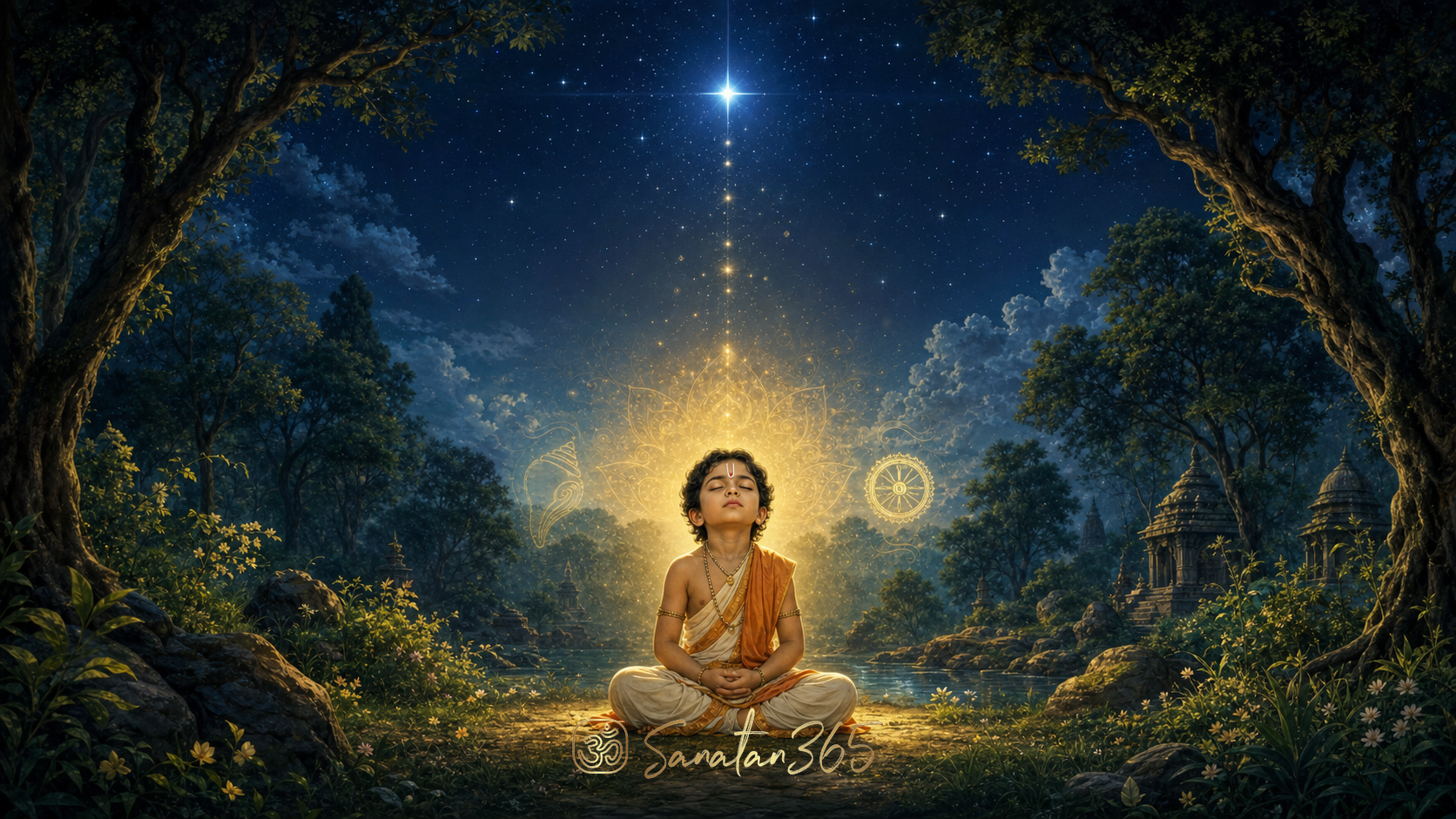
He leaves for the forest to seek Lord Vishnu. Sage Narada meets him and first tests his resolve. Narada knows that forest austerity is difficult even for adults, and Dhruva is only a child. But when Dhruva remains firm, Narada gives him a sacred discipline and teaches the mantra "Om Namo Bhagavate Vasudevaya" (ॐ नमो भगवते वासुदेवाय, "I bow to the Blessed Lord Vasudeva"). The Bhagavata Purana's English translations preserve this turning point as the moment where raw pain becomes guided practice.
Dhruva performs tapas (तपस्, disciplined spiritual austerity) with extraordinary concentration. Lord Vishnu appears, touches him with the conch, and Dhruva's speech becomes praise. The child who left home seeking status now stands before the Divine and discovers that what he receives is larger than the palace seat that first wounded him.
Key takeaway: The story does not deny Dhruva's hurt. It shows how hurt can be redirected into disciplined devotion instead of bitterness.
Why is Dhruva connected with the Pole Star?
The name Dhruva itself means fixed, steady, or immovable. That is why the story's cosmic ending matters. In Hindu memory, Dhruva becomes linked with Dhruva Tara, the fixed northern star used as a symbol of orientation and stability. Traditional accounts describe Vishnu granting him Dhruva-pada, a supreme and steady station.
The Pole Star image gives the story a language every generation can understand. A star that appears steady in the northern sky becomes a symbol for a mind that has stopped spinning around insult, jealousy, and comparison. Dhruva begins by wanting a father's lap. He ends as a sign by which others can find direction.
This does not mean the story should be reduced to astronomy. Its symbolic force is devotional and moral. The child seeks a fixed place because worldly affection has felt unstable. Through bhakti, his inner center becomes steady. In that sense, Dhruva Tara is not just a reward. It is the visible form of the quality he cultivates.
The Vishnu Purana tradition also emphasizes that Dhruva's original desire changes in the presence of Vishnu. The child who wanted a throne-like honor comes to value remembrance of the Lord more deeply. This is one of the story's most important movements: desire is not simply crushed; it is purified.
Key takeaway: Dhruva becomes associated with the Pole Star because his devotion becomes steady, directional, and useful to others.
What does the Dhruva story teach about pain and devotion?
Many Hindu stories begin with a crisis. Nachiketa is sent to Yama in the Katha Upanishad; Prahlada faces danger for his devotion to Vishnu; Dhruva is wounded by rejection inside his own family. The crisis is not the whole story. It is the doorway through which the deeper teaching appears.
Dhruva's first emotion is not saintly calm. He is hurt, angry, and determined to gain a place no one can deny. This makes the story especially human. Children and adults alike know the pain of comparison: another person receives affection, recognition, opportunity, or status, while one feels unseen.
Suniti's wisdom is that she does not feed resentment. She does not say, "Defeat Suruchi." She turns Dhruva toward the Divine. Narada then turns that emotional force into sadhana (साधना, disciplined spiritual practice). The pattern is important:
- Pain is acknowledged.
- Revenge is avoided.
- A higher refuge is named.
- Practice gives the emotion direction.
- Divine encounter changes the desire itself.
This is why the Dhruva story is often told to children, but it is not childish. It teaches emotional alchemy. The raw material is disappointment. The refined result is steadiness.
There is also a warning. Dhruva's later life, as told in the Bhagavata Purana, includes a moment of anger after his brother Uttama's death. Dhruva wages war against the Yakshas and must be restrained by Svayambhuva Manu. This part is sometimes skipped in simple retellings, but it matters. Even a blessed devotee must continue to master anger. Spiritual attainment does not make vigilance unnecessary.
Key takeaway: Dhruva teaches that devotion is not the absence of emotion; it is the training of emotion toward the Divine and dharma.
How does Sage Narada shape the Dhruva story?
Sage Narada is more than a messenger in this story. He is the teacher who prevents intensity from becoming mere stubbornness. Dhruva has determination, but determination alone is not wisdom. Narada gives method, mantra, and spiritual orientation.
In many Hindu narratives, the guru does not erase the seeker's personality. The guru refines it. Dhruva is not told to become weak, passive, or forgetful. He is taught how to concentrate. Narada's instruction turns the child's fierce will into bhakti yoga (भक्ति योग, the path of devotion).
The mantra "Om Namo Bhagavate Vasudevaya" holds a special place in Vaishnava devotional practice. In Dhruva's story, it becomes the bridge between a child's sorrow and Vishnu's grace. The mantra is not presented as magic in a mechanical sense. It is part of a whole discipline: posture, breath, attention, austerity, and surrender.
This is why the story pairs well with broader Hindu teachings on japa (जप, repeated sacred recitation). In Japa Meditation Meaning: Mantra Repetition as Daily Practice, mantra repetition is described as a way to steady attention around the divine name. Dhruva's example shows the same principle in narrative form. A restless wound becomes a repeated remembrance.
Narada also teaches proportion. He first warns Dhruva that the path is difficult. That warning is not discouragement; it is spiritual realism. True teachers do not flatter the seeker. They test whether the seeker's aspiration can endure discipline.
Key takeaway: Narada transforms Dhruva's determination into guided devotion, showing that intensity needs wisdom to become spiritual strength.
Why is the Dhruva story powerful for families and children?
The Dhruva story remains a family favorite because it speaks to a child's inner world without treating the child as spiritually small. Dhruva is young, but his longing is taken seriously. He is not dismissed. He is guided.
For parents and teachers, the story offers several gentle lessons:
- Children feel comparison deeply, even when adults think the moment is small.
- A wounded child needs truthful comfort, not false promises.
- Devotional stories can help children name emotions without becoming ruled by them.
- Discipline is easier to teach when it is connected to love, not fear.
- Spiritual greatness is not limited by age.
The story also invites careful storytelling. It should not be used to tell children that they must accept mistreatment silently. Suniti does not celebrate the insult. Narada does not praise cruelty. The story's teaching is that one should not let another person's harshness decide the shape of one's soul.
Dhruva's journey is also different from Nachiketa Story: What the Katha Upanishad Teaches About Fear, Choice, and the Self, though both are young seekers. Nachiketa asks Yama about death and the Self. Dhruva seeks Vishnu through devotion after personal hurt. Together, they show two childhood forms of spiritual seriousness: inquiry and devotion.
For diaspora families, Dhruva Tara also gives the story a visual anchor. A parent can point toward the northern sky and speak about steadiness, faith, and guidance. Even when the exact astronomical details are explained differently in modern science and ancient cosmology, the ethical symbol remains clear.
Key takeaway: Dhruva is powerful for families because it honors a child's pain while teaching steadiness, devotion, and wise guidance.
What is the deeper meaning of Dhruva's transformation?
The deepest movement in the Dhruva story is from recognition-seeking to God-centered steadiness. Dhruva begins by wanting a status that will answer Suruchi's insult. When Vishnu appears, Dhruva realizes that divine presence exceeds the reward he imagined.
This is a common pattern in bhakti literature. The devotee may begin with a worldly motive: safety, prosperity, victory, healing, respect, or relief. The tradition does not always reject that beginning. It recognizes that human beings often start from need. But through sincere practice, the motive can mature.
Dhruva's transformation also corrects a misunderstanding about devotion. Bhakti is sometimes mistaken for emotional softness. Dhruva shows another side: steadiness, endurance, and one-pointed attention. His devotion is tender, but it is also strong.
The story's moral world is not simplistic. The palace is not wholly evil. The forest is not merely escape. The star is not merely reward. Each stage reveals a different layer of the seeker's inner life:
- The palace reveals the wound of comparison.
- The mother reveals the voice of dharma.
- Narada reveals the need for guidance.
- The forest reveals the discipline of practice.
- Vishnu reveals grace.
- Dhruva Tara reveals steadiness made visible.
This is why the story has lasted. It is devotional, but also psychologically precise. It knows that people often ask God for one thing and receive a deeper reordering of the heart.
Key takeaway: Dhruva's real victory is not gaining a higher seat than his brother; it is becoming steady enough to guide others.
FAQ
What is the Dhruva story about?
The Dhruva story is about a young prince who is hurt by rejection, goes to the forest to seek Lord Vishnu, receives guidance from Sage Narada, practices intense devotion, and is blessed with a steady cosmic place associated with Dhruva Tara, the Pole Star.
Where is the Dhruva story found?
The story is mainly known from the Bhagavata Purana, Skandha 4, chapters 8-12, with related telling in the Vishnu Purana tradition. Public English references include the Bhagavata Purana translation at Wisdom Library and the Vishnu Purana translation at Sacred Texts.
What does the name Dhruva mean?
Dhruva (ध्रुव) means fixed, steady, firm, or immovable. The meaning fits the story because Dhruva becomes a symbol of unwavering devotion and is traditionally linked with Dhruva Tara, the steady northern star.
What mantra did Dhruva chant?
Sage Narada teaches Dhruva the mantra "Om Namo Bhagavate Vasudevaya" (ॐ नमो भगवते वासुदेवाय), which means "I bow to the Blessed Lord Vasudeva." In the story, the mantra helps focus Dhruva's devotion toward Lord Vishnu.
What is the main lesson of the Dhruva story?
The main lesson is that pain can be transformed through guidance, discipline, and devotion. Dhruva begins with rejection, but through bhakti and Vishnu's grace, he becomes a symbol of steadiness rather than resentment.
About the author
Sanatan365 Editorial
Bringing Sanatan Dharma to modern seekers through authentic, scripture-grounded content.
Related in Stories
 Stories
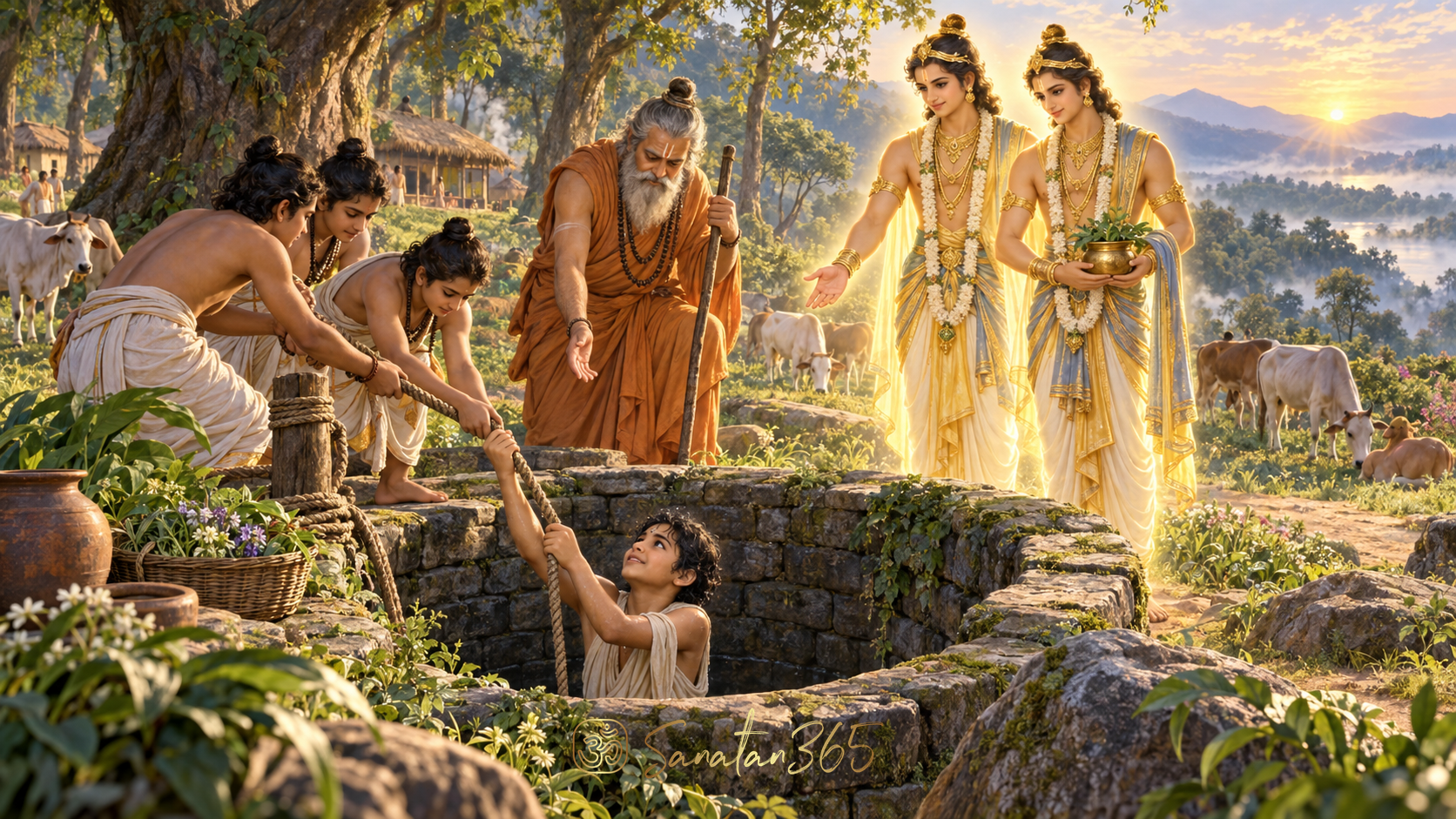
Upamanyu’s Story: Discipline, Discernment, and the Ashvins’ Grace
Upamanyu’s early Mahabharata story follows a hungry student tested by his teacher, blinded after eating harmful leaves, and restored by the…
 Stories
King Parikshit and Shukadeva: Seven Days of Sacred Listening
When King Parikshit learned that only seven days remained, the Bhagavata Purana says he turned from power toward one urgent question: what…
 Stories
Arundhati Vashistha Star Meaning: A Hindu Wedding Guide
The Arundhati–Vashistha star pair joins an ancient story of companionship with a living Hindu wedding custom. Learn who they are, why the s…