
Kapaleeshwarar Temple Mylapore: Shiva, the Peacock Legend, and Living Devotion
Explore Kapaleeshwarar Temple in Chennai's Mylapore: its Shiva shrine, Parvati's peacock legend, Tamil Shaiva heritage, architecture, and respectful visiting.
A peacock belongs to the story of a Chennai shrine, but the heart of that story is devotion, not spectacle.
Kapaleeshwarar Temple Mylapore is a living Shiva temple in Chennai, Tamil Nadu. Lord Shiva is worshipped as Kapaleeshwarar and Goddess Parvati as Karpagambal. Its peacock legend connects the name Mylapore to the Tamil mayil (மயில், peacock), while its sanctums, gateway towers and daily worship keep Tamil Shaiva devotion tangible. The legend is a sacred tradition, not a dateable historical report; the temple is also a present-day place of prayer, not merely a monument. A Tamil Nadu Tourism guide describes both the deities and the peahen story.
For a first-time visitor, the most helpful question is not simply how old the structure is. It is how a city neighbourhood, a local sacred story, and worship of Shiva and the Divine Mother continue to shape one another.
What Is Special About Kapaleeshwarar Temple Mylapore?
The temple's special character lies in its combination of place, story and practice. Mylapore is an old cultural neighbourhood within modern Chennai. Streets, shops, households and worshippers surround the shrine. One can arrive through an ordinary urban day and still enter a rhythm governed by bells, lamps, prayer and the movement toward the sanctum. That juxtaposition makes the temple feel less like an isolated relic than a centre of living communal memory.
The main deity is Kapaleeshwarar, a form of Lord Shiva. Shiva is worshipped in the linga (लिङ्ग, sacred emblem through which Shiva is approached). Goddess Parvati is honoured as Karpagambal, a name associated in local devotion with gracious giving. Their shrines are not interchangeable: each is approached with its own attention and reverence. The Tamil Nadu Tourism account identifies both forms and places the peacock story at the centre of the temple's local identity.
The name Kapaleeshwarar itself is traditionally explained through kapala (कपाल, skull), an element of Shiva's iconography and associated narratives. Such stories carry theological meaning; they should not be flattened into a claim that a single literal event can be established by historical method. The peacock tradition similarly tells a devotional truth about attention, humility and restoration. It is meaningful precisely because worshippers have continued to retell it in a living place.
A visitor will also notice that this is a Tamil Shaiva shrine. Shaiva means centred on Shiva; bhakti (भक्ति, loving devotion) is the devotional relationship expressed in hymns, worship, remembrance and service. Mylapore's significance is therefore not exhausted by a photograph of its gateway. The sound of prayer, the care of ritual, and the nearby neighbourhood all participate in its character.
Key takeaway: Kapaleeshwarar Temple is special because the worship of Shiva and Karpagambal, Mylapore's peacock story, and everyday Tamil devotional life remain inseparable.
Why Is Mylapore Linked to the Peacock Legend?
In a widely told temple tradition, Goddess Parvati takes the form of a peahen and worships Shiva. The Tamil word mayil means peacock; the story is associated with the name Mylapore. Accounts vary in their details, as sacred narratives often do. What remains steady is the image of the Divine Mother turning toward Shiva with concentrated devotion. The Tamil Nadu Tourism description presents this as a legend and notes the temple's representation of the peahen near a punnai tree.
It is worth reading that story with care. It does not need to be treated as a modern claim about zoology or archaeology. Nor does the peahen image diminish Parvati. In devotional language, divine forms and symbolic actions invite reflection. Here, a beautiful and familiar bird becomes a local sign of prayer, learning and return. A worshipper can see in the story an invitation to seek understanding with steadiness.
The legend also makes Mylapore more than a postal location. Sacred geography often attaches meaning to a place through stories, hymns, water, trees and repeated ritual. The punnai tree and peahen image offer a tangible reminder that the story belongs here, in a particular neighbourhood. A visitor who knows this before arriving can look beyond the tall entrance tower and notice how small details preserve the temple's memory.
There is no need to decide that every narrative detail must have a single universal interpretation. Some devotees may hear an account of devotion to Shiva; others may focus on Parvati's resolve or the grace of restored understanding. Hindu traditions hold such layers without requiring one to cancel the others. The story need not be used to rank deities or paths. It offers a way to contemplate relationship, attention and reverence.
For families, the peacock story can also be an accessible entry point. Children may remember the bird first, then ask why the Goddess prayed, why the shrine honours both Shiva and Karpagambal, and why a place can preserve a story over generations. Those questions are better than a memorized date without context.
Key takeaway: The peacock legend gives Mylapore a devotional identity; it is best understood as local sacred tradition rather than a verified historical chronology.
How Does the Temple's Architecture Shape Darshan?
A gopuram (गोपुरम्, monumental South Indian temple gateway tower) announces the transition from street to sacred precinct. At Kapaleeshwarar Temple, sculptural detail and colour draw the eye upward. Yet entry is only the beginning. Temple architecture is not built solely to impress from outside; it directs movement toward darshan (दर्शन, sacred seeing and being seen by the deity).
The approach asks a visitor to change pace. One passes through a gateway, observes shrines and ritual activity, and moves toward the worship focal point. Even when the temple is busy, this sequence can make attention more deliberate. The carved forms tell stories, but the sanctum gathers that many-sided imagery into a moment of stillness. The visible and the inward support one another.
The large temple tank near the western side is another feature of the Mylapore setting noted in the tourism guide. Water bodies associated with temples can serve ritual, ecological and civic functions, though particular uses vary by place and season. A visitor should observe local directions rather than assume the tank is always open for a particular practice. Its presence nonetheless widens the temple's spatial vocabulary: the shrine is not only a room for prayer, but part of a larger sacred landscape.
The punnai-tree setting and the peahen image make the legend visible on site. This is a subtle design lesson. Not every spiritually important feature is the tallest or most ornate. A tree, a modest sculpture or a pause in the route may hold the story most closely. The architecture works through scale and intimacy together.
The temple's present form also requires historical humility. Local accounts distinguish older devotional associations from the surviving built complex. Claims that every visible stone is from one ancient founding period should be treated cautiously. Structures can be repaired, expanded, rebuilt and reinterpreted while worship continues. Continuity of devotion is not the same as an unchanged architectural fabric. That distinction protects the temple's story from exaggerated age claims and allows its real history to remain interesting.
A helpful way to look is in four movements:
- Notice the gateway and how it marks the shift from neighbourhood to shrine.
- Observe the relationship between the Shiva and Karpagambal worship spaces.
- Look for the peahen-story setting without turning a prayerful space into a photo hunt.
- Give the sanctum more time than the outer ornament.
A temple such as Ekambareswarar in Kanchipuram offers another distinct Tamil Shaiva relationship among Parvati, Shiva, place and sacred tree. Comparing them can deepen appreciation without collapsing their separate local traditions.
Key takeaway: Kapaleeshwarar Temple's gateways, shrines, tank and peahen-story setting guide the visitor from public city life toward focused darshan.
What Does Tamil Shaiva Devotion Add to the Temple's Meaning?
Tamil Shaiva tradition is not only a set of old texts. It includes songs, liturgy, temple festivals, stories and the repeated acts by which a community keeps a shrine alive. In this world, a temple can be a place where poetry is remembered in worship, where a family returns year after year, and where a newcomer learns through seeing and listening before knowing every term.
One should avoid describing all Tamil Shiva temples as though they were the same. Kapaleeshwarar's Mylapore identity is shaped by Karpagambal's peacock legend, the temple's location within Chennai, and the particular pattern of its worship. Other Shaiva sites centre different narratives and landscapes. Mukteshvara Temple in Bhubaneswar, for example, teaches a different regional architectural language. The comparison shows how a shared devotion to Shiva can take culturally specific form without requiring one form to be superior.
The presence of Karpagambal matters in another way. It prevents an account of the temple from treating the Goddess as a decorative footnote. Devotees approach her as a living focus of reverence. The peacock legend makes her agency visible: she seeks, worships and returns. Whether one visits chiefly for Shiva, Karpagambal or the experience of the whole shrine, respectful attention includes both worship traditions.
In devotional life, a festival can intensify what daily worship already expresses. Temple streets, music, procession and community participation may bring sacred presence beyond the sanctum into the neighbourhood. Exact festival schedules and access rules change, so visitors should confirm current information locally rather than rely on an old blog timetable. The enduring point is that Tamil temple life is social as well as personal. It requires artisans, priests, volunteers, musicians, families and ordinary visitors to care for the space.
This offers a useful correction to an architecture-only reading. A gateway tower cannot sing a hymn by itself. A sculpture cannot welcome a visitor by itself. A living temple is sustained through people who clean, tend lamps, conduct worship, learn songs, preserve stories and make room for others. The sacred built form is therefore a setting for practice, not a substitute for it.
For readers outside Tamil Nadu, this can be a gentle introduction to regional diversity within Sanatan Dharma. Tamil language, local trees and temple streets make the worship here particular; Shiva and Parvati are also honoured across many regions. Local difference is not a problem to smooth away. It is part of how a tradition remains alive in many homes and places.
Key takeaway: Tamil Shaiva devotion gives Kapaleeshwarar Temple its living voice, while Mylapore's particular stories and community practices make that voice locally distinct.
How Can Visitors Approach Kapaleeshwarar Temple Respectfully?
Begin with the simplest assumption: the temple is a place of worship. The entrance, tank, shrine and nearby streets may be fascinating to photograph, but worshippers are not scenery. A respectful visitor makes space for prayer, follows signs and staff directions, and keeps cameras away where photography is restricted.
Dress modestly and be prepared for footwear rules. Hours, festival access, queue routes and photography policies can change; check current official or on-site guidance shortly before visiting. This is especially important during major observances, when a quiet weekday route may not resemble the festival route. Avoid promising a fixed opening time or a guaranteed ritual experience to someone planning a journey.
A first visit can be both curious and prayerful. One need not know every iconographic detail. Pause at the gateway, notice the temple's relation to Mylapore's streets, then let the movement toward Shiva and Karpagambal set the pace. If uncertain about a ritual, watch quietly or ask a temple representative rather than improvising an offering. Do not block devotees to obtain a clean image.
For families, a short conversation before entry helps. Explain darshan as an encounter of reverent seeing; explain the peacock as part of Karpagambal's local legend; explain that people may pray differently. Children can be invited to observe the bells, flowers, lamps and movements respectfully, then share what they noticed afterward. That approach turns a visit into learning without making worship a performance for them.
The visit can continue beyond the sanctum through responsible attention to the neighbourhood. Mylapore's shops, food, crafts and streets are part of the setting, but commerce should not crowd out the temple's purpose. Give the shrine its own time before moving to the next stop. A short period of quiet reflection may be more memorable than a rushed circuit of photographs.
If travel is impossible, the same story can still prompt reflection: What does concentrated attention look like amid everyday duties? How does one honour a place without claiming to possess it? What might it mean to approach the Divine with Karpagambal's steadiness? These are devotional questions, not claims that a particular visit guarantees an outcome.
Key takeaway: Respectful visiting means allowing Kapaleeshwarar Temple to be a living shrine first and a heritage sight second.
FAQ
Where is Kapaleeshwarar Temple located?
Kapaleeshwarar Temple is in Mylapore, a neighbourhood of Chennai in Tamil Nadu, India. It is a living shrine to Lord Shiva as Kapaleeshwarar, with Goddess Parvati worshipped as Karpagambal.
Why is Mylapore associated with a peacock?
A local sacred legend says that Goddess Parvati worshipped Shiva in the form of a peahen. The Tamil word mayil means peacock, and the story is traditionally linked to Mylapore's name. It should be described as a temple tradition, not a verified historical event.
Is Kapaleeshwarar Temple only an architectural monument?
No. Its architecture is important, but worship, daily ritual, stories and community participation make it a living temple. Visitors should prioritize respect for devotees and current temple rules.
Which deities are worshipped at the temple?
Lord Shiva is worshipped as Kapaleeshwarar and Goddess Parvati as Karpagambal. The peacock legend particularly connects Karpagambal to Mylapore's sacred identity.
What should a first-time visitor check before going?
Check current opening hours, festival arrangements, footwear and photography rules through official or on-site channels. These practical details can change, while the basic rule remains constant: approach the shrine with courtesy and quiet attention.
Conclusion
Kapaleeshwarar Temple Mylapore joins a local sacred story to daily devotion. The peacock legend remembers Karpagambal's focused worship; the shrine honours Shiva and the Goddess; its gateways and neighbourhood show how an urban community continues to live around a temple. Its meaning is best received with the same care that sustains it: curiosity informed by humility, and attention that makes room for prayer.
Key takeaway: The temple is not defined by a single legend or photograph, but by the enduring relationship among Shiva, Karpagambal, Mylapore and living devotees.
About the author
Sanatan365 Editorial
Bringing Sanatan Dharma to modern seekers through authentic, scripture-grounded content.
Related in Temples
 Temples
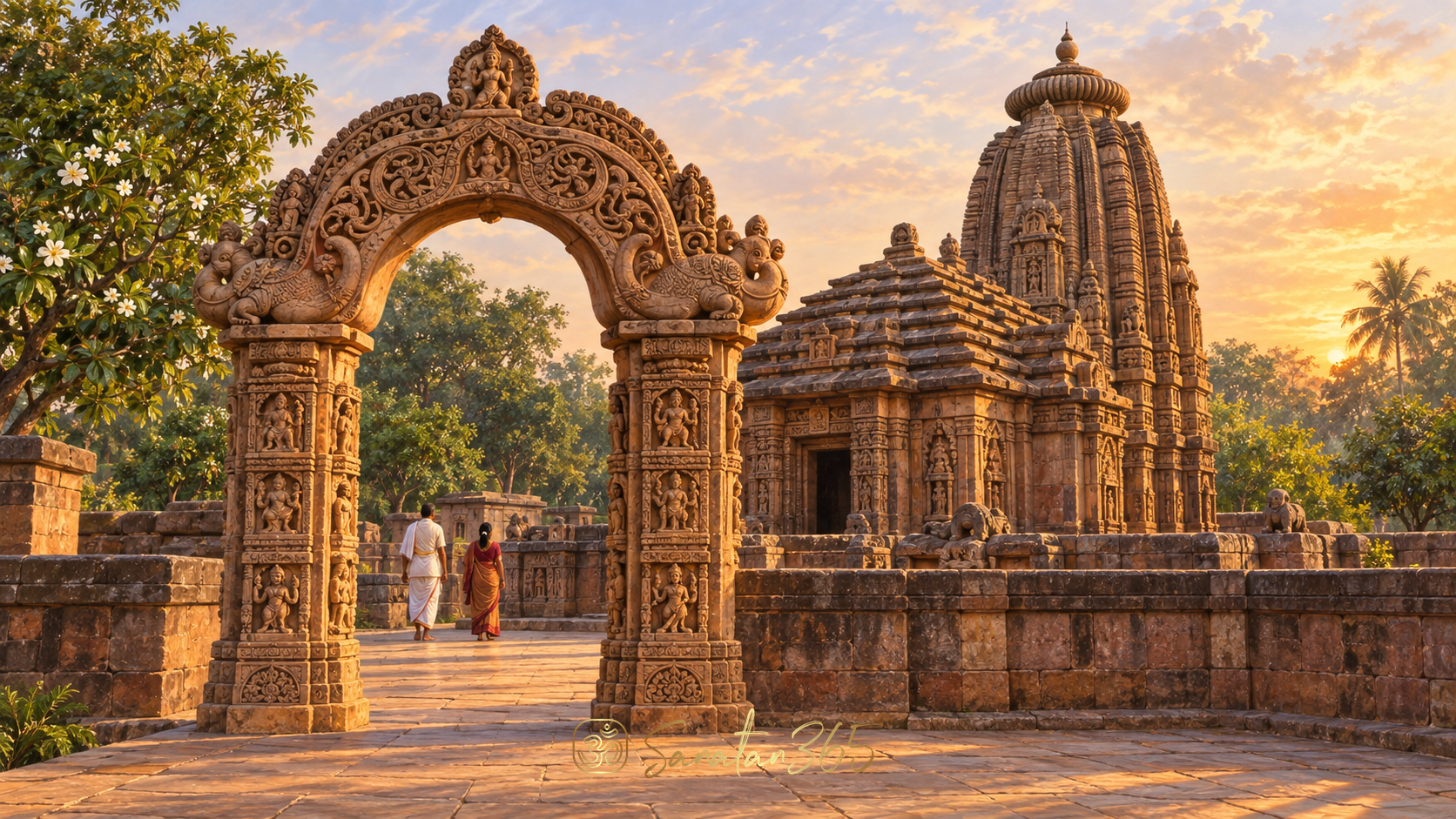
Mukteshvara Temple, Bhubaneswar: Shiva, Stone, and the Art of Arrival
Explore Mukteshvara Temple in Bhubaneswar through its sculpted torana, Kalinga architecture, Shiva devotion, and a thoughtful way to visit…
 Temples
Lepakshi Veerabhadra Temple: Sacred Art, Architecture, and Devotion
Lepakshi's Veerabhadra Temple brings Vijayanagara architecture, Shaiva devotion, painted ceilings, carved pillars, and living sacred memory…
 Temples
Chennakeshava Temple Belur: Vishnu, Hoysala Art, and Living Worship
Chennakeshava Temple in Belur is both a living Vishnu shrine and a landmark of Hoysala sacred architecture. Its sculpted surfaces show how…

