Konark Sun Temple Meaning: Surya's Chariot Carved in Stone
Konark Sun Temple was conceived as a monumental chariot of Surya, where stone wheels, horses, light, and movement turn architecture into a meditation on sacred time. Its meaning is inseparable from Odisha's living cultural memory and the duty to protect a fragile heritage site.
Konark does not merely contain images of a chariot. The temple itself was conceived as motion made monumental: Surya, the solar deity, crossing the heavens in a vast vehicle of carved stone. The Konark Sun Temple meaning therefore begins with a striking idea. Time moves, light reveals, and human life is asked to move with awareness rather than drift without direction.
Built on Odisha's coast in the thirteenth century, the surviving complex is both a sacred monument and a vulnerable work of world heritage. Its wheels, horses, celestial figures, musicians, plants, animals, and scenes of ordinary life do not form a single code with one easy answer. Together, they place cosmic rhythm, royal devotion, artistic mastery, and human experience within the orbit of Surya.
What Is the Konark Sun Temple Meaning?
The clearest answer is architectural: Konark represents the chariot of Surya moving across the sky. The temple is described by the UNESCO World Heritage Centre as a monumental representation of the sun god's chariot, with twenty-four carved wheels and a team of horses. The name is commonly connected with kona (कोण, corner or angle) and arka (अर्क, the Sun), though names and etymologies should be handled with care rather than turned into rigid theology.
Surya is not only the visible sun. In Hindu thought, sunlight readily becomes a language for darshana (दर्शन, sacred seeing), knowledge, healthful order, witness, and the regularity that makes life possible. Dawn returns without demanding applause. Seasons turn. Crops grow through relationships among light, rain, soil, and labour. Konark magnifies that dependable rhythm until a visitor can walk beside it.
The monument also expresses royal devotion. Inscriptions and historical scholarship associate its construction with King Narasimhadeva I of the Eastern Ganga dynasty in the thirteenth century. Yet reducing Konark to a king's victory statement would miss its devotional and artistic scale. Thousands of makers translated stone into movement, texture, music, bodies, animals, foliage, and divinity. Their work joins political history to a sacred imagination much larger than one ruler.
Key takeaway: Konark turns the daily movement of the sun into an architectural reflection on order, vision, energy, and responsible human action.
Why Was Konark Built as Surya's Stone Chariot?
The chariot is a natural form for expressing the sun's passage. Vedic hymns address Surya and related solar forms through images of radiance, seeing, paths, horses, and ordered movement. Later iconography frequently presents Surya standing upright, often with lotuses, while a charioteer guides the solar vehicle. Konark expands this sacred image from sculpture into landscape-scale architecture.
A chariot unites power with direction. Horses can generate force, but reins and a charioteer give that force a path. This distinction matters spiritually. Energy without discernment scatters; disciplined energy serves dharma (धर्म, sustaining order and right responsibility). The temple's conception can therefore invite a practical question: what directs the energy of one's days?
The chariot also prevents the temple from feeling static. Stone appears permanent, yet its subject is continual passage. Dawn becomes noon; noon bends toward evening. Childhood, responsibility, ageing, and remembrance follow one another. Konark does not need to preach that time is precious. Its very form makes stillness and movement meet.
This relationship between sacred structure and inner orientation appears across Hindu temple traditions. The meaning of tirtha and sacred crossing helps explain why visiting a holy place is more than sightseeing, while the Lingaraj Temple's Kalinga architecture offers another window into Odisha's distinctive temple world.
Key takeaway: Surya's chariot is not simply transport for a deity; it is a disciplined image of power moving through time with purpose.
What Do the Wheels and Horses at Konark Symbolize?
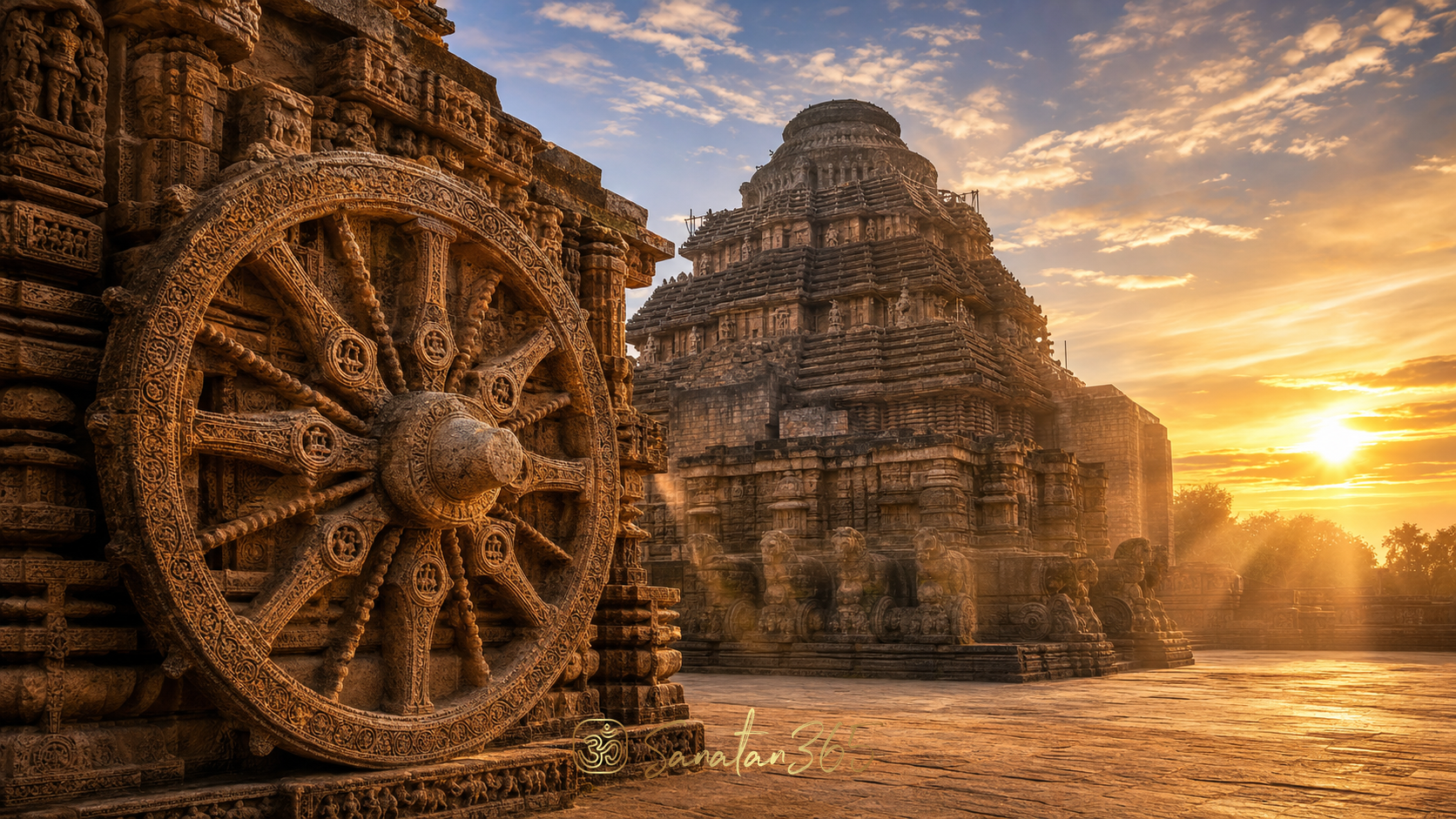
Konark's great wheels are among the most recognizable works of Indian architecture. The monument has twenty-four wheels, richly carved with hubs, spokes, rims, miniature figures, floral forms, and scenes of life. Seven horses are associated with the chariot composition, although the surviving monument has changed substantially over centuries.
Popular explanations often identify the twenty-four wheels with the hours of a day, pairs of months, or cycles of time, and the seven horses with days of the week or colours of light. Some of these readings are meaningful later interpretations, but not every neat numerical claim has equal historical support. A responsible reading distinguishes what is physically present from symbolism that has accumulated around it.
What the wheels unquestionably communicate is patterned movement. A wheel turns and returns, yet it also carries a traveller forward. Hindu reflection often holds these two truths together: existence contains cycles, but choices within those cycles matter. Morning returns, but this morning is not recoverable once spent.
The horses intensify that sense of momentum. In sacred art, a horse can suggest vitality, speed, royal strength, and directed life-force. At Konark, they pull not a small ceremonial vehicle but the temple itself. Architecture becomes an event.
The carvings on and around the wheels also resist a false separation between sacred and ordinary life. Musicians, dancers, animals, plants, affectionate couples, processions, and daily activities inhabit the temple's sculptural world. The cosmos is not represented as an empty abstraction. Human life, with its beauty and complexity, unfolds under the same sun.
Key takeaway: Konark's wheels and horses make time visible as both cycle and forward movement, asking that vitality be guided rather than wasted.
How Does Light Shape the Temple's Sacred Architecture?
No solar temple can be understood apart from light. At Konark, changing illumination brings different carvings into relief. Edges sharpen in the morning, surfaces flatten under strong midday sun, and long shadows return toward evening. The monument is never visually identical from hour to hour.
This does not justify every dramatic claim that circulates online about exact alignments or miraculous effects. The safer and more beautiful truth is observable: sunlight activates the architecture. Carved depth depends on shadow; shadow depends on the sun's position. Surya is therefore represented by image, orientation, rhythm, and the visitor's own act of seeing.
The Sanskrit-rooted idea of prakasha (प्रकाश, illumination or radiance) can mean more than physical brightness in Indian philosophical writing. Light becomes a metaphor for recognition: something was present, but not yet clearly seen. Konark's sculptural density rewards this patient attention. A quick photograph catches a wheel; slower looking notices the lives carved across it.
The temple once included a towering main sanctuary, or deul (ଦେଉଳ, the Odia term for a temple or its sanctum structure), which no longer survives in its original form. The large audience hall remains the dominant mass. Any mental picture of Konark should therefore honour the surviving monument instead of imagining a perfectly intact fantasy reconstruction.
Key takeaway: At Konark, light is not decoration. It is an active partner that reveals form, marks passing hours, and trains attentive seeing.
What Does Konark Reveal About Odisha's Kalinga Tradition?
Konark belongs to the mature Kalinga school of temple architecture. Its soaring vertical conception, rhythmic wall projections, sculptural programmes, and relationship between sanctuary and assembly spaces connect it to Odisha's wider sacred landscape. The Archaeological Survey of India protects the monument, while UNESCO recognizes it as a World Heritage Site.
It is also important to speak of Konark as part of Odisha's living cultural memory, not merely as a ruin from a vanished civilization. Surya worship, temple arts, Odissi dance, stone carving, pilgrimage routes, and local storytelling continue to shape how the site is encountered. The annual Konark Dance Festival is a modern cultural setting rather than proof of an unchanged medieval ritual, yet it shows how architecture can remain a stage for artistic continuity.
The famous sculptures include sacred figures as well as depictions of courtly, musical, martial, animal, domestic, and intimate life. Mature visitors may notice erotic imagery among the much broader programme. Such carvings should be approached without embarrassment, sensationalism, or the claim that one interpretation explains them all. They belong within a temple vision capacious enough to acknowledge fertility, desire, social life, discipline, and transcendence.
Konark's damaged condition tells another story. Coastal weather, structural change, historical disruption, vegetation, and human intervention have all affected the complex. Conservation is not peripheral to its spiritual meaning. Reverence for a sacred inheritance includes the restraint required to protect it.
Key takeaway: Konark is simultaneously a Surya temple, a summit of Kalinga architecture, an Odia cultural inheritance, and a conservation responsibility.
How Should Visitors Approach Konark Responsibly?
A responsible visit begins with the recognition that Konark is neither a theme park nor a backdrop available without limits. It is a protected monument with sacred associations and fragile stone surfaces.
Visitors can keep five simple disciplines:
- Follow current site rules. Opening hours, access areas, ticketing, and photography guidance can change, so consult official sources before travel.
- Do not touch or climb carvings. Stone that appears massive can lose detail through repeated contact and abrasion.
- Dress and speak with respect. The site receives pilgrims, families, students, scholars, and international visitors.
- Allow time for slow observation. Walk around the surviving structures, notice changing light, and look beyond the most photographed wheel.
- Support responsible local culture. Learn from credible guides and artisans without purchasing objects falsely presented as antiquities.
Odisha's coastal heat and humidity can be intense. Water, sun protection, and a gentler pace are practical forms of care; they do not diminish devotion. Visitors should also verify accessibility conditions and avoid assuming that every part of an archaeological complex is easy to navigate.
A pilgrimage-minded visitor may begin with a quiet intention rather than a demand for a dramatic experience. Pranama (प्रणाम, a respectful bow) can be inward as well as physical: attention, restraint, gratitude, and willingness to learn.
Key takeaway: The most respectful way to meet Konark is through informed attention, physical restraint, and care for the monument's future.
What Can Surya's Chariot Teach Modern Readers About Time?
Konark's most contemporary lesson may be that time is not merely a pressure to move faster. The sun's movement is regular, not frantic. A wheel works because its centre is stable while its rim moves. This offers a compelling image for modern life: activity needs orientation.
Surya's radiance also exposes. In bright light, avoidance becomes harder. A daily solar reflection can therefore remain simple and non-superstitious: What deserves clear attention today? Which responsibility has been postponed? Where is energy being spent without direction?
The temple does not promise control over time. Its own damaged history makes such a promise impossible. Instead, Konark holds grandeur and impermanence together. Human beings can build with extraordinary vision, yet every structure still requires care. The answer to impermanence is not despair; it is stewardship.
One may honour this teaching without copying a ritual outside its proper context. Watching sunrise, offering gratitude, keeping a promise, working with steadiness, or protecting shared heritage can each become a modest response to the chariot's deeper invitation.
Key takeaway: Konark teaches neither haste nor passivity, but purposeful movement anchored in clarity, rhythm, and stewardship.
FAQ
What is the main meaning of Konark Sun Temple?
Konark Sun Temple represents the celestial chariot of Surya. Its monumental wheels, horses, carvings, and relationship with light express sacred time, solar energy, disciplined movement, and the breadth of life under the sun.
Who built the Konark Sun Temple?
Historical evidence associates the temple with King Narasimhadeva I of the Eastern Ganga dynasty in the thirteenth century. Its creation depended on generations of architectural, sculptural, engineering, and devotional knowledge.
Why does Konark have twenty-four wheels and seven horses?
The wheels and horses establish the temple as Surya's chariot. Later interpretations connect the numbers with hours, months, days, or solar qualities, but these neat correspondences should be presented as interpretations rather than universally proven original meanings.
Is worship still performed inside the Konark Sun Temple?
The surviving protected monument is primarily encountered as a heritage and sacred site rather than as a fully functioning temple sanctuary. Visitors should follow current official guidance and respect the devotional significance the place continues to hold.
What is the best way to visit Konark respectfully?
Check official timings, avoid touching or climbing carvings, dress and speak respectfully, allow time for careful observation, and follow all conservation rules. Early hours can also offer gentler heat and more revealing light.
Konark's stone chariot has endured precisely because care has outlived many moments of neglect. Its deepest invitation is not to conquer time, but to meet time consciously.
Key takeaway: Surya's chariot reminds every generation to move with purpose, see clearly, and protect what it has inherited.
About the author
Sanatan365 Editorial
Bringing Sanatan Dharma to modern seekers through authentic, scripture-grounded content.
Related in Temples
 Temples
Kamakshi Amman Temple: Kanchipuram's Shrine of Sacred Stillness
Kamakshi Amman Temple places the Divine Mother at the spiritual heart of Kanchipuram. Its seated goddess, Sri Chakra tradition, and sacred-…
 Temples
Lingaraj Temple: Shiva, Harihara, and Kalinga Architecture
Lingaraj Temple in Bhubaneswar joins Shiva devotion, Harihara theology, Kalinga architecture, sacred water, and living worship in one histo…
 Temples
Dwarkadhish Temple Meaning: Krishna, Dwarka, and Sacred Pilgrimage
Dwarkadhish Temple remembers Krishna as the responsible ruler of Dwarka. Explore its meaning, sacred geography, living worship, and respect…