Rajarani Temple: How to Read Its Eight Guardians
Learn to read Rajarani Temple’s eight guardians, distinguish them from other figures, and understand what the carvings can tell us about the shrine.
A photograph of Rajarani Temple can show the curve of its tower, the warm colour of its stone and the depth of its carvings. A few steps around a corner reveal what a single photograph leaves out.
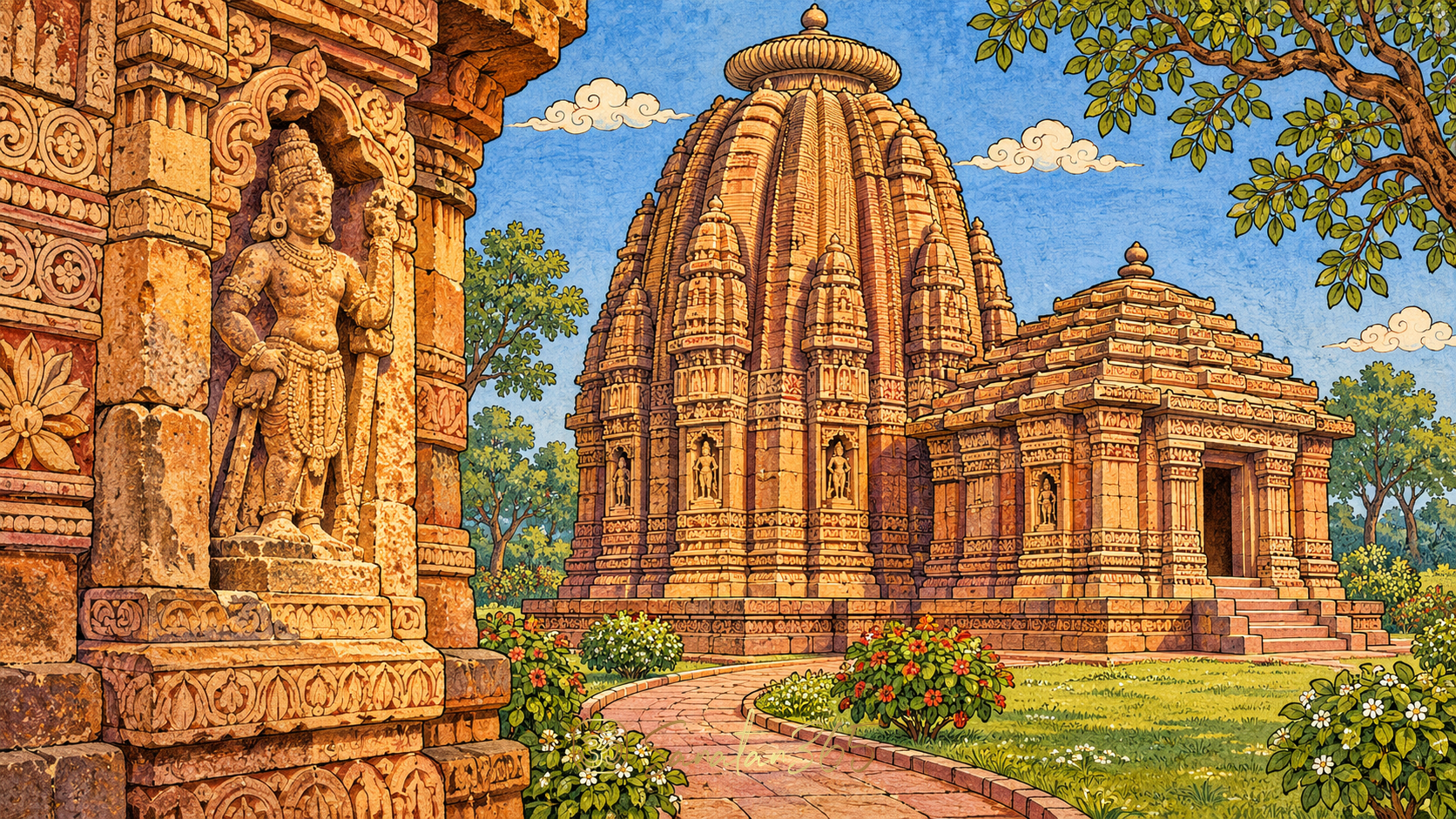
Rajarani Temple in Bhubaneswar is an eleventh-century monument of Odisha’s Kalinga architectural tradition. Eight guardians on its shrine tower represent the four principal and four intermediate directions. Their placement gives a reader of the building a concrete question: what changes when a carved figure belongs to a particular direction rather than to a single front-facing display? The answer begins outside, in the relationship between the sculpture and the wall that carries it.
What are the eight guardians of Rajarani Temple?
Odisha Tourism’s Rajarani Music Festival brochure identifies eight figures on the shrine tower as dikpālas (दिक्पाल, guardians of the directions). Their role is expressed in their name: they guard or preside over directions. Eight includes the four directions familiar from the sides of a map and the four between them. This makes the group a way of thinking about the space around the shrine.
A person studying a photograph might reasonably ask which deity a particular carving depicts. It is a good question, but it is not the only starting point. A second question is what the figure is doing in that place. The brochure’s description gives the group a relationship to the tower and to orientation. The figures belong to a set even when only one or two can be studied from a given position.
There is a useful distinction between identifying the group and identifying each member from a fragment. The first is supported by the official description. The second calls for a reliable plan or a labelled photograph and sufficient surviving detail. A carving partly hidden by shadow does not become an identified guardian merely because it is on an ornate wall. Conversely, inability to name a figure on the spot does not make the group’s organising idea any harder to understand.
A small compass rose on a page can help a family picture the difference between four directions and eight. It is a teaching aid for the concept. It does not become a verified map of the temple’s individual niches unless it is checked against a source that records those locations.
Key takeaway: The guardians make sense as an ensemble tied to direction. Recognising that ensemble is separate from naming each figure.
Why does the tower carry the guardians?
The Odisha Tourism monument profile draws attention to the shrine’s spire, its reddish-gold sandstone and the carvings that include guardians and celestial maidens. The festival brochure places the eight guardians on the ornate deul (ଦେଉଳ, Odia for temple; here the shrine structure). That location matters. A tower above a shrine is visible as a single rising form from a distance, while its sculpture becomes easier to separate into groups at closer range.
Try beginning with the silhouette. The eye can follow the rising outline without having to resolve any of the figures. A closer view reveals that the outer wall does not read like a sheet of paper with pictures printed on it. Projections, recesses and mouldings set some details forward and allow others to fall into shadow. An oblique view can make that depth easier to see than a head-on view does.
That relationship offers one interpretation of why a group concerned with direction works so well here. The sculpture gives form to an idea that already involves looking and turning. A person can hold the tall silhouette in mind and then consider how a carving is placed within the space that surrounds it. The building’s exterior thus supplies the context in which the figures are encountered. This is an observation about how the sculpture can be read today; it is not evidence of a prescribed historical route for visitors.
The entrance hall provides a second large mass against which to judge the rising shrine tower. From a view that includes both, it is easier to see where the tower starts and to keep a sculptural detail anchored to the correct part of the building. That simple visual distinction is more useful to a first-time observer than memorising a whole architectural vocabulary.
Key takeaway: Read the tower first as a shape and then as a surface. The guardians belong to the building’s three-dimensional design.
How can a visitor read a damaged or unfamiliar figure?
Begin by recording what can actually be seen. Is the figure on a projection or in a recess? Does it stand alone, or is another form close enough to belong to the same carving? Is there a surviving object in the hand, or is that area broken or shaded? In a photograph, a dark patch can make a shallow cut appear deeper than it is. Looking from another permitted angle often clarifies which lines belong to the stone and which belong to the light.
Then describe the figure without naming it. A brief note such as “upright figure in a tall niche, with the lower part in shadow” is more useful for later comparison than a confident identification without evidence. It preserves the things a second observer could check. If a credible diagram or site description becomes available, the note can be placed alongside it. The description may support an identification, or it may reveal that there is too little detail to decide.
That discipline also helps distinguish between different kinds of temple carving. The tourism profile mentions celestial maidens as well as guardians. A graceful stance, an elaborate setting or a prominent position is insufficient by itself to assign a figure to either group. One panel can be appreciated for the bend of a limb or the handling of jewellery even when the figure’s name is uncertain. The carver’s decisions and the figure’s identity are two questions, each deserving attention.
A useful set of images consists of a wide view, a view showing the figure in its niche, and a closer detail taken without touching the surface or crossing a barrier. The wide view lets a later reader recover the location. The middle view preserves the architectural frame. The detail shows the marks that might support a more specific reading. A single tightly cropped photograph may be beautiful and still omit the best clue.
Key takeaway: Establish position and surviving detail before giving a carved figure a name.
What can the carvings tell us about a sanctum without a presiding deity?
The official monument profile says that Rajarani Temple has no presiding deity and that its imagery suggests a Shaiva origin, meaning an association with worship of Shiva. Those are different types of information. One describes the condition of the shrine now; the other interprets evidence about its religious setting. Putting them side by side is more helpful than turning the absence of a deity into a story about what definitely happened.
The guardians do not by themselves settle the question of dedication. Their subject is direction, and the source treats the temple’s iconography as a broader body of evidence. The inference is stronger when it is kept at the level the source supports. A description of Shaiva associations leaves room to discuss the sacred character of the sculpture without claiming an exact founding event, an original installed image or an explanation for its absence.
Bhubaneswar’s nearby monuments offer a useful comparison. The guide to Lingaraj Temple’s worship and architecture discusses a different site with its own traditions of worship and interpretation. Those traditions can sharpen a reader’s questions about Rajarani, but details of one shrine cannot be carried over to the other. Even buildings in the same city, using a related architectural language, may have quite different histories and present-day uses.
This distinction also helps explain what a visit can offer. Someone expecting the worship practices of a functioning shrine should consult the relevant temple’s own information. At Rajarani the exterior is a particularly good place to spend time, because its plan, profiles and sculpture preserve evidence that does not depend on seeing a deity in the inner room. The absence noted by the source does not remove the need to approach the site and its imagery respectfully.
Key takeaway: The absence of a presiding deity describes the temple today. The sculpture offers clues about its past, with limits on what those clues establish.
How can families look at the temple without rushing?
A rewarding visit can begin with three stops. First, find an allowed vantage point far enough back to see the shrine tower and hall together. Sketch their outlines with two or three lines. This is an exercise in noticing which form rises and which broadens, so a rough sketch works. Next, choose a wall where a figure and its surrounding stone can be seen together. Find the line of the recess or projection that holds it. Finally, move to another allowed viewpoint and see what becomes visible or disappears.
These stops give children and adults different tasks within the same visit. One person can notice colour, another can look for changes in depth, and another can describe where a figure sits. Their observations need not agree at first. The difference can be a reason to return to the wider view and check where everyone was standing. A shaded detail seen from one spot may look quite different from a sunlit carving in a photograph.
The same activity works with photographs for readers who cannot visit. Use views from different sides when possible, and keep the credits and captions with the images. Mark which parts of the structure are actually shown. If the available images leave a side out, let that side remain unobserved rather than filling it in by symmetry. This is particularly helpful for a monument where the question is how a group of carvings occupies space.
A comparison with Mukteshvara Temple’s carved gateway can make the exercise more specific. The gateway invites attention to the way a visitor approaches and passes a threshold. At Rajarani, the directional guardians invite attention to the sides and corners of a shrine tower. Visiting both with a distinct question makes it easier to remember what each building taught, even when the details of an entire day begin to blur.
Key takeaway: A wide view, a wall detail and a change of position reveal more than a hurried search for eight faces.
FAQ
Where is Rajarani Temple?
Rajarani Temple is in Bhubaneswar, in Odisha’s Khordha district. Odisha Tourism identifies it as an eleventh-century heritage monument and lists nearby sites including Mukteswara and Lingaraj temples.
Why are there eight directional guardians?
The group encompasses the four principal directions and the four intermediate directions. The official festival brochure identifies the guardians as part of the sculpture of the shrine tower. Their purpose as a group is easier to grasp from the building’s layout than from a close-up of an isolated face.
Does Rajarani Temple have a presiding deity today?
Odisha Tourism says that it does not. Its profile describes the sculpture as suggesting a Shaiva origin. This association does not explain on its own when or why the shrine came to have no presiding deity.
What should a first-time visitor look for?
Start with the outline of the tower and the contrasting profile of the entrance hall. Then notice how a niche or projection frames one figure. A second viewing angle can show how the stone turns the corner and how the same detail changes with the light.
About the author
Sanatan365 Editorial
Bringing Sanatan Dharma to modern seekers through authentic, scripture-grounded content.
Related in Temples
 Temples
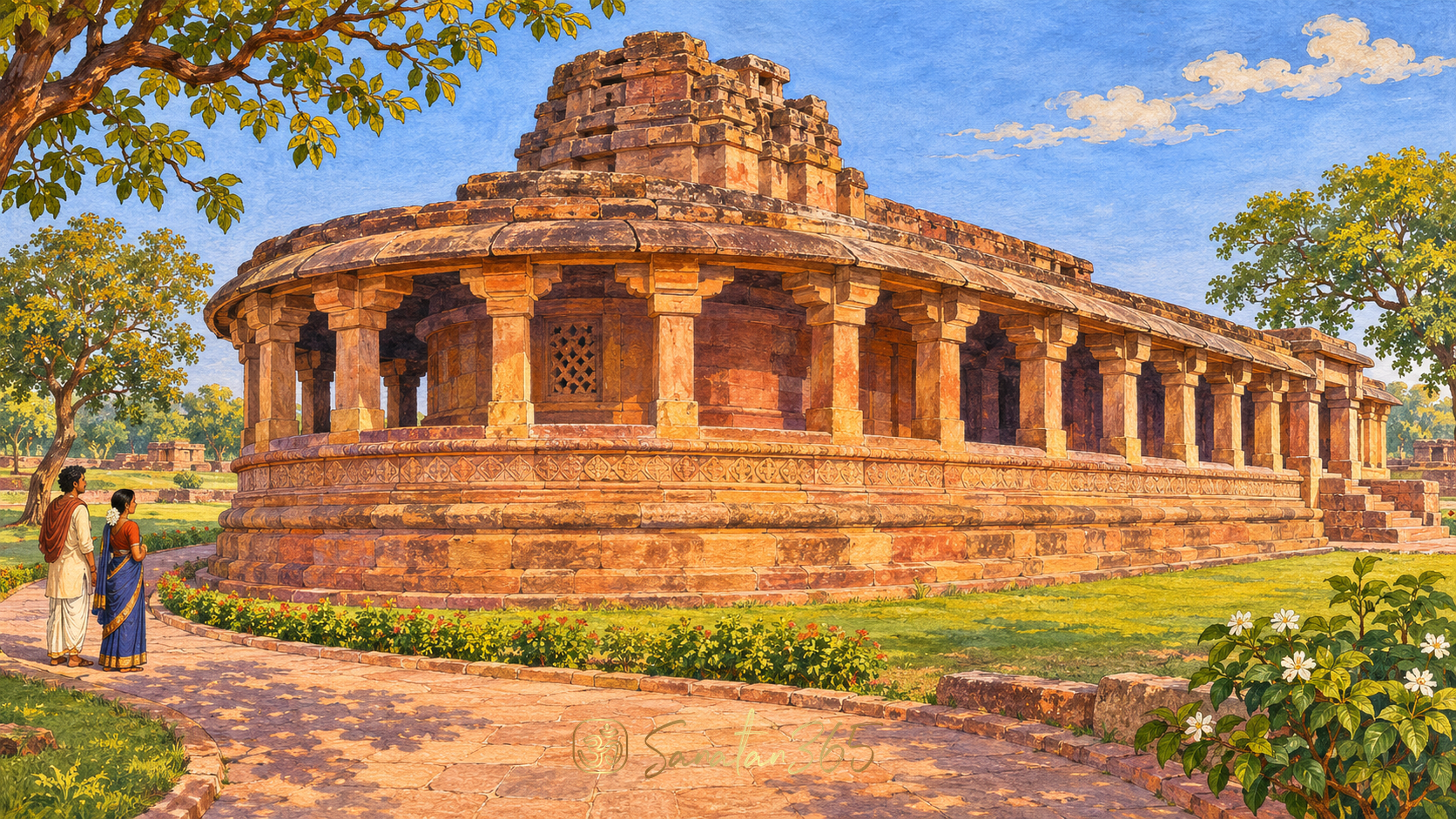
Aihole Durga Temple: Reading the Curved Stone Plan
Read Aihole’s Durga Temple through its rounded rear, raised plinth and pillared gallery, and see how a curved plan creates a sheltered rout…
 Temples
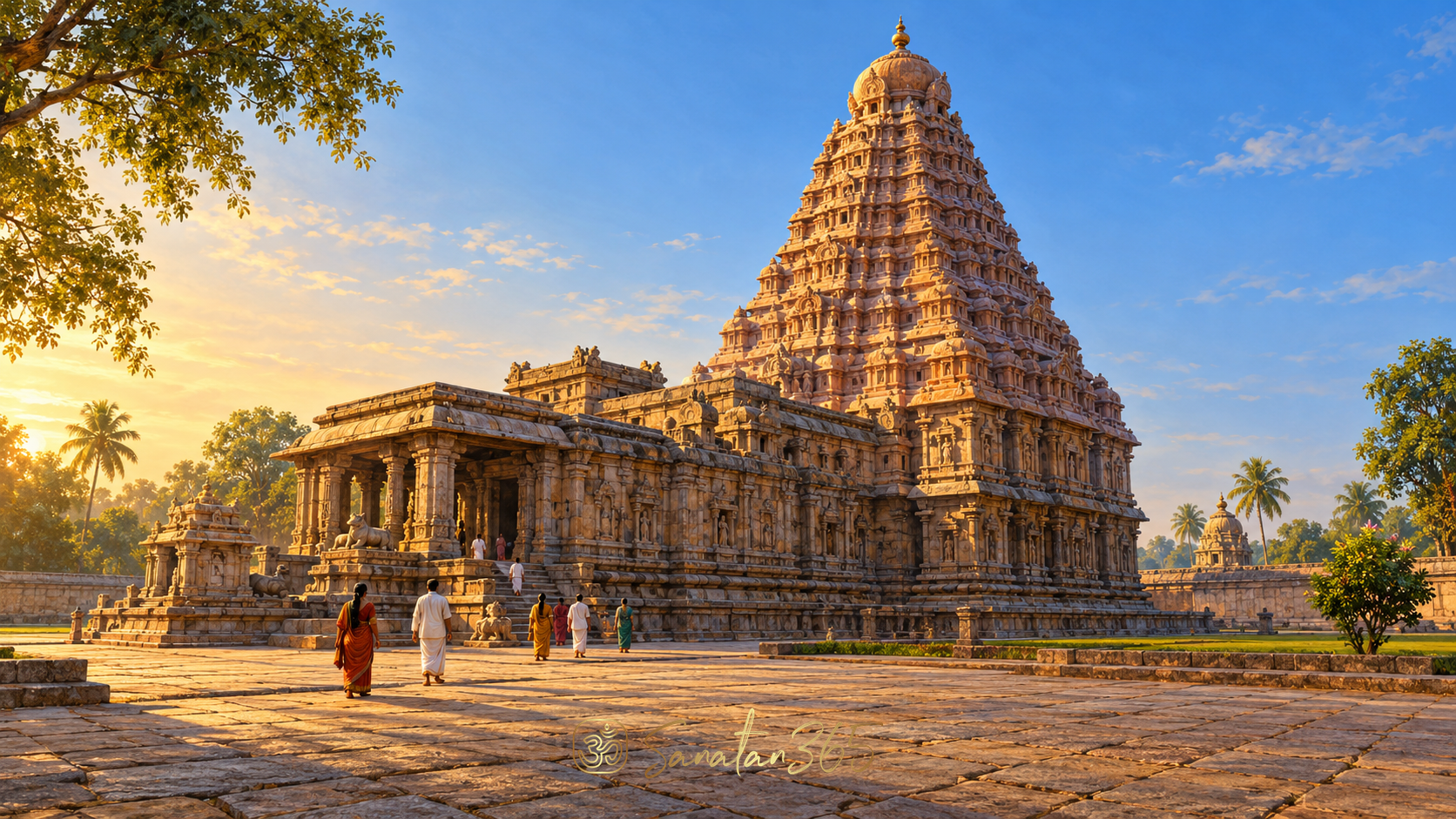
Gangaikonda Cholapuram Temple: Reading the Curve of Sacred Stone
How a curving Chola sanctum tower, carved surfaces and continuing Shiva worship invite a more attentive way of seeing Gangaikonda Cholapura…
 Temples
Tiruchendur Murugan Temple: Devotion at the Edge of the Sea
At Tiruchendur, Murugan worship meets the sea. Read its coastal setting, sacred traditions and water observances with devotion, care and hi…

