
Surya Arghya Meaning: Why Water Is Offered to the Rising Sun
Learn the meaning of Surya Arghya, why devotees offer water to the rising sun, and how to approach this daily Hindu practice with gratitude, care, and reverence.
Before the day becomes crowded with words, Surya Arghya begins with three simple things: water, light, and attention. A devotee faces the dawn and lets a clear stream fall from a small vessel while offering reverence to Surya, the solar deity. The Surya Arghya meaning is not that the sun needs human water. The offering trains the person to receive daylight as a gift, begin the day with gratitude, and place disciplined awareness before hurried activity.
This practice appears in different household, regional, and lineage settings. Details vary, but its centre remains remarkably clear: acknowledge the visible source of light, offer something pure, and remember that life depends on powers no individual created.
What Is Surya Arghya Meaning?
Surya (सूर्य, Sūrya, the sun or solar deity) is honoured in Vedic and later Hindu traditions as the luminous divine presence associated with light, order, vision, vitality, and the rhythm of time. Arghya (अर्घ्य, arghya, an offering of honour, often made with water) is a respectful presentation given in worship or sacred hospitality. Together, Surya Arghya means an offering of water and reverence to Surya.
The act is often performed at sunrise, when darkness gives way to visible light. A devotee may stand outdoors or in a clean place with an open view of the morning sky, hold a lota (लोटा, loṭā, a small rounded water vessel), and pour the water slowly while praying. Some families use a copper vessel; others follow materials specified by their own tradition.
Arghya also has a wider ritual meaning. Water may be offered to welcome and honour a sacred presence. The existing guide to Arghya in Hindu worship explores that broader language of sacred hospitality. Surya Arghya is a distinct daily application: its focus is Surya, its natural moment is dawn, and its emotional grammar is gratitude for light and a new beginning.
The offering should not be reduced to a transaction. It is not a payment for guaranteed success, health, or luck. It is an act of upāsanā (उपासना, upāsanā, reverent spiritual attendance or worship), shaped by attention and regularity.
Key takeaway: Surya Arghya is a water offering of honour to Surya, usually made at sunrise as an expression of gratitude and disciplined remembrance.
Why Is Water Offered to Surya at Sunrise?
Sunrise joins outer event and inner opportunity. The world becomes visible again, while the person receives a natural invitation to begin again. Offering water at this threshold marks the change deliberately.
Vedic hymns speak of Surya and the solar power Savitr with reverence for illumination. The famous Gayatri mantra in Rig Veda 3.62.10 contemplates the radiance of Savitr and asks that understanding be inspired. Translations and theological interpretations vary, but the hymn clearly links solar brilliance with awakened intelligence rather than mere physical brightness. Readers can compare translations through the Rigveda resources at the Internet Sacred Text Archive.
The Aditya Hridayam (आदित्यहृदयम्, Āditya Hṛdayam, “Heart of the Sun”) in the Yuddha Kanda of the Valmiki Ramayana likewise presents solar contemplation at a moment when Rama needs steadiness before battle. The episode does not make dawn worship an escape from duty. It places clear remembrance before responsible action.
Water is especially fitting because it receives light visibly. As the stream descends, it catches the colours of dawn and makes an intangible radiance perceptible. The devotee offers a life-sustaining element toward the cosmic source that drives seasons, warmth, photosynthesis, and the daily measure of time. Traditional worship and modern scientific understanding use different languages here; neither requires the claim that ritual water physically sustains the sun.
The timing also encourages consistency. A practice attached to sunrise has a stable natural cue. One need not wait for a dramatic emotion. Dawn arrives, and the devotee arrives too.
Key takeaway: Water is offered at sunrise because dawn makes renewal visible and gives gratitude, prayer, and duty a natural daily threshold.
What Do Water, Light, and the Copper Vessel Symbolize?
Every element of Surya Arghya can educate attention.
Water expresses purity and willing offering
Water cleanses, nourishes, adapts to its vessel, and moves downward without pride. In worship, a clean water offering can therefore express sincerity, humility, and the wish to begin with clarity. The symbolism does not mean that ordinary water becomes a magical guarantee. Its meaning arises through reverent use.
Light represents visibility and discernment
Surya makes forms visible. This outer fact supports an inner reflection: may confusion become clearer, may hidden motives be seen, and may action follow dharma (धर्म, dharma, sustaining order and responsible conduct). Light in this context is not permission to claim perfect insight. It is a call to seek honesty.
The falling stream gathers attention
When poured slowly, the stream creates a brief visual centre. Hands, eyes, breath, mantra, and intention can meet in one act. The ritual is therefore embodied. Gratitude is not left as a vague idea; it takes shape through posture, water, timing, and restraint.
Copper belongs to a living ritual culture
A copper vessel is common in many Surya worship traditions. Copper carries a warm colour that suits the dawn and has a long history in Indian household ritual. Yet one should avoid inventing biomedical claims about water simply because it touched copper. The vessel's ritual suitability and cultural continuity are sufficient reasons to honour it. If a household or teacher uses another clean vessel, that tradition should be followed respectfully.
Key takeaway: Water suggests purity and humility, light invites discernment, the stream gathers the senses, and the vessel connects the act with inherited practice.
How Can a Beginner Offer Surya Arghya Respectfully?
A beginner can keep the practice simple. Lineage instructions, family customs, and local conditions should take precedence over a universal internet formula.
- Prepare a clean place and vessel. Fill a clean lota or small vessel with fresh water. Some traditions add a flower or other permitted offering, but plain clean water is enough for a simple beginning.
- Approach sunrise calmly. Bathe or wash as appropriate to the household custom, wear clean clothing, and stand where spilled water will not create a hazard or disrespect a shared space.
- Face the morning light without staring at the sun. Keep the gaze soft and directed toward the water stream or the horizon. Direct solar gazing can injure the eyes.
- Hold the vessel steadily. Raise it comfortably with both hands or according to family instruction. There is no value in straining the shoulders or forcing a dramatic posture.
- Pour the water slowly. Let the stream fall onto clean earth, a plant-safe place, or a suitable basin. Avoid wasting large quantities; reverence includes care for water.
- Offer a short prayer or silence. A simple “Om Suryaya Namah” may be used where appropriate, or the devotee may offer gratitude in their own words.
- Close with intention. Bow or join the palms, then name one quality to carry into the day: clarity, steadiness, truthfulness, generosity, or responsible action.
If sunrise is not visible because of weather, buildings, mobility, work, or season, sincerity need not disappear. A person can face the brightening sky or a clean window and offer a modest prayer. The goal is not to turn practical limitation into spiritual guilt.
Key takeaway: A respectful beginner practice uses clean water, steady attention, a safe gaze, a short prayer, and an intention that continues into daily conduct.
Which Mantras Are Commonly Used with Surya Arghya?
The shortest widely used salutation is:
Om Suryaya Namah (ॐ सूर्याय नमः, oṃ sūryāya namaḥ), meaning “Reverence to Surya.”
Its simplicity makes it suitable for many beginners. Pronunciation can be learned gradually from a trusted teacher or family member. Devotion should not become anxiety about immediate perfection.
Some practitioners recite the Gayatri mantra as part of sandhyā (सन्ध्या, sandhyā, prayer at the junctions of the day). However, Gayatri practice may be embedded in specific initiation and lineage disciplines. A reader should not assume that every household combines the same mantra, gesture, and sequence. The guide to Sandhya Vandana explains the wider twilight-prayer context.
The Aditya Hridayam and collections of Surya's names are also used in some traditions, but a long recitation is not required merely to make a daily offering sincere. One well-understood salutation, offered attentively, is better than many words repeated without care.
Mantra should support the ethical meaning of the act. If a person praises light but chooses deception through the day, the ritual has not yet completed its teaching. The real continuation of “reverence to Surya” is conduct willing to be seen clearly.
Key takeaway: “Om Suryaya Namah” is a concise salutation, while longer recitations should follow family or lineage guidance rather than a one-size-fits-all formula.
What Safety and Tradition-Specific Boundaries Should Be Remembered?
Surya Arghya is a spiritual practice, not medical treatment. It should never be promoted as a guaranteed cure for eyesight, digestion, mood, hormones, or any illness. Morning routine and prayer may feel meaningful, but health concerns belong with qualified clinicians.
Eye safety is especially important. Do not stare directly at the sun, even near sunrise, and never use the water stream as an optical lens for prolonged viewing. People with eye conditions should follow professional medical advice. Children should practise only with attentive adult guidance.
Physical safety matters too. Wet stone, balconies, rooftops, traffic areas, and unstable riverbanks can create risks. Choose a secure surface and pour only where the water can drain responsibly. In cold weather or with limited mobility, remain comfortable rather than treating discomfort as proof of devotion.
Tradition also deserves humility. Some households specify bath, direction, vessel, mantra, hand position, or the inclusion of flowers, rice, or red sandal paste. Others keep the offering plain. These differences need not be ranked. A family practice can be followed with reverence, while a person without inherited instruction can begin modestly and seek guidance from a knowledgeable teacher.
Key takeaway: Protect the eyes and body, avoid medical promises, conserve water, and respect variations among household and lineage traditions.
What Can Surya Arghya Teach Beyond the Ritual?
The deepest test of a morning practice is what happens after the water reaches the ground.
Surya Arghya teaches gratitude before consumption. Most mornings begin by taking: attention from a phone, food from the kitchen, electricity from a grid, effort from other people. The offering reverses the first movement. Before taking, give thanks.
It teaches regularity without spectacle. Sunrise does not wait for motivation, applause, or a perfect mood. A small daily act can shape character precisely because it is repeated when no audience is present.
It teaches visible responsibility. Under bright light, details appear. A devotee may ask: What am I avoiding? Which promise needs action? Where can today's speech become clearer? This makes worship a preparation for dharma rather than a hiding place from it.
Finally, it teaches release. The water cannot be taken back once poured. The devotee offers it fully and begins the day without controlling every result. Effort remains necessary, but ownership softens.
A practical closing reflection can be held in four lines:
- May I receive light with gratitude.
- May I see my duties clearly.
- May my energy serve rather than scatter.
- May I release the results I cannot control.
Key takeaway: Beyond ritual, Surya Arghya trains gratitude, consistency, honest self-seeing, purposeful action, and release.
FAQ
What is Surya Arghya in simple words?
Surya Arghya is the Hindu practice of respectfully offering water to Surya, usually at sunrise. It expresses gratitude for light and life while helping the devotee begin the day with prayer and focused intention.
Which direction should a person face for Surya Arghya?
At sunrise, practitioners commonly face east, toward the brightening horizon. Local space, weather, mobility, and family tradition can affect the exact arrangement.
Is a copper lota compulsory?
A copper lota is traditional and widely used, but practices vary. A beginner should follow household or teacher guidance and prioritize a clean, respectful vessel rather than making unsupported claims about a material.
Can Surya Arghya be offered when the sun is hidden by clouds?
Yes. Clouds do not cancel sunrise. A devotee can face the brightening sky and make the offering with the same gratitude, provided the place and conditions are safe.
Does offering water to Surya guarantee health or success?
No. Surya Arghya is devotional practice, not a guaranteed medical, financial, or astrological remedy. Its trustworthy fruits are the qualities it trains: gratitude, attention, regularity, reverence, and responsible action.
About the author
Sanatan365 Editorial
Bringing Sanatan Dharma to modern seekers through authentic, scripture-grounded content.
Related in Practices
 Practices
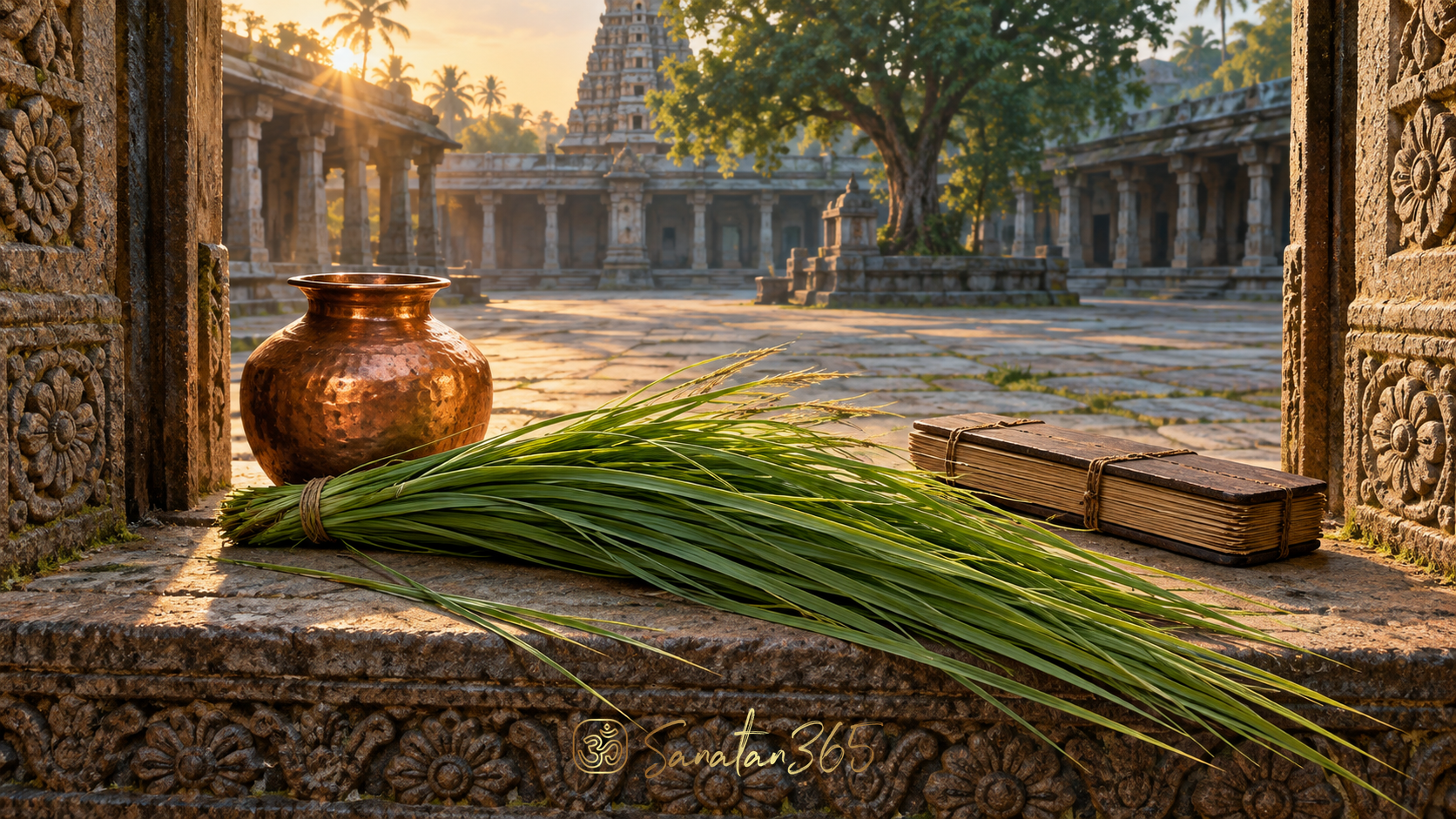
Kusha Grass Meaning: Why Darbha Has a Place in Hindu Rituals
Understand kusha or darbha grass, its traditional place in worship and ancestral rites, and how to approach varied customs with care.
 Practices
Bhuta Shuddhi Meaning: Purifying the Five Elements Within
Bhuta Shuddhi means the purification of the five elements: earth, water, fire, air, and space. In Hindu yogic and Tantric traditions, it is…
 Practices
Likhita Japa: Meaning and Practice of Writing a Mantra
Likhita japa turns mantra repetition into a written devotional discipline. Learn its meaning, how it differs from spoken and mental japa, a…

