Mangalacharan Meaning: The Auspicious Invocation Before Sacred Work
Mangalacharan is the Hindu practice of beginning sacred study, prayer, art, or writing with an invocation for clarity, humility, and auspicious completion.
A sacred beginning is never treated as a small thing in Hindu practice.
Mangalacharan meaning is the practice of opening a text, prayer, ritual, performance, or important undertaking with an auspicious invocation. The Sanskrit-rooted term is often written as maṅgalācaraṇa (मङ्गलाचरण): maṅgala means auspiciousness or blessing, and ācaraṇa means conduct, performance, or observance. In simple terms, Mangalacharan is a reverent beginning: a prayerful act that asks the mind to become clear, the ego to become humble, and the work ahead to unfold under divine grace.
This is why many Hindu texts, kathas, bhajans, dance recitals, and home prayers do not begin abruptly. They begin by remembering Ganesha, Saraswati, the guru, a chosen deity, or the Supreme Reality itself.
Key takeaway: Mangalacharan is not only a verse; it is the discipline of beginning well.
What is the Mangalacharan meaning in daily practice?
In daily practice, Mangalacharan means pausing before action and placing the action in a sacred frame. It may be a Sanskrit shloka, a short prayer, a silent bow, or a few lines addressed to a deity, guru, or ideal. The aim is not performance. The aim is orientation.
Traditional Sanskrit and regional dictionaries describe maṅgalācaraṇa as an auspicious opening prayer used at the beginning of a composition, recitation, undertaking, Purana reading, or katha. Wisdom Library's Sanskrit and Marathi entries define it as an invocation at the opening of a poem or work, and as a prayer for the success of an undertaking (Wisdom Library).
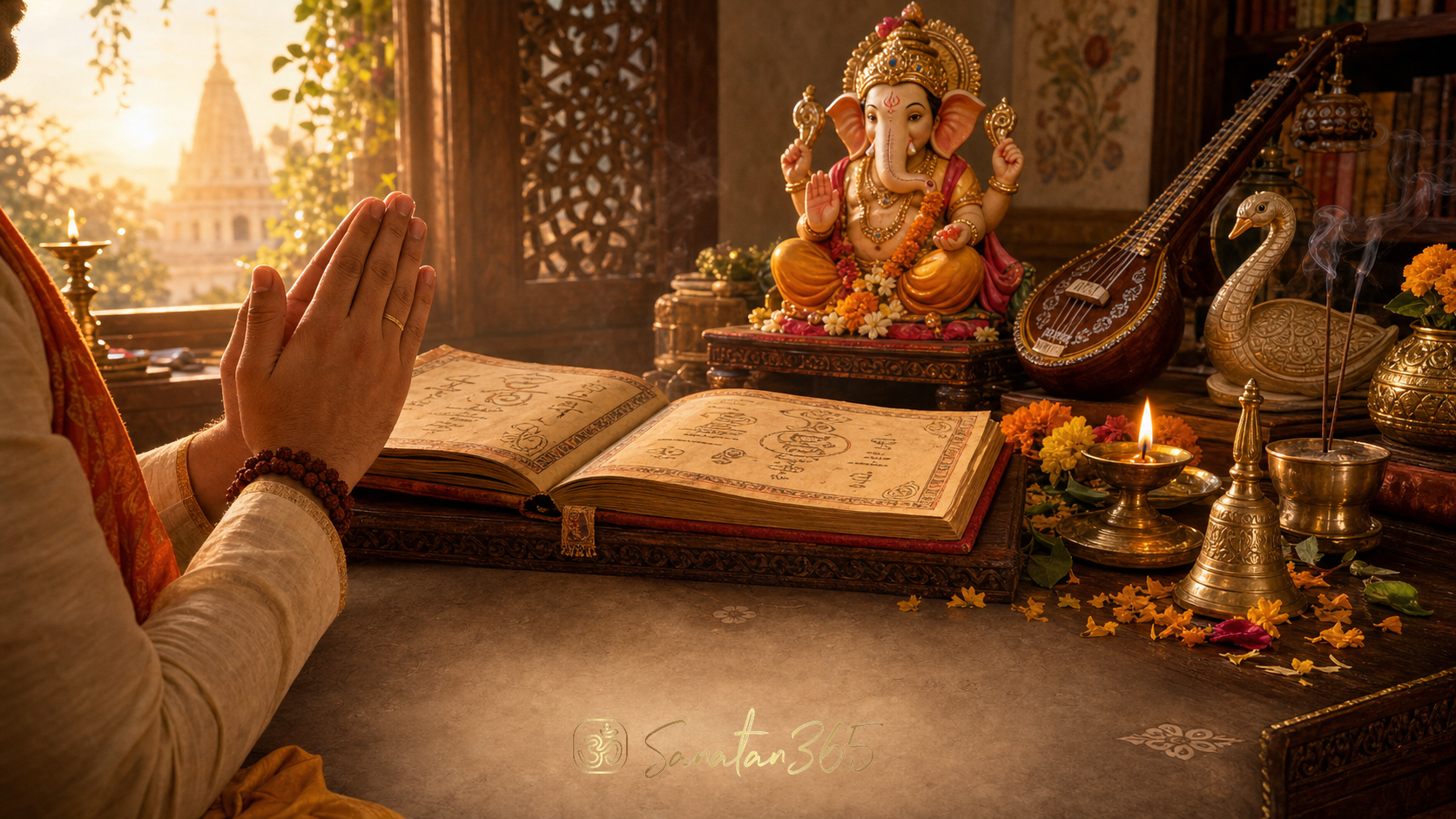
That definition explains both the literary and devotional sides of the practice. A poet may begin with a verse to Saraswati. A devotee may begin a vrata katha by invoking Ganesha. A family may begin a new house ceremony with a prayer. A musician may bow before the first note. A student may silently remember the guru before study.
The outer forms differ, but the inner movement is the same:
- Recognize that the work is meaningful.
- Remember a source of wisdom beyond the restless mind.
- Ask for obstacles to be removed.
- Begin with humility instead of haste.
This is especially important because Hindu tradition does not view sacred knowledge as merely information. Knowledge is connected with adhikāra (अधिकार, readiness or eligibility), shraddha (श्रद्धा, reverent trust), and sankalpa (सङ्कल्प, intentional resolve). Mangalacharan gently gathers these qualities before the work begins.
Key takeaway: In practice, Mangalacharan turns the first moment of an action into a conscious offering.
Why do Hindu texts begin with an auspicious invocation?
Many Hindu philosophical, devotional, and literary works begin with an invocation because the beginning is believed to shape the energy of the entire work. If the first movement is ego, argument, or restlessness, the work carries that tone. If the first movement is remembrance, gratitude, and clarity, the work is more likely to serve truth.
This is why mangala shlokas appear at the start of many Sanskrit works. A shloka (श्लोक, metrical verse) may praise a deity, remember the guru, bow to the Supreme, or state the central truth of the text. In some traditions, the opening verse is not merely decorative. It can carry the seed of the whole teaching.
The famous opening remembrance used before reciting the Mahabharata and Srimad Bhagavatam invokes Narayana, Nara, Saraswati, and Vyasa before beginning the recitation:
nārāyaṇaṃ namaskṛtya naraṃ caiva narottamam devīṃ sarasvatīṃ vyāsaṃ tato jayam udīrayet
The sense is: having bowed to Narayana, to Nara, to Devi Saraswati, and to Vyasa, one may then speak of victory. This verse shows the layered nature of Mangalacharan. It honors the Divine, the ideal human seeker, the goddess of learning, and the sage who transmitted the epic tradition. It is not a random preface. It tells the listener how to enter the text.
In devotional lineages, such as Gaudiya Vaishnava traditions, long sequences of Mangalacharan prayers may honor the guru, previous acharyas, devotees, and Bhagavan before scriptural study or kirtan. Publicly available devotional editions often identify the opening verses of major works as auspicious invocation prayers (Caitanya Caritamrta Compact).
The deeper reason is simple: Hindu knowledge is relational. The student receives. The teacher transmits. The deity blesses. The text opens itself through humility.
Key takeaway: Mangalacharan teaches that sacred learning begins with relationship, not self-assertion.
Which deities or principles are invoked in Mangalacharan?
There is no single mandatory form of Mangalacharan for all Hindus. The invoked presence depends on the text, region, family tradition, guru-parampara, art form, or purpose of the act. Still, several patterns are common.
Ganesha is invoked for the removal of obstacles. He is often remembered before puja, study, travel, marriage ceremonies, business openings, and artistic performance. Readers who want the wider symbolism can also study Ganesha Symbolism: Why the Remover of Obstacles Comes First. A common opening prayer is:
vakratuṇḍa mahākāya sūryakoṭi samaprabha nirvighnaṃ kuru me deva sarvakāryeṣu sarvadā
This means: O curved-trunk, great-bodied Lord, radiant like millions of suns, please make all my works free of obstacles. The word nirvighnam (निर्विघ्नम्) means free from obstruction.
Saraswati is invoked for speech, learning, music, memory, and refined understanding. Students, artists, poets, and teachers often turn to her before study or performance.
The guru is invoked because knowledge is transmitted through living and remembered lineages. Guru (गुरु) means the one who is weighty with wisdom, or the one who removes darkness. A guru invocation trains the mind to receive instruction without arrogance.
The chosen deity, or ishta devata (इष्टदेवता, cherished form of the Divine), may be invoked according to one's family or spiritual path. A Vaishnava poet may open with Vishnu or Krishna. A Shaiva work may begin with Shiva. A Shakta hymn may begin with Devi.
The formless Absolute may also be invoked. Some openings do not focus on a named form but on Brahman (ब्रह्मन्, ultimate reality), truth, peace, or the welfare of all beings.
This variety is important. Hindu practice holds both form and formlessness, local devotion and philosophical universality. Mangalacharan is not a rigid formula. It is a doorway shaped by devotion, context, and purpose.
Key takeaway: A Mangalacharan may invoke Ganesha, Saraswati, the guru, a chosen deity, or the Supreme Reality, depending on the work being begun.
How is Mangalacharan used in puja, katha, music, and dance?
Mangalacharan is visible wherever Hindu culture treats beginning as sacred.
In puja (पूजा, worship), the opening may include achamana, sankalpa, Ganesha dhyana, guru remembrance, and initial mantras. The devotee is not simply "starting a ritual." The devotee is preparing body, speech, and mind for worship.
In katha (कथा, sacred narration), the speaker may invoke Ganesha, Saraswati, Vyasa, the guru lineage, and the deity whose story is being told. This protects the narration from becoming entertainment alone. It reminds both speaker and listeners that sacred story is meant to refine the heart.
In music and kirtan, the first song or verse often functions as an invocation. A singer may begin by praising the guru, Ganesha, Krishna, Shiva, Devi, or the divine name. The voice is first offered, then expressed.
In classical dance, especially in forms such as Odissi and Bharatanatyam, invocatory pieces often appear at the start of a performance. The dancer salutes the stage, the deity, the guru, the musicians, and the audience. The stage becomes more than a platform. It becomes a consecrated space.
In writing and study, Mangalacharan may be as simple as writing "Om Shri Ganeshaya Namah" at the top of a notebook, silently bowing before reading scripture, or beginning a lecture with a prayer. Even when the act looks small, its discipline is deep.
The common thread is alignment. Hands, speech, memory, intellect, and intention are gathered before action. This protects the work from scattering.
Key takeaway: Mangalacharan appears across Hindu worship, storytelling, music, dance, and study because all meaningful action benefits from a sacred beginning.
How can a family practice Mangalacharan at home?
A family does not need a long ritual to practice Mangalacharan. The practice can be simple, sincere, and consistent.
Before a child's study session, the family may light a small lamp and chant a short Saraswati prayer. Before reading the Ramayana, Bhagavad Gita, or a Purana story, the reader may remember Ganesha, Vyasa, and the family guru. Before a birthday, wedding preparation, house move, or new business step, the family may offer flowers and pray for clarity, dharma, and freedom from avoidable obstacles.
A practical home pattern can look like this:
- Sit quietly for one minute.
- Light a diya if appropriate and safe.
- Offer a flower or folded-hands prayer.
- Chant one short invocation.
- State the intention of the work.
- Begin without rushing.
For example, before study:
Om Shri Saraswatyai Namah May learning become clear, humble, and useful.
Before a new task, this can be joined with the discipline of Sankalpa Meaning: Why Hindu Puja Begins with Sacred Intention:
Om Shri Ganeshaya Namah May obstacles be removed and may this work serve dharma.
Before family scripture reading, some families use a divine-name mantra such as Gayatri Mantra Meaning: A Vedic Prayer for Clear Intelligence or another lineage-approved prayer:
Om Namo Bhagavate Vasudevaya May this reading bring wisdom, devotion, and steadiness.
The wording can be adjusted by tradition. The key is not to turn the practice into superstition. Mangalacharan does not mean that a prayer mechanically guarantees success. It means the family begins with remembrance, steadiness, and reverence. That itself changes the quality of action.
Parents can also explain the practice to children in simple language: "Before we do something important, we pause, remember the Divine, and ask to do it with a clean mind." This makes the ritual meaningful rather than automatic.
Key takeaway: At home, Mangalacharan can be a short daily practice that teaches children reverence, attention, and humility before action.
What are common mistakes to avoid?
The first mistake is treating Mangalacharan as a magical shortcut. Hindu tradition honors prayer deeply, but prayer is not a substitute for effort, ethics, or preparation. If a student chants before study but does not study, the invocation has not been understood.
The second mistake is rushing through the verse without attention. A short prayer said with sincerity is better than a long sequence performed mechanically. The mind should know what it is asking for.
The third mistake is using invocations without respect for context. A lineage-specific Mangalacharan may belong to a particular sampradaya, or spiritual tradition. It is fine to learn from many traditions, but sacred forms should not be treated as aesthetic accessories.
The fourth mistake is assuming that only Sanskrit counts. Sanskrit carries immense sacred authority in Hindu tradition, but regional languages also carry bhakti. A Tamil, Marathi, Bengali, Hindi, Gujarati, Kannada, Telugu, Malayalam, Odia, or English prayer can function as Mangalacharan if it is offered with reverence and right intention.
The fifth mistake is making the practice fear-based. Mangalacharan is not meant to create anxiety that something terrible will happen if a line is forgotten. It is meant to cultivate auspiciousness, gratitude, and alertness.
This balance matters. The practice should make the mind more spacious, not more nervous. It should make the work more ethical, not more performative.
Key takeaway: Mangalacharan works best when it is sincere, context-aware, and joined with disciplined action.
Conclusion
Mangalacharan meaning is the wisdom of beginning with auspicious remembrance. Before a text, puja, katha, song, dance, study session, or important life action, it asks the human being to pause and bow. That pause is powerful. It reminds us that knowledge is received, speech should be purified, obstacles can be met with grace, and meaningful work should serve dharma.
The outer form may be a Sanskrit verse, a lamp, a folded-hands prayer, or a silent remembrance. The inner form is always the same: humility before beginning.
FAQ
What does Mangalacharan mean?
Mangalacharan means an auspicious invocation or prayer offered at the beginning of a sacred text, ritual, performance, study, or important undertaking. It comes from maṅgala (auspiciousness) and ācaraṇa (conduct or observance).
Is Mangalacharan always a Sanskrit mantra?
No. Many traditional forms are Sanskrit shlokas, but a sincere invocation in a regional language or even a silent prayer can serve the same purpose when offered with reverence and clarity.
Why is Ganesha often invoked first?
Ganesha is widely honored as Vighneshwara, the remover of obstacles. Invoking him at the beginning expresses the wish that the work proceed with clarity, steadiness, and freedom from avoidable obstruction.
Can children practice Mangalacharan?
Yes. Children can begin study, music, or scripture reading with a short prayer to Saraswati, Ganesha, the guru, or their family deity. The practice teaches attention, gratitude, and respect for learning.
Does Mangalacharan guarantee success?
No. It is not a mechanical guarantee. Mangalacharan aligns intention, humility, and remembrance. It should be joined with effort, preparation, ethical conduct, and patience.
About the author
Sanatan365 Editorial
Bringing Sanatan Dharma to modern seekers through authentic, scripture-grounded content.
Related in Rituals
 Rituals
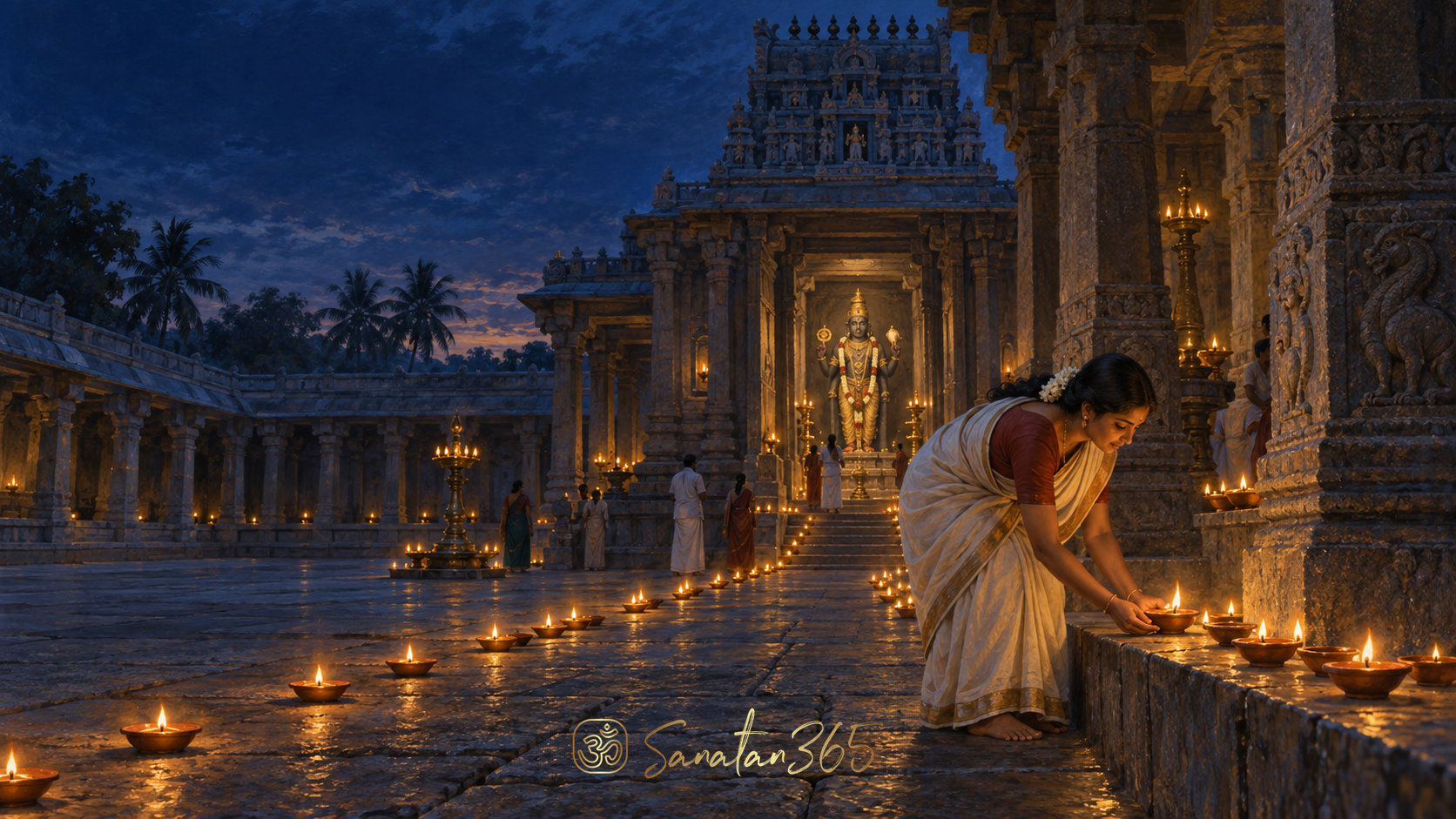
Deepa Dana Meaning: Why Devotees Offer Lamps
Deepa Dana is the devotional offering or giving of a lamp. Learn how it differs from aarti, what shared light signifies, and how to observe…
 Rituals
Kanya Puja Meaning: Honouring the Divine Feminine During Navratri
Kanya Puja honours young girls as living symbols of Devi during Navratri. Learn its meaning, timing, regional forms, offerings, and a respe…
 Rituals
Archana Puja Meaning: Names, Flowers, and Personal Temple Worship
Archana Puja is focused Hindu worship through sacred names, mantra, and offerings, often performed on behalf of a devotee or family.