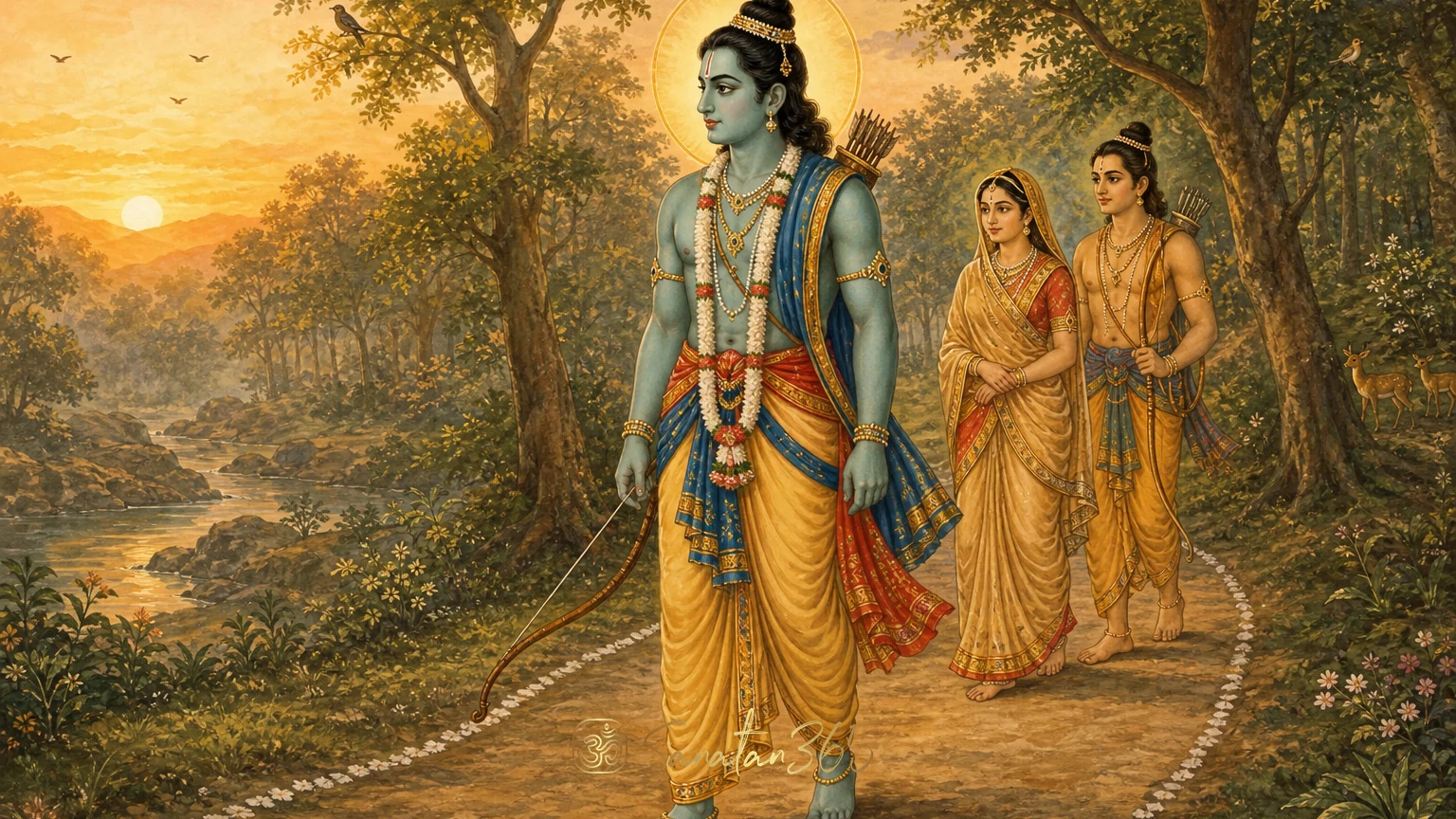
Maryada Purushottam Meaning: What Lord Rama Teaches About Dharma
A warm, practical guide to Maryada Purushottam meaning, Lord Rama's model of dharma, and how restraint can become spiritual strength.
Lord Rama is remembered not only for power, victory, or kingship. He is remembered for restraint when power could have become pride.
Maryada Purushottam meaning is the meaning of the title given to Lord Rama as the supreme person who lives within maryada (मर्यादा, sacred boundary, dignity, and ethical restraint). In simple terms, Maryada Purushottam means the ideal person who shows how dharma (धर्म, sacred order and right conduct) can be lived through duty, truthfulness, compassion, and self-control. The title does not make Rama distant from human life. It makes his life a mirror for difficult choices.
Key takeaway: Maryada Purushottam means Rama as the highest example of dignity, restraint, and dharmic conduct.
What Is Maryada Purushottam Meaning in Simple Words?
Maryada Purushottam meaning becomes clear when the two parts are understood together. Maryada means boundary, proper conduct, dignity, or the limits that protect order. Purushottam (पुरुषोत्तम, the highest or best among persons) points to an ideal human expression. Together, the phrase honors Lord Rama as the one who lives greatness without abandoning restraint.
Many traditions explain Rama through the Ramayana, especially the Valmiki Ramayana and later devotional retellings such as the Ramcharitmanas. The exact phrase “Maryada Purushottam” is especially prominent in living devotional language and later interpretive tradition. That distinction matters. A careful reader should not treat every beloved title as a direct quotation from the earliest text. But the title captures how generations have understood Rama’s life: dharma held steadily under pressure.
Rama’s greatness is not shown only in heroic action. It is shown in the way he responds to loss, exile, duty, friendship, kingship, and grief. He does not become lawless because he is strong. He does not become careless because he is loved. He does not treat personal feeling as the only measure of right action.
For modern seekers, this is the power of the title. It says that freedom without self-mastery can become chaos, but restraint guided by compassion becomes strength.
Key takeaway: The title honors Rama as greatness governed by sacred boundary, not greatness driven by ego.
Why Is Lord Rama Called Maryada Purushottam?
Lord Rama is called Maryada Purushottam because his life is remembered as a model of dharma in action. He is a son, husband, brother, friend, warrior, king, and seeker of truth. Each role carries responsibility. Rama’s example asks: what does righteousness look like when roles collide?
In the Ramayana tradition, Rama accepts exile to honor his father’s word. He protects sages in the forest. He builds alliances with humility. He treats friendship with loyalty. He fights adharma (अधर्म, conduct against dharma) without celebrating cruelty. These are not small virtues. They are the architecture of character.
A helpful way to understand Rama is through svadharma (स्वधर्म, one’s own duty or dharma according to context). The Bhagavad Gita 3.35 teaches that one’s own dharma, even imperfectly performed, is better than another’s dharma performed well Bhagavad Gita 3.35. Rama’s life is often read through this lens: he does not borrow someone else’s path because it is easier. He stands inside the responsibility given to him.
This does not mean every event in the Ramayana is easy to interpret. Hindu tradition has always allowed reflection, commentary, devotion, and debate. Rama’s life raises hard questions precisely because dharma is not a slogan. It must be discerned in context.
Key takeaway: Rama is called Maryada Purushottam because he shows duty, truth, and restraint under real pressure.
What Does Rama Teach About Boundaries and Freedom?
Modern culture often treats boundaries as limitations. Rama’s life shows another view: the right boundary can protect love, truth, and social trust.
A river becomes useful because its banks guide its flow. Without banks, water may flood and destroy. In the same way, maryada gives direction to energy. Courage needs maryada so it does not become aggression. Speech needs maryada so truth does not become cruelty. Desire needs maryada so affection does not become possession. Leadership needs maryada so authority does not become domination.
This is one reason Rama remains meaningful in family life. He represents the discipline of honoring relationships without reducing dharma to people-pleasing. A person may love parents, spouse, children, colleagues, and community, but love still needs truth. A family without boundaries can become confusion. A family with harsh boundaries can become cold. Rama points toward a middle discipline: warmth held by principle.
This also helps explain why Rama is beloved across India and the diaspora. Whether in Ayodhya, village Ram Leela performances, temple recitations, or home storytelling, Rama gives a language for dignified conduct. The lesson is not “suppress all feeling.” The lesson is “let feeling be guided by dharma.”
Key takeaway: In Rama’s example, boundaries are not cages; they are banks that help life flow toward dharma.
How Can Rama Lessons Guide Daily Life?
Rama lessons become practical when they are brought down from grand narrative into daily decisions. Most people are not ruling a kingdom or walking into exile. But everyone faces moments where comfort, ego, anger, and responsibility pull in different directions.
Here are five daily lessons from Maryada Purushottam:
- Keep your word carefully. Do not promise casually. Once a promise is made, honor it unless it would cause real harm.
- Choose speech with dignity. Truth should be spoken with clarity, but not with unnecessary injury. This connects with the discipline of satya (सत्य, truthfulness); see also Satya Meaning: Truthfulness as a Daily Practice of Dharma.
- Do the duty in front of you. Dharma is not always dramatic. It may be caring for a parent, completing honest work, apologizing, or protecting someone vulnerable.
- Use strength to protect, not dominate. Rama’s bow represents power under discipline.
- Let grief deepen compassion. The Ramayana is filled with separation and longing. Rama’s dignity does not mean he never feels pain. It means pain does not make him abandon dharma.
For parents, Rama’s story can become a gentle way to teach children responsibility. Rather than only saying “be good,” families can ask, “What would be the maryada here?” This turns ethics into reflection. It also pairs well with simple family lessons on action and consequence, such as Karma Meaning for Kids: A Gentle Hindu Lesson on Actions and Choices.
Key takeaway: Rama’s lessons become real when restraint, truth, and duty shape ordinary choices.
Is Maryada the Same as Rigidity?
Maryada is not the same as rigidity. This is an important distinction. A rigid person clings to rules without compassion. A person of maryada honors boundaries while still seeing the human being in front of them.
Rama’s life is full of tenderness: love for Sita, loyalty to Lakshmana, respect for sages, friendship with Sugriva, reverence for Hanuman, and compassion toward those who seek refuge. His restraint does not erase feeling. It gives feeling a dharmic form.
In modern life, this distinction prevents two mistakes. The first mistake is to reject all boundaries in the name of freedom. The second mistake is to use “values” as an excuse for harshness. Rama’s example asks for something more mature: principled compassion.
A person practicing maryada may say no without hatred. They may apologize without losing dignity. They may forgive without pretending wrongdoing was harmless. They may hold tradition with reverence while still explaining it gently to the next generation.
This is especially valuable for diaspora families. Children may ask hard questions about rituals, stories, or values. A Rama-centered approach does not demand blind silence. It answers with patience, context, and respect.
Key takeaway: Maryada is compassionate discipline, not cold rule-following.
What Is the Deeper Spiritual Message of Maryada Purushottam?
The deeper message is that dharma must be embodied. It is easier to admire virtue than to live it when there is cost. Rama’s life places virtue inside relationship, public responsibility, private sorrow, and moral complexity.
This is why the title Maryada Purushottam remains powerful. It does not merely praise Rama. It invites the seeker to examine their own conduct. Where does anger cross maryada? Where does comfort weaken duty? Where does pride disguise itself as principle? Where does love need clearer boundaries?
In bhakti (भक्ति, devotion), remembering Rama is not only moral study. It is also an act of love. The devotee does not approach Rama as an abstract ethics lesson. Rama is beloved as Lord, guide, king, friend, and refuge. Still, love for Rama naturally asks to become Rama-like in conduct: truthful, steady, protective, humble, and compassionate.
A simple daily reflection can help:
- What is my duty today?
- Where do I need more restraint?
- How can I speak truth with kindness?
- What boundary would protect dharma here?
- How can I use strength in service?
These questions are not dramatic. That is their strength. They let Rama’s example enter the ordinary places where character is formed.
Key takeaway: The spiritual message of Maryada Purushottam is to let devotion become disciplined conduct.
FAQ
What is Maryada Purushottam meaning?
Maryada Purushottam means the supreme or ideal person who lives within maryada: sacred boundary, dignity, and ethical restraint. The title is used for Lord Rama because his life is remembered as a model of dharma.
Why is Lord Rama called Maryada Purushottam?
Lord Rama is called Maryada Purushottam because he shows truthfulness, duty, restraint, loyalty, courage, and compassion even in difficult circumstances. His greatness is shown through disciplined conduct, not uncontrolled power.
Does Maryada mean strict rules only?
No. Maryada means boundary and dignified conduct, but it is not cold rigidity. In Rama’s example, maryada is joined with compassion, humility, and responsibility.
What can children learn from Rama’s example?
Children can learn to keep promises, speak truthfully, respect family, protect others, apologize when needed, and use strength kindly. Rama’s story helps ethics feel concrete rather than abstract.
Is Maryada Purushottam a direct phrase from Valmiki Ramayana?
The phrase is best understood as a beloved devotional and interpretive title for Rama, especially in later and living traditions. It summarizes how Rama’s conduct in the Ramayana has been understood across generations.
Maryada Purushottam is not only a title to repeat with reverence. It is a way to ask whether life is being lived with dignity, restraint, courage, and love.
Key takeaway: To remember Rama as Maryada Purushottam is to remember that the highest strength is power guided by dharma.
About the author
Sanatan365 Editorial
Bringing Sanatan Dharma to modern seekers through authentic, scripture-grounded content.
Related in Lessons
 Lessons
Ashtavakra and Bandin: Wisdom Beyond Appearance
The Ashtavakra and Bandin story in the Mahabharata follows a young scholar who enters King Janaka's court, answers prejudice with learning,…
 Lessons
Gargi Vachaknavi: The Upanishadic Voice of Fearless Inquiry
Gargi Vachaknavi stands in the Brihadaranyaka Upanishad as a formidable questioner whose disciplined dialogue with Yajnavalkya reveals cour…
 Lessons
Andal: The Poet-Saint Who Made Longing a Path of Devotion
Discover Andal, the Tamil poet-saint whose Tiruppavai transformed sacred longing, shared song, and wholehearted surrender into a living pat…

