Matsya Avatar Story: Manu, the Great Flood, and What Must Be Preserved
The Matsya Avatar story follows Manu, a tiny fish that becomes Vishnu, and a flood that tests what humanity is wise enough to preserve.
A tiny fish asks a king for protection, then grows until no vessel and no river can contain it. The Matsya Avatar story is the Hindu account of Manu, a coming flood, and Lord Vishnu’s fish form guiding life and sacred knowledge through dissolution toward renewal.
Matsya (मत्स्य, “fish”) is widely remembered as the first of Vishnu’s ten principal avataras (अवतार, divine descents). The story is not only about surviving water. It asks a sharper question: when an age is ending, what must be carried forward? Its answer includes seeds, sages, knowledge, disciplined attention, and the moral capacity to protect something small before knowing what it may become.
What Is the Matsya Avatar Story?
The Matsya Avatar story begins with Manu, an ancestral human figure and lawgiver in Hindu tradition. While Manu is performing his morning ablutions, a small fish comes into his hands and asks to be saved from larger fish. This danger is expressed through matsya-nyaya (मत्स्यन्याय, “the law of the fishes”), the condition in which the strong consume the weak when order and protection disappear.
Manu does not dismiss the request. He places the fish in a jar. The fish grows and needs a pond; it grows again and needs a river; eventually even the ocean becomes its proper domain. The astonishing growth reveals that this is no ordinary creature.
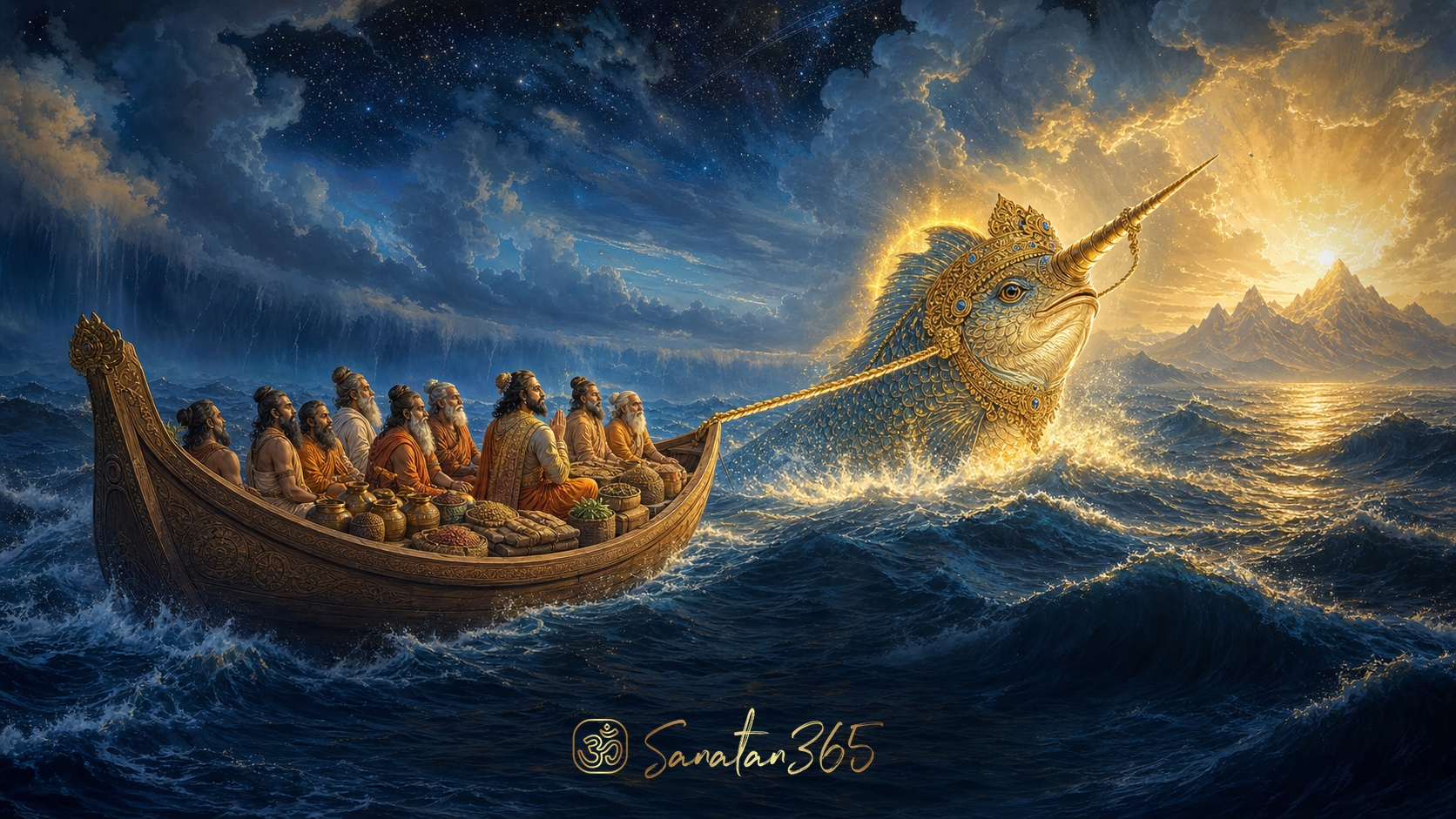
The fish warns Manu that a destructive flood will come. Manu is told to prepare a boat. When the waters rise, the great horned fish returns. Manu fastens the vessel to its horn, and Matsya draws it through the flood toward safety. Readers exploring how Vishnu's preserving role appears through sacred form can also read about Lord Vishnu's shankha, chakra, gada, and padma.
The earliest surviving version appears in the Shatapatha Brahmana, where the fish saves Manu and the vessel comes to rest by a northern mountain. Later Puranic tellings identify the fish explicitly with Lord Vishnu and expand what the boat carries. The Bhagavata Purana, especially Book 8, chapter 24, describes Satyavrata-Manu, the seven sages, seeds, and divine instruction during the cosmic flood.
These are not careless contradictions. Hindu sacred narratives often develop through layers of recitation, theology, region, and time. The early account emphasizes protection, preparation, and renewal. Later Vaishnava tellings make Vishnu’s preserving grace unmistakable and place the event within the larger rhythm of cosmic dissolution and restoration.
Key takeaway: The Matsya Avatar story begins with compassion for the vulnerable and grows into a vision of divine preservation across a world-changing flood.
Why Does Vishnu Take the Form of a Fish?
Vishnu takes fish form because preservation must meet creation where the danger is. In a flood, a land-bound form would not express the same perfect fitness. Matsya moves through the very element that overwhelms everyone else.
This reveals an important meaning of avatara. An avatara is not merely a costume adopted for spectacle. The divine descent responds to a particular imbalance in a form suited to restoring dharma (धर्म, sustaining order, right relationship, and responsible conduct). The Encyclopaedia Britannica overview of avatar notes the close association of avatar doctrine with Vishnu and the restoration of cosmic and moral order.
The fish form also reverses the logic of power. Matsya first arrives as a being that can be crushed or swallowed. Manu must respond before receiving proof of greatness. Only after he protects the small fish does its immeasurable nature become visible.
That sequence matters. If the divine had appeared first in overwhelming majesty, Manu’s obedience would have required little moral imagination. Instead, he is tested by vulnerability. He acts because protection is right, not because reward is guaranteed.
The story therefore links Vishnu’s preservation with Manu’s participation. Divine grace does not make human responsibility irrelevant. Manu must listen, move the fish, build the boat, gather what is needed, and remain steady when the flood arrives. Grace guides; responsibility prepares.
There is also a contemplative contrast between growth and recognition. The fish becomes larger at every stage, but Manu’s understanding must grow too. The jar that was sufficient yesterday becomes a limitation today. Sacred attention includes the humility to notice when an old container no longer fits a living reality.
Key takeaway: Vishnu’s fish form shows that divine preservation is responsive, while Manu’s care shows that grace works alongside alert and compassionate human action.
What Do Manu, the Boat, and the Great Flood Mean?
The Matsya Avatar meaning becomes clearer when its central images are read together rather than reduced to one secret code.
Manu represents responsible humanity
Manu is not saved through passivity. He notices, protects, prepares, and follows guidance. In later tellings, he becomes the bearer of continuity into a renewed age. His worthiness is practical: he can be trusted with life because he first proved trustworthy toward one small life.
The boat represents ordered preservation
A boat is a boundary that does not deny the flood; it makes passage through the flood possible. In the story, the vessel carries more than one individual. Later accounts emphasize the Saptarishi (सप्तर्षि, seven sages), seeds, and other essentials of life. The boat becomes a disciplined archive of biological, cultural, and spiritual continuity.
The flood represents dissolution and transition
The flood is linked with pralaya (प्रलय, cosmic dissolution or a period in which a created order withdraws). Pralaya should not be flattened into a modern prediction about a specific disaster. Hindu cosmology often understands time cyclically: manifestation, preservation, dissolution, and renewed manifestation belong to a vast rhythm.
The story nevertheless has ethical force in ordinary life. Families face migration, loss, upheaval, and generational change. Communities face ecological disruption and forgotten traditions. Individuals move through seasons when familiar structures no longer hold. The story asks what deserves a place in the boat.
Its answer is not endless possession. Manu does not preserve luxury, vanity, or every object accumulated by the old world. The story centers the conditions for renewal: life, seed, wisdom, memory, and dharmic guidance.
This is why the boat remains such a powerful image for diaspora families. A family leaving India for London, New Jersey, Singapore, or another home cannot carry every material detail of inherited life. It can carry language, prayer, stories, food traditions, reverence for elders, ethical responsibility, and the ability to teach children why these matter. Preservation is selective, living, and future-facing.
Key takeaway: Manu, the boat, and the flood together teach that renewal depends on responsible people preserving the essentials of life and wisdom through change.
Why Are Seeds, Sages, and Sacred Knowledge Preserved?
Seeds, sages, and sacred knowledge represent three kinds of continuity: biological life, living interpretation, and remembered truth.
Seeds hold futures in compact form. They can look inactive while carrying forests, grain, medicine, flowers, and nourishment within them. Preserving seeds means thinking beyond immediate survival toward the world that must be cultivated afterward.
The sages represent more than stored information. A manuscript can preserve words, but a wise teacher preserves context, pronunciation, disciplined interpretation, and ethical application. Rishi (ऋषि, seer or sage) refers to those associated with the seeing and transmission of sacred insight. Their presence on the vessel suggests that renewal needs living wisdom, not data alone. The meaning of the Saptarishi tradition offers further context for the seven sages as bearers of sacred lineage.
Puranic versions also connect Matsya with the recovery or protection of the Vedas. Details differ across texts, but the theological point is stable: sacred knowledge must not vanish into chaos. Vishnu as preserver safeguards the conditions through which dharma can become intelligible again.
This has a modern parallel, though the story should not be forced into a technological allegory. A society may store millions of files and still lose wisdom if nobody learns how to distinguish truth from noise, knowledge from manipulation, or memory from nostalgia. Preservation requires selection and transmission.
A family can apply this principle simply:
- Preserve one story accurately enough to retell it.
- Teach the meaning of one daily prayer, not only its sound.
- Record an elder’s regional custom and the value behind it.
- Keep sacred texts respectfully and study them with qualified guidance.
- Protect biodiversity and food knowledge without making exaggerated claims.
- Let children ask questions without treating inquiry as disrespect.
The Matsya Avatar story itself demonstrates this living method. It survived not because every version is identical, but because generations preserved its moral and theological center while speaking through different textual worlds.
Key takeaway: Seeds preserve life, sages preserve living understanding, and sacred knowledge preserves orientation; a renewed world needs all three.
What Does the Matsya Avatar Story Teach About Dharma?
The first dharmic act in the story is small enough to overlook: Manu protects a fish. This protective dimension complements the wider Hindu understanding of Rta as cosmic order and lived dharma.
This act interrupts matsya-nyaya, the rule of unchecked predation. The phrase later becomes important in Indian political and ethical thought because it describes what happens when justice collapses and the powerful consume those without protection. Manu creates a refuge before he creates a boat.
That gives the narrative a moral progression:
- Protect the vulnerable.
- Pay attention to changing reality.
- Accept credible warning without panic.
- Prepare before crisis becomes visible to everyone.
- Preserve what serves future life.
- Receive guidance with humility.
- Rebuild after danger passes.
None of these requires fear-based spirituality. The story does not ask readers to obsess over catastrophe or interpret every storm as supernatural punishment. It presents preparedness as a form of responsibility and preservation as a sacred duty.
The lesson also applies to ecological care. Water is both life-giving and overwhelming in the narrative. A reverent reading does not use the story to make unsupported claims about a particular modern event. It lets the story deepen respect for watersheds, animals, seeds, climate responsibility, and the fragility of communities exposed to floods. Spiritual symbolism should strengthen practical care, not replace science or civic planning.
At the personal level, matsya-nyaya can appear wherever power loses restraint: in a workplace, family, institution, or online space. The story asks whether the strong merely take more space or use strength to create shelter. Vishnu’s greatness is revealed as preservation, and Manu’s worth is revealed as care.
Key takeaway: Dharma in the Matsya story is protective strength: noticing vulnerability, preparing responsibly, and carrying life and wisdom toward renewal.
How Can Modern Families Retell the Manu and Matsya Story?
The Manu and Matsya story works especially well for family storytelling because its action is vivid and its moral questions can grow with the listener.
For a young child, keep the sequence clear: a little fish asks for help; Manu protects it; the fish grows; it warns him about the flood; Manu prepares a boat; the great Matsya guides everyone safely. Emphasize kindness, listening, and caring for living beings.
For older children, introduce the harder questions:
- Why did the divine first appear as someone vulnerable?
- What would we place in a boat meant to renew life?
- Is storing information the same as preserving wisdom?
- How can warnings be taken seriously without becoming fearful?
- What does strength look like when it protects rather than dominates?
Adults can compare the Shatapatha Brahmana account with later Puranic tellings and notice how the narrative develops. This teaches an important way of reading Hindu tradition: respectful attention to textual layers without insisting that spiritual value depends on a single flattened version.
Families can also make the story practical. Planting and caring for a seed after the retelling creates an appropriate embodied lesson. So does recording a grandparent’s prayer, learning the source of a family custom, donating responsibly after a flood, or discussing an emergency plan without alarm.
The strongest conclusion is not “a divine power will solve every crisis for us.” It is that divine guidance calls forth human readiness. Manu survives because he recognizes grace, but also because he builds.
Key takeaway: Retelling the story becomes most meaningful when wonder leads to questions, and questions lead to compassionate, prepared action.
FAQ
Who is Matsya Avatar?
Matsya Avatar is Lord Vishnu’s fish incarnation, widely remembered as the first of the Dashavatara, the ten principal avatars. Matsya guides Manu’s boat through a great flood and preserves the foundations of renewed life.
Who is Manu in the Matsya Avatar story?
Manu is an ancestral human figure and lawgiver in Hindu tradition. In the flood narrative, he protects a tiny fish, follows its warning, prepares a boat, and becomes a bearer of life and continuity into a renewed age.
Where is the Matsya Avatar story found?
An early form of the story appears in the Shatapatha Brahmana 1.8.1. Later versions appear in texts including the Bhagavata Purana and Matsya Purana, where the fish is explicitly identified with Vishnu and the narrative gains further theological detail.
Why does Matsya have a horn?
In the narrative, the horn provides the point to which Manu’s vessel is fastened so Matsya can guide it through the flood. Visually and symbolically, it joins divine direction with human preparation.
What is the main Matsya Avatar meaning?
The central Matsya Avatar meaning is preservation through dharma. The story teaches protection of the vulnerable, attention to warning, responsible preparation, and the safeguarding of life, wisdom, and sacred knowledge through periods of profound change.
The Matsya Avatar story begins with something small enough to fit in a hand and expands until it holds a world. Manu’s first decision is not heroic in appearance; he simply refuses to let the vulnerable be consumed. That act prepares him for a far larger trust.
The story’s final gift is a standard for preservation. What deserves to cross the flood is not everything the old world possessed. It is what allows life to begin responsibly again.
Key takeaway: Protect what is vulnerable, preserve what gives life and wisdom, and meet uncertain change with both trust and preparation.
About the author
Sanatan365 Editorial
Bringing Sanatan Dharma to modern seekers through authentic, scripture-grounded content.
Related in Stories
 Stories
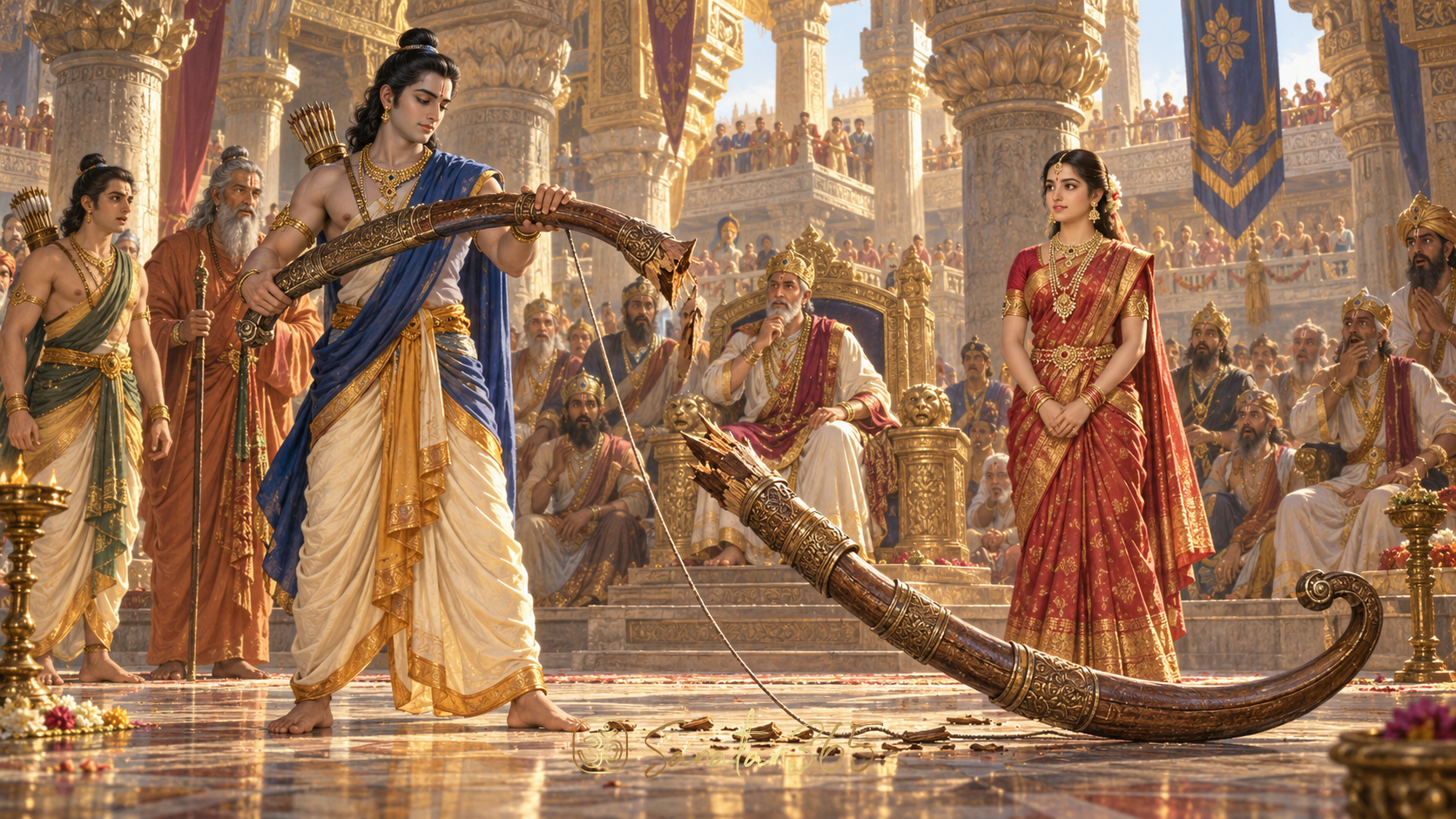
Sita Swayamvara in the Ramayana: Shiva's Bow and the Meaning of the Marriage
Read the Bala Kanda account of Rama, Sita, Janaka and Shiva's bow, and separate the text's sequence from later devotional retellings.
 Stories
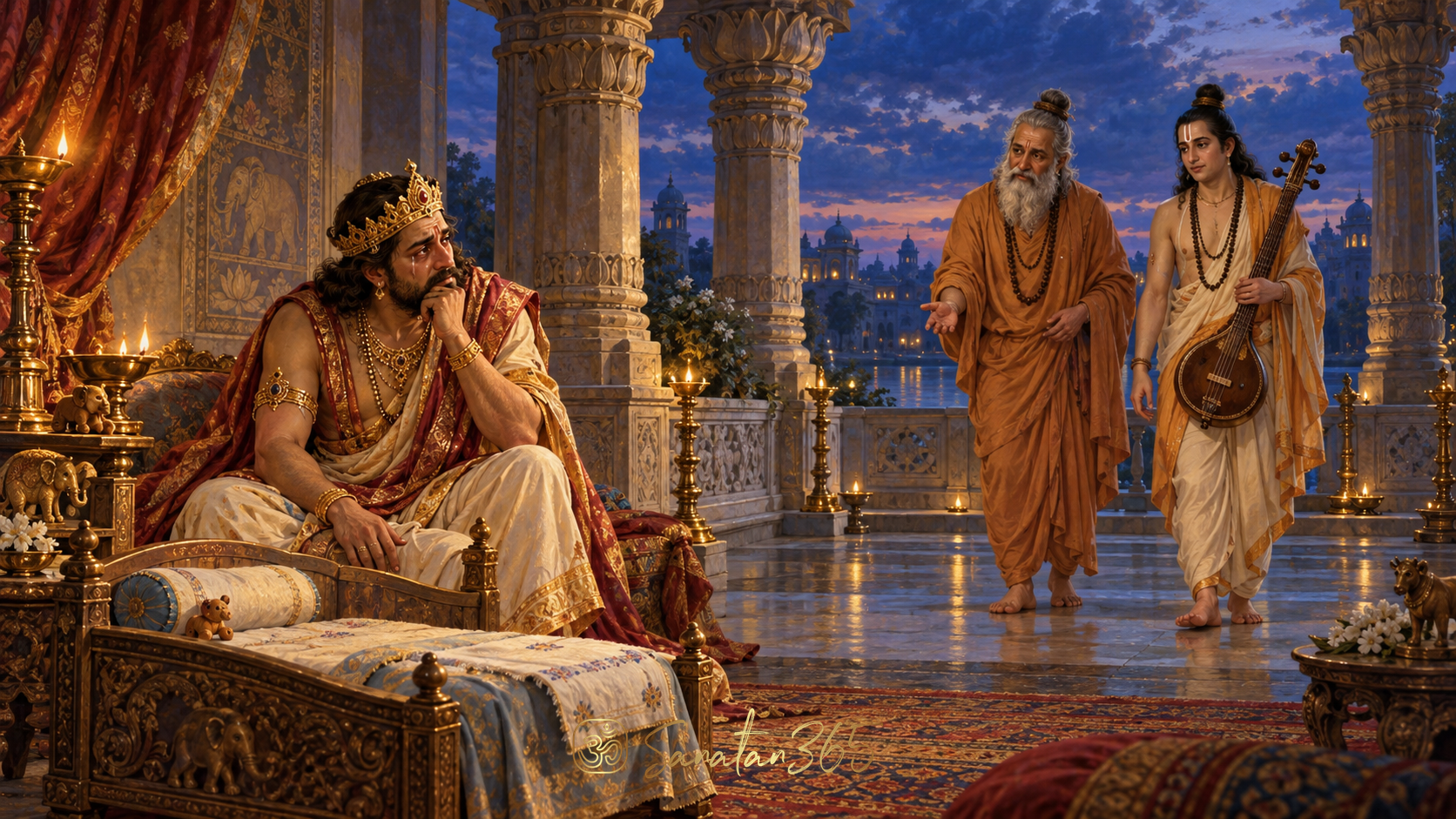
King Chitraketu Story: Grief, Wisdom, and Humility in the Bhagavata
The Bhagavata Purana tells how King Chitraketu met devastating loss, listened to Narada and Angira, and learned a difficult humility. Read…
 Stories
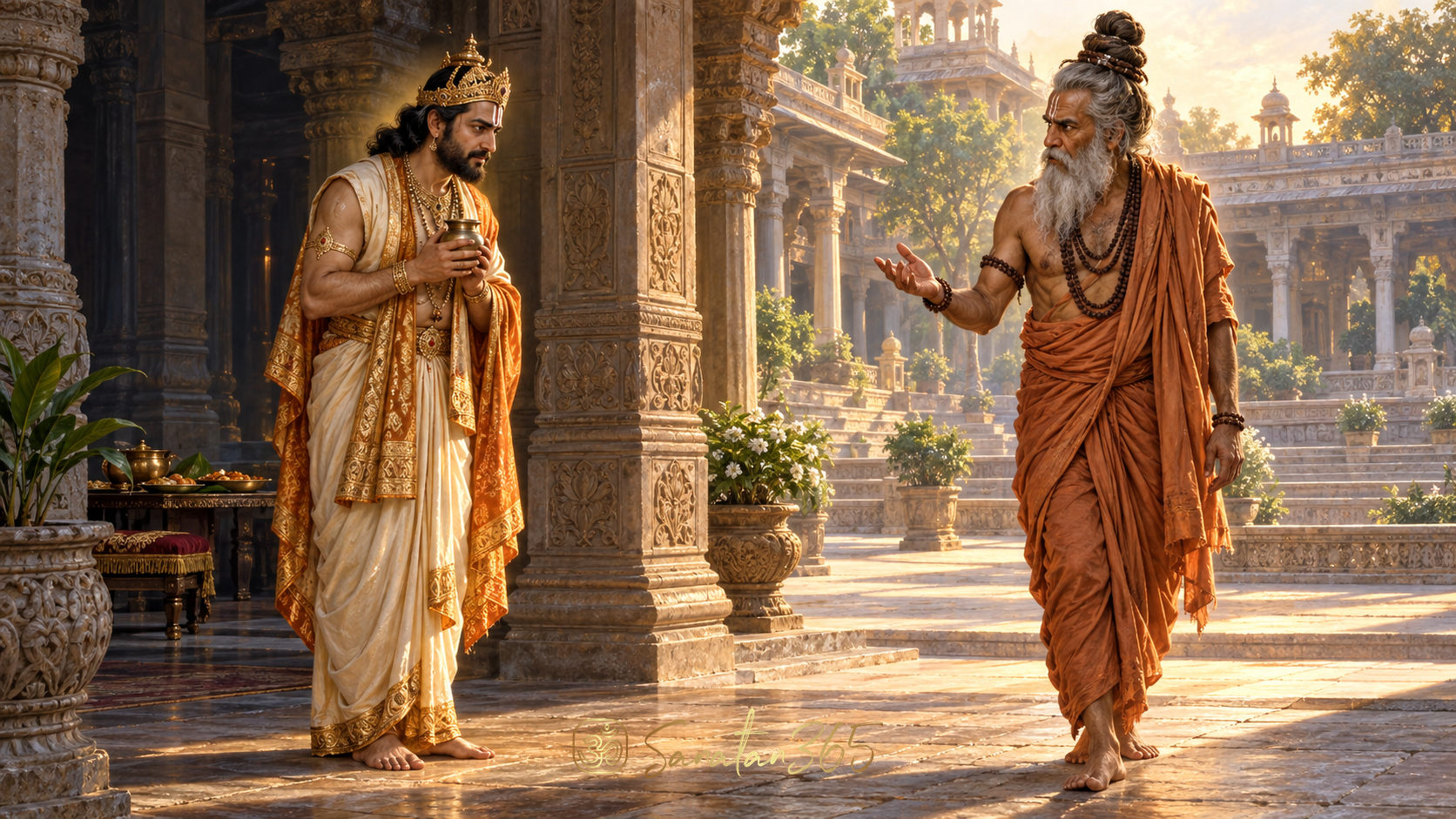
King Ambarisha and Durvasa: A Story of Devotion and Humility
The Bhagavata Purana story of King Ambarisha and Sage Durvasa explores a difficult fast, an angry visitor, and the restraint behind devotio…