Mauna Meaning: The Hindu Practice of Sacred Silence
Mauna meaning explained through Hindu silence practice, speech discipline, vrata, yoga, Bhagavad Gita 17.15, Katha Upanishad insight, and simple daily application.
Silence can be a discipline, not an absence.
Mauna meaning begins with mauna (मौन, sacred silence): the Hindu practice of restraining speech so the mind becomes clearer, kinder, and more inwardly steady. Mauna is not merely refusing to talk. In its mature form, it trains vak (वाक्, speech), manas (मनस्, mind), and sankalpa (संकल्प, sacred resolve) so words arise from dharma rather than restlessness.
What is Mauna meaning in Hindu practice?
The simplest Mauna meaning is "silence," but Hindu practice gives the word a deeper discipline. Mauna can mean a short period of not speaking, a mauna vrat (मौन व्रत, vow of silence), or an inward quiet where speech, reaction, and mental noise begin to settle.
Yogapedia defines mauna as a Sanskrit word for silence and connects it with the yogic practice of not speaking to heighten awareness (Yogapedia). The American Institute of Vedic Studies describes mauna as the practice of not-speaking and links it with the respected ideal of the muni, the sage whose silence reflects inner discipline (Vedic Studies). Those modern explanations point to an older Hindu intuition: speech has power, so restraint of speech has power too.
This is why mauna is not the same as sulking, avoidance, or emotional shutdown. A person can be outwardly quiet yet inwardly angry, judgemental, or distracted. That is not the silence Hindu practice is aiming at. Mauna asks the seeker to pause the outward stream of words so the inner stream can be seen honestly.
In daily life, speech often becomes automatic. People explain, defend, interrupt, complain, perform, and fill gaps because silence feels uncomfortable. Mauna creates a small sacred gap. In that gap, the practitioner can ask: Is this word true? Is it needed? Is it kind? Is silence more dharmic here?
Key takeaway: Mauna is sacred silence practiced as self-discipline, not mere muteness or social withdrawal.
Why does Hindu tradition treat speech as sacred?
Hindu thought rarely treats speech as casual. Vak is connected with mantra, scripture recitation, blessing, teaching, promise, prayer, and truth. A spoken word can heal, guide, wound, confuse, or bind. That makes speech an ethical field.
The Bhagavad Gita 17.15 gives a concise standard for tapas of speech, describing disciplined speech as words that are non-agitating, truthful, pleasant, beneficial, and joined with sacred recitation. Gita Pub's translation captures the core idea: speech becomes austerity when it does not harm, carries truth, and benefits the listener (Bhagavad Gita 17.15).
That verse does not command permanent silence. It points toward purified speech. Mauna supports that purification because it interrupts the habit of speaking from impulse. A seeker who practices silence for even one hour may notice how many words usually arise from anxiety, self-display, impatience, or the desire to control another person's response.
Patanjali's Yoga Sutra 2.30 lists the yamas (यम, ethical restraints): ahimsa (अहिंसा, non-harming), satya (सत्य, truthfulness), asteya (अस्तेय, non-stealing), brahmacharya (ब्रह्मचर्य, disciplined use of energy), and aparigraha (अपरिग्रह, non-grasping). Speech is implicated in all five. Harsh words violate ahimsa. False words violate satya. Gossip steals dignity. Careless talk leaks energy. Possessive speech clings to ego.
Mauna therefore becomes a practical doorway into the yamas. It gives the tongue a rest so conscience can catch up. For related ethical practice, see Satya Meaning: Truthfulness as a Daily Practice of Dharma and Ahimsa Meaning: Non-Harming as a Daily Hindu Practice.
Key takeaway: Hindu practice values speech because words carry dharma or adharma; mauna trains the seeker to speak less reactively and more truthfully.
How is Mauna connected to vrata and tapas?
A vrata (व्रत, vow or sacred observance) is not a random restriction. It is a chosen discipline that aligns the body, senses, and mind toward a sacred aim. A mauna vrat can be as small as one hour of silence on a chosen morning or as serious as a longer vow under the guidance of a teacher.
Tapas (तपस्, disciplined heat or austerity) does not mean self-punishment. It means the warmth generated when a person willingly gives up lower habits for higher clarity. In that sense, mauna is tapas of the tongue and mind. It exposes the practitioner's dependency on speech.
The first challenge of mauna is often practical. How does one answer family members? What about work? What if silence seems rude? This is why Hindu practice usually values intelligent discipline over theatrical extremes. A householder can practice mauna in a modest, dharmic way:
- Choose a realistic window, such as sunrise to breakfast.
- Tell family members in advance so the vow does not create confusion.
- Keep essential communication available for safety and duty.
- Avoid replacing speech with frantic texting.
- Use the silence for japa, study, prayer, or quiet service.
- End the period with gratitude rather than self-congratulation.
The quality of the vow matters more than its length. A short mauna practiced with humility is stronger than a long silence performed for ego. If silence makes someone insensitive to household responsibilities, the vow has become distorted. Dharma is not an excuse to neglect care.
Key takeaway: Mauna vrat is a sacred speech discipline, best practiced with clarity, humility, and respect for one's real duties.
What does Mauna teach about the mind?
The Katha Upanishad gives a powerful inward movement: the discerning person should gather speech into the mind, then the mind into deeper intelligence, and finally into the serene Self. A public-domain translation of Katha Upanishad 1.3.13 presents this movement as dissolving speech into mind and mind into higher awareness (Katha Upanishad).
This matters because speech is often the outer edge of thought. When speech quiets down, the practitioner may suddenly hear the mind more clearly. The first discovery is not always peaceful. There may be unfinished arguments, cravings, worries, rehearsed replies, old resentments, and restless planning. Mauna does not create these movements. It reveals them.
That revelation is useful. A person cannot refine what remains unseen. Silence shows where speech has become a servant of ego instead of dharma. It also shows how much energy is lost in unnecessary commentary.
Mauna gradually changes the relationship between impulse and action. A thought appears, but the tongue does not immediately obey it. A feeling appears, but the person does not instantly make it public. A judgement appears, but silence gives it time to soften. This small delay is spiritually significant. It creates freedom.
For some seekers, mauna also deepens japa (जप, mantra repetition). When outer speech is restrained, mantra can become more subtle. The movement from loud chanting to soft chanting to mental repetition mirrors the broader movement from outer expression toward inner steadiness.
Key takeaway: Mauna reveals the mind's hidden noise and gives the seeker space to respond from awareness rather than impulse.
How can beginners practice Mauna without becoming harsh or withdrawn?
The danger of any discipline is pride. Mauna can easily become a way to feel superior, punish others, or avoid difficult conversations. That is not Hindu silence. Sacred silence should make a person gentler, not colder.
Beginners can keep the practice balanced with a few simple rules:
- Practice at a time that does not disrupt essential duties.
- Begin with 15 to 30 minutes rather than a dramatic full-day vow.
- Pair silence with a positive practice such as mantra, svadhyaya (स्वाध्याय, sacred study), or mindful service.
- When speech resumes, speak slowly and kindly.
- Do not use silence as a weapon in conflict.
- If a real apology, safety instruction, or act of care is needed, speak.
This last point is important. Mauna is not a license to abandon compassionate communication. If a child needs reassurance, a colleague needs clarity, or a loved one needs an honest answer, dharma may require speech. The point is not "never speak." The point is "let speech become worthy."
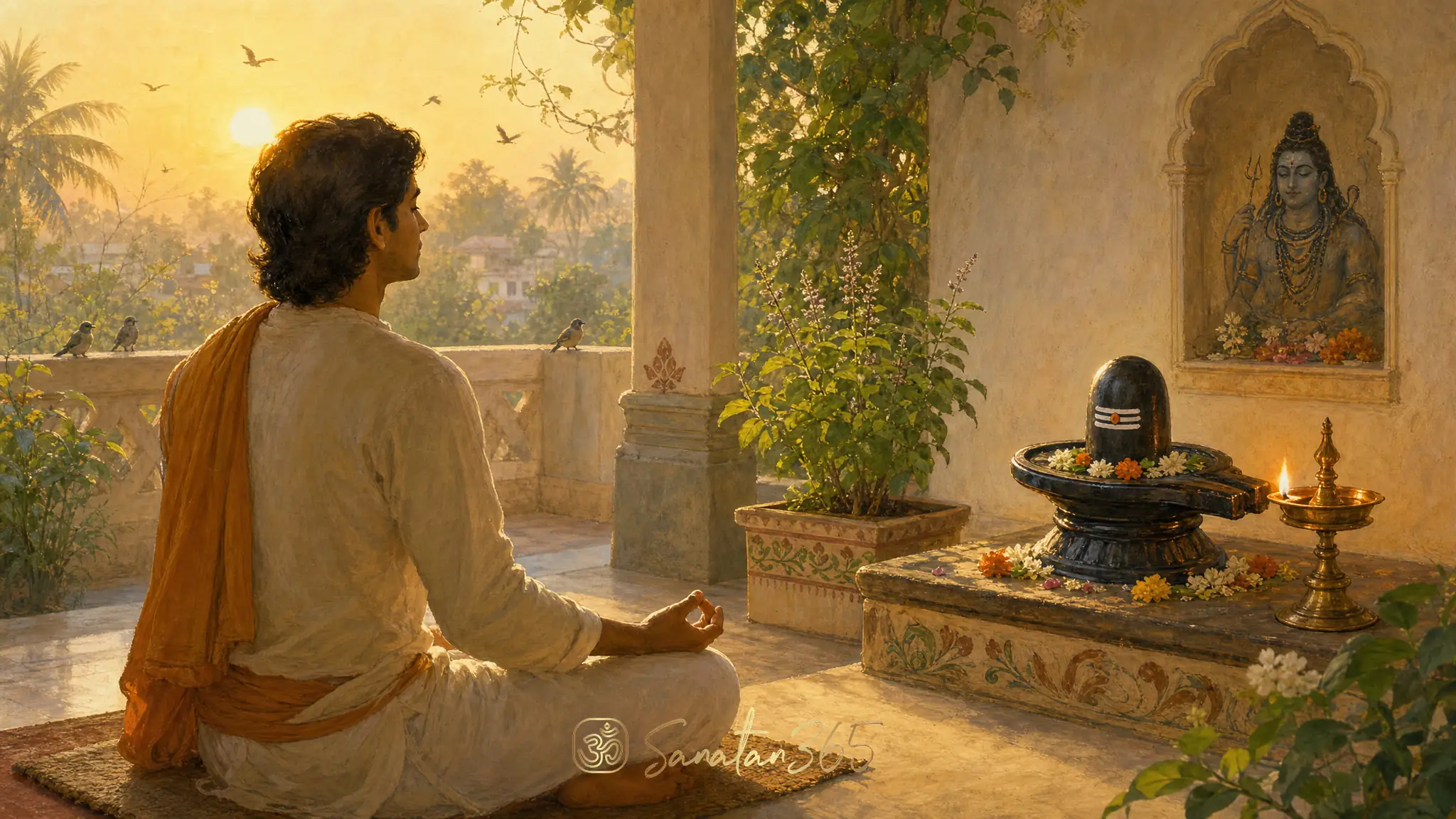
For modern families and diaspora seekers, mauna can fit into ordinary life. A student may keep silent for the first 20 minutes after waking. A parent may practice a no-complaint morning while preparing breakfast. A professional may choose one commute without podcasts, messages, or calls. A devotee may sit quietly before a home altar, offering speech back to the Divine before entering the day.
Digital mauna is also useful. Many people technically "keep silence" while scrolling, reacting, and typing. That is not silence in the deeper sense. A beginner's practice may include putting the phone away, disabling non-urgent notifications, and refusing the urge to comment on everything. A morning silence window can pair naturally with Brahma Muhurta Meaning: A Gentle Hindu Morning Practice Before Sunrise.
Key takeaway: Mauna should make speech more compassionate and necessary, not make the practitioner emotionally unavailable.
What is the difference between silence, suppression, and inner quiet?
Silence is not always spiritual. Suppression can look like silence from the outside. Fear can look like silence. Resentment can look like silence. Exhaustion can look like silence. Hindu mauna asks for something more conscious.
Outer silence is the first layer. The mouth rests. The body stops performing speech. This is useful, but incomplete.
Mental restraint is the second layer. The practitioner begins to notice inner speech: complaint, fantasy, argument, self-criticism, comparison. Instead of feeding every thought, the seeker lets many of them pass.
Inner quiet is the deeper layer. It cannot be forced. It appears gradually when speech, breath, attention, and intention become aligned. This is why mauna is often paired with japa, meditation, pranayama, scripture recitation, or seva. Silence needs a sacred center. Without that center, it may become blankness or moodiness.
Mauna also does not mean denying emotion. If grief is present, the practitioner can acknowledge grief silently. If anger is present, one can observe heat in the body without letting the tongue become destructive. If love is present, one can express it through service, presence, or a few careful words after the vow ends.
The mature fruit of mauna is not wordlessness. It is truthful speech emerging from quiet. A person who has practiced silence may speak fewer words, but those words become more precise, more generous, and less self-serving.
Key takeaway: the goal of mauna is not blank suppression; it is inner quiet that purifies the words eventually spoken.
How can Mauna become a daily Hindu practice?
Mauna becomes powerful when it is woven into rhythm. It does not need to be rare or dramatic. Like lighting a diya, offering water to Tulsi, or repeating a mantra, it can become a small daily return to sacred order.
A simple seven-day beginning rhythm may help:
- Day 1: Five minutes of silence before checking the phone.
- Day 2: Ten minutes of silence with three rounds of slow breathing.
- Day 3: Fifteen minutes of silence with a chosen mantra.
- Day 4: One meal eaten without media or unnecessary talk.
- Day 5: One hour without complaint, gossip, or reactive replies.
- Day 6: A short mauna vrat at dawn with svadhyaya.
- Day 7: Reflect on how speech changed during the week.
This rhythm is gentle enough for householders and serious enough to reveal habits. It can be adjusted around school, work, parenting, elder care, and health needs. No one should use mauna to ignore medical advice, mental health care, or necessary conversation. It is a spiritual support, not a replacement for professional help where professional help is needed.
Mauna also prepares the heart for better listening. In many homes, the real deficit is not speech but listening. Silence teaches the practitioner to hear another person without planning a reply. It teaches patience before judgement. It teaches reverence before mantra. It teaches the dignity of not filling every sacred space.
In that sense, mauna is not anti-social. It can make relationships cleaner because it reduces impulsive speech. The practitioner returns from silence with more attention to offer.
Key takeaway: daily mauna can be short, practical, and household-friendly when it is joined with mantra, study, listening, and compassionate duty.
The final lesson of mauna is not that words are bad. Words can bless, teach, comfort, chant, and reveal truth. But words become sacred only when they arise from a quieter place within. Mauna gives the seeker a way to return there.
FAQ
What is Mauna meaning in simple terms?
Mauna meaning in simple terms is sacred silence. In Hindu practice, mauna means restraining speech so the mind becomes clearer, speech becomes more truthful, and the practitioner learns to respond with dharma rather than impulse.
Is mauna vrat only for monks and sadhus?
No. Monks, sadhus, and serious renunciates may take deeper vows, but householders can practice modest mauna too. A short morning silence, a quiet meal, or an hour without unnecessary speech can be a valid householder practice when done with humility and care.
Can I write or text during mauna?
If writing or texting simply replaces talking, the deeper practice is weakened. Essential communication for duty, safety, or kindness is fine, but the spirit of mauna is to reduce outward expression and turn attention inward.
What should I do during a period of mauna?
Use the silence for japa, prayer, svadhyaya, meditation, slow breathing, or quiet service. Avoid filling the silence with scrolling, entertainment, or mental arguments. The aim is sacred attention, not just lack of sound.
Is silence always better than speaking?
No. Hindu practice values truthful, beneficial, non-harming speech. If speech is needed for care, honesty, safety, apology, or duty, speaking may be more dharmic than remaining silent. Mauna trains speech; it does not abolish it.
About the author
Sanatan365 Editorial
Bringing Sanatan Dharma to modern seekers through authentic, scripture-grounded content.
Related in Practices
 Practices
Kusha Grass Meaning: Why Darbha Has a Place in Hindu Rituals
Understand kusha or darbha grass, its traditional place in worship and ancestral rites, and how to approach varied customs with care.
 Practices
Bhuta Shuddhi Meaning: Purifying the Five Elements Within
Bhuta Shuddhi means the purification of the five elements: earth, water, fire, air, and space. In Hindu yogic and Tantric traditions, it is…
 Practices
Likhita Japa: Meaning and Practice of Writing a Mantra
Likhita japa turns mantra repetition into a written devotional discipline. Learn its meaning, how it differs from spoken and mental japa, a…

