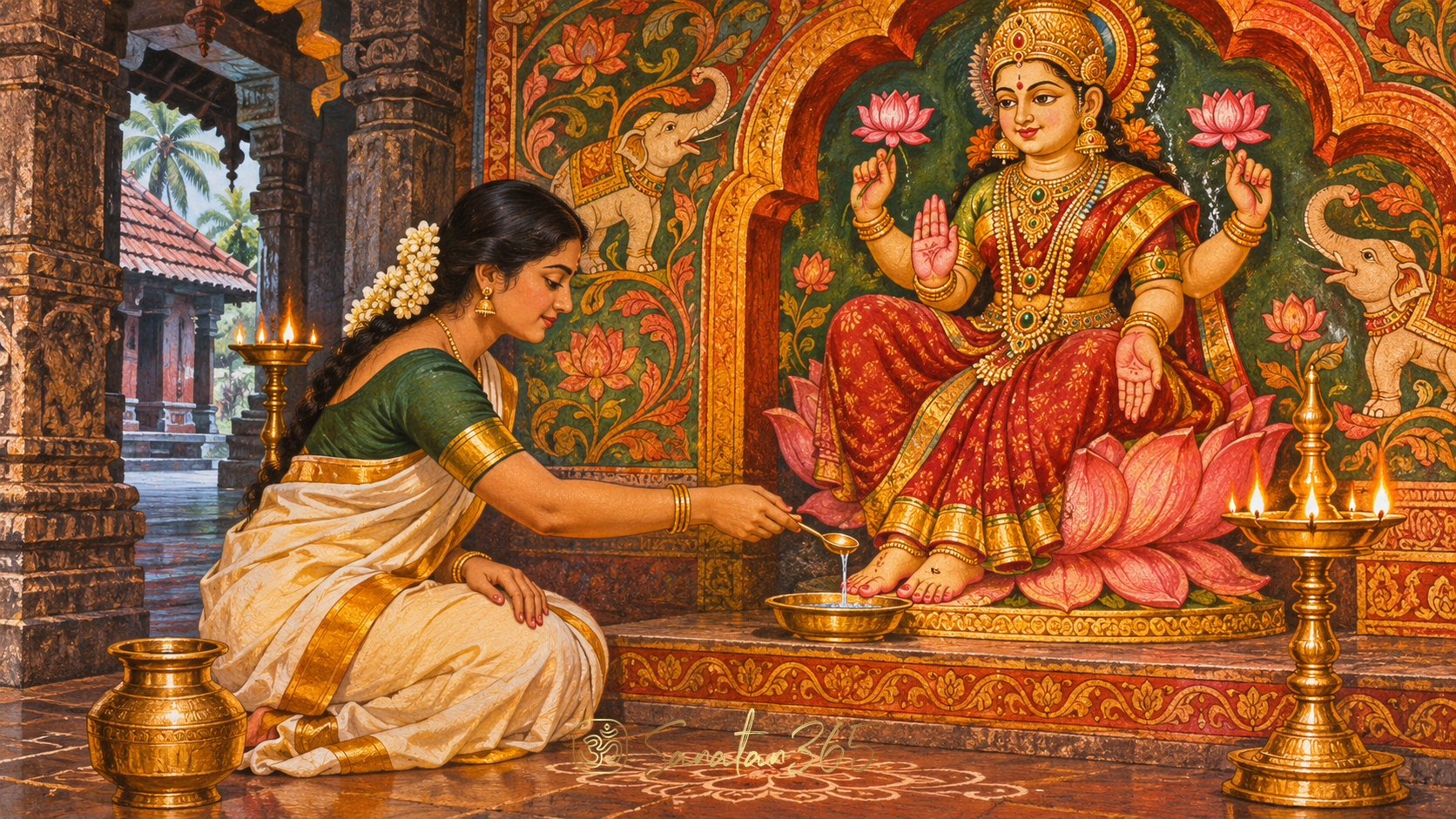
Padyam Meaning in Puja: Water Offered at the Feet
Learn why water is offered at the deity’s feet and how pādyam differs from the other water offerings in a puja welcome.
Three offerings can use water and still say three different things. The first is often explained with reference to a guest’s feet.
The padyam meaning in puja is water offered for the feet of the deity. Pādyam (पाद्यम्, water for washing the feet) takes its place among gestures of welcome in pūjā (पूजा, worship). The same liquid may appear in the next offerings, but each has a different purpose. The words that accompany the offering help a learner recognise which act is being performed.
What is the padyam meaning in puja?
The sixteen-step guide from Sri Pattabhi Rama Temple describes the rite as welcoming and serving the Divine as a revered guest. In that account, the small presentations of water sit among early acts of hospitality. The worshipper has welcomed the deity and offered a seat. The act at the feet then gives the welcome a concrete form.
The reference to feet is the clearest clue. Pāda (पाद, foot) is the word a learner can keep in mind when the offering is called pādyam. A vessel of water on its own could be for any of several actions. When the guide names the offering for the feet, that purpose identifies the step. This matters especially when the movement is so small that an observer cannot tell the steps apart by sight alone.
The Sri Venkateswara Temple teaching manual for Mahalakshmi puja labels the act as offering water to wash the feet. Its instructions belong to a particular form of worship. The guide gives a useful example of how an instruction and its purpose can be written side by side, so a new reader can follow what the worshipper means by a brief presentation of water.
An observer may see the water offered with a small implement or into a vessel. The act can still be directed toward the feet in words and attention. The Mahalakshmi manual describes presenting the water with a flower or a leaf. A viewer trying to understand it at another shrine can start with the purpose and then watch how the local form represents it.
Key takeaway: Pādyam names water by what it is offered for, namely the deity’s feet.
Why are the feet part of the welcome?
The temple guide’s hospitality comparison gives this action a setting. A guest is received through a sequence of courtesies. Offering water for the feet answers a particular need within that imagined welcome. A seat concerns how a guest will be received in a place. Water for the feet concerns how that guest will be attended to after arrival.
The principle can be understood without reconstructing an ancient scene. In an ordinary welcome, small actions make the greeting tangible. A hand opens a door, a place is cleared to sit, and a drink may be brought. Each does something the words of greeting alone cannot. The ritual analogy uses the feet to show how reverence can take the form of specific service rather than remaining a general feeling.
An earlier act, āvāhana (आवाहन, invocation or invitation), expresses the welcome more directly. The guide to āvāhana and welcoming the Divine discusses its place in worship. Pādyam carries the reception into the next kind of action. The invitation makes sense of whom the worshipper is addressing. The water makes sense of the particular service offered to that presence.
The welcome analogy also helps explain why a small gesture can deserve a distinct name. A string of actions may look repetitive if all attention goes to the vessels. When the reader follows the words, the steps become a set of intentional acts. Pādyam asks the worshipper to attend to the feet at a point where the welcome has already begun. That specificity is part of what makes it useful to learn the names.
Key takeaway: Offering water at the feet gives the welcome a particular act of service.
How is padyam different from the other water offerings?
In the Mahalakshmi manual, three offerings can be distinguished by what they address. These descriptions help identify the uses in that guide:
- Pādyam is water for the feet.
- Arghyam (अर्घ्यम्, an offering of honour) is described there as water for the hands.
- Ācamanīyam (आचमनीयम्, water for ritual purification) is the Mahalakshmi manual’s designation for the third offering. The Pattabhi Rama guide describes water for the face and mouth.
The contrast shows why “water offering” is a broad description. It names the material without describing the act. In this sequence, what changes is the service the worshipper is offering. A beginner can hear the names in order and match each to the description, rather than looking for three different liquids or assuming each vessel determines the step.
The word arghyam has uses beyond this one sequence. The guide to arghya and respectful water offerings shows why context matters when the term appears in explanations of worship. The handwashing description above is specific to the manual used here. The broader term can be encountered with a different practical explanation elsewhere. That variety does not take away the distinctive link between pādyam and the feet.
There is a second distinction to notice. A preparatory ācamana (आचमन, ritual sipping of water) may refer to an act performed by the worshipper. The water offered in the welcome sequence is directed toward the deity. The similar words are easier to follow when the reader asks who is receiving the water. The guide to ācamana and ritual preparation discusses the worshipper’s side of that distinction.
Key takeaway: Listen for the purpose and recipient of the water to tell these offerings apart.
What does a small offering of water represent?
Water can be easy to overlook precisely because it appears in so many settings. Here a small quantity receives a special intention through the words and direction of the offering. The point can be seen in the way a simple manual handles the step. It needs to tell the learner what the water is for even when the physical movement is brief.
A small offering can also concentrate attention. The worshipper remembers the guest, the feet and the courtesy in one act. The temple guide’s broader description of service makes sense of this. There is room for detail in worship even when the offering itself is modest. The name gives that detail enough weight to be recognised and recalled.
A learner sometimes expects a full washing because the English label says “water to wash the feet.” The presentation may instead be brief and symbolic. An instruction can speak in the language of serving a guest while a hand makes a small offering suited to the particular shrine and vessel. A learner can follow the meaning of the service without assuming that every material image is handled the same way.
The title of a ritual step is therefore a useful aid to observation. The water can be seen. The words explain why it appears there. The posture of offering gives those words an action. When all three are held together, pādyam becomes easier to recognise and easier to distinguish from a more general reference to water in worship.
The same distinction can help when reading a transliterated guide next to an English guide. One may present the Sanskrit name alone, while the other describes the action in a few words. Matching those two descriptions is more useful than memorising an isolated list. If a translation appears to call every step a libation, compare the recipient and stated purpose before deciding that two steps are identical. A short note alongside the term, such as “water for the feet,” is enough to keep the purpose visible. This is particularly helpful in a group where some people know a recited sequence by sound and others know the names only from a printed page. Both forms of knowledge can make the same brief gesture easier to recognise.
Key takeaway: The size of the offering can be small while its purpose remains precise.
How can a learner follow padyam in a puja guide?
Start with the sequence as it is given by the source being used. Look for the invitation and the seat, then see where the guide places water for the feet. After that, look for the separate description of the next water offering. This is a reading method. It does not require assuming that every family, temple or tradition follows one fixed order.
Three questions can help a learner follow a guide or demonstration:
- Who is being welcomed or served at this point?
- What purpose does the spoken instruction give the water?
- How does the guide show the offering with the implements available?
A reader learning from a family member can ask which part of the local sequence is called pādyam and how the person learned to distinguish it. The answer may refer to a word in the formula, to the placement of the vessel, or to the sequence around it. Such a discussion can bring the local practice into clearer view without setting it against the way another household performs worship.
The Sri Pattabhi Rama Temple guide explicitly notes that steps may be sequenced or grouped differently through regional, community, family and deity traditions. That observation is useful whenever the reader encounters two checklists. A different grouping is a reason to read more closely. If one list names a combined set of offerings, the learner can still find the purpose of each by reading the words or asking the person who is guiding the rite.
In a shared space, one can also learn by watching where attention turns. An observer may notice that the worshipper’s body hardly moves between two steps, while the words direct the offerings in different ways. That is a sign to listen more carefully instead of trying to infer everything from the vessel. When the action at the feet can be identified by purpose, location and words, the name becomes easier to remember on the next occasion.
Key takeaway: Identify pādyam by its purpose and follow the order and handling taught in the particular shrine or household.
FAQ
What is offered in pādyam?
Pādyam is water offered for the feet of the deity. In a puja sequence it is an act of welcome and service.
What is the difference between pādyam and arghyam?
Pādyam is directed to the feet. Arghyam is an offering of honour, and the cited Mahalakshmi manual describes it as water for the hands in that sequence.
What is the difference between the deity’s water offering and preparatory ācamana?
In the welcome sequence the water for the deity’s purification is offered to the deity. A preparatory ācamana can be performed by the worshipper. The recipient identifies which action the guide is describing.
Is pādyam always performed in the same order?
A temple teaching guide gives a sequence for that form of worship. Steps can be grouped or ordered differently in other traditions. Look for the water described as being for the feet.
About the author
Sanatan365 Editorial
Bringing Sanatan Dharma to modern seekers through authentic, scripture-grounded content.
Related in Rituals
 Rituals
Udaka Shanti Meaning: Understanding the Prayer Around Water
Udaka Shanti brings water and Vedic recitation into a prayer for peace. Learn what to notice, why versions differ and how a family can part…
 Rituals
Avahana Meaning: Welcoming the Divine into Puja
Understand avahana as a devotional welcome, its place beside dedication and offerings, and why a household should learn the invocation with…
 Rituals
Visarjana Meaning: The Sacred Farewell That Concludes Puja
Understand visarjana as a formal farewell in worship, distinguish it from immersion, and read two traditions’ concluding prayers with care.

