Panchamrit Meaning: Five Sacred Ingredients in Hindu Puja
Panchamrit is the fivefold sacred mixture offered in Hindu worship. Learn what its ingredients mean, how traditions vary, and how to prepare it reverently.
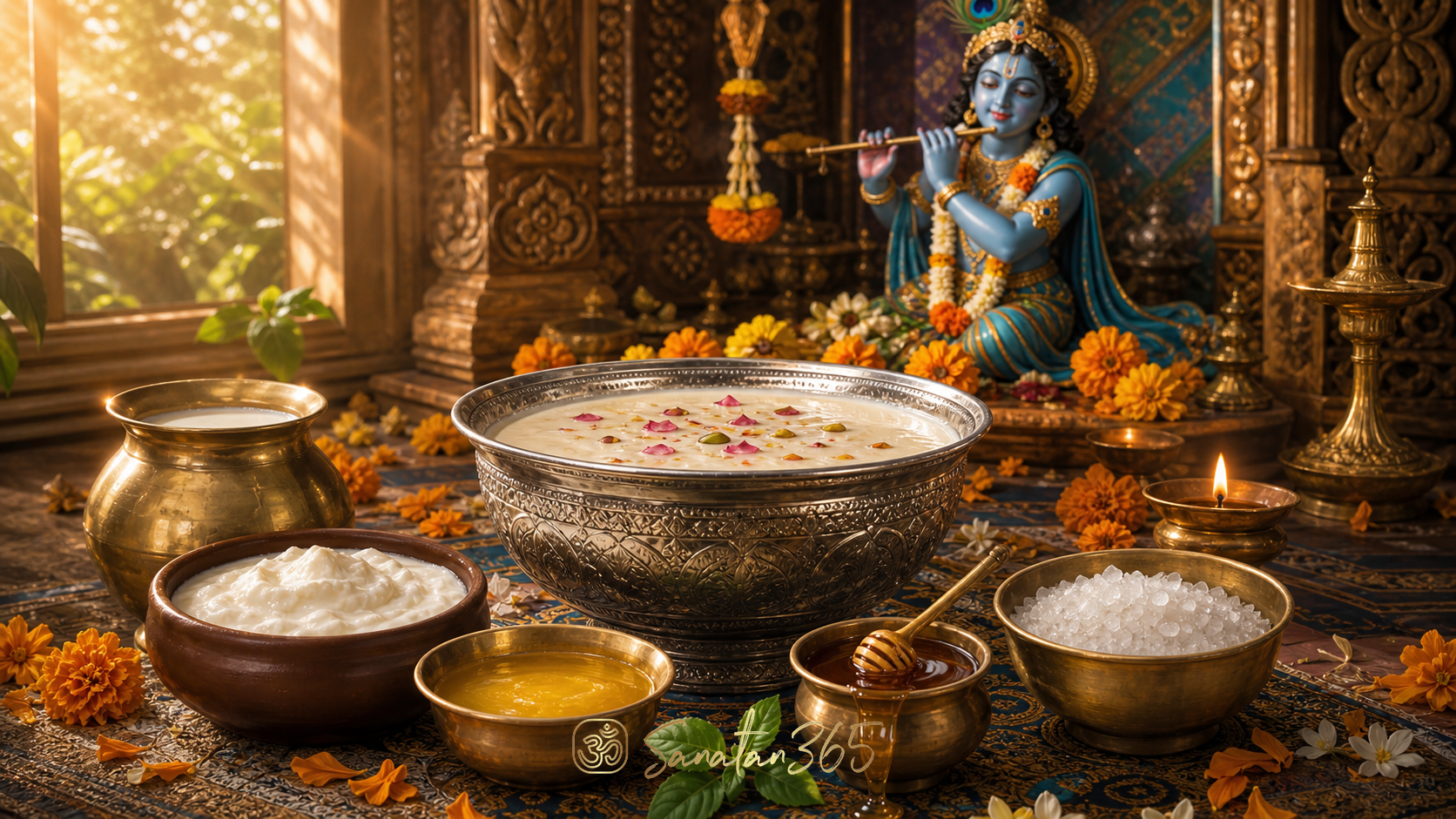
A small bowl can hold an entire theology of offering. The Panchamrit meaning begins with its name: pañca (पञ्च, five) and amṛta (अमृत, nectar or deathless essence). In Hindu puja, Panchamrit is a sacred mixture commonly made from milk, curd, ghee, honey, and sugar. It may be offered during worship, used in abhisheka (अभिषेक, ritual bathing of a sacred form), and later received as prasada (प्रसाद, a gracious sacred offering).
Panchamrit is not a magical recipe or a health guarantee. Its depth comes from devotional intention, cleanliness, proportion, and the act of bringing distinct gifts into harmony. Family, temple, deity, and regional customs vary, so a trusted household tradition or temple priest remains the best guide for a specific ceremony.
What Is the Panchamrit Meaning in Hindu Puja?
Panchamrit, also written Panchamrut in several Indian languages, literally means “five nectars.” The familiar five ingredients are:
- Milk (dugdha)
- Curd or yogurt (dadhi)
- Ghee (ghṛta)
- Honey (madhu)
- Sugar (śarkarā)
Together, they form an offering that is both material and contemplative. Hindu worship does not treat matter as spiritually irrelevant. Water, flowers, fragrance, flame, food, and sound can all become vehicles of bhakti (भक्ति, loving devotion) when offered with care. The Hindu American Foundation's guide to traditional puja explains puja as a discipline that gathers the senses and directs action, devotion, knowledge, and attention toward the Divine.
This context matters. Panchamrit is not sacred merely because five foods have been stirred together. It becomes part of worship through saṅkalpa (सङ्कल्प, sacred intention), mantra, offering, and respectful reception. The devotee gives something nourishing and beautiful, then receives it back as grace.
Bhagavad Gita 9.26 gives the enduring principle behind even a simple offering:
“Whoever offers Me with devotion a leaf, a flower, a fruit, or water, that offering of love, made by the pure-hearted, I accept.”
The verse does not prescribe Panchamrit, but it clarifies the devotional center: sincerity matters more than display.
Key takeaway: Panchamrit means five nectars joined as one devotional offering; the sacred center is loving attention, not culinary complexity.
What Do the Five Panchamrit Ingredients Represent?
There is no single universal symbolic chart binding every ingredient to one fixed meaning. Temples, teachers, families, and regional traditions may explain them differently. The interpretations below are therefore contemplative associations, not rigid doctrine.
Milk: nourishment and purity of intention
Milk is often associated with maternal nourishment, gentleness, and a clear beginning. In the mixture, it creates the broad, pale base that receives the other ingredients. A devotee may reflect on whether spiritual life is being nourished regularly rather than only during festivals.
Curd: transformation through living practice
Curd begins as milk but changes through culture and time. It can symbolize the transformation of good intention into a mature habit. Devotion becomes steadier when prayer, ethical conduct, study, and service are repeated rather than admired from a distance.
Ghee: refinement and sustaining light
Ghee is produced by patient clarification. It also fuels the lamp used in many forms of worship. Its presence may evoke tapas (तपस्, disciplined spiritual effort or refining heat): the willingness to remove what clouds attention and preserve what is luminous.
Honey: harmony created from many sources
Honey gathers the work of countless flowers and bees into one sweetness. It naturally suggests cooperation and the ability to discover unity without erasing variety. This is especially fitting in a tradition with many deities, philosophies, languages, and local customs held within a larger sacred inheritance.
Sugar: sweetness in speech and conduct
Sugar completes the mixture with direct sweetness. Symbolically, it can invite mādhurya (माधुर्य, sweetness or graciousness) in words and relationships. Religious discipline without kindness can become hard; sweetness without discipline can become shallow. Panchamrit places both refinement and tenderness in the same bowl.
These meanings are most useful when they prompt self-examination. The ingredients do not mechanically transfer virtues. They remind the devotee to cultivate nourishment, transformation, clarity, harmony, and kindness.
Key takeaway: The five ingredients can serve as mirrors for five qualities of practice, while their exact symbolism remains open to lineage and regional interpretation.
How Is Panchamrit Used in Abhisheka and Prasada?
In many temples and homes, Panchamrit appears in one of two connected settings: ritual bathing and sacred distribution.
During abhisheka, liquids are respectfully poured over a murti, Shiva linga, or another approved sacred focal point while mantras are recited. Depending on the tradition, water, milk, Panchamrit, or other substances may be used in sequence. The sacred form is then carefully cleansed, dried, dressed, and worshipped. One should never improvise this process with a temple murti or a delicate household image; materials and cleaning rules differ.
Panchamrit may also be prepared in a clean vessel, offered without being poured over the sacred form, and later distributed as prasada. Prasada is not simply “blessed food” in the casual sense. It expresses a movement of relationship: something is offered to the Divine, and what returns is accepted with gratitude and humility.
The distinction between Panchamrit, charanamrit (चरणामृत, nectar associated with the feet of the deity), and other temple tirtha preparations varies across communities. The terms may overlap in everyday speech, but their ritual preparation can differ. Follow the usage of the temple or family tradition rather than insisting on one nationwide definition.
This is also why hygiene is part of reverence. Clean hands, fresh ingredients, a clean vessel, and careful distribution protect both the dignity of the offering and the people receiving it. Anyone with dairy allergies, diabetes, immune vulnerability, or dietary restrictions should be free to decline or receive only a symbolic amount without embarrassment.
Key takeaway: Panchamrit can participate in abhisheka and become prasada, but the exact ritual method belongs to the worship tradition being followed.
How to Make Panchamrit for Puja Respectfully
For a simple household preparation, begin with the custom of the family or teacher guiding the puja. Where no specific ratio is prescribed, the following method offers a modest, adaptable starting point.
A simple preparation
- Bathe or wash hands thoroughly and clean the preparation surface.
- Use a small, clean silver, brass, steel, glass, or food-safe bowl reserved for puja where possible.
- Add fresh milk and plain curd as the main base.
- Add a small quantity of melted ghee.
- Add honey and sugar in modest amounts.
- Mix gently with a clean spoon while maintaining a prayerful intention.
- Offer according to the puja being performed.
- Refrigerate promptly if it will not be distributed immediately, and discard anything unsafe to consume.
Make only as much as the gathering will use. Sacredness does not justify waste. If the Panchamrit has touched a material not safe for consumption, has remained unrefrigerated too long, or was used on a murti with non-food-safe finishes, do not distribute it as food. Ask a knowledgeable priest how it should be handled respectfully.
Some families add tulsi leaves, fruit, banana, dates, coconut, or other ingredients. These can be beloved regional or household forms, but once additions are made, the simple “five ingredients” formula is no longer the only description needed. There is no contradiction: Hindu practice often preserves a recognizable core while allowing local expression.
For vegan households, substituting plant products may create a sincere devotional preparation, but it should not be presented as the classical dairy-based Panchamrit used by a temple unless that tradition explicitly accepts it. A simple fruit, flower, or water offering is already complete when made with devotion, as Bhagavad Gita 9.26 affirms.
Key takeaway: Prepare a small, fresh quantity with clean utensils, follow the relevant tradition, and treat food safety and freedom from pressure as parts of respectful worship.
Why Does One Mixture Hold So Many Lessons?
Panchamrit teaches through composition. None of its ingredients loses its character, yet each changes the whole. Milk softens honey; curd adds body; ghee brings richness; sugar dissolves; honey binds sweetness across the mixture. Difference becomes offering through relationship.
That pattern can illuminate household spiritual life. A family may include elders and children, fluent practitioners and beginners, people who love mantra and people who connect through service. Unity does not require identical temperament. Like the five nectars, a community becomes harmonious when each contribution is offered without domination.
The bowl also teaches scale. A teaspoon of ghee can transform the mixture; too much can overwhelm it. Spiritual disciplines likewise require proportion. Study without tenderness may become pride. Emotion without discernment may become instability. Ritual without ethics may become performance. Ethics without devotion may become dry obligation. Hindu practice repeatedly seeks integration: karma (right action), bhakti (devotion), jñāna (knowledge), and dhyāna (meditative attention).
Finally, Panchamrit turns receiving into a practice. Prasada is commonly accepted in the right hand or cupped hands, consumed respectfully, and not treated as an ordinary sample. The amount may be tiny, but gratitude enlarges it. The sacred is encountered not through quantity, but through the quality of attention.
Those exploring related home practices may also read about Nitya Puja Meaning: Daily Worship as a Living Hindu Practice, Pradakshina Meaning: Why Hindus Walk Clockwise Around the Sacred, and Aarti Meaning: Why Hindus Offer Light in Worship. Each practice shows how embodied action can train the mind and heart.
Key takeaway: Panchamrit offers a living image of unity, proportion, and grateful receiving.
Panchamrit Meaning Beyond the Recipe
The deepest Panchamrit meaning is not hidden in a secret ratio. It is visible in the movement from many to one, from possession to offering, and from offering to grace. Five familiar foods become sacred through intention and relationship. Their symbolism encourages nourishment, transformation, clarity, harmony, and sweetness, but their ritual use remains grounded in real traditions rather than private invention.
Prepared with cleanliness, restraint, and reverence, Panchamrit makes an ancient insight tangible: spiritual life is not separate from the substances, senses, and relationships of daily life. Even a small bowl can become a lesson in how to give well and receive humbly.
Key takeaway: Panchamrit is a fivefold devotional offering whose lasting teaching is to unite ordinary life with sacred attention.
FAQ
What is Panchamrit made of?
The most widely recognized Panchamrit ingredients are milk, curd, ghee, honey, and sugar. Regional and family traditions may add tulsi, fruit, or other ingredients, so the exact preparation can vary.
What does the word Panchamrit mean?
Panchamrit comes from Sanskrit pañca, meaning five, and amṛta, meaning nectar or deathless essence. The name is commonly translated as “five nectars.”
Is Panchamrit the same as charanamrit?
The terms sometimes overlap in common usage, but many traditions distinguish them according to preparation and ritual use. Charanamrit specifically refers to sacred nectar associated with the deity's feet. Local temple usage should guide the distinction.
Can Panchamrit be prepared without dairy?
A dairy-free devotional offering can be made sincerely, but it should not automatically be called the classical Panchamrit of a tradition that specifies milk, curd, and ghee. Fruit, flowers, or water are also complete offerings when given with devotion.
Can everyone consume Panchamrit?
People with dairy allergies, diabetes, dietary restrictions, or health concerns may decline or take only a symbolic amount. No one should be pressured to consume it. Fresh ingredients and proper food handling are essential.
About the author
Sanatan365 Editorial
Bringing Sanatan Dharma to modern seekers through authentic, scripture-grounded content.
Related in Rituals
 Rituals
Vastra Offering Meaning: Why Clothing Is Offered in Puja
The offering of cloth turns ordinary care into sacred hospitality. Understand vastra in Hindu worship without confusing expense with devoti…
 Rituals
Madhuparka Meaning: Sweetness and Sacred Hospitality
Read madhuparka as a ceremonial honey mixture of welcome, exploring textual recipes, guest reception and its distinction from panchamrita.
 Rituals
Samavartana Meaning: Returning Home After Sacred Study
Samavartana marks the completion of traditional study through a ceremonial bath and return. Its lasting question is how learning becomes re…

