Tithi Meaning: How the Hindu Lunar Day Shapes Sacred Time
Learn what a tithi is, how the Sun-Moon angle creates 30 lunar days, why festival dates shift, and how to read Shukla and Krishna Paksha with care.
A civil date changes at midnight; a tithi can change at 3:13 in the afternoon. That single difference explains why a Hindu festival may fall on one Gregorian date in one year and another date in the next.
The simplest tithi meaning is “lunar day,” but a tithi is not a fixed 24-hour weekday. It is one of thirty divisions of a lunar month, measured by the changing angular relationship between the Moon and the Sun. Tithis organize the waxing and waning fortnights, help determine vrata and festival observances, and give Hindu sacred time its responsive, sky-rooted rhythm.
What is the Tithi meaning in the Hindu calendar?
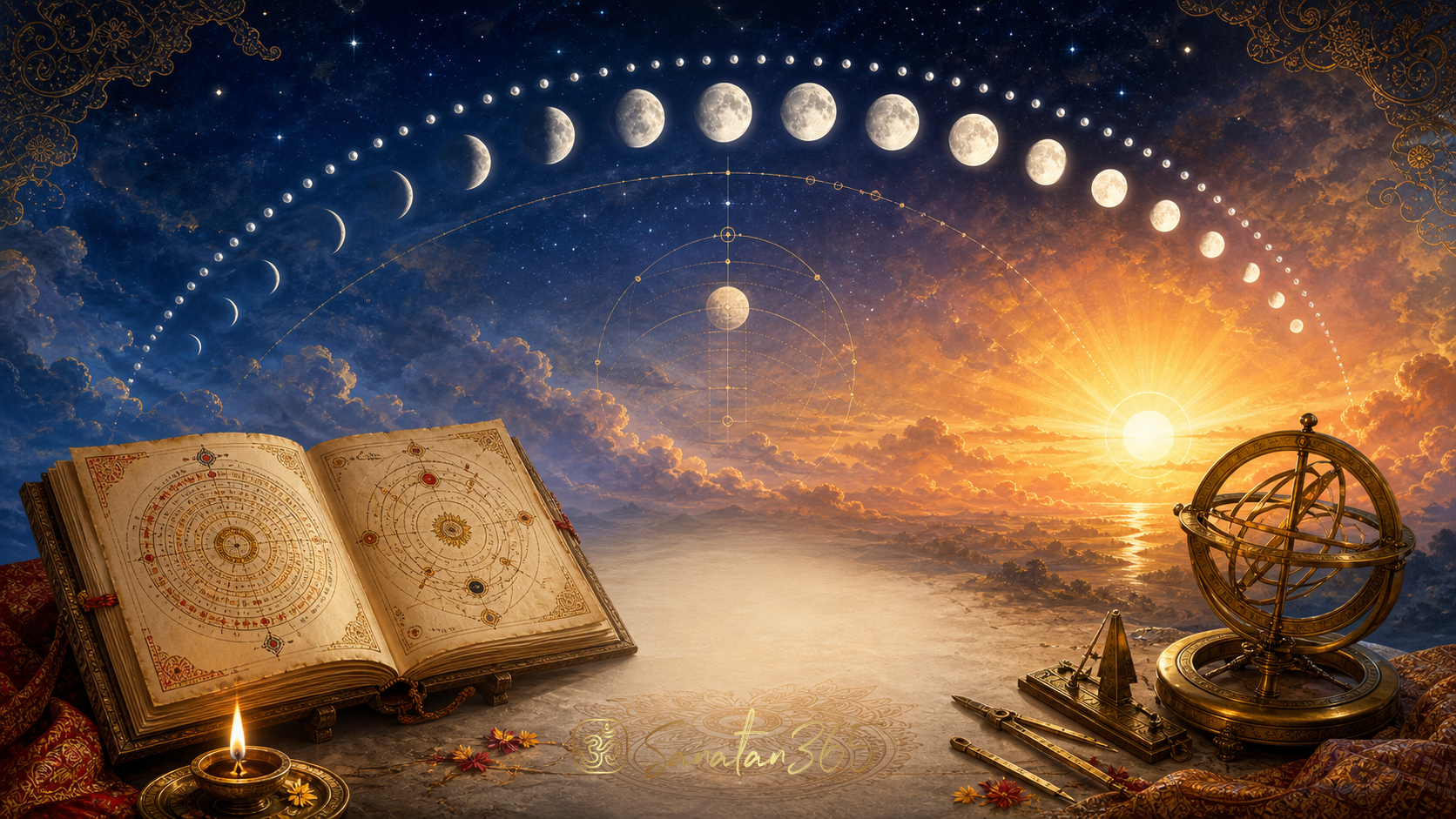
Tithi (तिथि, tithi, lunar day) is the time required for the longitudinal angle between the Moon and the Sun to increase by 12 degrees. Because a full circle has 360 degrees, one lunation contains thirty such divisions: 360 divided by 12 equals 30. The Government of India archival account of the Indian calendar gives this same astronomical definition, while Encyclopaedia Britannica's Hindu calendar overview identifies tithi as one of the five limbs of the traditional calendar.
This definition matters because the clock does not create the tithi. The relative motion of two celestial bodies does. A tithi can begin in the morning, afternoon, evening, or during the night. It may continue across parts of two civil dates, and a single civil date can contain portions of two tithis.
The word “day” therefore needs care. A weekday such as Tuesday is counted from one civil day to the next. A tithi is an astronomical interval whose boundary arrives whenever the Sun-Moon separation crosses the next multiple of 12 degrees. The two systems overlap, but they are not identical.
Tithi is also only one part of the panchāṅga (पञ्चाङ्ग, pañcāṅga, “five limbs”). The other four are vāra (weekday), nakshatra (lunar mansion), yoga (a Sun-Moon calculation), and karana (half a tithi). A fuller introduction appears in Panchang Meaning, while Nakshatra Meaning explains the Moon's position among the traditional lunar mansions.
Key takeaway: A tithi is a 12-degree phase in the changing relationship between the Moon and Sun, not a fixed midnight-to-midnight date.
How are the thirty tithis arranged?
The thirty tithis form two pakshas. Paksha (पक्ष, pakṣa, fortnight or lunar phase) literally carries the sense of a side or wing. Each paksha contains fifteen tithis.
Shukla Paksha: the waxing fortnight
Shukla Paksha (शुक्ल पक्ष, śukla pakṣa, bright or waxing fortnight) begins after Amavasya, the new-moon tithi. The visible Moon generally grows from a slender crescent toward fullness. Its sequence is:
- Pratipada: first
- Dwitiya: second
- Tritiya: third
- Chaturthi: fourth
- Panchami: fifth
- Shashthi: sixth
- Saptami: seventh
- Ashtami: eighth
- Navami: ninth
- Dashami: tenth
- Ekadashi: eleventh
- Dwadashi: twelfth
- Trayodashi: thirteenth
- Chaturdashi: fourteenth
- Purnima: full moon
Krishna Paksha: the waning fortnight
Krishna Paksha (कृष्ण पक्ष, kṛṣṇa pakṣa, dark or waning fortnight) begins after Purnima. The visible Moon generally diminishes until Amavasya. The first fourteen names repeat, while the fifteenth tithi is Amavasya, the new moon.
“Bright” and “dark” describe the Moon's visible phase, not a moral ranking. Both fortnights contain important observances. Ekadashi vrata occurs in both; Pradosha is associated with Trayodashi in both; Purnima and Amavasya each carry distinct devotional, ancestral, regional, and contemplative practices.
The two fortnights also make the Hindu calendar easy to speak aloud. “Ashadha Shukla Ekadashi” identifies a lunar month, a paksha, and the eleventh tithi. That is far more precise within the traditional system than saying only “the eleventh day.”
Key takeaway: The lunar month has fifteen waxing tithis from Pratipada to Purnima and fifteen waning tithis from Pratipada to Amavasya.
Why does a tithi not match a 24-hour date?
The Moon does not move at a perfectly uniform speed along its apparent path. As a result, each 12-degree Sun-Moon interval takes a slightly different amount of clock time. A tithi is often close to a solar day, but it is not locked to 24 hours.
This creates three situations that can surprise anyone reading a Panchang for the first time:
- A tithi changes during the day. A calendar may say “Amavasya until 3:13 PM, then Shukla Pratipada.” Both belong to the same Tuesday, but not to the same tithi.
- One tithi touches two dates. If a tithi begins Monday evening and ends Tuesday afternoon, it appears across both civil dates.
- A sunrise sequence may skip or repeat a tithi name. If a short tithi begins after one sunrise and ends before the next, it is absent at sunrise. If a long tithi spans two sunrises, the same name may appear on consecutive civil days.
Traditional calendrical language calls a sunrise-skipped tithi kshaya (क्षय, kṣaya, diminished or omitted in the sunrise count) and a tithi present at two sunrises vriddhi or adhika (वृद्धि / अधिक, vṛddhi / adhika, extended or additional). The tithi itself still occurs astronomically; what changes is its relationship to local sunrise.
Location matters for the same reason. Sunrise in Varanasi occurs at a different clock time from sunrise in London, Singapore, or New York. A tithi boundary is a global astronomical moment, but the rule connecting that moment to sunrise and observance is applied locally. That is why diaspora families should use a reliable Panchang set to their own city rather than copying an India-only time without adjustment.
This is also why a printed calendar and a mobile Panchang may appear to disagree when they use different locations, calculation conventions, or observance rules. The right response is not to assume that sacred time is arbitrary. It is to check the place, timezone, tithi end time, sunrise, and the rule for the specific vrata or festival.
Key takeaway: Tithi lengths vary, and their connection to local sunrise can make a lunar day begin mid-date, span two dates, or appear differently across locations.
How does tithi determine Hindu festival dates?
Many Hindu festivals are defined by a lunar month and tithi rather than by a fixed Gregorian date. Krishna Janmashtami is connected with Krishna Paksha Ashtami; Rama Navami with Shukla Paksha Navami; Mahashivaratri with Krishna Paksha Chaturdashi; and Guru Purnima with Ashadha Purnima. The Gregorian date shifts because lunar and solar cycles do not align into identical yearly blocks.
Knowing the target tithi is necessary, but it is not always sufficient. Different observances use different decision rules. A festival may prioritize:
- the tithi present at sunrise;
- the tithi prevailing at moonrise;
- the tithi present at midnight;
- a particular nakshatra or weekday combination;
- a parana window after a vrata;
- a sampradaya-specific rule preserved by a temple or lineage.
For example, an Ekadashi fast is not responsibly scheduled by choosing any date on which a portion of Ekadashi appears. The relevant tradition also considers sunrise, Dashami contact, and the correct Dwadashi parana period. Similarly, Sankashti Chaturthi observance relates to moonrise, while Janmashtami traditions consider the midnight period and Rohini Nakshatra in different ways.
This layered reasoning explains why two respected calendars may sometimes publish adjacent observance dates. Regional amanta and purnimanta month systems, local sunrise, and lineage rules can all matter. The difference does not automatically signal error. A family should follow its established sampradaya (सम्प्रदाय, sampradāya, living tradition), local temple, or trusted regional Panchang when a practice has a defined rule.
The same principle protects readers from oversimplified search results. “Today's tithi” is location-sensitive, and “festival date” may depend on more than the tithi's start and end. A good Panchang shows the underlying timing so that the conclusion can be understood rather than merely copied.
Key takeaway: Hindu festival dates follow specific tithi-and-observance rules, which may also involve sunrise, moonrise, midnight, nakshatra, location, and lineage.
How can a beginner read tithi in a Panchang?
A beginner does not need to calculate planetary longitudes by hand. The goal is to read a trustworthy Panchang intelligently and know which questions to ask.
Use this five-step method:
- Set the correct location. Choose the city where the observance will take place, not a default city in another country.
- Read the full tithi line. Note the paksha, tithi name, and exact end time. If the end time is after midnight, check how the calendar displays the next civil date.
- Check sunrise and the event rule. Determine whether the practice uses sunrise, moonrise, midnight, or another reference point.
- Confirm the lunar month system. North Indian purnimanta and many western or southern amanta calendars can name the running month differently while agreeing on the actual tithi.
- Use a tradition-aware source. For a vrata, temple festival, or family samskara, confirm with the relevant temple, acharya, priest, or established calendar rather than relying on a generic horoscope page.
It also helps to separate three questions that are often mixed together:
- What tithi is active now? This is an astronomical and location-formatted calendar question.
- Which civil date carries the observance? This requires the observance rule.
- What does the observance mean? This belongs to scripture, tradition, history, and lived practice, not astronomy alone.
Tithi can guide ritual timing without becoming fatalism. A Panchang describes qualities and relationships in time; it does not remove moral responsibility, practical evidence, or human judgment. Important medical, legal, financial, or safety decisions should never be made solely from an auspicious-time calculation.
For readers learning adjacent concepts, Rashi Meaning distinguishes the Moon sign from tithi, while Guru Tattva Meaning explores why living guidance matters more than calendar data alone.
Key takeaway: Read tithi with the correct location, end time, sunrise, month convention, and observance rule; do not treat a single calendar label as the whole decision.
Sacred time as relationship
The Hindu lunar day offers a different experience of time from the numbered square on a wall calendar. It asks the observer to notice relationship: Moon to Sun, waxing to waning, local sunrise to celestial boundary, individual practice to inherited tradition.
That does not make tithi less precise. Its precision is simply astronomical rather than bureaucratic. The calculation is exact enough to mark a 12-degree interval, while its ritual use remains attentive to place, purpose, and community.
Seen this way, the shifting festival date is not an inconvenience to be corrected. It is evidence that sacred time is still being read from a living sky. Purnima arrives through fullness, Amavasya through conjunction, and every named tithi marks a stage between them. The calendar remembers motion.
The single key takeaway: Tithi joins astronomy and devotion by measuring the Moon-Sun relationship and translating it into a locally observed rhythm of sacred time.
FAQ
What is tithi in simple words?
A tithi is a Hindu lunar day. It is the time during which the angular distance between the Moon and the Sun increases by 12 degrees. There are thirty tithis in a lunar month.
Is tithi the same as a date?
No. A civil date normally runs from midnight to midnight, while a tithi can begin or end at any clock time. One date may contain parts of two tithis, and one tithi may span parts of two dates.
What are Shukla Paksha and Krishna Paksha?
Shukla Paksha is the waxing or bright fortnight from after Amavasya toward Purnima. Krishna Paksha is the waning or dark fortnight from after Purnima toward Amavasya. Each contains fifteen tithis.
Why do Hindu festival dates change every year?
Many festivals are fixed to a lunar month and tithi, not to a Gregorian date. Because the lunar and solar cycles do not align into identical years, the matching civil date shifts. Local sunrise and observance rules can also affect the final date.
Which tithi applies when it changes during the day?
That depends on the purpose. A daily Panchang can state both tithis and the transition time, while a festival or vrata follows its own rule based on sunrise, moonrise, midnight, or another prescribed period. Use a location-specific Panchang and the rule of the relevant tradition.
About the author
Sanatan365 Editorial
Bringing Sanatan Dharma to modern seekers through authentic, scripture-grounded content.
Related in Astrology
 Astrology
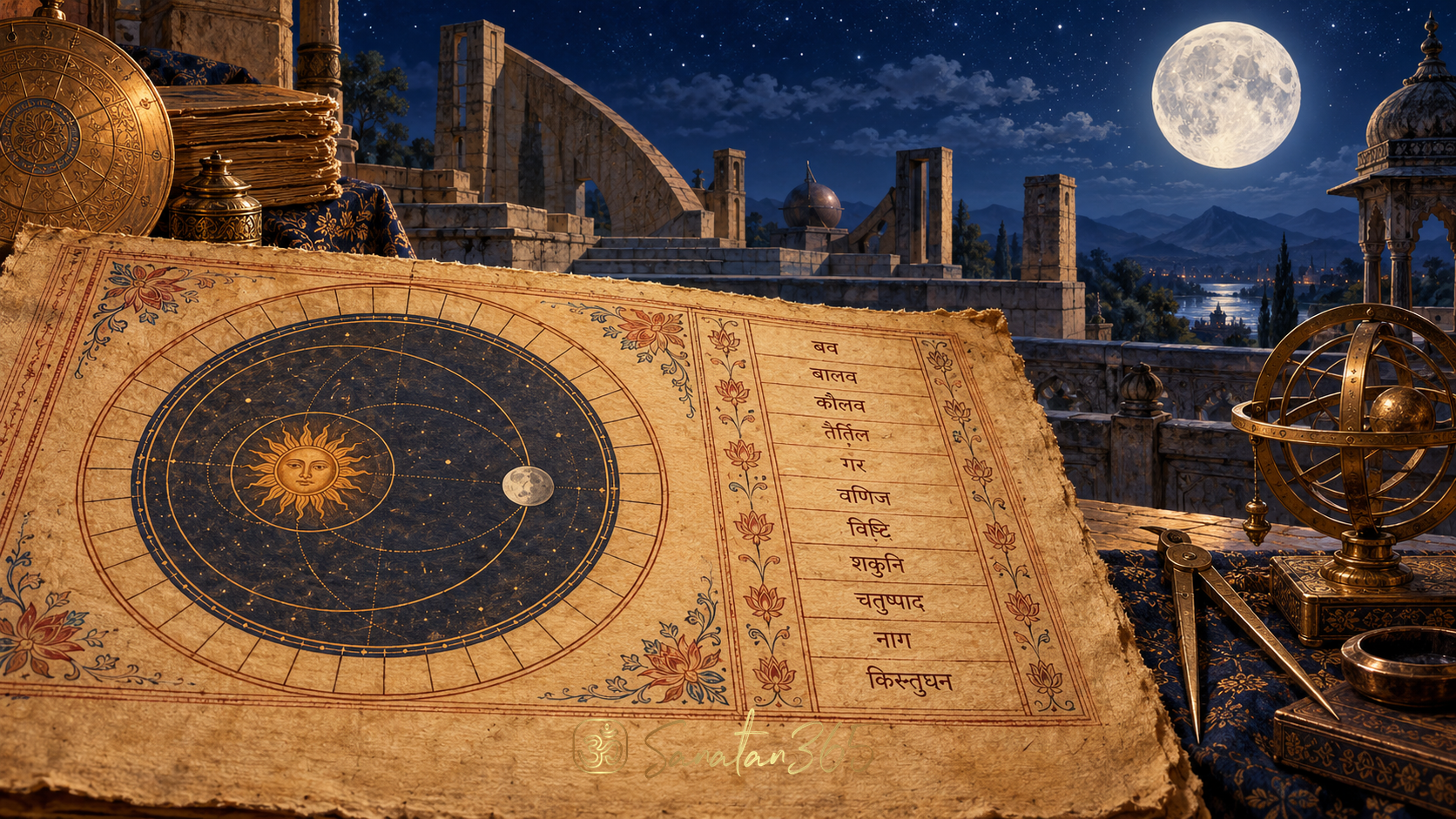
Karana Meaning: How to Read the Half-Tithi in a Panchang
Understand the eleven karanas, their six-degree lunar measure, why they change within a day, and how to read timings without fear-based pre…
 Astrology
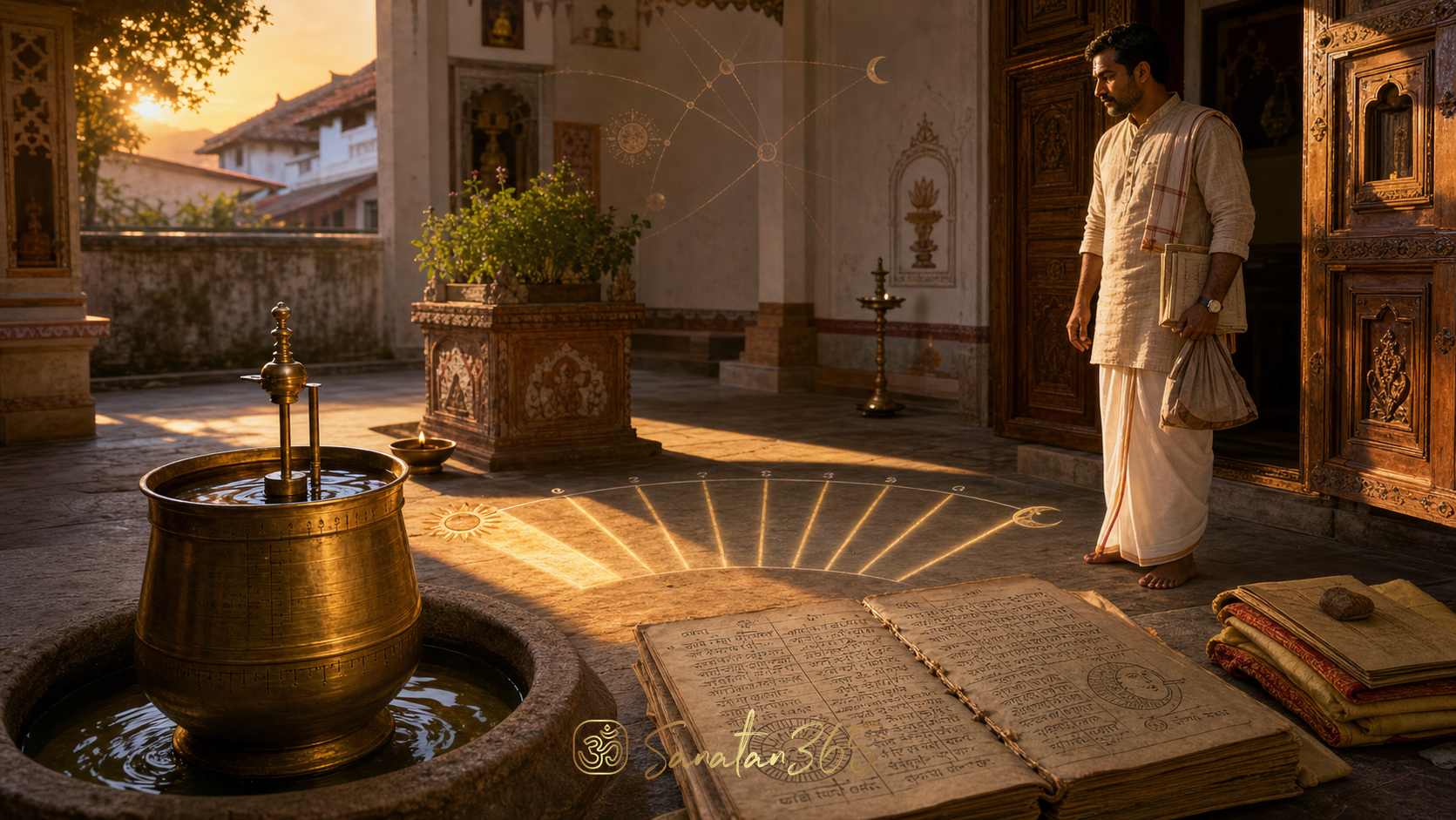
Rahu Kalam Meaning: Timing, Calculation, and Thoughtful Practice
Rahu Kalam is a daily interval traditionally treated as unsuitable for beginning important worldly undertakings. Learn how it is calculated…
 Astrology
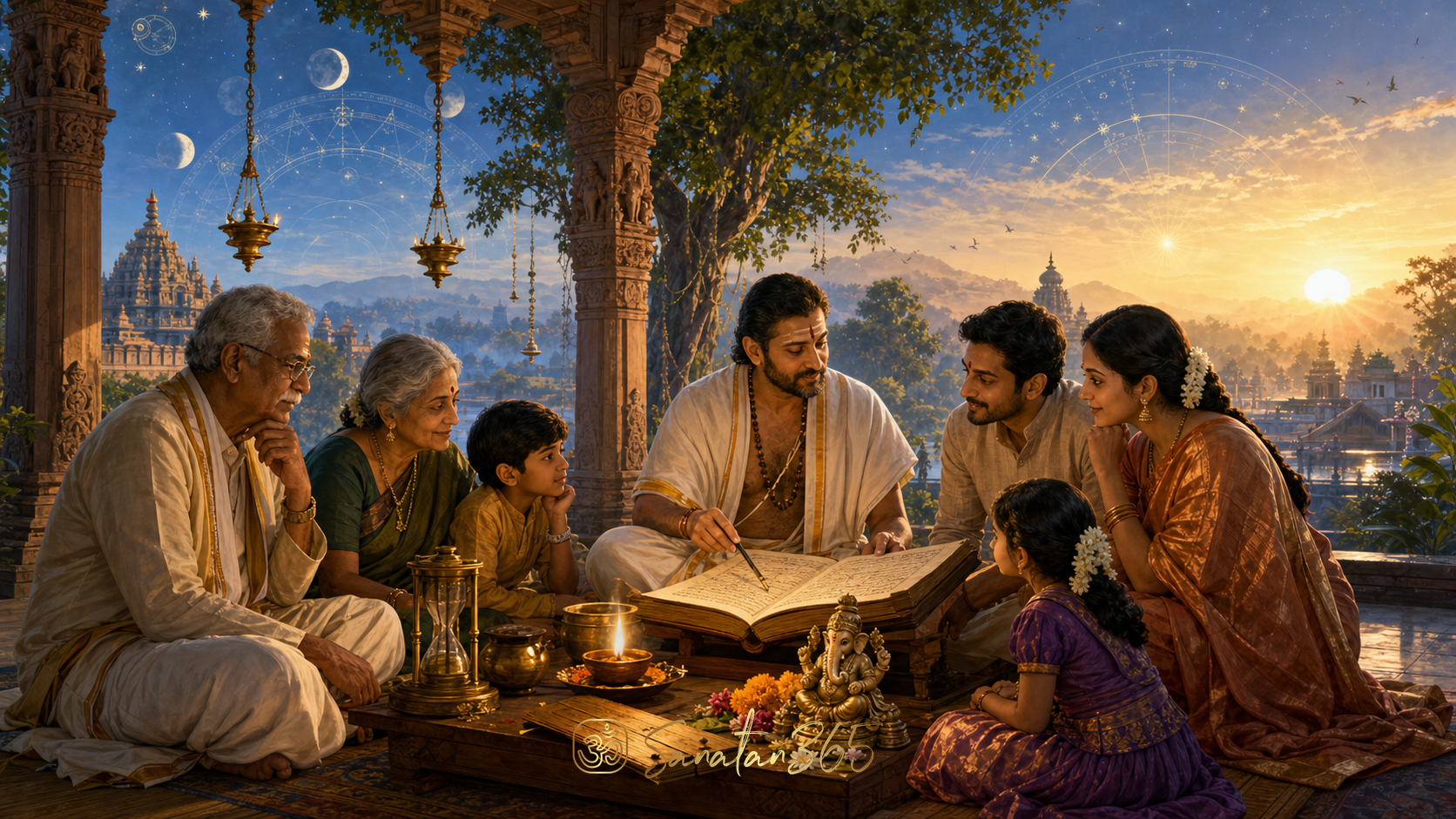
Muhurta Meaning: How Hindu Tradition Chooses an Auspicious Time
Muhurta is the Hindu discipline of choosing a fitting time for a meaningful action by considering the Panchanga, the purpose of the act, an…

