Sandhya Vandana Meaning: Twilight Prayer and Gayatri Practice
Sandhya Vandana is the Hindu discipline of greeting sacred transition times with purification, breath, water offering, and Gayatri mantra.
The most powerful daily practices are often built around the quietest hours.
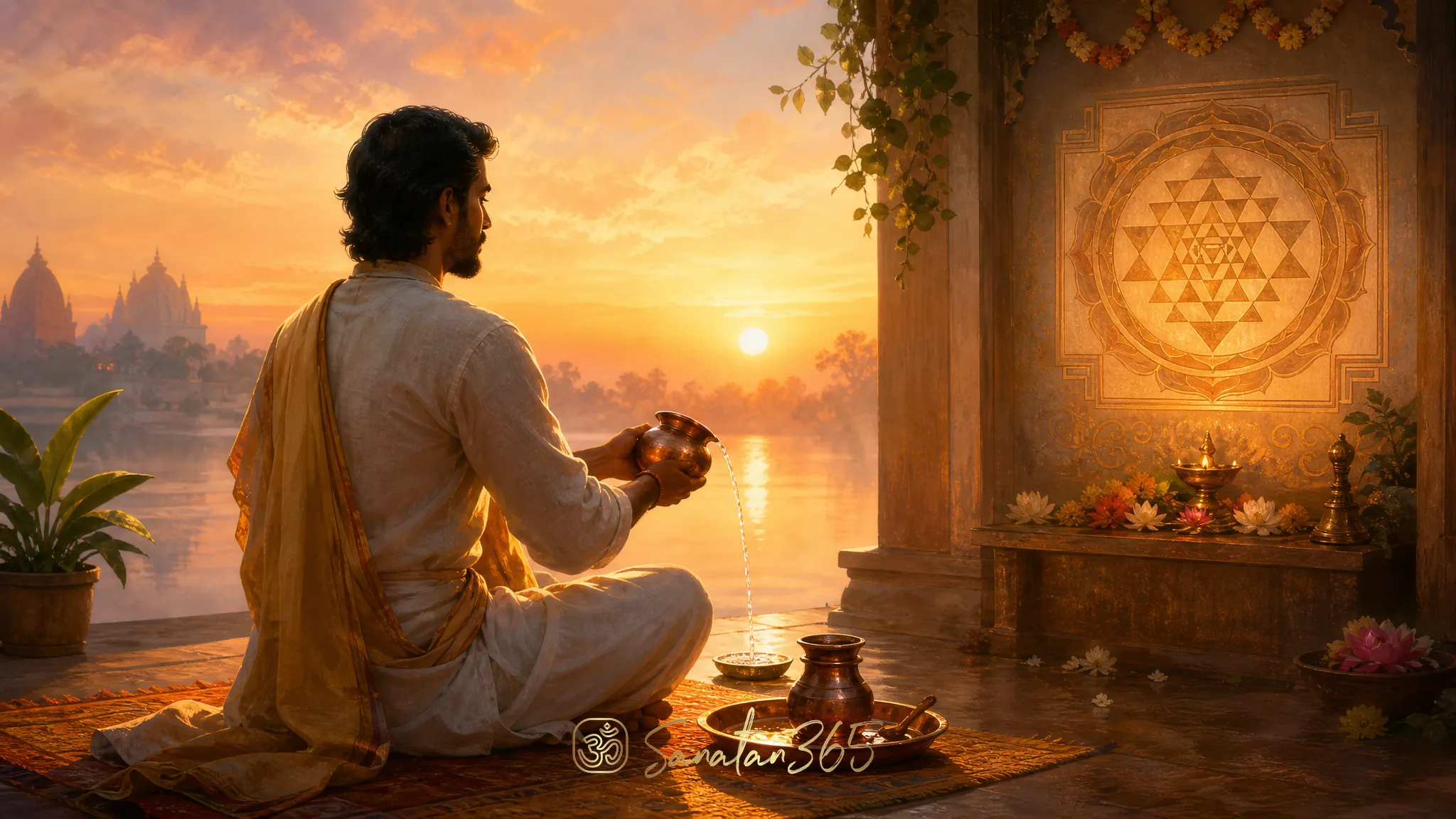
Sandhya Vandana meaning begins with sandhya (सन्ध्या, twilight or sacred junction) and vandana (वन्दन, reverent salutation). In Hindu practice, it refers to greeting the transition points of the day, especially dawn, noon, and dusk, through purification, breath awareness, water offering, and Gayatri mantra japa (जप, repeated recitation). Its heart is not hurry or display. It is the discipline of returning the mind to light at the exact moments when the day itself is changing.
For many lineages, Sandhya Vandana is a formal Vedic nitya karma (नित्य कर्म, daily duty), especially after upanayana (उपनयन, sacred initiation). For a wider modern reader, it also reveals a practical Hindu insight: the day becomes more sacred when its thresholds are not crossed unconsciously.
What Is Sandhya Vandana Meaning in Daily Hindu Practice?
Sandhya Vandana meaning is not simply "morning prayer." It is a complete discipline of sacred transition. Hinduism Today describes sandhya periods as times when prana (प्राण, vital energy) is balanced in nature, making them suitable for prayer and awareness (Hinduism Today). Traditional practice usually names three main sandhyas:
- Pratah sandhya (प्रातः सन्ध्या): dawn, facing the beginning of the day.
- Madhyahna sandhya (मध्याह्न सन्ध्या): solar noon, pausing in the middle of action.
- Sayam sandhya (सायं सन्ध्या): dusk, closing the day with recollection.
The word sandhya itself suggests a junction. Dawn is the meeting of night and day. Noon is the turning point of the sun's visible arc. Dusk is the meeting of day and night. These are not random clock slots. They are natural reminders that life moves through thresholds, and that the mind should learn how to cross them with awareness.
In formal households and sampradayas (सम्प्रदाय, lineage traditions), the exact mantras, gestures, directions, and counts vary. Some follow Rig Veda, Yajur Veda, or Sama Veda procedures. Some regional families emphasize particular achamana (आचमन, ritual sipping of water), pranayama (प्राणायाम, disciplined breathing), marjana (मार्जन, sprinkling or purification), arghya (अर्घ्य, water offering), and Gayatri japa. The details matter inside a lineage, but the underlying movement is consistent: purify, steady, offer, chant, remember, and dedicate.
Key takeaway: Sandhya Vandana is a daily Hindu method for making time itself sacred through awareness, mantra, and disciplined salutation.
Why Is the Gayatri Mantra Central to Sandhya Vandana?
The Gayatri Mantra is central because Sandhya Vandana is ultimately a practice of inner illumination. The mantra comes from Rig Veda 3.62.10 and invokes Savitr, the divine solar presence that impels insight and life. A common English sense of the prayer is: may the divine radiance awaken and guide our intelligence. Sathya Sai International gives a devotional translation that emphasizes divine light illuminating the physical, mental, and spiritual realms (Sathya Sai International).
This is why Sandhya Vandana is not only a ritual of the sun outside. It is also a ritual of the buddhi (बुद्धि, discerning intelligence) within. The practitioner stands at the edge of light and asks that the inner faculty of judgment become clearer.
In many traditions, Gayatri japa is done after preparatory purification. The body is settled. The breath is regulated. Water has been offered. The mind has been given a sequence, so it is less scattered when mantra begins. This order teaches something important: sacred speech is not treated casually. The practitioner prepares the vessel before receiving the mantra.
The Gayatri Mantra also links Sandhya Vandana to a wider Hindu vision of knowledge. It is not merely asking for success, protection, or comfort. It asks for illumination of dhiyah (धियः, intellects or understandings). That makes it especially relevant for students, householders, professionals, and elders alike. Everyone acts from some form of understanding. The practice asks that understanding to be refined.
Readers who want a deeper mantra-specific introduction can also read Gayatri Mantra Meaning: A Vedic Prayer for Clear Intelligence, which explains the prayer as a Vedic invocation of clear intelligence.
Key takeaway: Gayatri is the heart of Sandhya Vandana because the practice seeks awakened intelligence, not only outer ritual correctness.
What Are the Main Steps of Sandhyavandanam?
Different lineages preserve different procedures, so no article should replace instruction from a qualified family elder, acharya, or guru. Still, the broad architecture of Sandhyavandanam can be understood as a sequence of inner preparation and offering.
Common elements include:
- Achamana: ritual sipping of water with mantras, symbolizing internal purification.
- Pranayama: regulated breathing, often joined with mantra remembrance, to steady body and mind.
- Sankalpa: a conscious resolve that frames the act as sacred practice.
- Marjana: sprinkling or touching water for purification.
- Arghya pradanam: offering water, commonly toward the sun, as reverent salutation.
- Gayatri japa: repeated recitation or meditation on the Gayatri Mantra.
- Upasthana: standing prayer or reverent address to the divine presence associated with the time of day.
- Samarpana: offering the fruit of the practice to the Divine.
This sequence matters because it prevents prayer from becoming vague intention alone. The hands, breath, voice, water, posture, and attention all participate. Sanatan Dharma often treats the human being as integrated: body, speech, mind, memory, and environment. Sandhya Vandana trains all of them together.
The water offering is especially meaningful. Water is humble, clear, and life-sustaining. When offered at sunrise or sunset, it becomes a visible form of gratitude. The practitioner does not possess the light. The practitioner receives it, honors it, and returns a small offering through water and mantra.
For those who practice a simplified form under guidance, the same principles can remain: cleanliness, a steady place, a few minutes of breath awareness, sincere Gayatri japa if one is authorized to chant it, and a closing dedication. For those not initiated into a specific mantra practice, a respectful prayer to Surya, Narayana, Shiva, Devi, or one's ishta devata (इष्ट देवता, chosen form of the Divine) may be more appropriate than copying formal rites without context.
Key takeaway: The steps of Sandhyavandanam move from purification to steadiness, from offering to mantra, and from personal effort to dedication.
How Does Sandhya Vandana Shape the Mind?
Sandhya Vandana shapes the mind by repeating a simple lesson every day: do not let life run past the sacred unnoticed.
At dawn, the practice asks for clarity before action begins. At noon, it interrupts momentum before the day becomes purely mechanical. At dusk, it invites review before the night absorbs the mind into rest, distraction, or fatigue. This rhythm has psychological wisdom. Human attention is often captured by urgency. Sandhya Vandana returns attention to order.
It also trains humility. The practitioner may be educated, busy, wealthy, anxious, or ambitious. Still, at the sandhya point, all of that is placed before a larger rhythm: sun, breath, water, mantra, and dharma. This does not diminish human responsibility. It purifies it.
The practice also supports satya (सत्य, truthfulness) and self-observation. When one pauses daily, one begins to notice the quality of speech, choices, anger, desire, and gratitude. This is why daily ritual can become ethical practice. It is not only "I performed a rite." It is also "I remembered who I am trying to become."
Sandhya Vandana sits naturally beside other Hindu disciplines such as Dhyana Meaning: Hindu Meditation as Steady Awareness, Not Empty Escape and Mauna Meaning: The Hindu Practice of Sacred Silence. Dhyana steadies attention. Mauna refines speech. Sandhya Vandana gives both a daily time structure.
Key takeaway: Sandhya Vandana is a training in sacred rhythm, helping the mind begin, pause, and close the day with clarity.
How Can Modern Families Understand Sandhya Vandana Respectfully?
Modern families often encounter Sandhya Vandana in different ways. Some inherit it as a precise family discipline. Some see grandparents doing it with water, mantra, and a small vessel at sunrise. Some hear the word only when learning about Gayatri Mantra or upanayana. The best starting point is respect.
Respect means not flattening the practice into a generic wellness routine. It has Vedic, ritual, familial, and lineage-specific depth. At the same time, respect does not require distance. Even someone who does not perform the formal rite can learn from its architecture:
- Begin the day with remembrance before screens.
- Pause at noon for one minute of breath and gratitude.
- Close the evening with a simple prayer or reflection.
- Treat water, light, and speech as sacred gifts.
- Learn mantras through proper sources, not random fragments.
For diaspora families, Sandhya Vandana can also become a cultural bridge. Children may first ask practical questions: Why water? Why sunrise? Why repeat the same mantra? These questions are not interruptions. They are openings. Parents can explain that Sanatan Dharma often uses visible actions to train invisible qualities: attention, gratitude, purity, restraint, and devotion.
For householders with formal practice, consistency matters more than performance. A shorter practice done reverently is often more transformative than a long practice done with irritation. For beginners, the right path is to learn from a trusted elder or acharya, understand one's family tradition, and avoid mixing procedures casually.
Key takeaway: Modern families can honor Sandhya Vandana by preserving its lineage depth while learning its universal lesson of sacred daily rhythm.
What Is a Gentle Beginner's Reflection on Sandhya Vandana?
A gentle beginner's reflection can begin with the three thresholds of the day. One does not need to imitate a full formal rite without instruction. Instead, one can observe what Sandhya Vandana is teaching.
At dawn, ask: What quality should guide my actions today?
At noon, ask: Have I become careless in speech, food, work, or emotion?
At dusk, ask: What should be offered back before the day ends?
These questions are not replacements for traditional Sandhyavandanam. They are a way to understand its inner direction. The formal rite offers water and mantra. The reflective lesson offers attention and accountability. Both point toward the same larger truth: the day is not spiritually empty.
When learned properly, Sandhya Vandana becomes less about "adding another task" and more about restoring proportion. Work is important, but not ultimate. Family is sacred, but needs patience. Knowledge is powerful, but must be illuminated by humility. Time passes, but each transition can become a doorway.
That is the quiet beauty of Sandhya Vandana meaning. It asks the practitioner to notice light, not as decoration, but as discipline.
Key takeaway: Beginners can approach Sandhya Vandana by first honoring its lesson: cross the day's thresholds with awareness, gratitude, and reverence.
FAQ
What is Sandhya Vandana meaning in simple words?
Sandhya Vandana means reverent salutation at the sandhya, the sacred junctions of the day such as dawn, noon, and dusk. It usually includes purification, breath regulation, water offering, and Gayatri mantra practice.
Is Sandhya Vandana only for people who have had upanayana?
Formal Vedic Sandhyavandanam is traditionally tied to upanayana and lineage instruction. Others can still respectfully learn its meaning, observe the sacredness of dawn and dusk, and practice appropriate prayers taught by their own family or teacher.
Why is the Gayatri Mantra used in Sandhya Vandana?
The Gayatri Mantra invokes divine radiance to guide the intellect. Since Sandhya Vandana is performed at times of natural transition and light, Gayatri becomes the central prayer for inner clarity.
Can Sandhya Vandana be done in a simplified way?
A simplified practice should be learned from a trusted elder, acharya, or family tradition. For general reflection, one may pause at dawn or dusk for cleanliness, breath, gratitude, and respectful prayer without pretending to perform the full formal rite.
What is the main benefit of Sandhya Vandana?
Its main benefit is spiritual discipline. It trains the practitioner to begin, pause, and close the day with purity, attention, humility, and remembrance of the Divine.
The single key takeaway: Sandhya Vandana teaches that the turning points of the day are not empty moments; they are invitations to return the mind to light.
About the author
Sanatan365 Editorial
Bringing Sanatan Dharma to modern seekers through authentic, scripture-grounded content.
Related in Practices
 Practices
Kusha Grass Meaning: Why Darbha Has a Place in Hindu Rituals
Understand kusha or darbha grass, its traditional place in worship and ancestral rites, and how to approach varied customs with care.
 Practices
Bhuta Shuddhi Meaning: Purifying the Five Elements Within
Bhuta Shuddhi means the purification of the five elements: earth, water, fire, air, and space. In Hindu yogic and Tantric traditions, it is…
 Practices
Likhita Japa: Meaning and Practice of Writing a Mantra
Likhita japa turns mantra repetition into a written devotional discipline. Learn its meaning, how it differs from spoken and mental japa, a…

