Raksha Bandhan 2026: Date, Meaning, and Rakhi Traditions
Raksha Bandhan 2026 falls on 28 August in India. Explore the meaning of rakhi, a respectful home ceremony, regional traditions, and the deeper ethic of mutual care.
A single thread can carry more than affection: it can make care visible, responsibility memorable, and family love accountable.
Raksha Bandhan 2026 falls on Friday, 28 August in India, on Shravana Purnima, the full-moon close of the sacred month of Shravana. Raksha Bandhan (रक्षाबन्धन, raksha bandhana, “a bond of protection or care”) is marked by tying a rakhi, offering prayers, sharing sweets, and renewing a promise to stand by one another. Although the best-known form is between a sister and brother, its spiritual centre is broader: protection becomes dharmic when it is mutual, respectful, and expressed through dependable action.
Key takeaway: Raksha Bandhan is not only a thread ceremony; it is a yearly renewal of loving responsibility.
When Is Raksha Bandhan 2026 in India?
Raksha Bandhan 2026 is observed on Friday, 28 August in India. The festival belongs to Shravana Purnima (श्रावण पूर्णिमा, the full-moon day of the Hindu month of Shravana). The Drik Panchang August 2026 festival calendar lists Raksha Bandhan on 28 August, alongside other traditions connected with the Shravana full moon.
The exact auspicious window should be checked for the city where the ceremony will take place. A panchanga (पञ्चाङ्ग, a traditional Hindu almanac based on five calendrical limbs) is location-sensitive: sunrise, tithi boundaries, and observance windows vary across Delhi, Mumbai, Chennai, Kolkata, London, Singapore, and other places. The Drik Panchang Rakhi page provides city-specific timings.
Many families avoid Bhadra (भद्रा, a calendrical period traditionally considered unsuitable for the rakhi ceremony) and tie the rakhi after it ends. This is a matter of ritual calendar observance, not fear. When family members live in different time zones, they can consult a trusted local temple or panchanga and choose a practical time that preserves reverence without creating anxiety.
A simple planning list helps:
- Confirm the local date and suitable time for the city of observance.
- Prepare the rakhi and puja items the previous evening.
- Make space for elders, children, and family members joining by video.
- Keep the ceremony unhurried, even if it is brief.
- Let the promise made during the ritual become one concrete act of care.
Diaspora families may observe before work or school, or gather on the nearest practical evening while remembering the actual tithi. The heart of the festival is not weakened by distance. A rakhi sent in advance, a prayer shared on a call, and a sincere commitment can keep the bond alive across continents.
Key takeaway: The date is 28 August 2026 in India, while the precise ceremony time should follow a reliable local panchanga.
What Is the Meaning of Raksha Bandhan?
The meaning of Raksha Bandhan begins with two Sanskrit words. Raksha (रक्षा, protection, guardianship, or care) and bandhana (बन्धन, binding or bond) together describe a bond made visible through a sacred thread. Older Sanskrit usage also connects raksha with an amulet or protective thread tied on significant occasions. The modern family festival preserves that sacred logic while placing affection and duty at its centre.
The rakhi is not a contract of control. Nor does it declare that one person is permanently weak and another permanently strong. A more dharmic reading is reciprocal: each person promises to protect the other's dignity, encourage wise choices, offer help in difficulty, and respect appropriate boundaries. Protection without respect can become possession; affection without responsibility can remain sentiment. Raksha Bandhan holds the two together.
This is why the festival can remain meaningful in changing families. A brother may promise to support his sister, and a sister may pray for his well-being and challenge him when he loses his way. Siblings may care for ageing parents together. Cousins may renew bonds weakened by distance. Friends or community members may tie a thread in traditions where a relationship of honour and mutual care is being affirmed.
The ceremony also teaches the value of sankalpa (सङ्कल्प, a clear sacred intention). In Hindu practice, intention becomes stronger when it is named, witnessed, and followed by action. Readers who want a deeper foundation can explore why Hindu puja begins with sacred intention. The rakhi is the visible reminder; the real vow lives in conduct after the festival.
Examples of a living Raksha Bandhan promise include:
- listening without dismissing a sibling's concern;
- protecting private confidences;
- showing up during illness, grief, or practical difficulty;
- refusing harmful jokes or disrespect within the family;
- supporting education, work, caregiving, or a difficult decision;
- apologising when pride has damaged the relationship.
These actions are less decorative than a gift, but they carry the festival's meaning through the year.
Key takeaway: Raksha Bandhan turns love into a mutual discipline of dignity, honesty, and dependable care.
How Is a Rakhi Ceremony Performed at Home?
A home Rakhi ceremony can be simple, reverent, and adapted to family parampara (परम्परा, inherited tradition or lineage of practice). Customs vary, so elders and trusted family practice should guide details. The following sequence offers a respectful general form rather than one mandatory rule.
Prepare a clean place and puja thali
Set aside a clean space near the home altar or another peaceful area. A puja thali may include:
- the rakhi;
- a small diya (दीप, sacred lamp);
- roli or kumkum for tilaka (तिलक, an auspicious forehead mark);
- akshata (अक्षत, unbroken rice grains used as an auspicious offering);
- flowers;
- sweets or fruit;
- a small water vessel if customary.
The lamp should be handled safely and never left unattended. The ceremony does not become more sacred through excess. Cleanliness, attention, and sincerity matter more than an elaborate display.
Begin with remembrance and prayer
Family members may invoke Ganesha, their ishta-devata (इष्टदेवता, personally cherished form of the Divine), or the Divine according to their tradition. A short prayer can ask for wisdom, well-being, harmony, and the strength to uphold family dharma. This resembles the wider logic of arghya as a respectful water offering: an outward act gathers attention around gratitude.
Apply tilaka and tie the rakhi
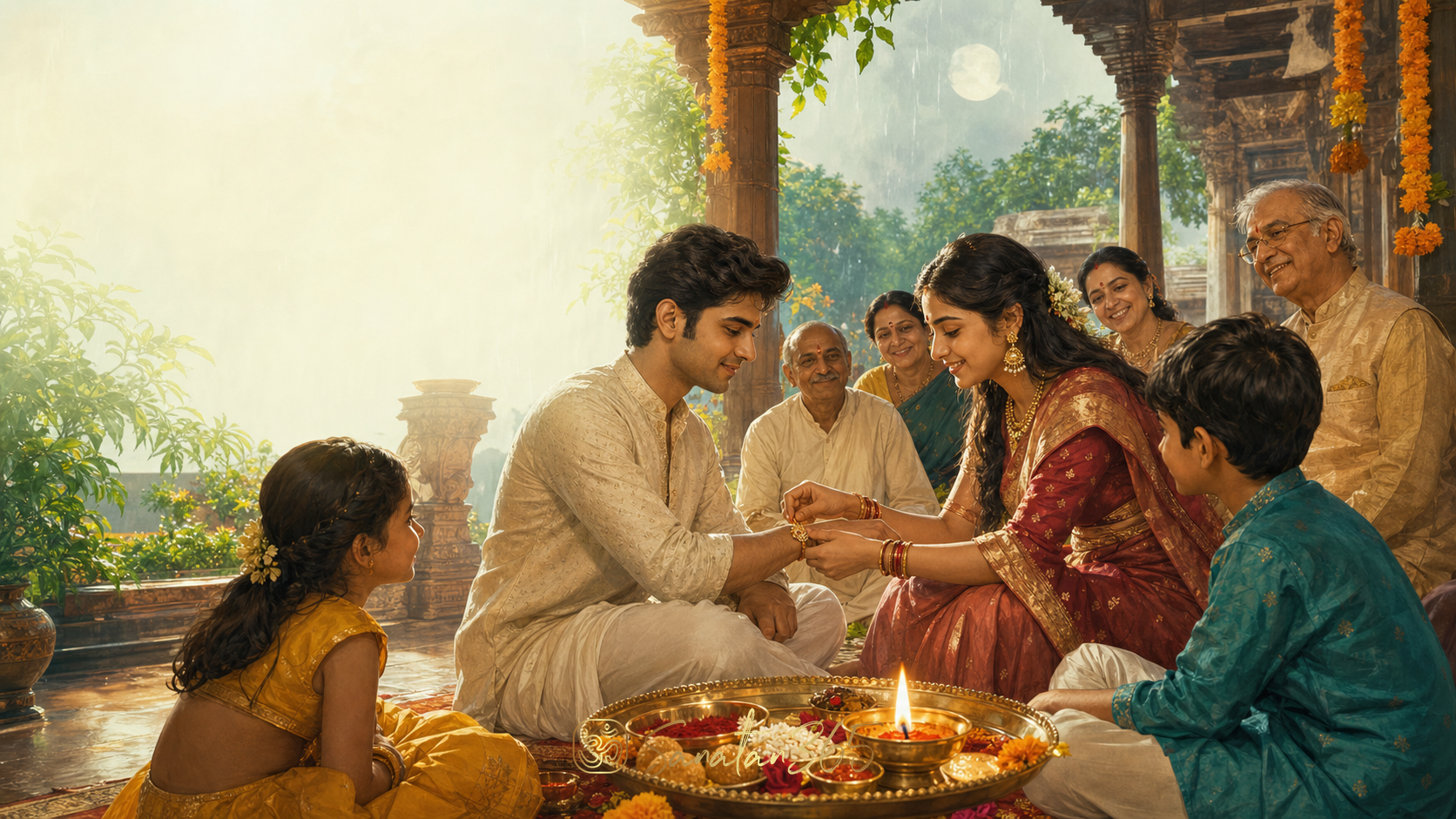
The sister traditionally applies tilaka, places akshata, and ties the rakhi on her brother's wrist. Families may recite a traditional mantra, chant a familiar divine name, or offer a prayer in their own words. The brother receives the thread with respect rather than treating it as a casual accessory.
Some families perform a small aarti (आरती, offering and circling of sacred light) and exchange sweets. The brother may then offer a gift and renew his promise of care. The gift should express gratitude, not turn the festival into a measure of wealth. A handwritten note, time together, help with a responsibility, or support for a meaningful goal may carry more value than an expensive object.
Include absent or younger family members
When siblings cannot meet, the rakhi may be sent by post and tied during a video call. A parent can help a young child understand that the thread represents kindness and responsibility. If a sibling has died, some families remember them through prayer, charity, or quiet gratitude; grief should be held gently rather than forced into celebration.
Food shared after the ritual is often received in a spirit close to prasada (प्रसाद, blessed offering or gracefully received food). The deeper meaning of sacred food is explored in naivedya and prasad traditions. As always, dietary needs and health conditions should be respected.
Key takeaway: A good Rakhi ceremony is attentive and sincere: prayer, tilaka, thread, sweets, gratitude, and a promise that can be lived.
Which Rakhi Traditions Vary Across India?
Raksha Bandhan shares the Shravana full moon with several regional observances. This does not dilute the festival; it shows how one sacred lunar day can hold many forms of gratitude, renewal, study, livelihood, and kinship.
In much of North India, the sister-brother ceremony is prominent, with family gatherings, tilaka, rakhi, sweets, and gifts. In Rajasthan, some traditions include lumba rakhi, tied to the bangle of a brother's wife, recognising that family care is carried through households rather than by one relationship alone.
In Maharashtra and coastal communities, Shravana Purnima is also associated with Narali Purnima, when coconuts are offered in gratitude to the sea. Fishing communities may pray for safety and a responsible return to work after the monsoon season. The ritual focus differs, yet protection, livelihood, gratitude, and relationship remain close.
In Odisha, the day may be known as Gamha Purnima and is associated with Lord Balabhadra as well as agrarian customs. Some communities honour cattle, recognising their place in rural livelihood. In parts of Uttarakhand and other Himalayan regions, the day may connect with sacred-thread renewal and local forms of raksha sutra (रक्षा सूत्र, protective sacred thread).
Several Vedic learning traditions observe Upakarma, a renewal of study and sacred discipline, around this full moon. The details vary by Veda, region, and calendrical calculation. It should not be flattened into the sibling ritual, but it shares the season's theme of recommitment.
For the global diaspora, regional customs often meet in one temple or community hall. A Maharashtrian family may explain Narali Purnima to a North Indian neighbour; an Odia family may share the meaning of Gamha Purnima; children may learn that Hindu unity does not require identical practice. Respectful variation is part of Sanatan Dharma's living strength.
Key takeaway: Raksha Bandhan belongs to a wider Shravana Purnima landscape in which regions renew kinship, study, livelihood, and gratitude in distinct ways.
How Can Raksha Bandhan Stay Meaningful in Modern Families?
The festival stays meaningful when it is freed from three pressures: compulsory perfection, one-sided gender roles, and gift competition.
First, family bonds can be tender and complicated at the same time. A rakhi should never be used to erase harm, demand instant reconciliation, or force contact where safety and boundaries are needed. Dharma includes truth and discernment. A respectful message may be appropriate in one relationship; distance may be necessary in another. Ritual is strongest when it supports integrity rather than appearance.
Second, protection can be understood as mutual care. Sisters are not merely recipients of protection, and brothers are not valuable only as providers. Each person brings courage, counsel, practical help, prayer, and moral accountability. This reading honours the traditional ceremony while recognising the full agency of everyone involved.
Third, a meaningful celebration need not be expensive. Families can choose one action for the coming year:
- Schedule a monthly sibling call.
- Share responsibility for an elder's care.
- Create an emergency contact plan.
- Support one another's education or work goal.
- Make a small joint donation to a trusted cause.
- Resolve one practical family burden together.
Eco-conscious choices can also preserve reverence. Choose a durable handmade rakhi, natural fibres where practical, and minimal packaging. Avoid decorative materials that quickly become litter. A sacred thread should not create careless waste.
For children, the best teaching is concrete: “This thread reminds us to speak kindly, tell the truth, and help each other.” For adults, the same teaching becomes harder and deeper. It may mean making time, keeping confidence, offering honest counsel, or standing beside a sibling without controlling their choices.
The full moon itself offers a fitting image. Purnima (पूर्णिमा, fullness) does not mean every relationship is flawless. It suggests bringing the relationship into fuller awareness: gratitude for what is good, honesty about what needs repair, and willingness to act with greater care.
Key takeaway: Modern Raksha Bandhan becomes stronger through mutuality, boundaries, modest celebration, and one promise carried beyond the day.
A Bond Renewed Through Action
Raksha Bandhan 2026 arrives during the monsoon month of Shravana, when renewal is visible in the earth itself. The rakhi is small enough to fit around a wrist, yet its ethical demand is large: remember the bond, protect dignity, speak truthfully, and be present when care is needed.
Families do not need to make identical promises. One may promise to call more often. Another may share responsibility. Another may apologise. Another may simply pray with sincerity across a great distance. What matters is that the thread points beyond itself.
Key takeaway: The finest Raksha Bandhan gift is trustworthy care made real through the year.
FAQ
What is the date of Raksha Bandhan 2026?
Raksha Bandhan 2026 falls on Friday, 28 August in India. It is observed on Shravana Purnima. Because ritual timings vary by location, families should consult a trusted local panchanga for their city.
What does Raksha Bandhan mean?
Raksha Bandhan means a bond of protection or care. Raksha means protection or guardianship, while bandhana means binding or bond. The rakhi makes a promise of affection, dignity, and responsibility visible.
What items are needed for a Rakhi ceremony?
A simple puja thali may hold a rakhi, diya, roli or kumkum, akshata, flowers, and sweets or fruit. Family customs vary, and sincerity matters more than an elaborate arrangement.
Can Raksha Bandhan be celebrated when siblings live far apart?
Yes. A rakhi can be mailed in advance and tied during a video call. Siblings can share prayer, sweets in their respective homes, and one practical promise of care despite the distance.
Is Raksha Bandhan only about a brother protecting a sister?
The traditional sister-brother ceremony remains central in many families, but its dharmic meaning can be understood as mutual care. Both siblings can protect each other's dignity, offer wise support, respect boundaries, and share family responsibility.
About the author
Sanatan365 Editorial
Bringing Sanatan Dharma to modern seekers through authentic, scripture-grounded content.
Related in Festivals
 Festivals
Dussehra 2026: Date, Vijayadashami Meaning, and Living Traditions
Understand the 2026 Dussehra date, the meanings of Rama and Durga’s victories, regional celebrations, and a thoughtful way to observe Vijay…
 Festivals
Garba Meaning: The Lamp at the Heart of Navratri
Garba is a Gujarati devotional dance associated with Navratri. Its central lamp, shared circular rhythm and reverence for Goddess Amba expl…
 Festivals
Golu Meaning: Navratri Dolls, Living Stories, and Hospitality
Understand Navratri Golu through its handmade dolls, regional names, family stories and welcoming home visits, with thoughtful preparation…