Sanjaya in the Mahabharata: Divine Sight and the Duty to Tell the Truth
Sanjaya receives divine sight to narrate Kurukshetra to the blind king Dhritarashtra. His story asks what it means to see clearly, speak truthfully, and remain responsible when power resists wisdom.
Sanjaya in the Mahabharata: Divine Sight and the Duty to Tell the Truth
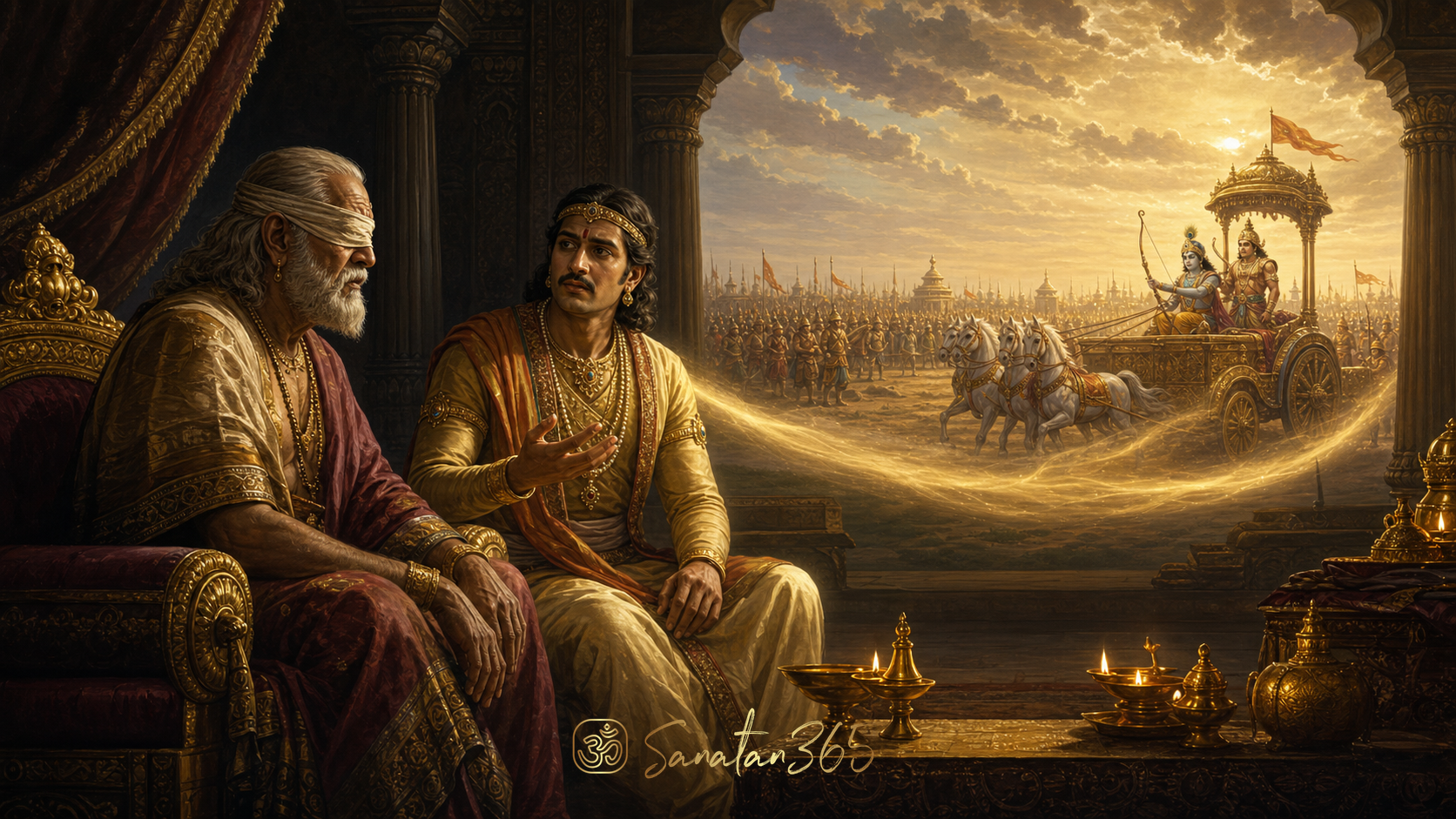
Sanjaya sees a war from far away, but his greater achievement is not supernatural vision. It is the discipline to describe what he sees truthfully to a king who has repeatedly resisted the truth. Sanjaya in Mahabharata is the counsellor and charioteer of Dhritarashtra whom Sage Vyasa grants divya drishti (दिव्य दृष्टि, divine sight), enabling him to witness Kurukshetra and narrate its events as they unfold.
Through Sanjaya, the Mahabharata asks a demanding question: if a person can see clearly, what do they owe those who cannot, or will not, see? His role joins perception, speech, compassion, and moral courage. He does not command armies or seek a throne. He serves dharma (धर्म, sustaining moral order) by remaining an attentive witness when confusion has become politically convenient.
Who Was Sanjaya in the Mahabharata?
Sanjaya is introduced as a trusted attendant, charioteer, counsellor, and envoy in the court of Hastinapura. He serves King Dhritarashtra, the blind Kuru monarch and father of the Kauravas. His position is close to power but not identical with power. That distinction matters: Sanjaya has access to the king, yet he must continually decide whether proximity will make him flattering, fearful, or truthful.
Before the war, Sanjaya carries messages between the Kaurava court and the Pandavas. In the Udyoga Parva, the Mahabharata's book of preparations and diplomacy, he witnesses the final attempts to prevent catastrophe. He therefore does not encounter Kurukshetra as an isolated spectacle. He knows the history of ignored counsel, injured relationships, failed negotiations, and deliberate choices that brought both armies to the field.
Sanjaya is neither presented as infallible nor detached from human feeling. He grieves, reacts, and sometimes speaks sharply. Yet his loyalties do not erase his discernment. He remains in the service of Dhritarashtra while refusing to pretend that Duryodhana's course is wise. This resembles the ethical courage found in Vidura Niti's teaching on truthful counsel: service to a leader is not the same as agreement with every desire.
The Sanskrit name Sanjaya (संजय) carries the sense of complete victory or one who has conquered. In the narrative, his victory is inward. He is not victorious through conquest of land but through the steadiness required to see, remember, and speak without surrendering entirely to fear or favour.
Key takeaway: Sanjaya's authority comes from trustworthy attention, not rank. He shows that a person near power can still preserve an independent moral sight.
Why Did Vyasa Give Sanjaya Divine Sight?
As war becomes unavoidable, Sage Vyasa offers Dhritarashtra the ability to see the battle. The king declines. He does not wish to witness the destruction of his relatives directly, though he still wants to know what happens. Vyasa then grants Sanjaya divya drishti, a divinely enabled vision that transcends ordinary distance and obstruction.
The gift allows Sanjaya to perceive the battlefield from the palace. Traditional accounts understand it as more than long-distance eyesight. He can follow events, hear conversations, know significant movements, and narrate what would otherwise be inaccessible. The Bhishma Parva, which contains the Bhagavad Gita, places this gift within the epic's sacred narrative frame. Readers receive Krishna and Arjuna's dialogue because Sanjaya receives it and later speaks it to Dhritarashtra.
This arrangement is symbolically precise. Dhritarashtra's physical blindness should never be treated as a moral defect; the Mahabharata's concern is his repeated unwillingness to restrain destructive attachment. Sanjaya's divine sight, likewise, is not proof that ordinary sight makes a person wise. The contrast is between honest perception and chosen denial. A person may possess eyes yet refuse evidence, or lack physical sight and still cultivate profound wisdom.
Vyasa's gift also creates responsibility. Sacred capacities in Hindu narratives are rarely mere entertainment. A vara (वर, boon) or unusual power places its receiver under an ethical demand. Sanjaya must use vision for truthful transmission, not manipulation, vanity, or advantage. What he sees is terrible: kin facing kin, vows becoming weapons, and admired elders falling. To continue bearing witness is itself a form of disciplined service.
The Mahabharata is available in public-domain English translation through the Internet Sacred Text Archive, while the Bhagavad Gita's narrative setting can be studied with multiple traditional commentaries through IIT Kanpur's Gita Supersite. These sources preserve the textual context in which Sanjaya's sight serves narration rather than spectacle.
Key takeaway: Divine sight is not the end of Sanjaya's task. It is the beginning of his obligation to turn perception into an accurate, morally serious account.
What Did Sanjaya See and Narrate at Kurukshetra?
The Bhagavad Gita opens with Dhritarashtra asking Sanjaya what his sons and the sons of Pandu did after gathering at Dharmakshetra Kurukshetra, the field of dharma. That first question already contains anxiety and division: “my sons” and “the sons of Pandu.” Sanjaya answers by describing Duryodhana's approach to his teacher Drona, the arrangement of the armies, the sounding of conches, and Arjuna's request that Krishna place the chariot between the two forces.
Sanjaya then narrates one of the world's most influential spiritual dialogues. Arjuna sees teachers, elders, cousins, and friends on both sides. His certainty collapses. Krishna's teaching addresses action, knowledge, devotion, self-mastery, the nature of the Self, and the offering of action without possessiveness. Sanjaya is the narrative bridge through whom Dhritarashtra, and every later listener, hears that exchange.
Yet Sanjaya does not disappear behind the report. At decisive points, he expresses wonder. Near the Gita's conclusion, he recalls the dialogue between Krishna and Arjuna as astonishing and sacred. He says that remembering Krishna's universal form fills him with wonder again and again. His presence reminds readers that a faithful witness need not be emotionally numb. Accuracy and reverence can coexist.
After the Gita, Sanjaya continues narrating the war's changing fortunes. He reports courage without hiding cruelty, strategy without disguising consequence, and victory without pretending that loss has vanished. When Dhritarashtra hopes for reassuring news, Sanjaya does not manufacture it. When disaster follows disaster, he connects outcomes to earlier choices.
This is why Sanjaya cannot be reduced to “the narrator of the Bhagavad Gita.” He is the epic's model of mediated witnessing. Most people learn about distant suffering through another person's words. Sanjaya shows how much moral weight those words carry. Selection, emphasis, omission, and tone can all clarify reality or protect delusion.
Key takeaway: Sanjaya transmits both teaching and consequence. He preserves the Gita's wisdom while refusing to hide the human cost surrounding it.
Why Is Truthful Witnessing a Form of Dharma?
Truth in the Mahabharata is rarely a matter of repeating facts without context. Satya (सत्य, truthfulness) must be joined with dharma, discernment, and concern for the welfare of others. Sanjaya's speech is valuable because it does not merely list battlefield events. He helps Dhritarashtra see patterns of cause and responsibility that the king would prefer to avoid.
Truthful witnessing has at least four dimensions:
- Attention: A witness must first resist distraction, prejudice, and premature judgment.
- Accuracy: What is uncertain should not be presented as certain, and what is painful should not be softened into falsehood.
- Context: Events need their moral and historical setting; consequences do not arise from nowhere.
- Courage: Truth may need to be spoken when the listener has more status, power, or emotional investment.
Sanjaya's courage differs from the dramatic sacrifice in King Harishchandra's story of truth. Harishchandra is tested through personal loss; Sanjaya is tested through sustained proximity to another person's denial. His task is repetitive and unglamorous: see, report, endure the reaction, and continue.
He also teaches an important limit. Speaking truth does not guarantee that truth will be accepted. Dhritarashtra often understands more than he acts upon. Sanjaya cannot make the king choose differently. He is responsible for the integrity of his counsel, not for controlling its outcome. This distinction protects truthful service from both despair and arrogance.
At the same time, “I only reported” is not always enough. A witness must examine whether speech is timely, complete, and directed toward preventing harm. Sanjaya had warned the court before the war; his later narration does not replace earlier moral effort. The epic therefore joins testimony with counsel. Clear seeing should, when possible, become wise action before calamity.
Key takeaway: Truthful witness is dharma when attention, accuracy, context, and courage are used in service of clarity rather than ego.
What Can Modern Readers Learn from Sanjaya's Clarity?
Modern life is filled with mediated vision. News, workplace reports, family accounts, research summaries, and social posts tell people about events they did not personally witness. Technology can increase access without increasing wisdom. Sanjaya's story offers a discipline for anyone who carries information between reality and a listener.
Separate observation from interpretation
Begin with what is known. Name what was directly observed, what came through a source, and what remains an interpretation. Sanjaya's authority depends on the trust that his report is not shaped to please Dhritarashtra.
Do not confuse loyalty with concealment
A loving relative, committed colleague, or faithful adviser may need to say what is unwelcome. Concealment can feel compassionate in the short term while allowing harm to grow. Sanjaya remains with the king, but his presence does not become automatic endorsement.
Keep compassion without distorting consequence
Sanjaya understands Dhritarashtra's grief. He does not mock it. He also does not erase the choices that preceded it. Mature compassion can acknowledge pain and responsibility together.
Refuse the intoxication of privileged access
Special knowledge can feed status. Sanjaya uses unusual access for service. A modern reader entrusted with confidential information, technical expertise, or institutional visibility can ask: does this knowledge protect truth and welfare, or merely increase personal influence?
Accept the boundary of counsel
No adviser can force discernment upon another adult. One can verify, explain, warn, and remain available. After that, the listener retains agency. The Bhagavad Gita similarly concludes its teaching by returning choice to Arjuna rather than coercing him.
These lessons apply especially when a group rewards comforting narratives. A Sanjaya-like witness does not become needlessly harsh or self-righteous. The aim is not to enjoy being the lone dissenter. It is to keep a path open between what is happening and what decision-makers understand.
Key takeaway: Modern clarity requires disciplined sourcing, compassionate candour, and the humility to speak responsibly without assuming control over another person's choice.
Conclusion
Sanjaya's divine sight is memorable, but the Mahabharata gives greater importance to what he does with it. He watches without turning suffering into spectacle. He speaks to a powerful king without making power the measure of truth. He feels grief and wonder without allowing emotion to falsify his account.
His example also warns against romanticising the witness. Seeing clearly can be painful, and telling the truth may not prevent every consequence. Still, without trustworthy witnesses, denial becomes easier and wisdom arrives too late. Sanjaya stands in the difficult middle: between battlefield and palace, sacred dialogue and political failure, knowledge and responsibility.
Key takeaway: The deepest meaning of Sanjaya's divine sight is ethical: to see clearly is to become responsible for speaking with truth, compassion, and courage.
FAQ
Who was Sanjaya in the Mahabharata?
Sanjaya was King Dhritarashtra's trusted charioteer, counsellor, envoy, and narrator. Sage Vyasa granted him divine sight so he could witness the Kurukshetra war and report it to the king from Hastinapura.
Why did Sanjaya have divine sight?
Vyasa first offered Dhritarashtra the ability to see the war, but the king declined. Vyasa then gave Sanjaya divya drishti, divine sight, enabling him to perceive distant events and narrate them accurately.
Did Sanjaya narrate the Bhagavad Gita?
Yes. Within the Mahabharata's narrative frame, Sanjaya recounts the dialogue between Lord Krishna and Arjuna to Dhritarashtra. His narration is how the king, and later readers, receive the Bhagavad Gita.
What does Sanjaya symbolize?
Sanjaya symbolizes clear perception, truthful reporting, responsible counsel, and the moral duty to speak honestly even when a powerful listener may resist the message.
Was Sanjaya neutral in the Mahabharata war?
Sanjaya served Dhritarashtra, but he did not treat truth as loyalty to one faction. He repeatedly recognized the consequences of Duryodhana's choices and conveyed events without manufacturing reassurance for the Kaurava court.
About the author
Sanatan365 Editorial
Bringing Sanatan Dharma to modern seekers through authentic, scripture-grounded content.
Related in Lessons
 Lessons
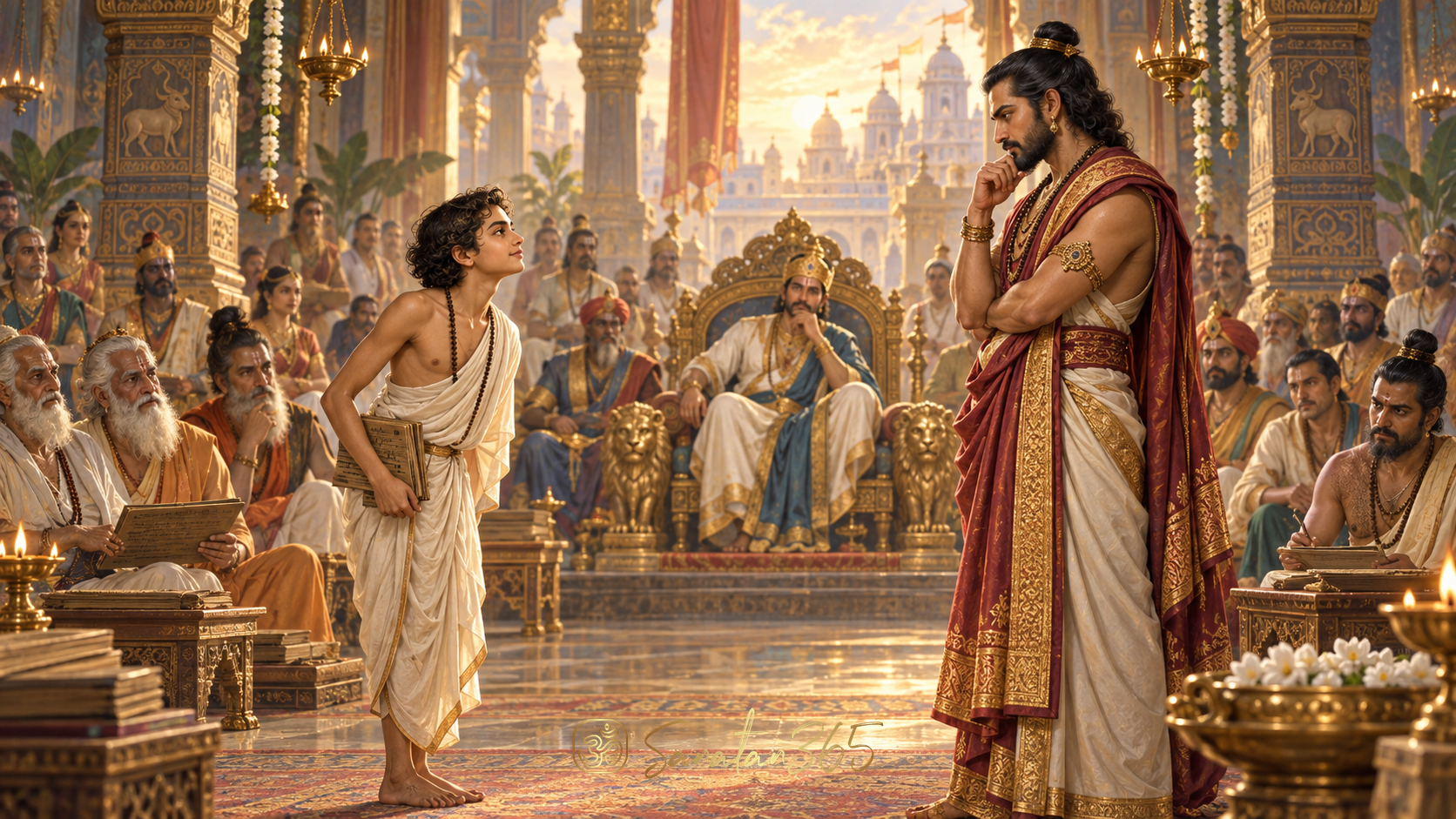
Ashtavakra and Bandin: Wisdom Beyond Appearance
The Ashtavakra and Bandin story in the Mahabharata follows a young scholar who enters King Janaka's court, answers prejudice with learning,…
 Lessons
Gargi Vachaknavi: The Upanishadic Voice of Fearless Inquiry
Gargi Vachaknavi stands in the Brihadaranyaka Upanishad as a formidable questioner whose disciplined dialogue with Yajnavalkya reveals cour…
 Lessons
Andal: The Poet-Saint Who Made Longing a Path of Devotion
Discover Andal, the Tamil poet-saint whose Tiruppavai transformed sacred longing, shared song, and wholehearted surrender into a living pat…