Sawan Shivaratri 2026: Date, Puja Time, Meaning, and Simple Worship
Sawan Shivaratri 2026 falls on 11 August in New Delhi. Learn the Chaturdashi timing, Nishita Kaal, meaning, vrat guidance, and a simple Shiva puja.
At midnight, Sawan Shivaratri asks for something more demanding than staying awake: it asks the mind to become still enough to notice what usually escapes it. Sawan Shivaratri 2026 falls on Tuesday, 11 August in New Delhi, during the waning Moon’s Chaturdashi tithi. Devotees honour Lord Shiva through fasting suited to their health, water abhishekam, mantra, prayer, ethical restraint, and night worship.
For New Delhi, Krishna Paksha Chaturdashi begins at 4:54 a.m. on 11 August and ends at 1:52 a.m. on 12 August. The central Nishita Kaal worship window is reported as 12:05 a.m. to 12:48 a.m. on 12 August. These are location-specific Panchang timings; anyone outside Delhi should check a trusted local panchanga or temple calendar rather than copying them unchanged.
When Is Sawan Shivaratri 2026 and What Is the Puja Time?
Sawan Shivaratri is observed on the Krishna Paksha Chaturdashi (कृष्ण पक्ष चतुर्दशी, fourteenth lunar day of the waning fortnight) that falls in the North Indian month of Shravan. Readers seeking the wider seasonal context can first review the Shravan month 2026 dates and practices. The Drik Panchang August 2026 festival calendar lists Sawan Shivaratri and Masik Shivaratri on Tuesday, 11 August 2026.
For New Delhi, the key reference timings are:
- Chaturdashi tithi begins: 4:54 a.m., Tuesday, 11 August 2026
- Chaturdashi tithi ends: 1:52 a.m., Wednesday, 12 August 2026
- Nishita Kaal puja: 12:05 a.m. to 12:48 a.m., Wednesday, 12 August 2026
- Main observance date: Tuesday, 11 August 2026
Nishita Kaal (निशीथ काल, the deep-midnight period) is a traditional window for Shiva worship. Some devotees perform one focused puja during this period. Others divide the night into four prahar (प्रहर, traditional watches of the night) and worship at each interval. Neither complexity nor sleeplessness is a measure of devotion. A sincere short observance is complete when it is performed responsibly.
Panchang calculations depend on latitude, longitude, sunrise, and the local span of a tithi. Delhi timings therefore cannot be treated as universal. Devotees in Chennai, London, Toronto, Singapore, or elsewhere should use their own city’s calendar. A temple’s announced schedule is usually the clearest guide for community worship.
Key takeaway: Sawan Shivaratri is observed on 11 August 2026 in New Delhi, but exact worship and fast-breaking times must be checked locally.
What Does Sawan Shivaratri Mean?
Shivaratri (शिवरात्रि) means “the night of Shiva.” Every lunar month includes a Masik Shivaratri on the dark fortnight’s Chaturdashi. The observance that falls during Shravan is called Sawan or Shravan Shivaratri across much of North India because Shravan is especially associated with Shiva devotion.
This is distinct from Maha Shivaratri, the major annual observance held in the late-winter month commonly identified as Phalguna or Magha according to regional calendars. The monthly sacred pattern is similar—fasting, vigil, linga worship, mantra, and inward attention—but Maha Shivaratri has wider pan-Indian prominence. Encyclopaedia Britannica’s overview notes the importance of the waning fortnight’s fourteenth day to Shiva worship and describes the night vigil and linga puja associated with the great annual festival.
Why is the night important? Daylight encourages outward activity; night removes many familiar distractions. Shaiva practice turns darkness into a contemplative symbol. Shiva is not confined to what the senses can grasp. The quiet night invites the devotee to loosen the ego’s constant commentary and attend to the still awareness beneath it.
Traditions also connect Shivaratri with the lingodbhava (लिङ्गोद्भव, emergence of the linga), the revelation of Shiva as an immeasurable pillar of light. In Puranic narration, Brahma and Vishnu cannot discover its beginning or end. The teaching is not a competition among deities. It points toward humility before the boundless Divine: intellect may inquire deeply while accepting that ultimate reality cannot be possessed.
Shravan adds monsoon imagery to this night. Rain cools heated earth; abhishekam cools the sacred linga; disciplined prayer cools reactive speech. The symbolism becomes ethical when a person refuses to pass anger, anxiety, or harm onward.
Key takeaway: Sawan Shivaratri joins the monthly discipline of Shiva’s night with Shravan’s call to cooling, cleansing, and humble attention.
How Can Someone Observe the Sawan Shivratri Vrat Safely?
A vrat (व्रत, a chosen sacred vow or observance) is not limited to avoiding food. It may include worship, mantra, truthful speech, simplicity, charity, study, or restraint from a harmful habit. Food discipline is one expression, not the entire practice.
A balanced observance may follow this rhythm:
- Set a clear intention. Choose one ethical vow, such as avoiding harsh speech, waste, gossip, or unnecessary consumption.
- Eat according to health and tradition. Some take fruit and milk; some eat one simple meal; some fast more strictly under trusted guidance.
- Keep the day inwardly clean. Reduce noise and perform ordinary duties conscientiously.
- Offer evening or midnight worship. A single short puja is acceptable when a full vigil is impractical.
- Break the fast locally and responsibly. Follow the local Panchang or temple’s parana guidance rather than a different city’s time.
Children, pregnant or breastfeeding people, older adults, anyone with diabetes or another health condition, and people taking medication should not undertake a strict fast without qualified medical advice. Spiritual discipline does not require ignoring the body. A health-safe vow of kindness, mantra, or service may be more demanding and more truthful than an unsafe food restriction.
Those working night shifts, caring for children, travelling, or managing illness need not force an all-night vigil. Shiva worship is not a performance of exhaustion. One may pray at a suitable hour, sleep adequately, and keep the observance through mindful conduct.
Key takeaway: The best vrat is sustainable, health-conscious, and visible in conduct—not an extreme fast used to measure devotion.
How Is a Simple Shiva Puja Performed at Home?
A home puja can be brief and reverent. Use a Shiva linga, murti, or image already honoured in the household’s tradition. If there is no established shrine, silent prayer and “Om Namah Shivaya” remain meaningful practices.
Prepare with cleanliness and care
Clean the worship surface and gather only what can be used without waste:
- A small vessel of clean water
- Bilva leaves, flowers, or fruit where responsibly available
- A safely placed lamp
- A cloth for cleaning and a bowl or tray for drainage
- A mala if one already uses it
Keep electrical cords, fabric, children, and pets away from flame and pooled water. Temple-scale quantities are unnecessary at home.
Make a sankalpa
A sankalpa (सङ्कल्प, a clear sacred intention) links ritual to life. It may be simple: “May this worship make thought calmer, speech kinder, and action more responsible.” The statement need not promise a particular material result.
Offer water abhishekam
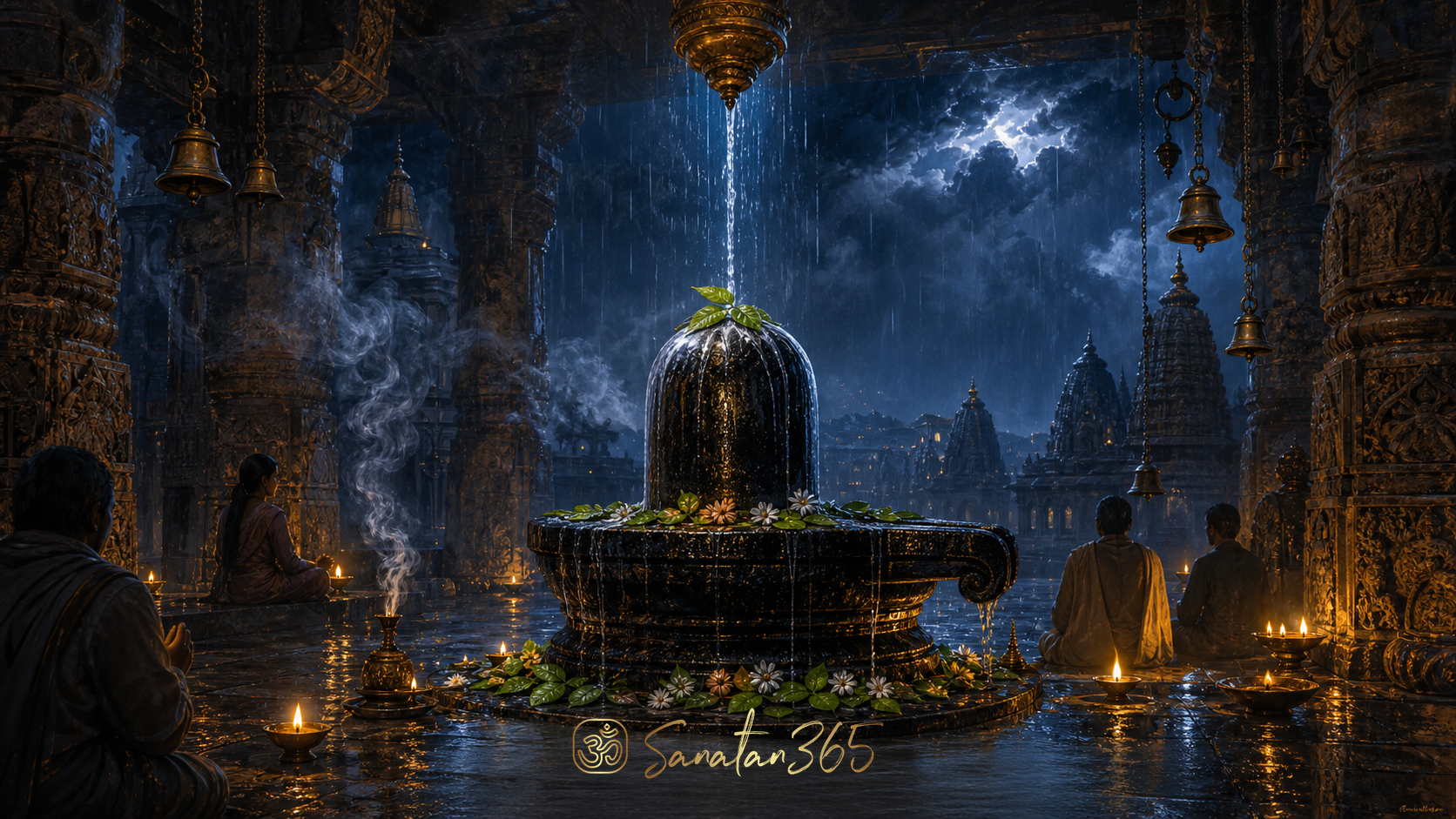
Abhishekam (अभिषेकम्, ritual bathing of a sacred form) may be performed with a small stream of clean water over the Shiva linga while chanting “Om Namah Shivaya.” The deeper symbolism is explored in this guide to Jalabhishek and water offered to the Shiva linga. Water alone is sufficient. Milk, honey, or other foods should not be poured wastefully or sent into unsuitable drains. Follow household and temple custom, and prefer ecological restraint.
Offer bilva leaves if available without damaging a tree. Their three leaflets are interpreted in several devotional ways, including Shiva’s three eyes and the purification of thought, word, and deed. These are traditional symbolic readings, not a basis for fear if bilva is unavailable.
Chant with attention
“Om Namah Shivaya” is widely used as a reverent salutation to Shiva. Chant slowly, or sit in silence between repetitions; the meaning of Om Namah Shivaya can support attentive practice. Vedic recitations such as Shri Rudram carry precise accents and lineage-based teaching; respectful listening to a qualified reciter may be more appropriate than imitating unfamiliar pronunciation.
Complete the worship through action
Receive fruit as prasada (प्रसाद, a sanctified offering received with grace), clean the space, and choose one act of seva (सेवा, selfless service). Help someone without announcement, feed a person or animal responsibly, reduce waste, or repair a neglected duty. Ritual reaches completion when it changes how one lives.
Key takeaway: Clean water, mantra, a safe lamp, and sincere attention are enough for a simple Shiva puja at home.
What Are the Four Prahar of Shivaratri?
Some temples and households divide the night into four prahar for repeated Shiva worship. Exact times depend on local sunset and sunrise. A common pattern gives each watch a distinct inner reflection:
- First prahar: arriving. Settle the body, acknowledge distraction, and begin with water, lamp, and mantra.
- Second prahar: purification. Examine speech and conduct. Ask what needs correction rather than what reward is desired.
- Third prahar: stillness. Reduce words. Let mantra become quieter and rest attention in awareness.
- Fourth prahar: renewal. Offer gratitude and form one practical intention for the coming day.
Offerings vary by lineage and region. Online charts that prescribe a rigid substance for every prahar should not override family tradition, temple guidance, health, or ecological common sense. Repetition is meant to deepen attention, not multiply consumption.
For a beginner, the four-part movement can happen within one 20-minute puja: arrival, honest reflection, silent mantra, and renewed action. The spiritual architecture remains even when the clock is shorter.
Key takeaway: Four-prahar worship is a rhythm of deepening attention; it is optional, location-specific, and adaptable without losing reverence.
What Should Be Avoided on Sawan Shivaratri?
Devotional intensity can attract misinformation. Several cautions preserve both dignity and safety:
- Do not promise guaranteed marriage, wealth, healing, protection, or removal of every problem.
- Do not judge another person’s fast, food, regional calendar, or form of Shiva worship.
- Do not claim Shiva is superior to another deity or Sanatan path.
- Do not pour large quantities of milk, oil, or food into drains or natural water bodies.
- Do not leave lamps unattended or crowd a small altar with flammable material.
- Do not repeat historical or scriptural claims without a reliable source.
- Do not treat a missed muhurta as spiritual failure.
Regional variety is part of living tradition. In the North Indian Purnimanta system, this Shivaratri falls within Shravan; elsewhere the month may be reckoned differently. The sacred date and language used by a family can therefore vary without diminishing anyone’s devotion.
Diaspora devotees may lack bilva leaves, nearby Shiva temples, or an all-night community program. Clean water, safe light, remembered mantra, and service preserve the heart of the observance. Substitution should not become anxiety.
Key takeaway: Sawan Shivaratri should produce humility and steadiness, never fear, waste, rivalry, or unsafe practice.
How Can the Night Become a Practice of Inner Stillness?
Shiva is often pictured in profound meditation. The icon does not ask everyone to withdraw from life; it asks whether action can arise from a less reactive center. A simple night practice can make that question concrete.
Sit upright for five minutes. Notice sound without naming each sound. Feel the breath without forcing it. When a thought appears, neither chase it nor fight it. Repeat “Om Namah Shivaya” once, then return to listening. This is not a claim to reproduce any formal lineage meditation. It is a modest devotional pause.
Then bring one difficulty to mind. Ask:
- What part of this situation is fact, and what part is fear?
- What response reduces harm?
- What truth needs to be spoken without cruelty?
- What result cannot be controlled after responsible action is taken?
The night of Shiva becomes practical when stillness improves judgment. A calmer mind is not an escape from duty. It is better prepared to meet duty without adding unnecessary heat.
Key takeaway: The deepest vigil is sustained awareness—the ability to remain present without feeding every reaction.
Conclusion
Sawan Shivaratri 2026 is observed on Tuesday, 11 August in New Delhi, with the local Nishita Kaal from 12:05 a.m. to 12:48 a.m. on 12 August. The date joins Shravan devotion with the monthly sacred night of Shiva.
Key takeaway: Observe with a locally verified time, a health-safe vrat, a simple water offering, attentive mantra, and one action that carries Shiva’s stillness into daily life.
FAQ
Is Sawan Shivaratri on 11 or 12 August 2026?
In New Delhi, the observance date is Tuesday, 11 August 2026. Chaturdashi continues after midnight and the Nishita Kaal puja falls early on 12 August. Local timings vary, so check a city-specific Panchang.
What is the Sawan Shivratri puja time in 2026?
For New Delhi, Nishita Kaal is reported as 12:05 a.m. to 12:48 a.m. on Wednesday, 12 August. The Chaturdashi tithi runs from 4:54 a.m. on 11 August to 1:52 a.m. on 12 August.
Is Sawan Shivaratri the same as Maha Shivaratri?
No. Sawan Shivaratri is the monthly Shivaratri that falls during North India’s Shravan month. Maha Shivaratri is the major annual festival observed in late winter. Both centre Shiva worship, fasting according to capacity, mantra, and night prayer.
Is fasting compulsory on Sawan Shivaratri?
No universal strict fast applies to everyone. A vrat can include suitable food restraint, mantra, ethical discipline, charity, or service. Health needs and qualified medical guidance take priority.
What can be offered to Lord Shiva at home?
Clean water, bilva leaves where responsibly available, flowers, fruit, a safely placed lamp, and sincere mantra are common offerings. Follow household tradition and avoid waste.
About the author
Sanatan365 Editorial
Bringing Sanatan Dharma to modern seekers through authentic, scripture-grounded content.
Related in Festivals
 Festivals
Dussehra 2026: Date, Vijayadashami Meaning, and Living Traditions
Understand the 2026 Dussehra date, the meanings of Rama and Durga’s victories, regional celebrations, and a thoughtful way to observe Vijay…
 Festivals
Garba Meaning: The Lamp at the Heart of Navratri
Garba is a Gujarati devotional dance associated with Navratri. Its central lamp, shared circular rhythm and reverence for Goddess Amba expl…
 Festivals
Golu Meaning: Navratri Dolls, Living Stories, and Hospitality
Understand Navratri Golu through its handmade dolls, regional names, family stories and welcoming home visits, with thoughtful preparation…