Makarasana Meaning: Crocodile Pose and the Value of Prone Rest
Learn the simple forehead-supported form of Makarasana, how it differs from Cobra and Shavasana (Corpse Pose), and why a resting posture need not become another test.
A yoga posture can be complete without lifting the chest, reaching further, or holding an impressive shape. Sometimes its whole instruction is to place the forehead down and stop adding effort.
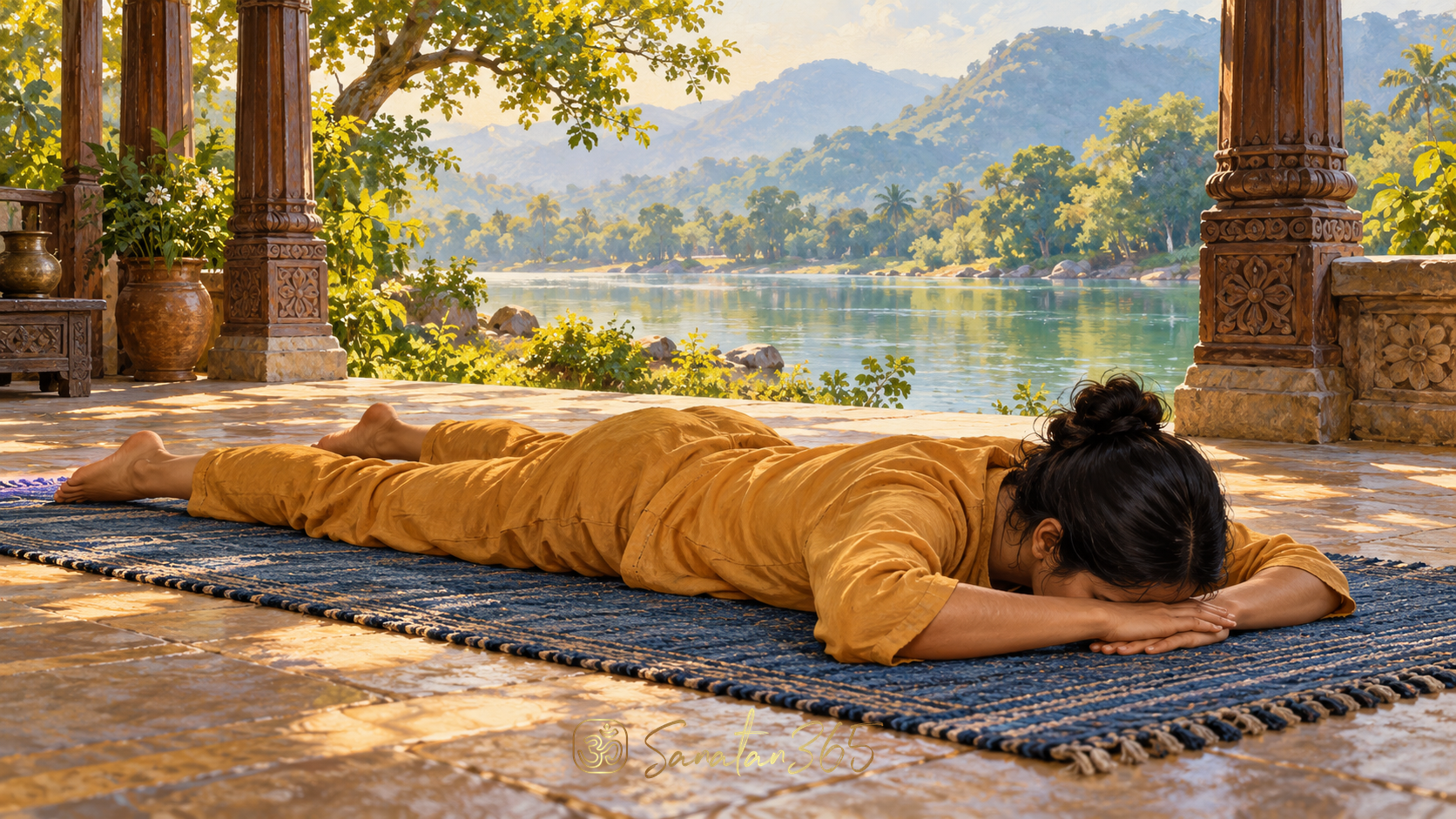
Makarasana meaning is usually given as Crocodile Pose: makara (मकर, conventionally crocodile in this posture name) and asana (आसन, posture or seat). In the Ministry of AYUSH Common Yoga Protocol, it is a prone resting position, lying face down with the legs apart and the forehead on stacked hands. Its purpose in that sequence is relaxation between prone postures, not an active backbend. This article explains that specific form, rather than treating every pose called Makarasana as identical.
The distinction matters. A beginner searching for Crocodile Pose may see a head resting on forearms, a chin supported in the palms, or a more elevated chest. These images need not represent a single instruction. Knowing which version is being taught is more useful than trying to combine them.
Makarasana meaning: which version is described here?
The name supplies an image of a body settled close to the ground. It does not require imitating an animal literally, making the spine rigid, or holding the face above the floor. The Common Yoga Protocol calls Makarasana a “prone relaxation posture” and directs the practitioner to place the right hand on the left hand, then the forehead on the hands. See its Makarasana instructions on printed page 24.
That is the reference form throughout this guide. The head has support; the chest is not deliberately pushed upward; the legs are resting rather than being lifted. The practical question is not how high the body rises, but whether unnecessary effort can be released without losing ease of breathing.
One name does not guarantee one arrangement
Yoga teaching passes through different schools, books and classrooms. A familiar name may therefore carry a different arm position or teaching emphasis. In her Yoga International explanation, Sandra Anderson describes a forearm-supported arrangement in which the upper chest is slightly elevated, together with alternatives. That is useful context for understanding why a photograph may differ from the government protocol.
The sensible response is to identify the version before following its details. A lifted chest from one instruction should not be added automatically to stacked hands from another. Ask a qualified teacher what supports the head, whether the chest is resting, and what the particular exercise is intended to teach.
The same care applies to cultural explanations. The word makara has a wider life in Indian art and mythology, where aquatic forms can be composite and symbolic. A posture name is not, by itself, evidence that every detail of a sculpted makara has a corresponding bodily instruction. Here the focus remains on the documented resting posture.
Key takeaway: Crocodile Pose is easier to understand when its specific teaching version is named first.
How is the forehead-supported Crocodile Pose arranged?
Choose a clear floor space with a firm, comfortable mat. Clothing should allow easy movement without pressing the abdomen or restricting the shoulders. There is no advantage in choosing a hard surface simply because the posture looks simple.
The following outline follows the Common Yoga Protocol's forehead-on-hands form. It is posture literacy, not a substitute for individual instruction when lying face down is uncomfortable or medically unsuitable.
- Come down without rushing. Arrange the body face down in a way that is comfortable to enter. There is no need to drop the weight abruptly or make a dramatic transition.
- Allow the legs to rest apart. The protocol describes feet wide apart and pointing outward. Do not force the toes into an angle that strains the knees, hips or ankles.
- Bend the arms and stack the hands. Place the right hand over the left as the protocol specifies. The hands form a low support, not a lever for pushing the chest up.
- Rest the forehead on the hands. Keep the nose clear and avoid pressing the face into the support. If this arrangement makes breathing awkward, come out rather than enduring it.
- Let the body remain supported. There is no instruction here to lift the thighs, pull the shoulders back strongly, or hold the abdomen tight.
- Notice ordinary breathing. The protocol describes closed eyes. If that is uncomfortable, a soft, unforced gaze is preferable to making closed eyes another demand.
An experienced teacher can help with a suitable support or another resting position. A towel should not become a reason to build a high stack under the forehead and then strain the neck to reach it. More equipment is not automatically more support.
The first adjustment may be to do less
A common misunderstanding is to maintain a “good posture” by gripping muscles that are not required. The hands may become rigid, the jaw may tighten, or the toes may remain deliberately pointed. The useful observation is very ordinary: what is actually holding weight, and what is still working without a reason?
Another misunderstanding is to make both sides look perfectly symmetrical at any cost. Bodies do not always rest in a picture-perfect shape. If comfort requires repeated twisting or pushing, stop and seek a better arrangement rather than correcting the appearance through force.
To leave, return attention to the room and move slowly into a comfortable position. Do not spring directly from rest into a demanding posture. The exit belongs to the practice as much as the settled shape does.
Key takeaway: The support is successful when it permits rest, not when it produces the most exact-looking photograph.
What can be noticed about breathing without controlling it?
Lying face down changes what is felt against the floor. A practitioner may notice movement around the lower ribs, back or abdomen more distinctly than when sitting upright. Anderson's account discusses this sensory feedback and uses Crocodile Pose in teaching diaphragmatic breathing. Her explanation of Makarasana and breath awareness describes a particular teaching approach, not a requirement to reproduce a dramatic sensation.
For an introductory resting practice, observation is enough. There is no need to take the largest possible breath, inflate the abdomen against the floor, count a strict ratio, or hold the breath. Feeling very little does not mean the posture has failed.
Three questions can keep attention simple:
- Can the breath continue without being pushed or deliberately slowed?
- Is the face resting comfortably rather than pressing down to hold the head in place?
- Is there any discomfort that calls for leaving the position?
These are checks for ease, not measurements of spiritual progress. They should not become a running commentary after every breath. Once the position is comfortable, attention can be quieter and less managerial.
Rest is not a breathing examination
It is easy to turn “notice the breath” into “make the breath correct.” That change can be subtle. A person starts comparing one side with the other, waits for a special expansion, or tries to keep every inhalation identical. The resting posture then becomes another task with a hidden pass mark.
A more restrained approach allows breathing to remain ordinary. There may be small differences from moment to moment. The aim here is neither breath retention nor a specialised breathing technique. Those belong to separate instruction. For background on that distinction, the article on pranayama as a deliberate yogic breath practice explains why breath training deserves its own context.
Nothing in this observation promises a medical result, a particular emotional state, or an unusual experience. Quiet attention can be valuable without being described as treatment. The body does not owe the practitioner a sensation in exchange for lying still.
Key takeaway: Breathing can be noticed without being enlarged, corrected or turned into a test.
How does Makarasana differ from Cobra and Shavasana (शवासन, Corpse Pose)?
Makarasana, Cobra Pose and Shavasana can appear in the same class, but their roles are not interchangeable. Knowing the difference prevents a resting interval from quietly becoming an extra backbend.
Crocodile Pose and Cobra Pose
Bhujangasana (भुजंगासन, Cobra Pose) is an active prone posture in which the front of the body rises into a backbend. The Common Yoga Protocol places it within the prone sequence and describes resting in Makarasana around these exercises.
In the forehead-supported Makarasana described here, there is no deliberate chest lift. If the hands begin pressing into the floor and the head rises to look forward, the practitioner has changed the action. That may belong to another exercise, but it is no longer the simple resting arrangement just described.
The resting interval should also remain independent of achievement. It is not a reward available only after a difficult Cobra Pose. Someone may choose rest without first earning it through exertion. Conversely, being able to lie comfortably in Makarasana does not establish readiness for a stronger backbend.
Crocodile Pose and Shavasana
Shavasana (शवासन, Corpse Pose) is commonly taught as supine rest: lying on the back. Makarasana is prone: lying on the front. The direction of the body changes the places that meet the ground and the supports that may be needed.
Neither posture is universally better. A person who dislikes lying face down need not persist because Crocodile Pose has been praised in a book. Another person may find a supported position on the front comfortable within an appropriate class. The relevant question is suitability, not a ranking of traditions or bodies.
The guide to Shavasana and attentive rest offers a useful comparison. Both discussions make room for a simple distinction: stillness is the outward shape; rest concerns how that shape is being inhabited.
Key takeaway: Crocodile Pose rests on the front, Cobra actively lifts the chest, and Shavasana commonly rests on the back.
When is another resting position a better choice?
A posture described as relaxing is not automatically suitable for everyone. The Common Yoga Protocol specifically advises avoiding Makarasana in pregnancy, low blood pressure and severe cardiac problems. Those cautions should not disappear when the posture is presented in a cheerful beginner guide.
Anyone with a relevant medical condition, recent surgery, an injury, or uncertainty about pressure on the abdomen should seek qualified individual advice rather than using a general article as clearance. Yoga teachers can assist with teaching and positioning; medical suitability belongs with an appropriate healthcare professional.
Pain, dizziness, breathlessness, numbness or an uncomfortable sense of pressure are reasons to stop. Do not interpret them as impurities leaving the body, emotional resistance, or proof that practice is beginning to work. Spiritual language should never be used to make someone remain in distress.
Duration follows suitability, not ambition
There is no universal beginner duration established by the simple instructions quoted here. Longer is not automatically better. A teacher may use a short interval between prone exercises, while another teaching method may devote more time to supported breath awareness. These are different contexts.
For home readers, the responsible starting point is not a ten-minute target copied from somewhere else. It is understanding the form, checking suitability and keeping the first experience modest. If repeated adjustments are needed, another supported resting position may be the more sensible choice.
The principle is also useful beyond the mat. A quiet practice need not carry the usual demand to improve, display or compare. That is a reflective invitation, not a physiological claim. In this posture, restraint can mean declining to add effort simply because effort feels more productive.
Key takeaway: Choosing another resting position is discernment, not failure; suitability matters more than duration or appearance.
FAQ
Is Makarasana the same as Crocodile Pose?
Yes, Crocodile Pose is its usual English name. However, the arm and chest arrangement can differ between teaching sources. This article describes the Common Yoga Protocol form with the forehead on stacked hands.
Should the chest be lifted in Makarasana?
Not deliberately in the forehead-supported resting form described here. Some other teaching versions use a slightly elevated chest. Follow one clearly identified method rather than mixing instructions from different versions.
Is breath-holding part of this resting posture?
No breath-holding is required here. Allow ordinary, comfortable breathing. Formal breath regulation should be learned as a separate practice with appropriate guidance.
Can Makarasana replace medical treatment for back pain?
No. A yoga posture is not a diagnosis or a replacement for medical treatment. Pain or a relevant health condition calls for qualified advice, not a promise that a resting shape will solve it.
What is the main lesson of this posture?
The forehead has support, the body rests, and effort need not be added unnecessarily. The central takeaway is simple: a resting posture is complete when it supports suitable, unforced rest, not when it becomes another achievement.
About the author
Sanatan365 Editorial
Bringing Sanatan Dharma to modern seekers through authentic, scripture-grounded content.
Related in Wellness
 Wellness
Vajrasana Meaning: The Thunderbolt Pose as a Supported Seat
Explore Vajrasana as a kneeling yoga seat, its thunderbolt name, practical supports, changing historical usage, and a respectful alternativ…
 Wellness
Sukhasana Meaning: Finding Ease in a Supported Seat
Sukhasana is a simple cross-legged yoga seat, not a test of flexibility. Learn its meaning, practical supports and the value of choosing st…
 Wellness
Tadasana Meaning: Mountain Pose and the Art of Standing Well
Why a simple standing posture deserves careful attention, how Mountain Pose differs from the raised-arm Palm Tree version, and how to pract…

