
Sringeri Sharadamba Temple: Where Learning Becomes Worship
Discover why Sringeri Sharadamba Temple is a living center of Saraswati worship, sacred learning, Advaita tradition, and thoughtful pilgrimage.
A temple dedicated to learning makes a striking claim: knowledge is not merely something a person possesses, but something approached with humility. Sringeri Sharadamba Temple in Karnataka is important because it brings worship of Goddess Sharadamba, the discipline of vidya (विद्या, liberating knowledge), and a living Advaita institution into one sacred landscape. Beside the Tunga River, prayer, study, teaching, and pilgrimage are understood as related forms of attention.
The temple is not simply a monument to the past. It remains part of the Sringeri Sharada Peetham, whose official history describes a continuing tradition associated with Adi Shankaracharya. To visit responsibly is therefore to enter an active place of worship and learning, not an architectural exhibit.
Why is Sringeri Sharadamba Temple important?
Sringeri Sharadamba Temple is revered as the principal shrine of Goddess Sharadamba at Sringeri, a town in Karnataka's Western Ghats. Sharadamba is worshipped as a form of Saraswati, the Divine associated with knowledge, speech, music, discernment, and the arts. The temple stands within the wider sacred complex of the Sringeri Sharada Peetham, traditionally linked to Adi Shankaracharya and the transmission of Advaita Vedanta.
Its importance can be understood through four connected dimensions:
- Living Devi worship: Sharadamba receives daily worship as the Divine Mother of wisdom, not as an abstract symbol alone.
- A seat of teaching: Sringeri has long joined religious learning, textual study, teacher-student transmission, and service.
- Sacred geography: The Tunga River and the green hill landscape create a setting in which nature, temple life, and contemplation meet.
- A culture of disciplined inquiry: The institution preserves a view of knowledge that includes intellectual clarity, ethical formation, and spiritual responsibility.
This combination gives Sringeri a distinctive atmosphere. One may arrive seeking blessings before examinations or studies, but the deeper invitation is not a guarantee of success. It is to become worthy of knowledge through steadiness, honesty, concentration, and reverence.
The temple belongs to a larger Indian understanding in which learning begins with right relationship. A student acknowledges teachers, sources, language, and the limits of personal certainty. That posture is visible in many Hindu practices, from invoking Saraswati before study to approaching scripture through shravana (श्रवण, attentive listening). Readers interested in that progression can explore how listening, reflection, and contemplation work together.
Key takeaway: Sringeri matters because it treats worship, study, ethical discipline, and living tradition as parts of one pursuit of wisdom.
Who is Goddess Sharadamba?
The name Sharada is closely associated with Saraswati, the Goddess of knowledge, eloquence, music, refined perception, and learning. At Sringeri, Sharadamba is approached with the intimacy of amba (अम्बा, mother). The name therefore carries both intellectual and relational meaning: wisdom is luminous, but it is also nurturing.
Saraswati imagery traditionally includes signs such as the veena (वीणा, a stringed instrument), manuscripts or books, a rosary, and the white lotus. These are not decorative accessories. Together they suggest harmony, disciplined expression, memory, contemplation, and purity of intention. The Encyclopaedia Britannica overview of Saraswati notes her enduring association with learning, speech, music, and the arts across Hindu traditions.
At Sringeri, however, the murti is encountered through temple worship rather than through a list of symbols. Murti (मूर्ति, sacred embodied form) refers to the consecrated form through which devotees offer reverence to the Divine. Darshan, from darshana (दर्शन, sacred seeing or beholding), is reciprocal in devotional understanding: the pilgrim does not merely inspect an image but presents attention before the deity.
This changes the meaning of asking Sharadamba for help. The prayer need not be, “Make achievement effortless.” It can become:
- May speech become truthful and beneficial.
- May memory serve understanding rather than pride.
- May learning be used responsibly.
- May confusion give way to patient inquiry.
- May knowledge deepen humility.
Such prayers align achievement with character. They also make the temple relevant beyond formal education. Artists seek clarity of expression; teachers seek responsibility; parents pray for a child's growth; professionals ask for discernment; spiritual students seek the wisdom to distinguish the enduring from the temporary.
The golden form of Sharadamba seen today is part of the temple's living history. Temple traditions describe earlier forms and later consecrations, but visitors should avoid reducing layered sacred memory to a single oversimplified date. The most reliable approach is to consult the Peetham's own accounts while recognizing that institutional history, devotional tradition, and modern historical method may frame details differently.
Key takeaway: Sharadamba represents knowledge made compassionate, disciplined, expressive, and worthy of service.
How did Sringeri become a seat of learning?
Sringeri tradition associates the founding of the Sharada Peetham with Adi Shankaracharya, the influential teacher of Advaita Vedanta. Advaita (अद्वैत, non-duality) teaches that ultimate reality, Brahman, is not divided into competing independent realities, and that liberating knowledge concerns the deepest identity of the Self. The tradition does not treat this insight as a slogan. It is approached through qualified teaching, reasoning, ethical preparation, and contemplation.
The Peetham's account tells of Shankaracharya choosing Sringeri after witnessing a cobra sheltering a pregnant frog from the sun. Whether received primarily as sacred memory or institutional origin narrative, the image is morally powerful. Natural enemies suspend aggression in a place marked by protection. The scene suggests that a true seat of learning should create conditions in which vulnerability is sheltered and attention can mature.
This is one reason Sringeri should not be understood as only “a famous old temple.” A matha (मठ, monastic and teaching institution) sustains relationships among teachers, students, ritual specialists, texts, pilgrims, and communities. Its continuity depends on daily acts: recitation, worship, study, preservation, hospitality, administration, and service.
The presence of Sharadamba within such an institution adds an essential balance. Philosophy is not separated from devotion, and learning is not separated from gratitude. Intellectual ability without humility can become sharp but sterile. Devotion without careful understanding can become vulnerable to confusion. Sringeri's ideal places both under discipline.
Visitors may also encounter the Vidyashankara Temple, renowned for its architecture and the way its interior pillars are popularly associated with zodiacal and solar alignments. Responsible appreciation distinguishes between observable architectural features, established temple tradition, and exaggerated claims circulated online. Wonder does not require overstatement. The stonework, spatial rhythm, iconography, and ritual life are already worthy of close attention.
This habit of careful distinction is itself part of viveka (विवेक, discernment). It asks a learner to separate evidence from repetition, symbolism from scientific claim, and reverence from credulity. The same quality appears in the story of Gargi Vachaknavi's disciplined questioning, where courage and intellectual restraint belong together.
Key takeaway: Sringeri became a seat of learning by sustaining a living institution in which teaching, reasoning, worship, preservation, and service reinforce one another.
What does the temple landscape teach about vidya?
The journey to Sringeri passes through the lush Western Ghats, and the sacred complex stands beside the Tunga River. This setting is not incidental to the pilgrim's experience. Flowing water, rain-darkened stone, trees, birds, temple bells, and measured movement between shrines slow the habit of consuming a place quickly.
In Sanskrit, vidya can mean knowledge, learning, or a discipline of understanding. In spiritual contexts, it also points toward knowledge that frees a person from fundamental confusion. Sringeri's landscape offers a practical metaphor for such learning: a river moves, reflects, nourishes, and takes the shape of its banks without losing continuity.
The metaphor should not replace philosophy, but it can prepare attention. A pilgrim may notice several lessons:
- Knowledge requires receptivity. A crowded mind cannot hear every nuance.
- Learning needs boundaries. Discipline gives inquiry a channel, just as banks guide a river.
- Clarity is not force. Muddy water settles when agitation decreases.
- Tradition is living transmission. A river remains continuous while its water is never static.
- Wisdom should nourish. Knowledge that serves only ego has missed its devotional purpose.
The temple also reveals that sacred learning is embodied. Devotees stand in a queue, remove footwear where required, lower their voices, receive prasada (प्रसाद, sanctified offering), and adjust themselves to a shared rhythm. These simple actions train patience and awareness of others.
That is why pilgrimage can be more than travel. Tirtha (तीर्थ, a sacred crossing place) names a place where ordinary orientation opens toward the sacred. The “crossing” is not achieved by collecting photographs. It begins when a visitor allows the place to correct haste, entitlement, noise, or distraction. The broader Hindu understanding of sacred crossing is explored in the meaning of tirtha.
The Tunga's ecology also deserves respect. Sacred rivers are not protected by reverent words alone. Avoiding litter, minimizing plastic, following local rules, and refusing to disturb animals are forms of worship expressed as conduct. Spiritual significance should make ecological responsibility stronger, not optional.
Key takeaway: Sringeri's sacred landscape teaches that knowledge grows through receptivity, discipline, continuity, service, and care for the world that sustains learning.
How can pilgrims visit Sringeri respectfully?
A thoughtful visit begins before reaching the temple. Check the official Sringeri Sharada Peetham website for current darshan timings, festival arrangements, accommodation information, dress expectations, and temporary restrictions. Timings can change, especially on major observances, and third-party travel pages may be outdated.
Prepare the intention
Decide what kind of attention the visit deserves. A simple sankalpa (संकल्प, sacred intention) may be: “May this visit deepen humility, clarity, and responsible learning.” Sankalpa is not a bargain with the Divine. It aligns action with purpose. A fuller explanation appears in why Hindu puja begins with sacred intention.
Students may carry a private prayer for concentration or ethical use of education. Families may introduce children to Sharadamba as the Divine Mother of learning without creating fear around marks or performance. Teachers may reflect on whether their words protect curiosity. Everyone can bring gratitude for those who made knowledge available.
Follow living-temple etiquette
- Wear modest clothing suited to an active sacred institution.
- Remove footwear only in the designated area and follow posted instructions.
- Keep phones silent and respect photography restrictions, especially near sanctums.
- Do not obstruct queues or ritual movement for pictures.
- Speak softly and allow space for those engaged in prayer.
- Accept prasada respectfully and avoid waste.
- Never touch murtis, ritual objects, manuscripts, or temple structures unless explicitly permitted.
- Ask local staff rather than assuming every Hindu temple follows identical customs.
Regional temple practice varies. What is normal in one place may be restricted in another. Respect is shown by attentive adaptation, not by insisting on one's prior experience.
Visit without turning devotion into transaction
Offerings and donations can support worship, education, feeding, preservation, and service, but pilgrims should use official counters and authorized channels. A prayer to Sharadamba is not a purchase of guaranteed exam results, career success, or supernatural advantage. Hindu devotion can include heartfelt worldly hopes while still acknowledging effort, karma, circumstance, and the freedom of the Divine.
Make room for silence and study
If circumstances allow, sit quietly in a permitted area after darshan. Recall one question worth carrying home. It might be:
- Where has information increased without wisdom?
- Is speech being used truthfully?
- What subject deserves patient study rather than a quick opinion?
- Which teacher or source has not been properly acknowledged?
- How can learning serve someone beyond the self?
The most meaningful souvenir from Sringeri may be a renewed practice: reading carefully, listening without interruption, beginning study with a short prayer, maintaining a notebook of questions, or teaching someone with patience.
Key takeaway: A respectful Sringeri pilgrimage joins accurate preparation, local etiquette, non-transactional devotion, ecological care, and a concrete commitment to better learning.
Sringeri Sharadamba Temple makes knowledge visible as a sacred relationship. Goddess Sharadamba is honoured not merely for helping the mind acquire more, but for refining how the mind speaks, distinguishes, remembers, creates, and serves. The Peetham, the shrines, the Tunga River, and the practices of pilgrims together express a demanding ideal: wisdom should make a person more attentive, not more arrogant.
The temple's enduring lesson can travel far beyond Karnataka. A desk can become more sacred when study begins with gratitude. A classroom can become more humane when questions are protected. A profession can become more responsible when expertise serves truth rather than vanity. In this sense, the pilgrimage continues wherever learning becomes worship.
Key takeaway: The deepest blessing of Sringeri is the resolve to seek knowledge with humility and use it for the good.
FAQ
Why is Sringeri Sharadamba Temple famous?
It is famous as the principal shrine of Goddess Sharadamba within the Sringeri Sharada Peetham, a living center of worship and learning traditionally associated with Adi Shankaracharya and Advaita Vedanta.
Is Sharadamba the same as Saraswati?
Sharadamba is worshipped as a form of Goddess Saraswati, the Divine associated with knowledge, speech, music, learning, and refined discernment. The name amba emphasizes her maternal presence.
What should students pray for at Sharadamba Temple?
Students may pray for concentration, truthful understanding, disciplined effort, good memory, humility, and the wisdom to use education responsibly. Devotion should complement study rather than replace it.
What else can pilgrims see at Sringeri?
The sacred complex includes the Sharadamba shrine, the Vidyashankara Temple, the Tunga River setting, and the wider living institutions of the Peetham. Visitors should confirm current access and timings through official sources.
What is the best time to visit Sringeri?
Sringeri is visited year-round. Weather, monsoon conditions, festival crowds, and temple schedules can affect the experience, so pilgrims should check current official guidance before travel rather than relying on fixed generic advice.
About the author
Sanatan365 Editorial
Bringing Sanatan Dharma to modern seekers through authentic, scripture-grounded content.
Related in Temples
 Temples
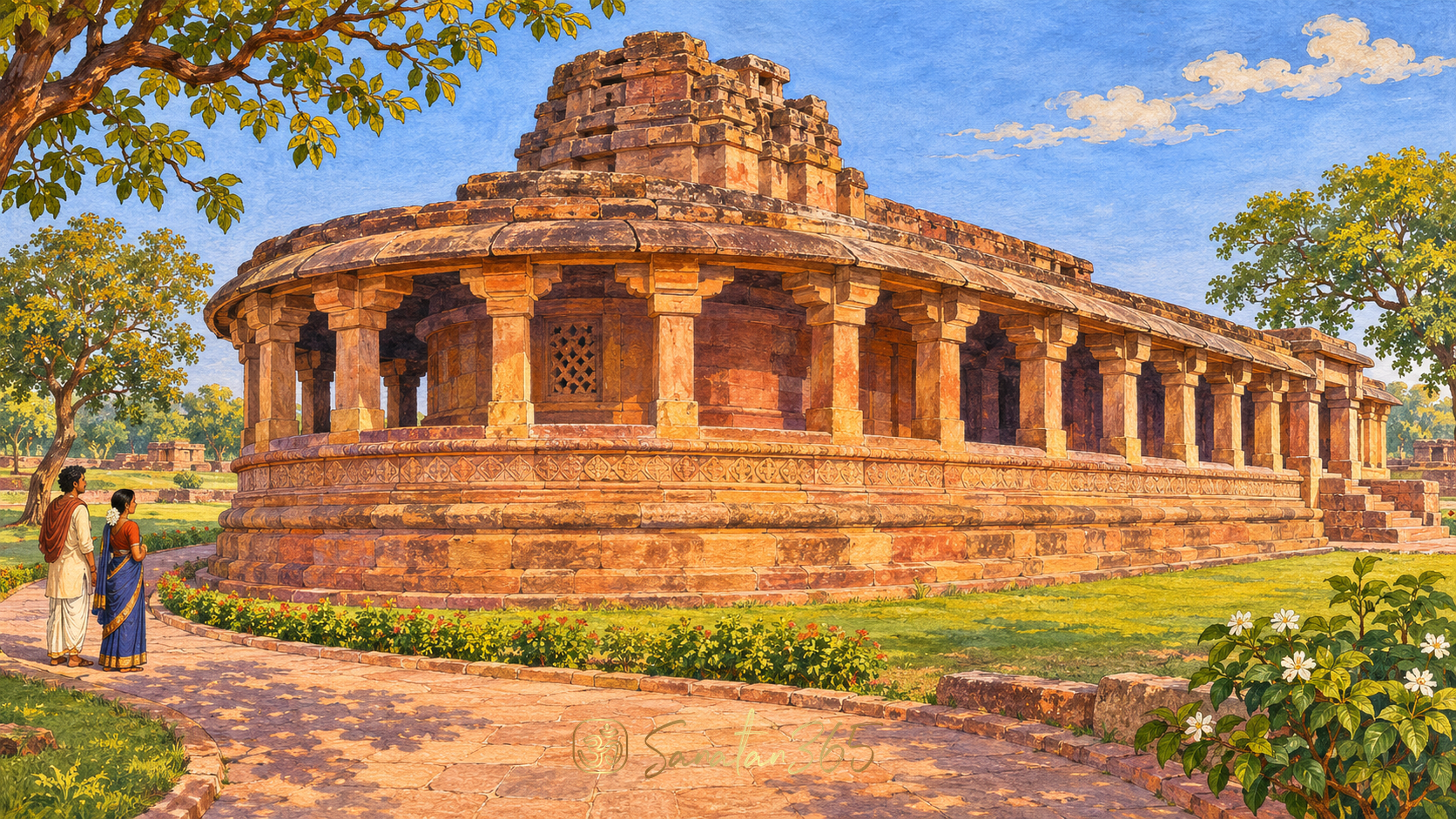
Aihole Durga Temple: Reading the Curved Stone Plan
Read Aihole’s Durga Temple through its rounded rear, raised plinth and pillared gallery, and see how a curved plan creates a sheltered rout…
 Temples
Rajarani Temple: How to Read Its Eight Guardians
Learn to read Rajarani Temple’s eight guardians, distinguish them from other figures, and understand what the carvings can tell us about th…
 Temples
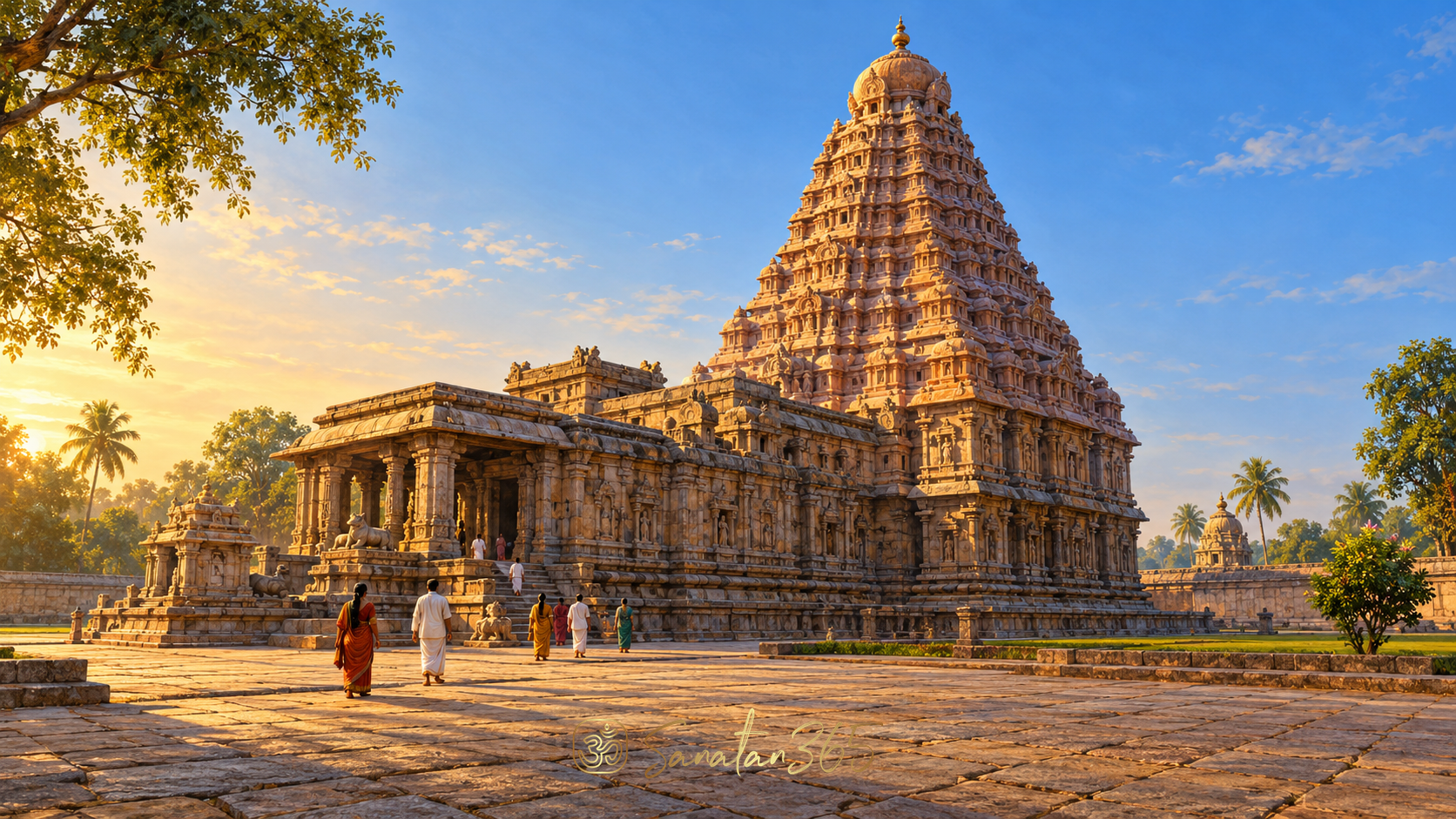
Gangaikonda Cholapuram Temple: Reading the Curve of Sacred Stone
How a curving Chola sanctum tower, carved surfaces and continuing Shiva worship invite a more attentive way of seeing Gangaikonda Cholapura…

