Trishanku Story: Ambition, Belonging, and the Wisdom of Limits
Explore the Ramayana story of Trishanku, Vishvamitra's extraordinary intervention, and what the image of a suspended heaven teaches about ambition, belonging, and limits.
A king asks for something no human body is meant to receive: entry into heaven without passing through death. The Trishanku story in the Valmiki Ramayana follows that request into a startling image—a ruler suspended between earth and heaven while a powerful sage begins creating another celestial order around him.
The story is not a simple warning against aspiration. It asks a harder question: what happens when longing for transcendence becomes inseparable from status, bodily identity, wounded pride, and the will to overpower a limit? Trishanku's suspended state becomes a vivid reflection on ambition, belonging, spiritual authority, and the difference between receiving grace and trying to compel reality.
What Is the Trishanku Story?
Trishanku is a king of the Ikshvaku lineage. In the Bala Kanda of the Valmiki Ramayana, he approaches his family priest, the sage Vashishtha, with an extraordinary desire: he wants to ascend to heaven in his physical body. Vashishtha refuses. Trishanku then asks Vashishtha's sons to perform the rite, but they also reject the request and take offence at his attempt to seek another answer after their father has spoken.
The conflict escalates. Trishanku is cursed and his royal appearance is transformed. Rejected by his own religious authorities and stripped of visible status, he goes to sage Vishvamitra. He recounts his vow and insists that he has tried to uphold truth and duty. Vishvamitra, moved by the king's appeal and also shaped by his own long rivalry with Vashishtha, promises to help.
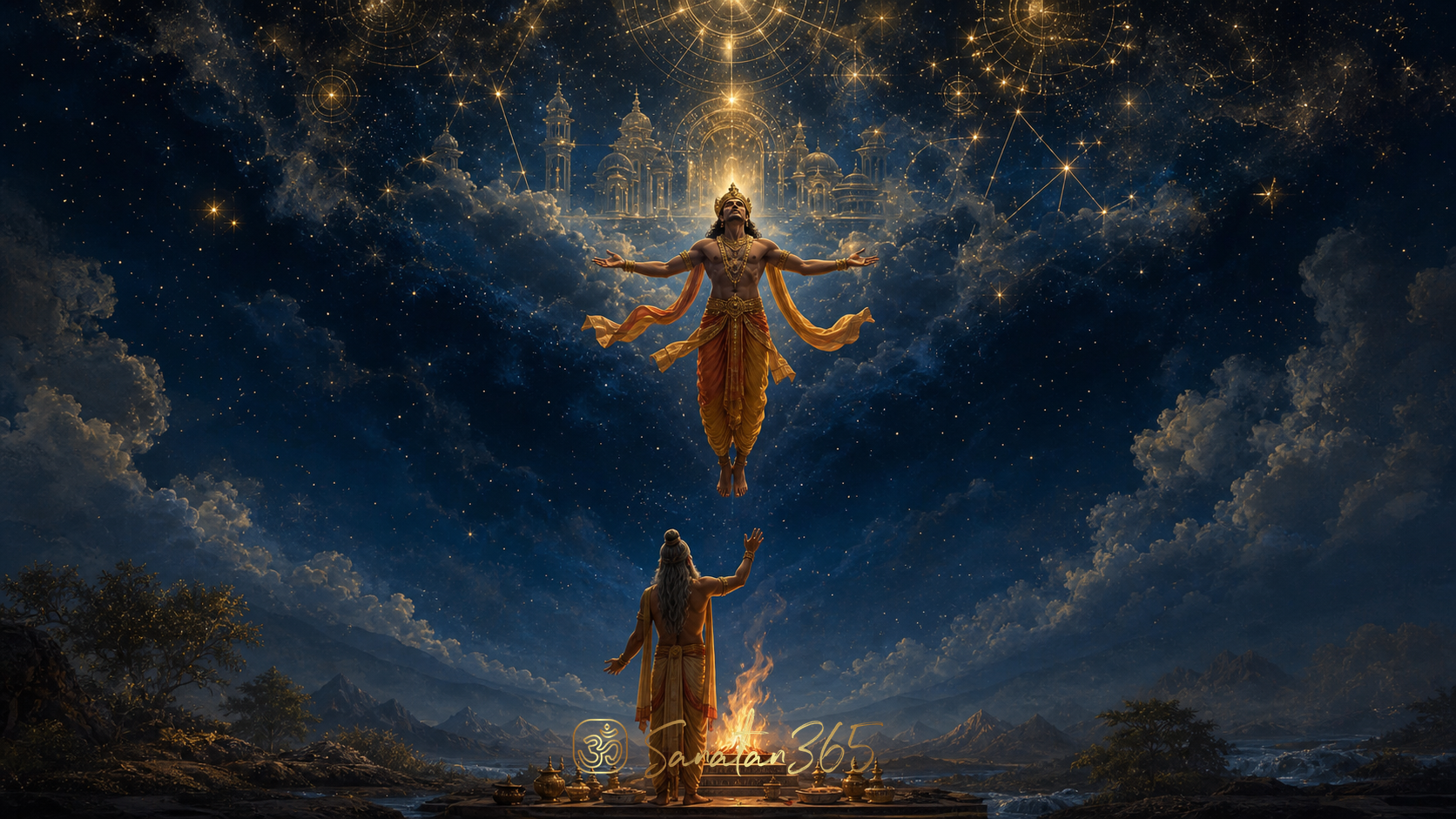
Vishvamitra summons sages and begins a great yajna (यज्ञ, sacrificial rite). Through the power of his tapas (तपस्, disciplined spiritual heat or austerity), he sends Trishanku upward in his body. The king rises toward heaven, but Indra rejects him and casts him down. As Trishanku falls headfirst, he cries out to Vishvamitra.
The sage commands him to stop. Trishanku remains suspended in the sky. Vishvamitra then begins forming new stars and a new celestial realm for him. The devas intervene, and a settlement is reached: the created constellations will remain, while Trishanku will dwell among them in an inverted state.
The primary narrative appears in Valmiki Ramayana, Bala Kanda 57–60; readers can consult the IIT Kanpur Ramayana project for the Sanskrit text and translations. Verse numbering and wording vary across editions, so the sequence matters more here than forcing every detail into one later retelling.
Key takeaway: Trishanku receives the extraordinary result he demanded, but not in the form of uncomplicated triumph.
Why Did Trishanku Want to Enter Heaven in His Body?
The text presents the request clearly but does not reduce it to a single psychological explanation. Later interpreters may see fear of death, attachment to the body, royal exceptionalism, intense faith, or a desire to test the limits of ritual power. Each reading illuminates part of the story, but none should be presented as the only meaning.
The body is important because it is normally subject to change, ageing, and death. Hindu traditions contain many accounts of liberation, divine ascent, and transformed embodiment, yet these are not usually treated as trophies that social power can demand. Trishanku's request turns transcendence into a visible achievement: he wants heaven while preserving the very form by which others recognize him as king.
That desire becomes more revealing after his appearance is altered. The signs of kingship disappear, but the vow remains. He seeks a teacher who will affirm the possibility that others denied. His longing now carries pain, humiliation, and the urgency to prove that rejection was not final.
This makes Trishanku more complex than a proud ruler in a cautionary tale. He is also a person searching for belonging after exclusion. The narrative does not require readers to approve his request in order to recognize the vulnerability beneath it.
The distinction is valuable in spiritual life. Mumukshutva (मुमुक्षुत्व, longing for liberation) is not the same as demanding a dramatic sign of superiority. A sincere desire for freedom gradually loosens attachment to prestige. An ambition that depends on being seen as exceptional may carry the vocabulary of transcendence while still orbiting the ego.
Key takeaway: A sacred goal can become distorted when identity, recognition, and fear are fused with it.
How Did Vishvamitra Create Trishanku's Heaven?
Vishvamitra's role gives the story its immense dramatic force. He is not merely a technician performing a ritual. Across the Ramayana, his life represents formidable tapas, transformation, anger, generosity, rivalry, and the pursuit of brahmarishi status. His support for Trishanku is both compassionate and charged with a contest over authority.
When the devas do not come to receive their share of the sacrifice, Vishvamitra uses his accumulated spiritual power directly. He sends Trishanku upward. When Indra pushes the king down, Vishvamitra halts the fall and begins creating an alternative cosmos.
This is an astonishing portrayal of tapas. Disciplined practice can produce power, but power alone does not settle whether an action is wise. The story separates spiritual capacity from complete freedom from anger, rivalry, or self-assertion. A person may be able to accomplish something extraordinary and still need discernment about why it should be done.
The eventual agreement with the devas matters. The narrative does not end with one side erasing the other. Vishvamitra's creation is not simply destroyed; Trishanku is not allowed to enter the established heaven as originally demanded. A bounded order emerges from confrontation.
This pattern appears elsewhere in Hindu storytelling: conflict reaches a point where raw victory would rupture dharma, and resolution requires placement, proportion, and restraint. The result acknowledges Vishvamitra's tapas, Trishanku's dependence, and the integrity of the cosmic order without pretending that every desire can be fulfilled exactly as imagined.
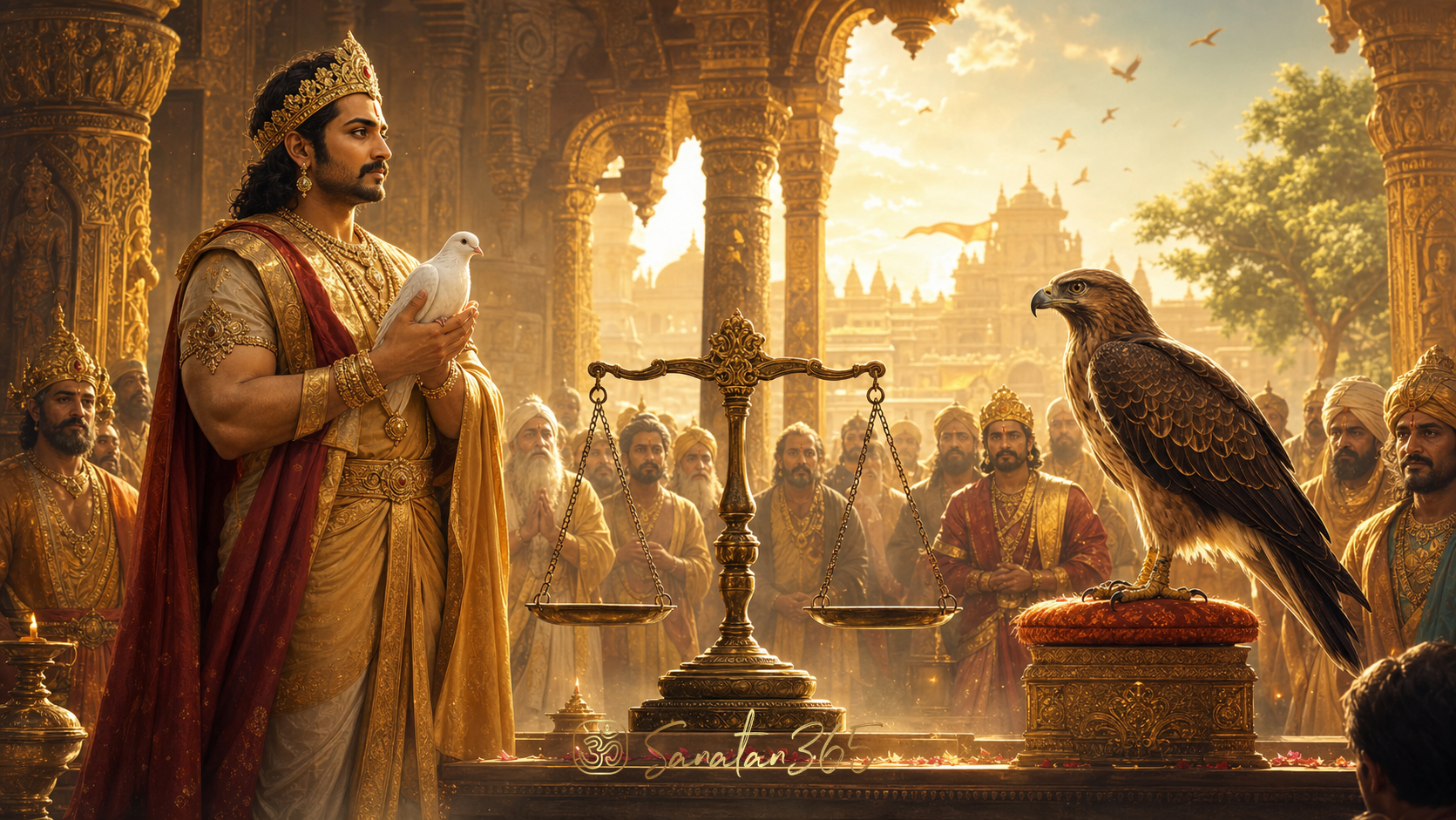
Readers interested in another story about competing duties may also explore King Shibi's test of compassion and protection. Both narratives resist easy moral slogans because several valid claims collide at once.
Key takeaway: Spiritual force becomes trustworthy when it is joined to discernment, proportion, and willingness to accept a boundary.
What Does Trishanku's Suspended State Mean?
Trishanku's inverted suspension is the image that endured. He is neither restored to earth nor admitted into the heaven he sought. He belongs to a celestial arrangement, yet his posture carries the memory of rejection and interrupted ascent.
One reading sees the image as the consequence of refusing ordinary human limits. Another sees it as a compassionate accommodation: Vishvamitra does not abandon the person who trusted him. A third sees an unresolved identity—Trishanku has left one social and cosmic location but has not entered another in the expected way.
These readings can coexist. Hindu narratives often preserve moral tension instead of flattening it. Trishanku's state is reward and warning, refuge and incompletion, wonder and discomfort.
The Sanskrit epic does not use the modern English phrase “liminal space,” but the concept helps describe the image. Trishanku is at a threshold without crossing it. His condition resembles moments when an old identity no longer fits but a new one has not become stable. Such moments can feel humiliating because they expose how much belonging depends on recognition by an established order.
The story also asks whether a specially created refuge resolves the original longing. Trishanku wanted admission to heaven in his body. He receives a place in the sky, but the unusual form of that place makes the cost visible. Achievement is not identical with fulfilment.
Key takeaway: Being granted the object of a desire does not guarantee that the deeper need beneath the desire has been met.
What Does the Trishanku Story Teach About Ambition and Spiritual Power?
The Trishanku story offers at least five practical reflections.
- Examine the form of the goal. A worthy longing can become attached to one rigid outcome. Asking “What do I truly seek beneath this form?” can reveal whether the need is freedom, recognition, safety, revenge, or belonging.
- Do not confuse refusal with worthlessness. Trishanku's rejection intensifies the conflict, but rejection does not define a person's ultimate value. It may still contain a boundary that deserves attention.
- Power does not eliminate accountability. Vishvamitra's tapas enables an immense act. The narrative nevertheless shows power entering negotiation with a larger order.
- A champion can help and still have mixed motives. Support may arise from compassion, identification, rivalry, or all three. Gratitude need not cancel discernment.
- Compromise can preserve truth without satisfying every demand. The final arrangement does not give either side a total victory. It prevents collapse and allows a new order to stand.
For modern readers, these lessons apply beyond royal ambition. A career title, public recognition, spiritual experience, relationship, or institutional acceptance can become a personal “heaven” that seems necessary for identity. Determination is valuable, but determination without inner inquiry can create a suspended life: unable to return, unable to arrive, and dependent on constant effort to maintain the result.
This is where viveka (विवेक, discernment between what is lasting and what is not) becomes essential. Discernment does not shame ambition. It asks ambition to become truthful. The ethical counsel explored in Vidura Niti offers a complementary lesson: wise guidance is most needed when desire and power make listening difficult.
Key takeaway: The question is not only “Can this be achieved?” but also “What will this achievement make of the person seeking it?”
How Is Trishanku Remembered in Modern Language?
“Trishanku's heaven” became a proverbial expression in several Indian languages for an in-between condition—neither fully here nor there. Modern usage may describe political uncertainty, migration, social transition, stalled projects, or a person caught between identities.
The phrase is powerful because it condenses the epic image into ordinary experience. Yet responsible use should not erase the sacred narrative behind it. Trishanku is not simply a synonym for failure. His story includes longing, exclusion, loyalty, immense spiritual effort, cosmic resistance, and negotiated belonging.
The proverb becomes most meaningful when it preserves this complexity. An in-between state may expose overreach, but it may also be a temporary place where identity is being reordered. It can be uncomfortable without being meaningless.
The Ramayana itself is an ancient Sanskrit epic with a vast history of regional retellings; the Encyclopaedia Britannica overview of the Ramayana offers useful background for readers approaching its literary history. The Trishanku episode should be read first in its epic context and only then compared with later proverbial meanings.
Key takeaway: “Trishanku's heaven” names an unresolved middle, but the original story makes that middle morally and spiritually complex.
Conclusion
Trishanku's suspended heaven is unforgettable because it refuses a neat verdict. The king's ambition is extraordinary, his rejection is painful, Vishvamitra's loyalty is fierce, his power is immense, and the final settlement is neither defeat nor fulfilment in the expected sense.
The story invites honest aspiration without contempt for limits. It honours commitment while warning that spiritual power can be entangled with wounded pride. Above all, it asks seekers to look beneath the visible goal: the deepest longing may not be for a special heaven, but for a belonging that cannot be secured by force.
Key takeaway: Ambition becomes wisdom when it can receive discernment, accept proportion, and seek belonging without demanding that reality prove one's exceptional status.
FAQ
Who was Trishanku in the Ramayana?
Trishanku was a king of the Ikshvaku lineage who asked to enter heaven in his physical body. After Vashishtha refused, he sought Vishvamitra's help, leading to his dramatic ascent, rejection by Indra, and suspension in a newly created celestial region.
What is Trishanku's heaven?
Trishanku's heaven refers to the celestial arrangement Vishvamitra began creating after Trishanku was cast down from heaven. In later speech, the phrase often describes an unresolved condition between two states or places.
Why was Trishanku hanging upside down?
In the narrative, Indra sends Trishanku back toward earth, and Vishvamitra stops his fall with the power of tapas. The final settlement leaves him in the sky in an inverted state, making his unusual ascent and rejection permanently visible.
Is the Trishanku story only a warning against ambition?
No. It can warn against rigid or status-driven ambition, but it also explores exclusion, loyalty, spiritual authority, mixed motives, and negotiated belonging. Its strength lies in holding these meanings together.
Where is the Trishanku story found?
The central episode is found in the Bala Kanda of the Valmiki Ramayana, especially sargas 57–60, though details and emphases may vary in translations and later retellings.
About the author
Sanatan365 Editorial
Bringing Sanatan Dharma to modern seekers through authentic, scripture-grounded content.
Related in Stories
 Stories
Mandodari in the Ramayana: Wise Counsel in Ravana's Court
Mandodari's story reveals the courage to speak dharma inside a powerful household, the limits of ignored counsel, and dignity amid grief.
 Stories
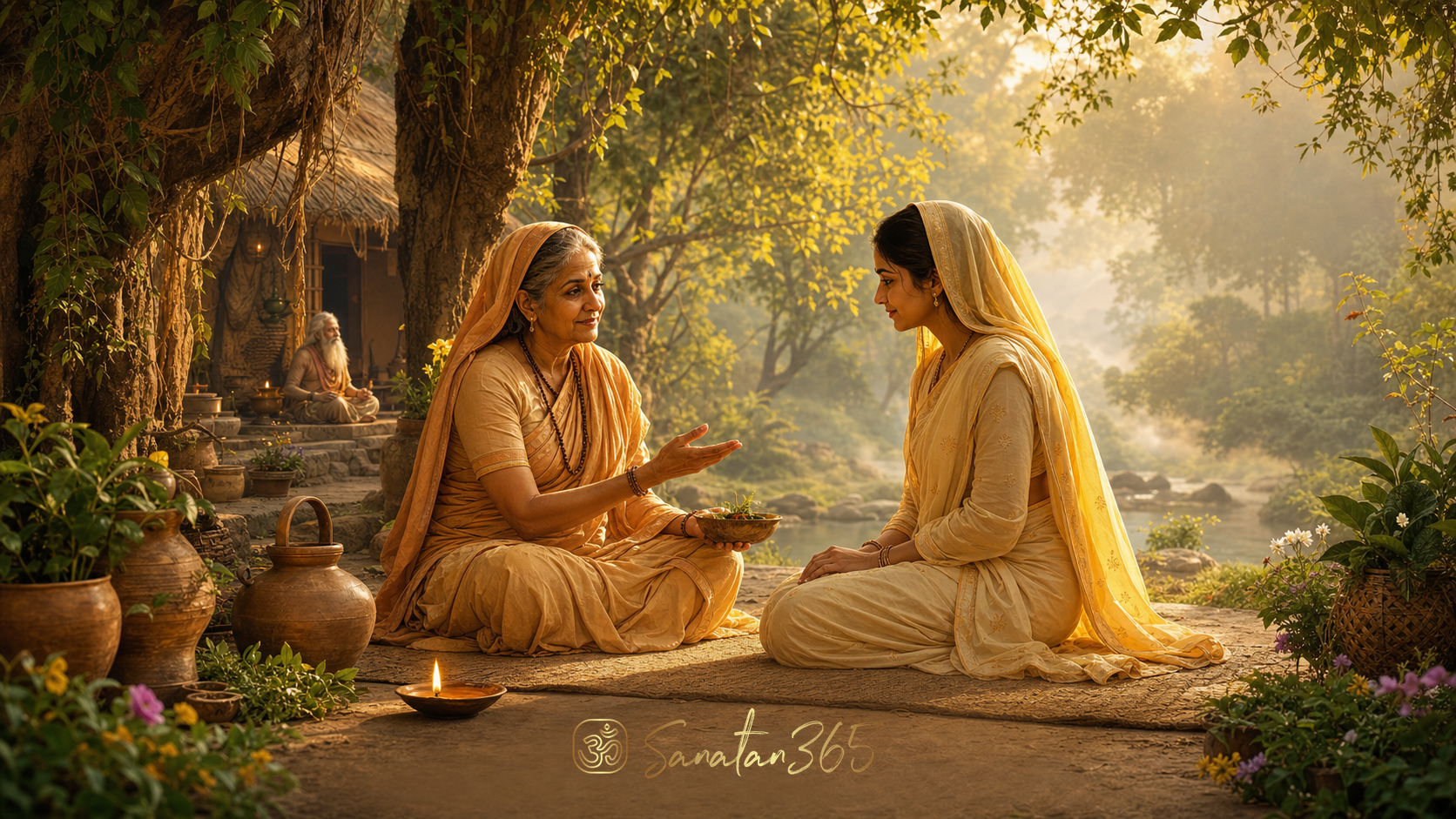
Anusuya Story: Devotion, Hospitality, and Quiet Strength
The story of Anusuya explores devoted partnership, sacred hospitality, discernment, and the quiet spiritual strength that protects dignity…
 Stories
King Shibi Story: Compassion, Sacrifice, and the Limits of Protection
The King Shibi story explores refuge, compassion, self-sacrifice, and the difficult dharma of protecting both the vulnerable and the hungry.