King Shibi Story: Compassion, Sacrifice, and the Limits of Protection
The King Shibi story explores refuge, compassion, self-sacrifice, and the difficult dharma of protecting both the vulnerable and the hungry.
A dove falls into a king's lap asking for refuge. A hawk arrives and asks a question that turns a simple rescue into a test of justice: if the dove must live, who will answer for the hawk's hunger?
The King Shibi story teaches that compassion is not complete when it sees only one claimant. King Shibi protects the frightened dove, yet he also listens to the hawk's lawful need for food. His final offer of his own flesh symbolizes a ruler accepting the cost of a promise instead of forcing that cost onto someone weaker. The episode is remembered as a profound study of dharma (धर्म, sustaining order and right conduct), sharanagati (शरणागति, seeking refuge), and sacrifice guided by responsibility.
Key takeaway: King Shibi's greatness lies not in dramatic suffering, but in refusing to save one life by casually dismissing another.
What Is the King Shibi Story?
King Shibi, also called Shivi or Sibi in different traditions, is remembered as a ruler whose commitment to protection was tested through a dove and a hawk. Versions appear across Indian literature, including episodes associated with the Mahabharata and later Hindu and Buddhist retellings. Details vary: the divine identities of the birds, the location of the trial, and the exact ending may change. The moral structure remains remarkably stable.
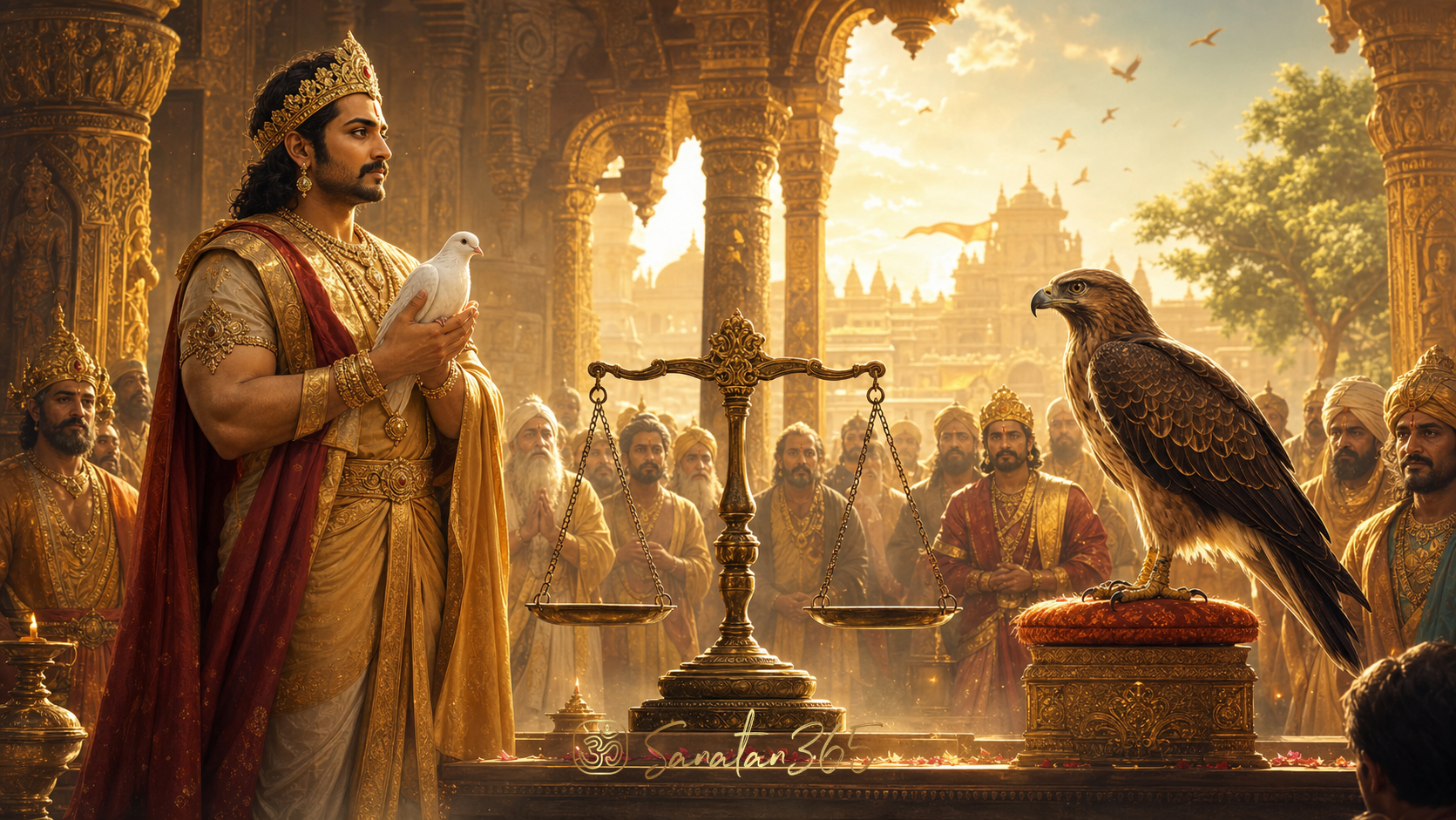
A terrified dove flies into Shibi's court and takes shelter with him. The bird appeals to the king as protector. Soon a hawk arrives and demands its prey. Shibi refuses to surrender a being that has sought refuge. The hawk then argues that it too lives according to its nature. If the king denies its food, the hawk and perhaps its young will suffer. Protection of the dove, the hawk insists, cannot be called righteous if it produces another creature's starvation.
The exchange changes the story. The hawk is not merely a villain. It speaks as a claimant within the same moral world. Shibi therefore offers other food, but the hawk insists on an equivalent measure. The king places the dove on one side of a balance and offers flesh from his own body on the other. Yet the dove remains heavier. At last Shibi offers his whole self. The test ends, the birds reveal the sacred purpose behind the trial in many versions, and the king's integrity is affirmed.
The story should be read symbolically and ethically, not as an instruction to injure oneself. Ancient narratives often use impossible tests to reveal the full weight of a virtue. Shibi embodies a king who does not make a noble promise with someone else's body, labour, or hunger.
The Mahabharata is available in public translation through Internet Sacred Text Archive, while the broader literary history of Indian ethical tales can be explored through the Encyclopaedia Britannica overview of Indian literature.
Key takeaway: The King Shibi story is a moral trial in which refuge, hunger, royal duty, and personal accountability meet.
Why Does the Dove Ask King Shibi for Refuge?
The dove's arrival is not accidental scenery. It activates one of the king's deepest responsibilities: to protect a vulnerable being that has come without weapons, status, or bargaining power. In many dharmic narratives, refuge creates a relationship. Once a ruler accepts a supplicant, abandoning that being for convenience becomes a failure of word and office.
Sharanagati means seeking shelter or surrendering into refuge. In devotional traditions, the term can describe turning toward the Divine. In the political and ethical frame of Shibi's court, it means that power must become protection. The dove has no army and cannot negotiate with the hawk. Its only resource is the king's integrity.
This makes the scene relevant far beyond monarchy. Refuge appears whenever someone with less power trusts someone with more:
- a child tells an adult about fear or harm;
- an employee reports wrongdoing to a leader;
- a guest enters a household in distress;
- a newcomer asks a community for safety;
- a friend reveals something vulnerable in confidence.
In each case, accepting trust creates duties. Protection does not always mean granting every request. It means listening seriously, preventing avoidable harm, preserving dignity, and not exploiting vulnerability.
Shibi does not first ask whether the dove is useful. He recognizes its claim because it is vulnerable and because it has sought lawful shelter. That response expresses abhaya (अभय, freedom from fear or assurance of safety). Temple images often communicate abhaya through an open hand; Shibi translates it into governance.
Yet refuge cannot become sentimental possession. The king does not declare the dove valuable and the hawk worthless. He protects without hatred. That distinction matters. When advocacy depends on demonizing everyone outside the protected group, compassion has already begun to lose its dharmic center.
Readers interested in another story where protection is tested by scarcity may explore King Rantideva's compassion. Shibi's test differs because two living claims directly conflict.
Key takeaway: The dove represents the moral claim created when vulnerability places trust in power.
Why Is the Hawk's Claim Also Part of Dharma?
The hawk brings the story its unsettling intelligence. If it were simply cruel, Shibi's choice would be easy. But the hawk says, in effect: hunger is also real. A king cannot preserve one creature by pretending another creature has no place in the order of life.
This is a classic conflict of duties. Ahimsa (अहिंसा, non-harming) directs the heart away from cruelty, yet embodied life involves competing needs. Food systems, habitats, livelihoods, family duties, and public policy rarely offer perfectly harmless choices. Dharma requires attention to consequences as well as intentions.
The hawk therefore functions as more than predator. It is the voice of neglected cost. Every generous decision has a cost somewhere:
- time offered to one responsibility is unavailable to another;
- money spent on one need cannot serve every need;
- protection for one group may create burdens for workers or families;
- a promise made publicly may be fulfilled privately by someone powerless;
- an institution's compassion can become unsustainable if resources are ignored.
The hawk asks who pays. Shibi's answer is ethically demanding: the powerful person who made the promise must first examine his own share of the burden.
This does not mean leaders must personally solve every problem or exhaust themselves. Responsible systems distribute duty fairly. But it does mean leaders should not advertise compassion while transferring every sacrifice downward. Shibi listens to the inconvenient claimant rather than silencing it.
The hawk also protects the story from a shallow reading of nature. Predation is not moral wickedness in an animal. The bird acts according to its embodied condition. The king's task is not to condemn nature but to find a response consistent with his vow. That humility is valuable in ecological thought: human sympathy for one animal should not erase the needs of an ecosystem.
Key takeaway: The hawk represents the hidden cost and competing duty that honest compassion must hear.
What Does King Shibi's Sacrifice Really Mean?
The balance scale is the story's central image. Shibi does not merely say that the dove matters. He places weight against weight. His promise must become measurable responsibility.
In narrative terms, the endlessly heavy dove reveals that life cannot be reduced to a convenient exchange. A small being may appear insignificant, yet the duty created by refuge carries immense moral weight. Shibi keeps adding his own flesh because partial gestures cannot satisfy a whole promise. When he finally offers his entire self, the test reaches its symbolic completion.
The episode praises tyaga (त्याग, relinquishment or selfless giving), but tyaga is not theatrical self-destruction. In the Bhagavad Gita's ethical vocabulary, relinquishment concerns attachment to ownership and reward while action remains disciplined. Shibi relinquishes privilege: he refuses to preserve his royal comfort by sacrificing the powerless.
Three features keep his sacrifice from becoming mere spectacle:
- Consent: Shibi offers himself; he does not volunteer another person.
- Accountability: He bears the consequence of his own vow as protector.
- Impartial hearing: He takes both the dove and hawk seriously.
These principles matter in modern service. A parent may give up convenience for a child, but should not erase personal health until the household collapses. A public servant may accept hardship, but should build durable institutions rather than glorify burnout. A spiritual volunteer may serve generously, but consent and boundaries still matter.
The miracle at the end confirms inner truth through an extraordinary scene. It should not be used to promise that every sacrifice will be visibly rewarded. Dharmic action is not a transaction that guarantees applause, wealth, or rescue. The story honors the disposition to accept responsibility even when the result is uncertain.
For a complementary reflection on giving that protects consent and power, see Rishi Dadhichi's sacrifice. Both stories ask who has the right to offer what.
Key takeaway: Shibi's sacrifice means that a promise is trustworthy only when the promiser accepts its cost.
How Should the Story Be Read Without Glorifying Self-Harm?
Sacred stories often intensify a virtue until it becomes impossible to ignore. That intensity requires careful interpretation. The King Shibi story does not instruct readers to cut or injure the body. It uses a royal ordeal and divine test to dramatize complete responsibility.
A safe modern reading distinguishes sacrifice from self-harm:
- sacrifice is purposeful, freely chosen, proportionate, and directed toward genuine good;
- self-harm is injury requiring compassionate support, not spiritual romanticization;
- service should respect health, dependants, lawful duties, and long-term capacity;
- spiritual worth is never measured by pain endured;
- professional medical and mental-health care should be sought when anyone is at risk.
If a person feels compelled to injure themselves, the right response is immediate support from trusted people and qualified professionals. No blog, ritual, story, or AI tool replaces emergency or clinical care.
The deeper demand of Shibi is usually less dramatic and more difficult: give up the comfort of looking away. Listen to both sides. Keep the promise. Accept inconvenience. Use authority to protect without dehumanizing. Make sure the cost does not fall invisibly on someone weaker.
This reading also guards against manipulation. Some people praise sacrifice when they want another person to surrender boundaries. Shibi's story offers the opposite principle. The king does not order the dove, hawk, servant, queen, or citizen to pay for his moral reputation. He places himself under scrutiny.
Healthy sacrifice strengthens dharma; coerced sacrifice often protects power. A family or institution can test the difference by asking:
- Who chose this burden?
- Who benefits from it?
- Can the person say no without punishment?
- Is the burden proportionate and sustainable?
- Are leaders sharing the cost?
Key takeaway: The story calls for accountable compassion, never literal injury or coerced suffering.
What Can Modern Leaders and Families Learn from King Shibi?
King Shibi's court is a model of moral attention. The frightened are heard, the inconvenient claimant is heard, and the ruler's own comfort is not treated as sacred. This creates a practical framework for leadership.
Protect trust before protecting image
When someone seeks refuge, the first duty is not public relations. It is safety, truth, and fair process. A leader should avoid promises that sound compassionate but cannot be kept. Once a promise is given, its cost must be faced honestly.
Invite the hawk's question
Every plan needs someone who can name trade-offs. In a family, this may be the person who asks whether a generous expense is affordable. In an organization, it may be the colleague who asks about workload. The hawk's voice is not necessarily opposition; it may be reality asking to be included.
Do not outsource virtue
Leaders should share the sacrifice created by their decisions. If a deadline requires hardship, authority should absorb inconvenience too. If a household welcomes guests, care work should not automatically fall on one person. If a community announces aid, volunteers need resources and rest.
Protect without hatred
Shibi does not need to call the hawk evil in order to shelter the dove. Modern disagreement often turns protection into hostility. The story suggests a stronger posture: defend firmly, hear accurately, and resist the pleasure of contempt.
Build a larger solution
The king searches for an alternative before offering himself. This is the creative work of dharma: not merely choosing between two injuries, but looking for a response that honours the legitimate core of both claims. Sometimes no perfect answer exists. Even then, transparency and shared burden preserve dignity.
Children can learn the story through simple questions: Why was the dove afraid? Was the hawk wrong to be hungry? What promise had the king made? Who should bear the cost of that promise? These questions teach compassion without flattening moral complexity.
Key takeaway: Shibi-style leadership protects the vulnerable, hears hidden costs, and shares the burden of its own decisions.
Conclusion
The King Shibi story endures because it refuses an easy version of goodness. The dove deserves refuge. The hawk's hunger matters. The king's word has consequences. Dharma appears not as a slogan but as the patient work of holding all three truths together.
Shibi's final offering makes one principle unforgettable: power becomes sacred when it accepts responsibility. The story does not ask readers to imitate bodily suffering. It asks them to stop making others pay for promises that make them look virtuous.
Single key takeaway: Compassion becomes dharmic when it protects the vulnerable, hears competing needs, and accepts its own fair share of the cost.
FAQ
Who was King Shibi?
King Shibi, also called Shivi or Sibi, is a celebrated righteous ruler in Indian narrative traditions. He is best known for protecting a dove from a hawk and offering his own flesh on a balance rather than betraying a being that sought refuge.
What does the King Shibi story teach?
It teaches protection of the vulnerable, fidelity to one's word, fair hearing of competing claims, and personal accountability. Its deepest lesson is that compassionate promises carry real costs that should not be pushed onto weaker beings.
Why does the hawk demand the dove?
The hawk argues that the dove is its natural food and that denying it nourishment creates another harm. This makes the story a conflict between duties rather than a simple battle between good and evil.
Did King Shibi really cut flesh from his body?
Traditional versions use this dramatic act as the decisive divine or moral test. Modern readers should understand it symbolically as complete responsibility, not as an instruction to injure themselves. Self-harm requires immediate compassionate and professional support.
What is the meaning of the balance scale in the story?
The scale shows that a promise has weight. The dove's surprising heaviness symbolizes the immeasurable value of life and the serious duty created when a vulnerable being seeks protection.
About the author
Sanatan365 Editorial
Bringing Sanatan Dharma to modern seekers through authentic, scripture-grounded content.
Related in Stories
 Stories
Sita Swayamvara in the Ramayana: Shiva's Bow and the Meaning of the Marriage
Read the Bala Kanda account of Rama, Sita, Janaka and Shiva's bow, and separate the text's sequence from later devotional retellings.
 Stories
King Chitraketu Story: Grief, Wisdom, and Humility in the Bhagavata
The Bhagavata Purana tells how King Chitraketu met devastating loss, listened to Narada and Angira, and learned a difficult humility. Read…
 Stories
King Ambarisha and Durvasa: A Story of Devotion and Humility
The Bhagavata Purana story of King Ambarisha and Sage Durvasa explores a difficult fast, an angry visitor, and the restraint behind devotio…