Vishwakarma Puja 2026: Date, Tools, and the Dignity of Work
Vishwakarma Puja on September 17, 2026 honours the divine architect and the tools of work. Explore its solar-calendar date, regional customs, and thoughtful workplace observance.
A workshop can become a place of worship without ceasing to be a place of work. On one September morning, the instruments that usually serve human hands receive flowers, gratitude, and a deliberate pause.
Vishwakarma Puja 2026 falls on Thursday, September 17, for the September observance associated with Kanya Sankranti (कन्या संक्रान्ति, the Sun’s transition into the sidereal sign Virgo). Puja (पूजा, reverential worship) honours Lord Vishwakarma, the divine architect and craftsman, and the tools through which people earn, build, repair, and create. Its deeper invitation is to treat skill, equipment, and the people behind every finished object with care.
When Is Vishwakarma Puja 2026?
The September festival follows a solar-calendar marker rather than a lunar date that shifts widely across the Gregorian calendar. Drik Panchang’s 2026 listing for New Delhi places Vishwakarma Puja on September 17 and gives the solar-transition moment as 7:58 a.m. local time, IST. It identifies the observance with the closing day of Bhadra, a month in the Bengali calendar.
That transition moment is not an instruction for every household or factory to begin worship at exactly 7:58. A panchang (पञ्चाङ्ग, a traditional Hindu calendrical almanac) may supply additional observance guidance; a local priest or established community calendar can explain how that guidance applies. Readers outside India should use their own location and time zone rather than copy a clock time from an Indian city.
Three distinctions prevent common confusion:
- Festival date: Thursday, September 17, 2026, for the September Kanya Sankranti observance discussed here.
- Solar-transition moment: the astronomical calendar marker, shown as 7:58 a.m. IST in the cited New Delhi listing.
- Local worship arrangements: the time selected through the relevant tradition and the practical needs of the community or workplace.
The name Vishwakarma Jayanti is also used for celebrations of the deity. Jayanti (जयन्ती) means a birth-anniversary observance, but not every community using that name follows the same annual calendar. This article concerns the September festival, not a claim that all Vishwakarma celebrations everywhere must occur on this date.
For a reader new to Hindu calendar vocabulary, the five components of a panchang offer useful background. Understanding the calendar is more helpful than collecting a precise-looking time without knowing what it represents.
Key takeaway: September 17 is the verified 2026 date for this observance; confirm local worship timing separately.
Who Is Vishwakarma, the Divine Architect?
Vishwakarma, also transliterated Vishvakarman (विश्वकर्मन्), is a name associated with the maker or fashioner of all. Hindu tradition reveres him as the divine architect and patron of skilled creation. The figure brings together imagination and execution: not only conceiving a beautiful form, but knowing how to give it structure.
The Vedic hymns addressed to Vishvakarman in Rig Veda 10.81–82 contemplate the maker of the world and the mystery of creation. They should not be reduced to a modern engineering manual. Their questions concern cosmic origin, divine knowledge, and the relationship between the world and its maker. Later devotional traditions develop the familiar imagery of a divine craftsman with instruments and remarkable works of sacred construction.
These layers belong together without being identical. A Vedic hymn, a later sacred narrative, and a modern festival image serve different purposes. It is more accurate to recognise that range than to present every popular story about a divine building or weapon as a single account shared by all Hindu texts.
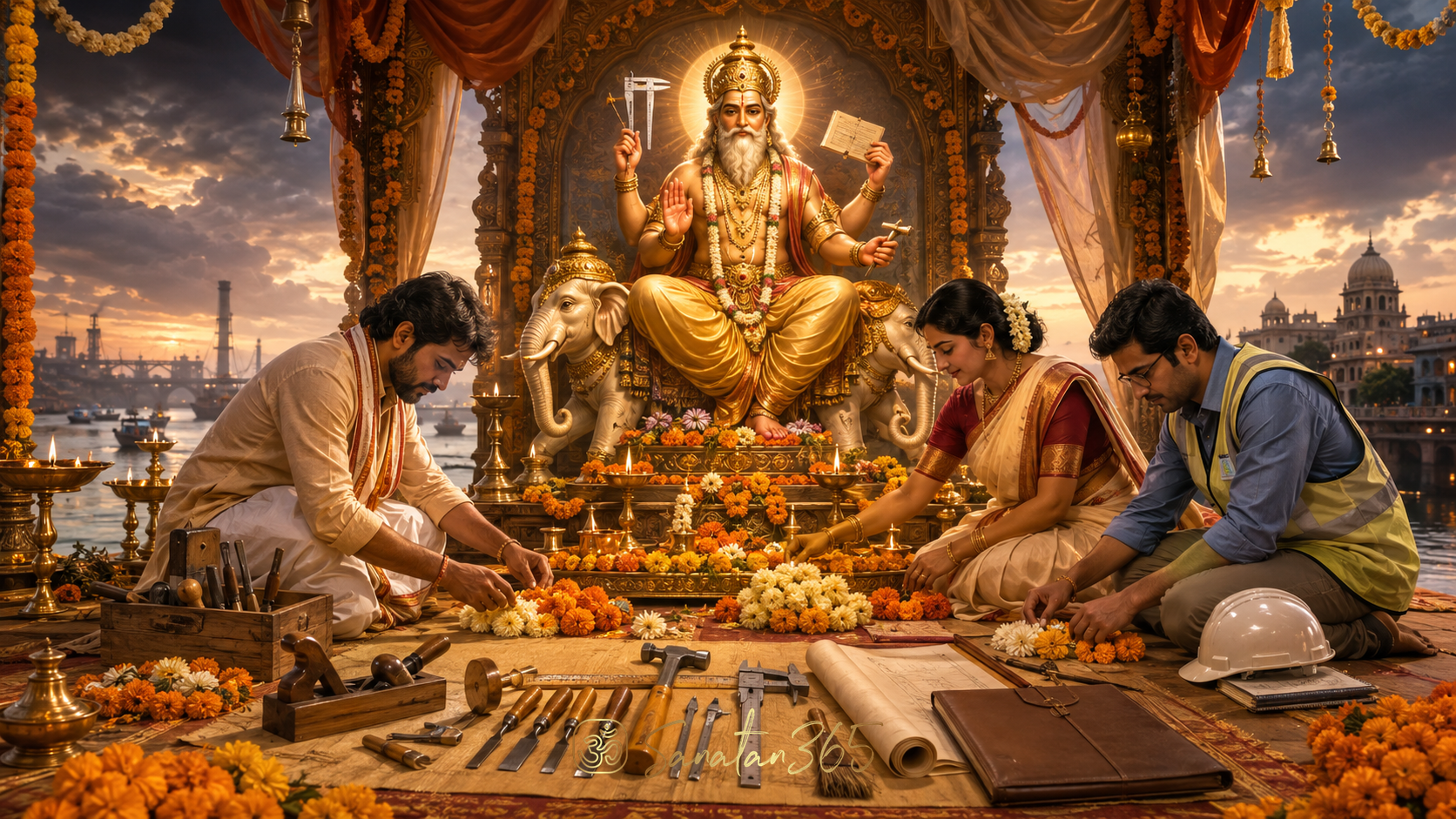
The Ministry of Tourism’s Utsav description of Vishwakarma Puja in West Bengal describes him as the divine engineer and architect. It records celebrations in offices, workshops, and factories, with images of Vishwakarma and his elephant placed in decorated temporary festival structures. This is a living devotional setting, not merely an abstract symbol of productivity.
For a carpenter, the connection may be immediate: an idea becomes a useful object only through patient, skilled action. An engineer may recognise the same responsibility in a drawing that must become a dependable structure. A repair technician meets it whenever understanding saves an object from being discarded. The festival gives religious expression to the seriousness of making things well.
Key takeaway: Vishwakarma devotion honours creative intelligence joined to the discipline and responsibility of craftsmanship.
Why Are Tools and Machines Worshipped?
A tool is easily noticed when it breaks and easily forgotten when it works. Vishwakarma Puja reverses that habit. Instruments usually treated as background are cleaned, arranged, and acknowledged as companions in a livelihood.
The Drik Panchang account names tools, machinery, and instruments among the objects honoured by artisans and professionals. The Utsav account likewise describes workers bringing the instruments of their profession before Lord Vishwakarma. Worship is directed within that devotional relationship; the equipment is not simply decorated as a seasonal display.
The gesture can express several kinds of gratitude. There is gratitude for materials, for the skill acquired through practice, for the teacher who showed how to use an instrument, and for the opportunity to contribute something useful. A finished chair conceals many dependencies: timber, design, sharpening, measurement, labour, transport, and the needs of the person who will use it.
This does not mean a garland guarantees that a machine will run perfectly. Prayer for protection and good work belongs alongside maintenance, training, and appropriate operating procedures. Reverence becomes credible when the equipment receives practical care after the ceremony as well as flowers during it.
Nor should the celebration value an expensive machine more than the person operating it. A modest hand tool may support a household as meaningfully as a large industrial system supports a business. The dignity lies neither in price nor prestige, but in the relationship between skill, livelihood, and service.
At home, that reflection may begin with a sewing machine, a drawing instrument, a workbench, or an everyday repair kit. In a contemporary office, a computer can be included as a tool of work where that fits the group’s practice. Such an adaptation should be described as an adaptation, not as a ritual requirement inherited unchanged from antiquity.
Key takeaway: Honouring tools is most meaningful when gratitude becomes maintenance, responsible use, and respect for skilled people.
How Can a Workplace Prepare for Vishwakarma Puja?
The following is a practical planning guide, not a substitute for a priest-led ceremony or a prescribed ritual sequence. A workplace with an established tradition should follow its qualified guide. A small team can still prepare thoughtfully without improvising unfamiliar sacred procedures.
Prepare the space before decorating it
Choose a clean, accessible place for an image of Lord Vishwakarma and any representative tools. Keep the arrangement distinct from operating equipment. Workers responsible for machinery should decide what can be moved, displayed, or temporarily taken out of use; ceremonial enthusiasm should never overrule those responsibilities.
Flowers, food, liquids, and open flames require particular care around electrical systems, fuels, ventilation intakes, and moving parts. Where a flame is unsuitable, consult the ritual guide about an appropriate arrangement. The religious purpose does not require placing people or equipment at risk.
Agree on a simple order
A useful planning sequence is:
- Confirm the date and local worship time with the relevant community calendar or priest.
- Clean and inspect the selected workspace and tools, with trained personnel handling specialist equipment.
- Arrange the devotional focal point, offerings, seating or standing space, and an unobstructed route through the area.
- Explain the programme briefly, especially for colleagues encountering the festival for the first time.
- Hold the worship according to the chosen tradition, followed by thanks to the people whose work sustains the organisation.
- Share food and restore the space responsibly, checking equipment before work resumes.
Offerings commonly include flowers and food, but the exact items and sequence vary. Aarti (आरती, the ceremonial offering of light) may form part of the worship. Prasad (प्रसाद, food received as a blessed offering) may then be shared. The meaning of prasad in Hindu worship explains why that food is received with gratitude rather than treated as an ordinary refreshment break.
Make participation welcoming
In a shared workplace, explain what will happen and allow colleagues to participate voluntarily. Some may offer a prayer; others may observe respectfully or join the meal. No employee should have to demonstrate religious participation to show loyalty to the team.
Include the people whose contributions are least visible: maintenance staff, cleaners, apprentices, drivers, and those who keep records or coordinate supplies. A celebration of work becomes incomplete when it recognises only the most prominent job titles.
Key takeaway: A thoughtful workplace observance combines a clear devotional focus with voluntary participation, practical preparation, and care for everyone present.
How Do Regional Celebrations Differ?
The September observance has a particularly visible public life in eastern India. In West Bengal, the Utsav account places it in the setting of decorated offices, workshops, factories, and temporary festival structures. The deity’s image, the gathering of workers, and the transformation of an ordinary work area into a sacred setting give the celebration its distinctive character.
The connection with the Bengali month Bhadra helps explain why calendar language may differ from what a reader knows at home. One family may say Vishwakarma Puja, another Biswakarma Puja, and another refer to the seasonal transition. Differences of spelling or pronunciation need not imply a different deity.
Elsewhere, local communities may organise worship around their own inherited calendar, occupational association, or temple. An article about the September festival should leave room for those traditions instead of declaring one date or set of offerings universally mandatory. The same restraint applies to whether tools are rested for the whole day: follow the actual local custom and the workplace’s responsibilities, not a blanket internet rule.
Tool worship also appears in other festival settings, including Ayudha Puja, an observance associated with Navratri (नवरात्रि, nine nights) whose name means worship of implements or instruments. The shared attention to tools is a useful connection, but it does not make the festivals interchangeable. Their calendars, regional settings, and devotional arrangements deserve to be understood in their own right.
For diaspora groups, the challenge is often practical. A gathering may need to accommodate local working hours, building rules, and a community priest’s availability. It is better to explain an adapted schedule honestly than to imply that a convenient weekend celebration changes the traditional calendar date.
Key takeaway: Recognise the September festival clearly while respecting the regional calendars and devotional practices surrounding it.
What Can the Festival Teach About Good Work?
Vishwakarma Puja asks an unusually concrete spiritual question: what kind of attention enters the things people make?
The answer can be seen in small decisions. A measurement is checked again. A fault is reported rather than concealed. An apprentice receives patient instruction. A damaged tool is repaired before the next person uses it. These examples are contemporary ethical reflections on the festival, not promises that a particular ritual will produce professional success.
Craftsmanship joins care for the object with care for its eventual user. A beautiful surface cannot excuse an unsafe structure. Speed cannot justify passing an avoidable defect to someone else. Even work that produces no physical object can carry the same discipline: a clear explanation, a dependable schedule, or an accurate record makes another person’s work easier.
The festival also offers a moment to remember teachers without making learning a finished achievement. Skills change, tools change, and experienced workers still have something to learn. Gratitude for knowledge is strengthened by keeping it useful and sharing it responsibly.
A simple closing reflection might ask: Which tool needs attention? Whose contribution has gone unacknowledged? What could be made more reliable before the next working day? These questions let a single celebration leave a practical trace through the year.
Key takeaway: The lasting offering is work carried out with skill, honesty, gratitude, and responsibility toward those it serves.
FAQ
What is the date of Vishwakarma Puja in 2026?
The September Kanya Sankranti observance falls on Thursday, September 17, 2026. The cited New Delhi calendar gives the solar-transition moment as 7:58 a.m. IST; confirm local worship arrangements separately.
Is Vishwakarma Puja only for factory workers?
No. It is especially associated with artisans, craftspeople, engineers, and workers using tools or machinery, but anyone may respectfully learn about or participate in the celebration. Local communities decide their own arrangements.
Can computers and modern equipment be included?
Yes, where the community treats them as contemporary instruments of work. Keep offerings away from sensitive equipment and follow workplace procedures. Including a computer is a modern application of the theme, not a compulsory ancient prescription.
Does worship replace servicing or maintenance?
No. Devotional prayers for good work accompany practical responsibility. Tools and machines still require inspection, maintenance, trained operation, and every relevant safety procedure.
Are Vishwakarma Puja and Ayudha Puja the same festival?
They share an emphasis on honouring instruments of work, but their calendar settings and regional traditions differ. This guide addresses the September Vishwakarma observance, not the Navratri-associated Ayudha Puja.
About the author
Sanatan365 Editorial
Bringing Sanatan Dharma to modern seekers through authentic, scripture-grounded content.
Related in Festivals
 Festivals
Garba Meaning: The Lamp at the Heart of Navratri
Garba is a Gujarati devotional dance associated with Navratri. Its central lamp, shared circular rhythm and reverence for Goddess Amba expl…
 Festivals
Golu Meaning: Navratri Dolls, Living Stories, and Hospitality
Understand Navratri Golu through its handmade dolls, regional names, family stories and welcoming home visits, with thoughtful preparation…
 Festivals
Sharad Navratri 2026: Dates, Nine Nights, and Devotion at Home
Understand Sharad Navratri 2026, its October dates, the meaning of nine nights, regional traditions, and a thoughtful home observance witho…

