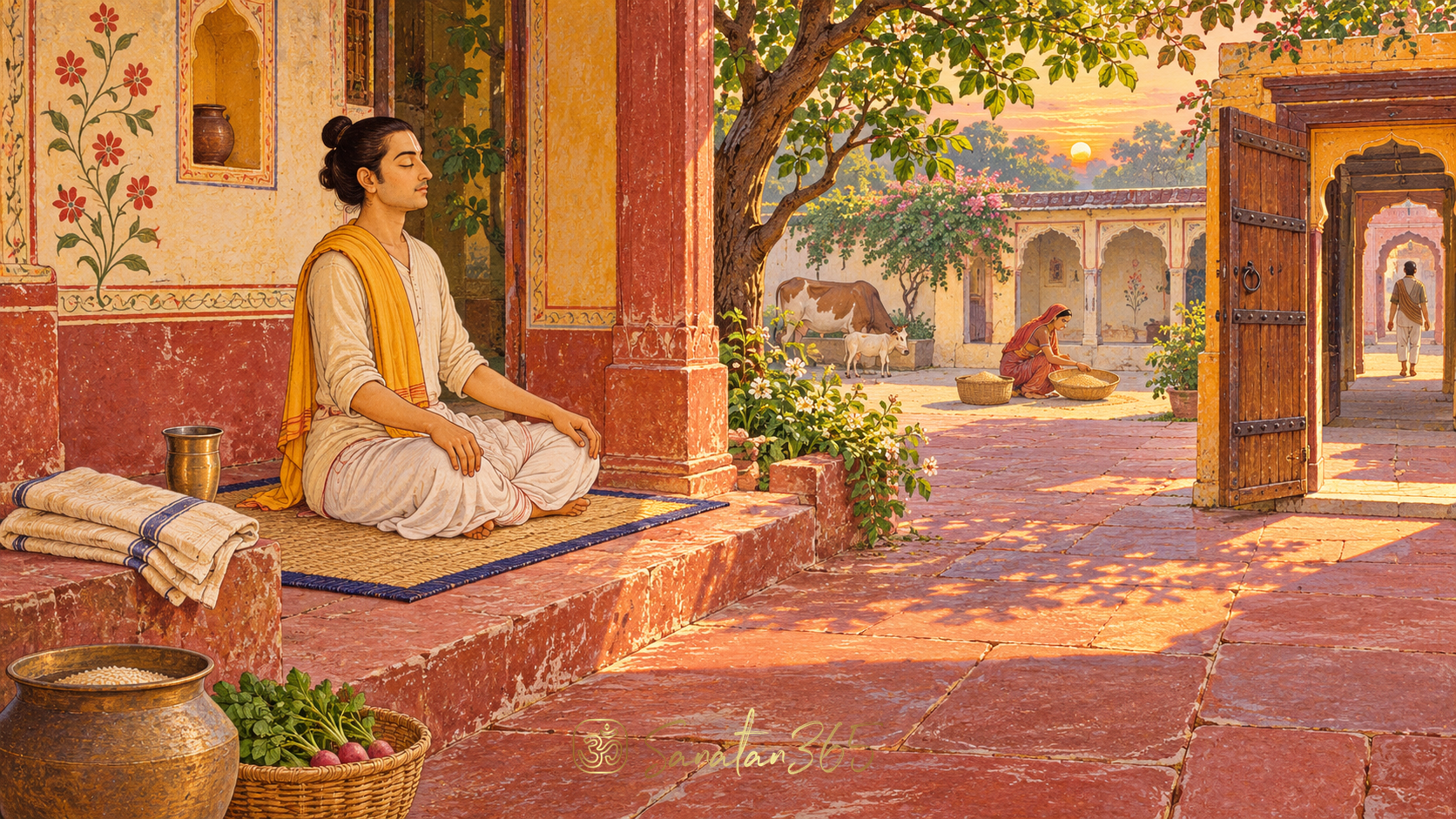
Yuktahara Viharasya Meaning: Making Room for Practice
Bhagavad Gita 6.17 looks at what happens before a person sits to meditate. Learn how food, recreation, effort and rest support the practice.
A meditation session can be shaped by an ordinary decision made hours before anyone sits down. One late household task can move the only quiet interval to a time when the person is already ready for bed.
The yuktahara viharasya meaning in Bhagavad Gita 6.17 is that suitably regulated eating and recreation support yoga (योग, yoga, spiritual discipline). The verse also includes effort in action, sleep and waking. Its practical question extends beyond how a person sits. What arrangement of the day gives the practice a place it can actually occupy?
What is the yuktahara viharasya meaning?
The opening expression (युक्ताहारविहारस्य, yuktāhāravihārasya, “of one whose eating and recreation are regulated”) describes the person whose practice the verse is discussing. Its parts point to fitness or regulation (yukta, युक्त), food (āhāra, आहार), and recreation or movement (vihāra, विहार). In the verse and word meanings for Bhagavad Gita 6.17, these are the first of several conditions. The verse keeps returning to the idea of regulation as it moves from food and recreation to a person's exertion, and then to sleep and waking.
Here is a plain-English rendering of the sense of the whole verse.
For a person whose food and recreation are suitably regulated, whose effort in action is measured, and whose sleep and waking are regulated, yoga becomes a means of overcoming sorrow.
The first line therefore gives only part of the picture. A person might pay great attention to the food on a plate and make no room for a pause after work. Another might keep a meditation appointment faithfully while leaving every small household duty until evening. The verse joins several kinds of activity in one sentence. It invites attention to what surrounds the sitting as well as to the sitting itself.
The closing reference to sorrow belongs to the text's account of yoga. The practical examples here concern how the day supports a spiritual discipline. A quiet sitting can still have interruptions, persistent thoughts, and days when the available time is short. The worth of arranging the time depends on the opportunity it gives the practitioner to return.
Key takeaway. Read the meal, the activity, the effort and the rest together. Each can shape the conditions in which meditation happens.
Why does the previous verse rule out extremes?
Read Bhagavad Gita 6.16 and 6.17 together in the section on meditation. The first verse names both ends of eating and sleeping. Eating to excess and foregoing food altogether are presented as obstacles. The verse likewise puts excessive sleep and excessive wakefulness outside the conditions it recommends. The next verse describes an appropriate arrangement in positive language.
This order matters. Someone might assume that adding spiritual discipline means removing comforts one by one, as if every sacrifice made the next sitting better. The paired verses give a more precise criterion. The practitioner considers whether the surrounding choice serves the discipline. A late wakeful stretch can look impressive on paper and leave the next day's sitting without an available place. A rigid rule about food can make the reader focus on compliance long after the meal has ended.
The same reading keeps moderation from becoming a formula. In an ordinary household, one person's quiet interval arrives just after the school departure. Another's arrives in the evening once a shared duty is finished. The source gives no hour at which both must sit and no quantity both must eat. The pair of verses helps each look at how the chosen conditions work together.
A reader who wants to look more closely at the food strand can turn to the explanation of moderate eating in yoga. That inquiry can be valuable on its own. The contribution of 6.17 is the way it makes the practitioner look up from the plate and see the day around it.
How do effort, sleep and waking support practice?
The verse includes exertion in actions (ceṣṭā, चेष्टा, effort or activity). This brings work and responsibility into the picture. An everyday example is the person who schedules ten quiet minutes but starts a task just beforehand that cannot be left halfway through. The task may matter. What changes the sitting is the sequence. If the task has a natural stopping point, the person can arrange the quiet interval after that point and give both activities their due.
Recreation deserves the same attention. The verse makes room for movement or recreation within a regulated day. A walk, a conversation or a familiar pastime can be ordinary parts of that day. Consider two evenings that both include a walk and a short sitting. On one evening, the walk ends with time to put things away before sitting. On the other, each return home leads directly into another errand and the same sitting is squeezed between unfinished jobs. The example is about the relation between activities. It does not require the walk to disappear.
The verse also mentions sleep and waking together. The pair matters because the time assigned to a practice comes out of an existing pattern of rest and activity. If a person regularly loses the proposed morning interval to essential preparation, an earlier promise on paper may merely move the pressure elsewhere. An interval after breakfast or after a settled evening task may fit the day better. There is room here to choose a point the household can recognise.
The sitting itself is described more deeply in the guide to steady awareness in Hindu meditation. This verse makes a contribution before that stage. It asks how the way time is used can leave a space in which the discipline is possible.
How can a household test one adjustment?
A reader can start with a practice already understood, such as a brief period of quiet sitting. The task is to observe where it fits. Choose one ordinary day and notice the job, meal, recreation or transition that usually happens immediately before the proposed time. The observation is specific. “The kitchen needs another ten minutes after I think I am finished” is easier to work with than “Evenings never work.”
Next, choose one adjustment to the sequence. A person who regularly begins the sitting while remembering an unfinished kitchen task might finish the wiping and put the cloth away first. Someone who immediately opens a work message after a morning walk might set aside a short interval before reading messages, if work permits. If a household member needs help at the original time, a later interval after that responsibility may be a better fit. Choose a practical end point, such as the cloth going back on its hook or the walking shoes being put away.
Keep the intended practice short enough to fit the time available. Over a few ordinary days, notice whether the interval became easier to find and whether the activities on either side still had enough attention. A household can learn from both observations. A sitting obtained by leaving another person to finish a shared task is a fragile arrangement. A sitting that fits after the task has a recognisable beginning.
This is a modern way of applying the verse, not a schedule laid down in it. A person can also keep the original time and move a discretionary activity away from it. The guide to steady practice through repetition offers a related way to think about returning. In this small experiment, the person gives the return a reliable cue.
What makes a routine suitable for practice?
A suitable routine leaves enough room to give the practice attention. It can often be recognised by the way one activity ends and the next begins. Consider a person who chooses the stretch after washing a cup in the morning. If the kettle, lunch box and doorway are out of the way for those minutes, the cup offers a useful cue. If the time still belongs to preparing the household for departure, the same cue may need a different place.
A shared room gives a useful test. Suppose the table where someone plans to sit quietly is also where another member of the household lays out the next day's work. Leaving at the first sign of activity would make the time unpredictable. Asking when the table is usually clear may reveal a better boundary. The practitioner can move the sitting to a chair near the doorway after the room is put back in order. The purpose of the practice stays recognisable, while its timing stops competing with another person's task.
Accepting day-to-day variation can make the distinction clearer. On an ordinary day, the arrangement may hold. On a day with guests, work or caregiving, it may need to move. The reader can ask what remains recognisable even then. Perhaps the full interval shrinks to a short pause after a shared task. Perhaps the person simply returns at the next ordinary opportunity. The verse's attention to the conditions around practice gives that return a place in the thinking.
There is a difference between completing a routine and seeing what made it workable. The first leaves a mark on a calendar. The second may reveal that a quieter transition came from finishing an ordinary duty, giving a conversation its own time, or choosing a sitting when waking and resting already had their proper space. This attention helps a person decide what is worth keeping as the household changes.
The verse begins with food and recreation and then keeps going. That movement is its most useful reminder in daily life. The conditions for spiritual practice are made in several ordinary acts around it. The reader can begin by arranging one of them with care.
FAQ
What does the phrase yuktahara viharasya mean in English?
It means “of one whose eating and recreation are regulated,” with movement or activity also within the range of vihāra. It describes the practitioner at the start of Bhagavad Gita 6.17. The verse goes on to name effort in action, sleep and waking, so the opening expression should be read as the beginning of a wider description.
Does Bhagavad Gita 6.17 give a fixed meal or sleep timetable?
The verse identifies the areas in which a suitable measure matters. It supplies no hour, portion or universal timetable. The immediately preceding verse frames the recommendation by naming extremes of eating and rest. Together the verses help readers examine how their habits support practice within the responsibilities they actually have.
Why does work appear in a verse about meditation?
The text names the practitioner's effort in action because it is one part of the life in which meditation takes place. An ordinary way to apply the point is to look at the boundary between a duty and a sitting. A clear stopping point can make it possible to attend to both without one repeatedly crowding the other out.
What is one small way to put the teaching into practice?
Choose one familiar quiet interval and look at what precedes it. If an unfinished discretionary task regularly delays the sitting, give that task another place, or find a time immediately after it can reasonably end. Keep observing long enough to learn whether the adjustment supports both the practice and the day's responsibilities.
About the author
Sanatan365 Editorial
Bringing Sanatan Dharma to modern seekers through authentic, scripture-grounded content.
Related in Practices
 Practices
Brahmarpanam Meaning: A Gita Verse Before the First Bite
Read Bhagavad Gita 4.24 as a verse about offering and see how a pre-meal recitation brings its imagery into an ordinary meal.
 Practices
Paduka Meaning: Sacred Sandals and the Practice of Remembrance
Why sacred sandals receive honour, what Rama and Bharata’s meeting reveals, and how paduka remembrance connects reverence with responsible…
 Practices
Pratipaksha Bhavana Meaning: Choosing an Ethical Response in Yoga
Read Yoga Sutras 2.33–2.34 as a practice of examining harmful reasoning and choosing a concrete ethical response in ordinary life.

