Bharata and Rama’s Sandals: Power Held in Trust
Bharata’s refusal to claim Rama’s throne becomes a demanding form of service in the Ramayana, where royal sandals mark entrusted authority.
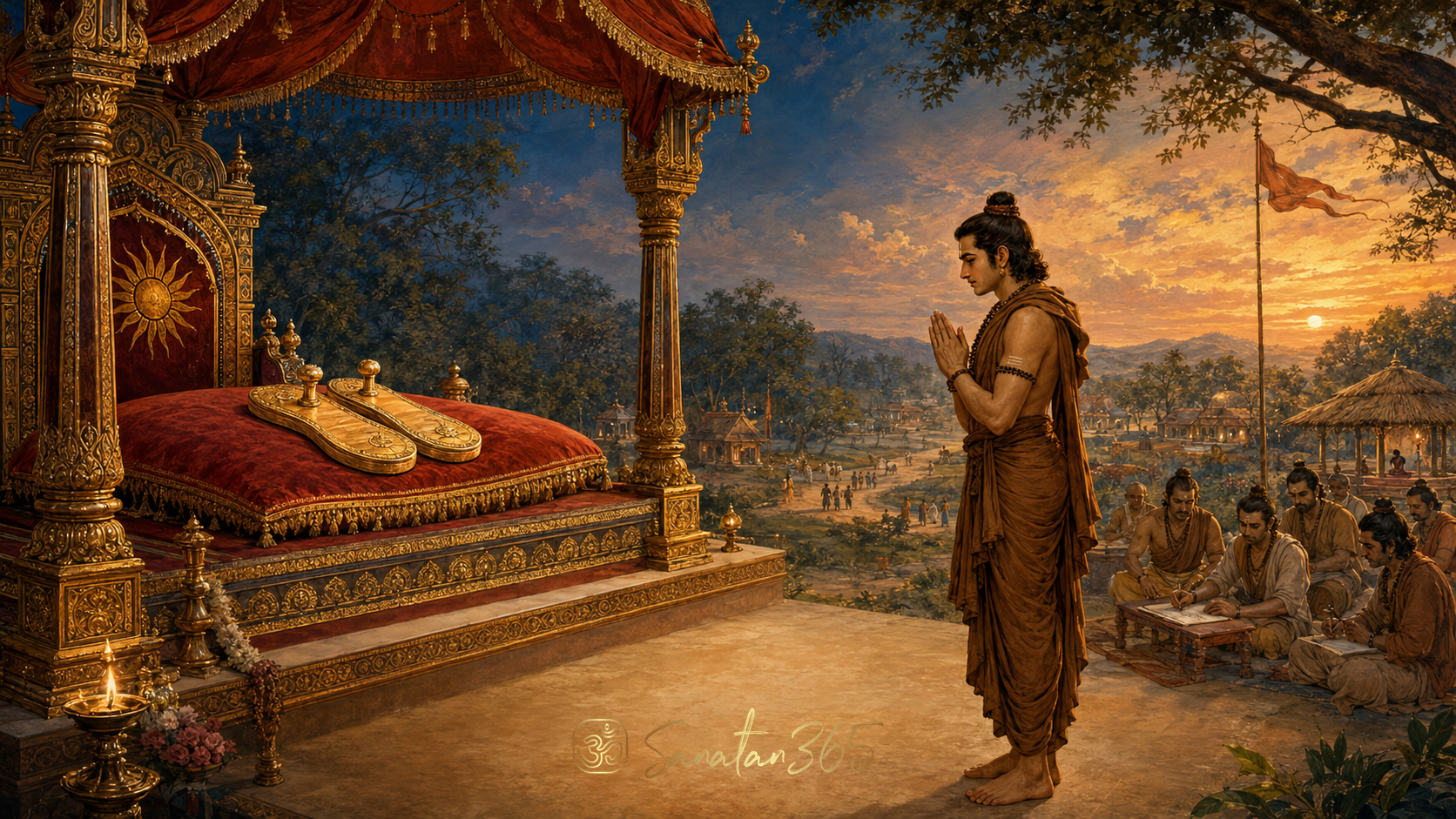
A throne can be occupied without anyone sitting on it. In the Ramayana, Bharata places Rama’s sandals at the centre of royal authority and accepts the work of governing without claiming the kingdom as his own.
The story of Bharata and Rama’s sandals explains why the prince serves from Nandigrama while his elder brother remains in exile. The sandals, called paduka (पादुका, sacred footwear), represent Rama’s authority. Bharata receives them as a trust, attends to the kingdom’s affairs, and intends to return that trust when Rama comes home. His devotion is expressed through responsibility, not escape from it.
This reading follows the Valmiki Ramayana’s Ayodhya Kanda, the book centred on Ayodhya, especially chapters 112 and 115 in Hari Prasad Shastri’s translation. It focuses on a precise question: what changes when power is understood as something entrusted rather than possessed?
Why are Bharata and Rama’s sandals central to the story?
Bharata’s difficulty is not a lack of opportunity. It is the character of the opportunity before him. Rama has gone into exile following the fulfilment of promises made by their father, King Dasharatha, to Queen Kaikeyi, Bharata’s mother. Bharata does not regard the resulting opening as permission to replace his brother.
A simpler tale might end with a refusal: the good prince rejects the throne, proving that he does not crave power. The Ramayana asks more of him. There is still a kingdom to care for. Refusing personal advantage does not remove the needs of the people whose lives depend on functioning government.
The sandals make a difficult distinction visible. Bharata will exercise responsibility, but he will not present himself as the ultimate source of that authority. He will serve in Rama’s name while preserving the expectation of Rama’s return. The object is small; the discipline it represents is extensive.
In devotional language, this is bhakti (भक्ति, loving devotion). Yet love here cannot remain an inward feeling. It must shape decisions, habits, public conduct, and the handling of resources. Bharata’s affection for his brother becomes a way of holding office without treating office as private property.
Readers familiar with the broader meaning of bhakti may recognise the relationship between remembrance and action. This episode supplies a particular narrative form: the beloved is absent, but the responsibilities associated with that relationship remain present every day.
The sandals are therefore neither an ornamental detail nor a shortcut around the work of ruling. They declare whose authority Bharata acknowledges and to whom his service must eventually be returned.
Key takeaway: Bharata refuses to make the throne his possession, but he does not refuse the duty of caring for the kingdom.
What happens when the brothers meet at Chitrakuta?
At Chitrakuta, the forest setting of their meeting, Bharata urges Rama to return. His appeal is personal and public: he longs for his brother, and he believes Rama should govern. The scene is moving because both brothers are trying to act faithfully, yet they do not agree on the immediate action required.
In Ayodhya Kanda, chapter 112, Bharata expresses doubt about his own ability to administer such a large kingdom. Rama does not answer by praising ambition. He treats Bharata’s humility as a source of strength and tells him to consult ministers, counsellors, and friends in the work ahead.
That counsel matters. Bharata’s service is not imagined as solitary moral brilliance. Good intentions need advice, cooperation, and the capacity to listen. The prince’s reluctance to claim greatness does not mean that he is permitted to avoid learning how to fulfil his responsibilities.
Rama, meanwhile, remains firm about the promise made in his father’s presence. The chapter presents fidelity to that promise as a boundary he will not cross. Bharata’s love does not simply dissolve it. Their eventual arrangement respects the fact that sincere affection can meet a commitment it cannot overturn.
Bharata then asks Rama to place his feet in sandals adorned with gold. Rama does so, removes them, and gives them back. This sequence is worth preserving in a retelling. The sandals are not an object Bharata chooses independently and declares sacred afterwards; the narrative binds them directly to Rama’s participation.
Rama also asks Bharata to care for Kaikeyi rather than remain angry with her. Within this particular family story, the request prevents service to one loved person from becoming a reason to neglect another. Retelling that moment carefully is more fruitful than reducing Kaikeyi to a permanent label or treating Bharata’s sorrow as permission for endless hostility.
The farewell does not make separation painless. It gives separation a form that can be lived responsibly. Bharata returns carrying a sign of relationship and a task, while Rama remains committed to the forest exile.
Key takeaway: The sandals emerge from a difficult agreement between the brothers, not from Bharata abandoning his judgment or Rama abandoning his promise.
How does Bharata govern from Nandigrama?
After returning his mothers to Ayodhya, Bharata seeks permission from the elders and the teacher Vasishtha to reside at Nandigrama. The narrative describes ministers, priests, his brother Shatrughna, and others accompanying him. Nandigrama becomes the place from which he serves while awaiting Rama’s return.
The details in Ayodhya Kanda, chapter 115 make the arrangement concrete. Bharata places the sandals on the royal throne, beneath the canopy, and recognises them as representing Rama. Royal business and gifts are first laid before them before being handled as circumstances require.
The text also describes Bharata adopting an austere appearance, with matted hair and bark clothing. This is a narrative sign of his chosen restraint and solidarity during Rama’s absence. It should not be turned into a claim that outward hardship alone proves devotion, or that readers must copy his clothing and diet to understand his example.
More important for the question of stewardship is that affairs continue to be attended to. The sandals do not draft decisions or consult advisers. Bharata and those assisting him must still do the human work. Devotional remembrance establishes the orientation of that work; it does not remove the need for competence.
Three features distinguish his service:
- Authority is acknowledged as received. Bharata does not quietly transform a temporary trust into a personal claim.
- Administration remains active. Matters of state and gifts are considered and dealt with, rather than left untouched in the name of renunciation.
- Return remains the purpose. The arrangement points towards restoring the kingdom to Rama, not prolonging Bharata’s own position.
The chapter locates this service at Nandigrama. A careful telling should preserve that setting instead of casually moving every detail into an imagined palace scene in Ayodhya. The kingdom is Ayodhya’s; the place of Bharata’s waiting and administration has its own narrative importance.
Readers need not settle questions of modern geography to understand the distinction. Chitrakuta is the setting of the brothers’ encounter; Ayodhya is the royal home and kingdom; Nandigrama is the setting of Bharata’s entrusted service. Each place performs a different role in the story.
Key takeaway: Nandigrama is not merely a place where Bharata waits. It is where waiting becomes disciplined, practical service.
What do the sandals teach about entrusted responsibility?
The episode offers an image of dharma (धर्म, sustaining duty and right conduct) that is more demanding than a public declaration of good intentions. Bharata’s commitment has to remain true after the emotional farewell, when ordinary decisions replace the intensity of the meeting.
The following reflections are applications of the story, not additional claims about what the ancient text explicitly says.
Responsibility does not always imply ownership
Someone may be asked to care for a family collection, maintain a shared place of worship, oversee a community fund, or complete work on another person’s behalf. In such situations, possession and permission are not identical. Access to something does not automatically confer the right to redefine its purpose.
Bharata’s example invites a useful question: what exactly has been entrusted, and what would faithful return look like? Naming the answer at the beginning can prevent a temporary responsibility from becoming an unexamined entitlement.
Humility should improve the work
Rama’s advice to consult others gives humility an active form. A person entrusted with a task need not pretend to know everything. Seeking informed help can be part of fidelity, especially when others will bear the consequences of a poor decision.
This is different from repeatedly declaring oneself unworthy while leaving the task undone. Bharata expresses doubt, receives counsel, and accepts the work. His modesty makes room for cooperation; it does not become a reason to disappear.
Remembrance needs a practical expression
The sandals keep the source of authority visible. In an ordinary setting, an analogous reminder might be a clear statement of purpose, a record of entrusted belongings, or an agreed handover plan. Such comparisons concern accountability, not an attempt to make sacred footwear interchangeable with office tools.
A reminder is useful when it changes conduct. Does it encourage careful handling, honest reporting, and timely return? If it becomes only decoration, the practical discipline has been lost even if the language of service remains.
Letting go is part of the trust
Temporary responsibility has a destination beyond successful performance: an honourable handover. The story directs attention towards returning what was received. That intention helps distinguish stewardship from the subtle desire to become indispensable.
A related but distinct discussion appears in the story of King Janaka and detached action. Bharata’s episode should retain its own emphasis: a particular brother, a particular entrusted kingdom, and a visible promise of return.
Key takeaway: A trust is honoured through competent care, consultation, clear limits, and readiness to hand it back.
How can families read this story without flattening it?
Children may first remember the surprising picture: a pair of sandals under a royal canopy. Adults can help that picture open into a question rather than rush to a slogan about being obedient or giving everything up.
A simple discussion can move through four steps:
- Tell the problem clearly. Rama is away, Bharata does not want to claim his place, and the kingdom still needs care.
- Notice the agreement. Rama gives the sandals after placing his feet in them, and Bharata accepts service in his name.
- Ask what happens next. Governing continues at Nandigrama; the promise becomes daily work.
- Choose a small comparison. How should someone care for a borrowed book, a shared instrument, or another person’s unfinished task?
The comparison should remain modest. Caring for a borrowed book is not equivalent to Bharata’s devotional commitment. It simply gives younger readers an accessible way to recognise the difference between using something and owning it.
Avoid saying the sandals magically performed all the duties of government. That interpretation misses the chapter’s attention to Bharata, advisers, and the handling of affairs. Equally, describing them as “just a symbol” can flatten their devotional significance. For Bharata, they embody a living bond with Rama, not a convenient prop.
Different Ramayana traditions may elaborate the emotional and devotional dimensions in their own ways. This article follows the two identified chapters in one English translation; it does not claim that every retelling uses identical wording or emphasis. Naming the version helps readers appreciate variety without mixing details invisibly.
The lasting image is therefore not an empty seat but a fulfilled responsibility. Bharata keeps Rama’s place by doing the work that place requires, while resisting the temptation to call it his own.
Key takeaway: The heart of the story is devoted stewardship: care faithfully for what is entrusted, without confusing responsibility with possession.
FAQ
Why did Bharata place Rama’s sandals on the throne?
Bharata recognised Rama as the rightful sovereign and accepted responsibility on his behalf. The sandals represented Rama’s authority, allowing Bharata to administer the kingdom as a custodian while awaiting his brother’s return.
Where did Bharata keep Rama’s sandals?
Ayodhya Kanda, chapter 115 in the Shastri translation describes Bharata placing the sandals on the royal throne at Nandigrama. He resided there and managed the kingdom with the assistance of counsellors while Rama remained away.
What does paduka mean in this story?
Paduka means footwear or sandals; in this devotional context, Rama’s sandals become an object of reverence because of their connection with him. They mark Bharata’s relationship to Rama and his understanding of entrusted authority.
Did Bharata stop governing while Rama was in exile?
No. The narrative describes matters of state and gifts being presented before the sandals and then handled as required. Bharata’s refusal to claim the kingdom personally is paired with active service, consultation, and responsibility.
What is the main lesson of Bharata’s service?
The episode shows that love and humility can lead to demanding action. Bharata accepts the work of caring for the kingdom without treating it as his possession, keeping faithful return at the centre of his service.
About the author
Sanatan365 Editorial
Bringing Sanatan Dharma to modern seekers through authentic, scripture-grounded content.
Related in Stories
 Stories
Sita Swayamvara in the Ramayana: Shiva's Bow and the Meaning of the Marriage
Read the Bala Kanda account of Rama, Sita, Janaka and Shiva's bow, and separate the text's sequence from later devotional retellings.
 Stories
King Chitraketu Story: Grief, Wisdom, and Humility in the Bhagavata
The Bhagavata Purana tells how King Chitraketu met devastating loss, listened to Narada and Angira, and learned a difficult humility. Read…
 Stories
King Ambarisha and Durvasa: A Story of Devotion and Humility
The Bhagavata Purana story of King Ambarisha and Sage Durvasa explores a difficult fast, an angry visitor, and the restraint behind devotio…

