Chandra Deva: Meaning of the Moon, Soma, and Sacred Renewal
Explore Chandra Deva’s lunar symbolism, the changing meaning of Soma, moonlit imagery, and the distinction between sacred stories and astronomical cycles.
The moon need not be full to hold a place in sacred art. A slender crescent can carry an entire theology of light, change, and renewal.
Chandra Deva is the Hindu moon deity: Chandra (चन्द्र, Candra, “moon” or “shining”) with Deva (देव, deva, “deity”). Often called Soma, he appears in devotional imagery, stories of waxing and waning, and traditions of sacred time. His changing radiance invites reflection on responsibility and renewal. Understanding him requires keeping three things distinct: the astronomical moon, the deity addressed in worship, and the meanings different texts and communities give to lunar imagery.
Who Is Chandra Deva, and Why Is He Called Soma?
A familiar divine name can carry more than one history. Soma (सोम, Soma) does not mean only the moon in every Sanskrit passage. In Vedic ritual literature, it names a sacred offering and the deity associated with that offering. In later traditions, Soma is closely identified with the moon. A reader who replaces every occurrence of “Soma” with “moon” can therefore miss the ritual setting of an older hymn.
Encyclopaedia Britannica’s entry on Soma distinguishes the ancient plant offering, its personified deity, and the later lunar identification. It also notes that the original plant remains unidentified. That uncertainty matters: a cultural introduction should not supply a supposedly certain modern recipe or present a commercial preparation as the recovered Vedic substance.
The connection becomes easier to understand through the imagery surrounding Soma. Nourishment, replenishment, sacred offering, and renewed radiance belong to this cluster of meanings. They do not make the moon a medicinal ingredient. They show how ritual language and observation of the night sky can meet within religious imagination.
Chandra also belongs to the Navagraha (नवग्रह, navagraha), the nine celestial powers recognised in Hindu astrological and devotional traditions. The familiar English shorthand “nine planets” is imperfect: the moon is a natural satellite in astronomy, while the traditional group follows a different religious classification. Readers can explore that distinction in this introduction to the Navagraha.
Different kinds of questions need different kinds of answers. “How does the moon move?” calls for astronomy. “Why is Chandra honoured?” calls for attention to ritual, literature, and belief. “What can his imagery mean to a devotee?” leaves room for reflection. None becomes clearer by pretending that all three are the same question.
Key takeaway: Chandra and Soma are closely connected in Hindu tradition, but Soma’s older ritual meanings should not be erased by its lunar identity.
How Is the Moon Deity Depicted?
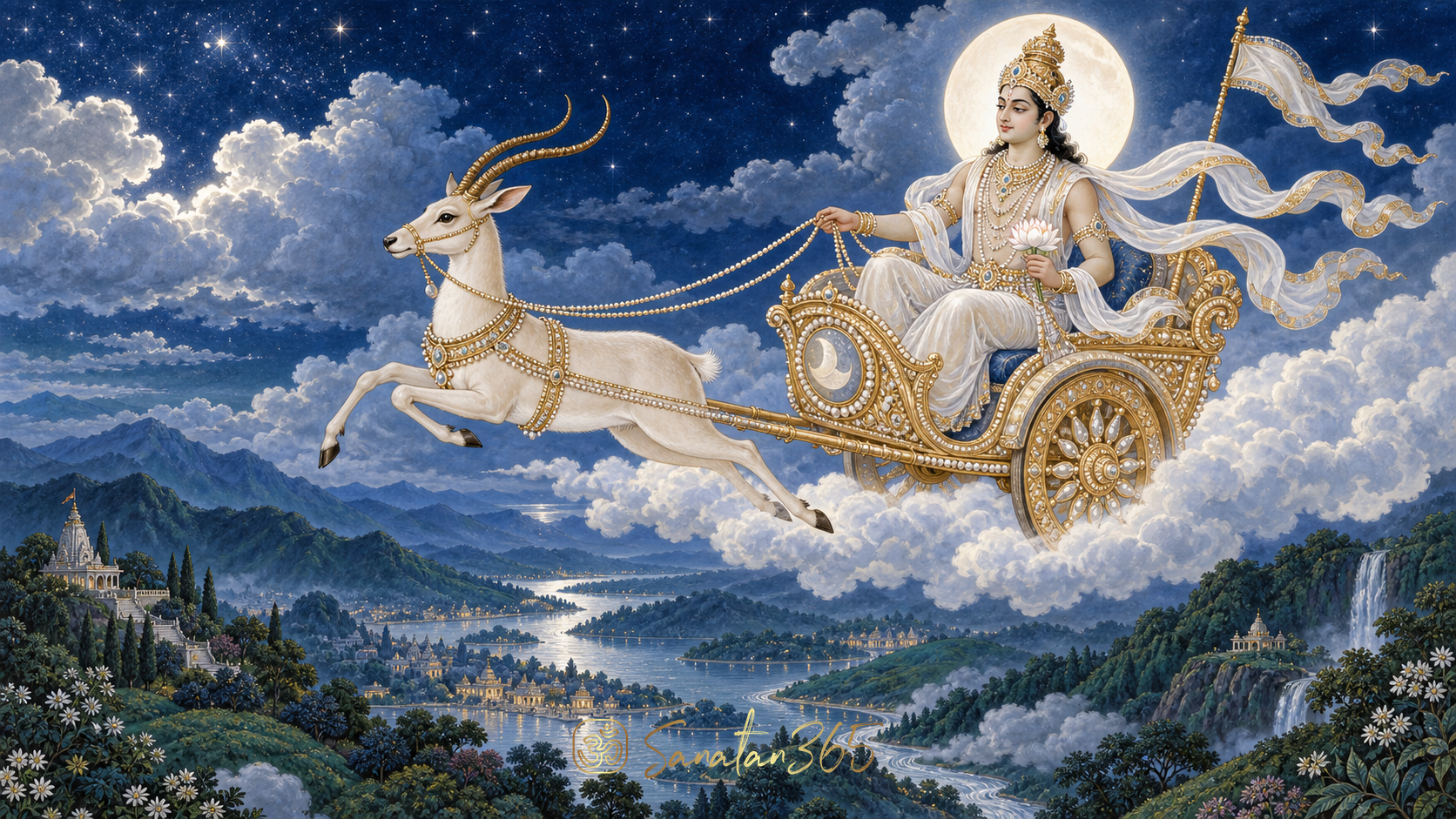
A useful place to begin is an actual work of art, rather than an imagined universal checklist. The Victoria and Albert Museum holds a watercolour catalogued as Chandra, the Moon god, from Calcutta, dated approximately 1885. Its description identifies the deity travelling in a chariot drawn by an antelope. The museum’s object record provides a specific, verifiable example of lunar iconography.
That example should not be turned into a rule that every Chandra image must follow. Textual descriptions and artistic traditions vary. World History Encyclopedia’s discussion of Soma, for instance, describes a chariot drawn by white horses in Puranic accounts. A viewer may encounter more than one accepted visual vocabulary without needing to declare one image mistaken merely because it differs from another.
The chariot makes movement visible. A deity who belongs to the changing sky is not presented simply as a motionless disc. The antelope gives the composition a distinctive identity, while pale clothing, luminous surroundings, or a lunar emblem may help an artist express moonlight. These are artistic choices to read alongside a work’s region, period, and catalogue description, not detached symbols with a single secret code.
Three questions help when looking at a Chandra image:
- What identifies the figure? Look for a museum label, a traditional title, or the context of a larger celestial group.
- What belongs to this particular artwork? Notice the vehicle, animals, posture, ornaments, and setting without assuming every detail is universal.
- What is interpretation rather than identification? A feeling of quietness may be a persuasive response to the composition, but it is not a substitute for knowing whom it depicts.
The same care improves contemporary devotional illustration. An image can be imaginative and reverent while remaining clear about its subject. A moonlit landscape alone may evoke atmosphere; Chandra’s recognisable presence turns it into an article-specific depiction of the moon deity.
Key takeaway: Chandra’s iconography has documented variety. Read a particular image carefully before treating its details as mandatory for every tradition.
What Do Waxing and Waning Mean in Sacred Narratives?
The Shiva Purana, a collection of Shiva-centred sacred narratives, tells a well-known story about Chandra, Daksha, and the loss of lunar radiance. In the Kotirudra Samhita, chapter 14, Daksha’s twenty-seven daughters are married to the moon. Chandra favours Rohini and neglects the others. Their distress leads Daksha to warn him; when he does not change his conduct, a curse follows.
The story does not begin with an innocent victim encountering an arbitrary inconvenience. It begins with unequal attention and an ignored appeal to act more fairly. That makes responsibility central to a thoughtful reading. Chandra’s brilliance does not remove the consequences of how he treats others.
Following counsel, Chandra goes to Prabhasa and worships Shiva. The chapter’s resolution is stated particularly clearly in verse 45: the moon’s radiance will decrease through one fortnight and increase through the other. The account connects this restoration with Shiva’s presence as Someshvara, the Lord of Soma. The official Somnath account of Chandra’s devotion preserves the same broad relationship between the neglected queens, Daksha’s curse, worship at Prabhasa, and divine grace.
This is a sacred narrative, not an astronomical explanation. The visible lunar phases arise because the moon orbits Earth and the portion of its sunlit half visible from Earth changes. The moon does not physically lose and regrow its substance each month. Recognising the distinction allows the story’s devotional and ethical meanings to be considered without confusing them with celestial mechanics.
A reflective reading can hold together three themes:
- Attention carries responsibility. Affection does not excuse neglect of commitments.
- Correction asks for a response. Being warned and changing course are different things.
- Renewal need not erase every consequence. In this telling, restoration arrives as a rhythm of decrease and increase, not permanent unchanging fullness.
These are interpretations of the narrative, not promises that every personal difficulty follows the same pattern. Nor should the story be used to judge another person’s circumstances as deserved. Its most useful ethical question is inward: where has selective attention caused an obligation to be overlooked?
Key takeaway: The waxing-and-waning story joins consequence with grace; its power lies in devotional meaning, not in replacing astronomy.
Why Does Shiva Bear the Crescent Moon?
The crescent in Shiva’s hair is among the most recognisable lunar images in Hindu art. Chandrashekhara (चन्द्रशेखर, Candraśekhara) means “the one whose crest bears the moon.” The name identifies Shiva through that visible attribute, bringing the changing moon into the presence of the deity.
The Somnath narrative supplies one important devotional context for the relationship: Chandra turns to Shiva and receives a form of renewal. It does not follow that every artwork, name, and local account must derive from a single identical episode. Sacred imagery often gathers several layers of interpretation, and responsible explanation leaves that variety intact.
For a devotee, the crescent can suggest that change itself is held within a greater sacred presence. The moon passes through visible phases, while the image offers a point of contemplation beyond the demand to remain constantly bright. This is a symbolic reading of the composition, not a claim that the image delivers a measurable effect simply by being viewed.
Another striking detail is scale. In many representations, the crescent is a small feature within an elaborate image, yet it contributes substantially to recognition. Sacred art often works this way: a carefully placed attribute carries a relationship that would require many sentences to explain in prose.
The moon should not become a reason to make a superiority claim between deities or devotional paths. Chandra’s place in Shiva imagery can be appreciated as a relationship of worship, shelter, and grace. It need not be turned into an argument about which form of the Divine other people ought to honour.
Those interested in the place associated with this narrative can continue with the meaning of Somnath’s Shiva temple. Here, however, Chandra remains the focus: the crescent reveals how lunar imagery participates in a wider devotional language without losing its distinct identity.
Key takeaway: Shiva’s crescent links lunar change with sacred presence. It invites contemplation without requiring a single universal interpretation.
How Can Lunar Symbolism Inspire Thoughtful Daily Life?
The moon offers a visible rhythm, but thoughtful practice need not turn every phase into a command. A family may mark a lunar observance according to its tradition; another reader may simply notice the evening sky and reflect on the day. These are different activities, and neither should be presented as a compulsory ritual for everyone.
For religious dates, the relevant authority is a local calendar and the tradition being followed, not a photograph of the moon or a social-media caption. A tithi (तिथि, tithi) is a lunar day calculated from the angular relationship between the sun and moon. It is not simply a civil date beginning at midnight. This guide to the meaning of tithi explains why observance dates require more care than the phrase “full-moon day” might suggest.
For personal reflection, the Chandra narrative offers a more concrete starting point than a general wish for calm. Consider an ordinary week in which one engaging project receives all the attention while routine commitments are repeatedly postponed. The problem is not that enthusiasm is wrong. The problem is that preference has quietly become neglect.
A short evening reflection could ask:
- Which commitment received less attention than it deserved?
- Was a fair request dismissed because it interrupted something enjoyable?
- What practical correction can be made tomorrow?
The answer might be a returned call, a completed household responsibility, or an honest acknowledgment of a missed promise. These examples are contemporary applications, not instructions quoted from the Shiva Purana. They connect the story’s concern with attention to actions a reader can actually take.
The imagery of phases also suggests patience with work that develops over time. A language lesson, a repaired friendship, or a sustained act of service may not display its fullest result immediately. Yet the metaphor has limits: patience is not an excuse to ignore harm, and cyclical imagery is not a guarantee that every loss will reverse itself.
There is room here for appreciation without prediction. Looking at Chandra’s imagery does not require making claims about a person’s fate or buying a remedy. Its value can lie in careful seeing, gratitude for the night sky, and a renewed willingness to fulfil ordinary responsibilities.
Key takeaway: Let lunar symbolism sharpen attention and responsibility. It need not become a prediction, a purchase, or a rule imposed on everyone.
FAQ
Who is Chandra Deva in Hinduism?
Chandra Deva is the Hindu moon deity, often called Soma and included among the Navagraha. He appears in devotional art, sacred narratives, and traditions of lunar time. The deity’s religious identity should be distinguished from the moon’s astronomical classification as Earth’s natural satellite.
Are Chandra and Soma the same?
They are closely identified in later Hindu traditions, but Soma has older meanings connected with a Vedic ritual offering and its deity. The context of a text matters. Not every early reference to Soma should automatically be read as a description of the moon.
Why is Chandra shown with an antelope?
An antelope-drawn chariot is a documented form of Chandra’s iconography, including in the V&A’s approximately 1885 Calcutta watercolour. Other traditions describe different vehicles or teams of animals. A specific artwork’s provenance and description are more reliable than a universal online checklist.
What explains Chandra’s waxing and waning in the story?
In the Shiva Purana, Kotirudra Samhita 14, Chandra neglects Daksha’s daughters other than Rohini, loses radiance through a curse, and receives renewal through Shiva’s grace. The narrative explains sacred meaning; astronomical phases result from the changing view of the moon’s sunlit half.
What is the central lesson of Chandra’s symbolism?
There is no single lesson binding every devotee. One grounded reading joins the beauty of renewed light with responsibility for neglected commitments. The central takeaway is to honour change without abandoning care: radiance is meaningful, but so is how attention is given.
About the author
Sanatan365 Editorial
Bringing Sanatan Dharma to modern seekers through authentic, scripture-grounded content.
Related in Deities
 Deities
Indra Deva Meaning: The Vajra, Rain, and Responsible Power
Indra links the thunderbolt and released waters with a demanding question: what is strength for? Read his Vedic imagery and later lessons w…
 Deities
Agni Deva Meaning: Sacred Fire and the Divine Messenger
Meet Agni as the Vedic priest and messenger, read the first Rig Veda hymn, and understand sacred fire without reducing a living deity to a…
 Deities
Brahma Deva Meaning: Four Faces, Creation, and Sacred Knowledge
Understand Brahma, the Hindu creator deity, through his four faces, lotus imagery, sacred knowledge, and a careful distinction from Brahman…

