Chhath Puja 2026 Date: Sunset and Sunrise Offerings
Chhath runs 13–16 November in Patna. Follow the four days from household preparation to the sunset and sunrise offerings, with local solar times.
One headline date cannot tell a family when Chhath begins or when it ends. The observance asks people to notice two different horizons: the sun going down and the sun returning.
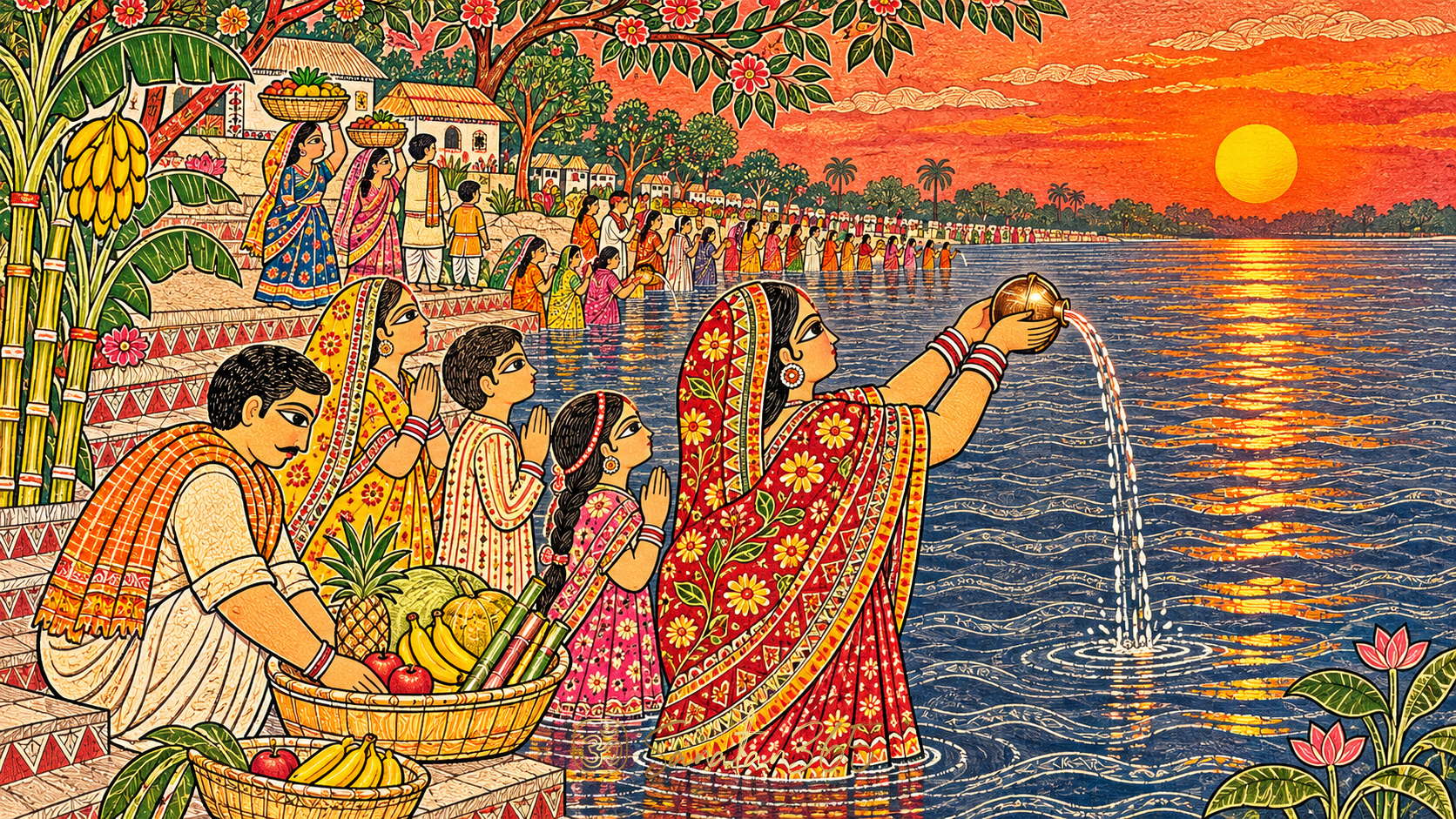
The Chhath Puja 2026 date for the main sunset offering in Patna, Bihar, is Sunday, 15 November. The four-day observance runs 13–16 November, starting on Friday and concluding after the sunrise offering on Monday. In the Patna calendar, sunset on Sunday is 5:01 p.m. IST and sunrise on Monday is 6:07 a.m. IST. These are local solar times.
What is the Chhath Puja 2026 date in Patna?
The Drik Panchang Chhath calendar for Patna gives a separate date to each of the four days. Its main Chhath Puja listing marks the third day, when the offering is made to the setting sun. A family preparing for the whole observance needs the dates on either side of that listing as well.
Nahāy Khāy (नहाय खाय, bathing and eating) and Kharnā (खरना, the second-day observance) describe stages of preparation. Arghya (अर्घ्य, a reverential offering, often of water) is offered in the evening and again at dawn. Sandhyā Arghya (संध्या अर्घ्य, evening offering) and Uṣā Arghya (उषा अर्घ्य, dawn offering) name those two moments. Pāraṇa (पारण, concluding a fast) belongs after the final offering in this sequence.
| Date in Patna | Observance | Place in the sequence |
|---|---|---|
| Friday, 13 November 2026 | Nahay Khay | Opening day of bathing and food preparation |
| Saturday, 14 November 2026 | Kharna | The second day, with an evening offering |
| Sunday, 15 November 2026 | Sandhya Arghya | Offering to the setting sun; sunset 5:01 p.m. IST |
| Monday, 16 November 2026 | Usha Arghya and Parana | Offering to the rising sun; sunrise 6:07 a.m. IST, followed by the conclusion |
The distinction between a calendar date and a solar time is practical. A date identifies the day of the observance; the sunrise or sunset time refers to a particular place. Neither tells a visitor when a particular entrance opens or when a family intends to set out. A calendar can answer the first two questions while the people organising a gathering answer the third.
It helps to save the four dates together. A calendar entry for Sunday alone may be sufficient for someone attending the evening gathering. It leaves out the return on Monday and does not explain what relatives mean when they speak of Friday or Saturday as part of Chhath. The complete sequence makes those conversations easier to follow.
Key takeaway: In Patna, Chhath runs 13–16 November 2026. The main sunset offering is on Sunday the 15th, and the sunrise offering is on Monday the 16th.
How do the four days of Chhath prepare for the riverbank?
Bihar Tourism’s account of Chhath Puja describes a four-day observance in Bihar and eastern Uttar Pradesh. It connects the first day with bathing and preparation at home, the second with an evening offering, the third with sunset worship on the riverbank and the fourth with dawn worship and sharing the offerings.
Seen as a sequence, the first two days give context to the public gathering. Chhath begins in the work of the household, before the most familiar images of worshippers at the water. The riverbank scene brings that preparation into view. Understanding the opening days helps a visitor see why the gathered baskets and food carry more meaning than their appearance alone suggests.
The tourism account mentions rice pudding and fruit among the offerings. Prasāda (प्रसाद, an offering received and shared after worship) gives a useful way to understand the movement between household and community. Something prepared with care can later be shared. Exact dishes and household arrangements are matters for the family or community to explain.
For a relative helping with preparations, listening is a useful first contribution. Someone may need space to lay out baskets, a hand carrying supplies or help arranging a meeting point. These are examples of practical support, not a festival checklist. Asking what is needed allows the helper to take part without assuming authority over the observance.
This also explains why a description of Chhath can be incomplete even when it accurately describes a striking riverbank photograph. The image may show the culmination of a day’s work without showing its beginning. A family story about preparing food, clearing space or making room for others can supply part of that missing context.
The four days have an order, but their meaning need not be reduced to instructions about abstinence. Families may follow a discipline received in their tradition. Readers can understand that discipline’s place in the observance without treating a public calendar as personal fasting guidance.
Key takeaway: The first two days establish the household preparation that becomes visible at the water. The sequence continues through the final offering and the sharing that follows it.
What distinguishes Sandhya Arghya from Usha Arghya?
Sandhya Arghya is directed toward the setting sun. Usha Arghya is directed toward the rising sun the next morning. Both honour Sūrya (सूर्य, the Sun revered as divine); the calendar places them on consecutive dates because the night lies between them.
That distinction is easy to miss in photographs. An orange horizon and a reflection on water could belong to either part of the observance. The relevant question is what the worshippers are facing and whether the light is receding or emerging. A sunset picture cannot serve as evidence of the next morning’s gathering merely because the colours look similar.
The pairing also gives the worship its particular shape. A reader may reflect on the fact that the sun is honoured as its light departs and again as it returns. That is a reading of the visible sequence, rather than a claim that all families explain it in exactly the same words. It leaves room for the meanings a household has received.
The separate guide to arghya as a reverential water offering explains the wider term. At Chhath, the calendar, setting and shared return at dawn make this use specific. Similarly, the article on a sunrise offering to Surya gives context for the morning gesture without replacing the festival’s paired observance.
For a young observer, two questions can make the difference concrete. Which offering is this, and what will happen next? On Sunday, the answer points toward a return after the night. On Monday, it points toward the close of the observance and the sharing of food. The same kind of reverential gesture has a different place in the whole.
A family watching from another city can discuss the sequence even if it cannot be present. Naming the two offerings correctly is a small way to stay connected. It also gives relatives a clear way to describe what they are about to do when they send a photograph or speak about the day.
Key takeaway: The sunset and sunrise offerings are distinct parts of one observance. Read the two together to understand why Chhath continues beyond the headline Sunday date.
How can families plan around local sunrise and sunset?
The Patna references of 5:01 p.m. on 15 November and 6:07 a.m. on 16 November describe solar events, as listed by the cited calendar. They are not a promise that every group begins an offering at that minute. A household can use them as orientation while checking the actual gathering arrangements with its hosts.
A simple plan can keep the different kinds of information apart:
- Save the two dates with the words sunset and sunrise next to them.
- Check a calendar set to the locality where the family will observe.
- Confirm the gathering point and arrival arrangements with the household or organiser.
- Decide in advance who will help with carrying, meeting relatives or accompanying a child.
- Allow a way for someone who cannot attend both gatherings to share in a suitable part of the family’s preparation or conclusion.
A family outside Patna should not copy the city’s clock times into its plans. Even within India, sunrise and sunset differ across places. Families abroad should check both the local calendar and the community’s arrangements, rather than convert the Patna times into another time zone and assume the resulting numbers describe their own horizon.
It can help to distinguish the worshippers carrying out the observance from relatives who have come to support them. A visitor does not need to reproduce every household practice to follow the meaning. A conversation with the host can explain where to stand, when to arrive and what kind of help is welcome.
The calendar gives a shared reference when family members discuss plans. The actual plan still belongs to the place and people concerned. Keeping those two sources of information separate reduces confusion while preserving the reason everyone has gathered.
Key takeaway: Use the Patna solar times for Patna only. Confirm the date, local horizon and community arrangements as separate facts.
What can a first-time visitor notice at Chhath?
A first visit can begin with attention to relationships: between the household and the riverbank, between the person offering and those who accompany them, and between the last light of one day and the first light of the next. These relationships make the gathering legible even to someone who does not yet recognise every object or song.
Bihar Tourism describes singing at the evening gathering and the sharing of offerings after the final ritual. Those details show how the observance has a communal life around its central act of worship. A guest can listen, watch and ask questions at an appropriate moment rather than assume every part of the gathering is meant as a public demonstration.
There is room for quiet participation. A family member might hold a bag or wait at an agreed meeting point. A child might notice the direction everyone is facing. Someone learning the vocabulary could listen for the words used by the people they know and ask about them afterwards. These modest acts can bring more understanding than trying to capture every moment on a phone.
The return at dawn gives the story a definite close. A visitor who can attend only on Sunday can still understand that they have witnessed one part of it. Someone joining on Monday can appreciate the preparations and evening worship that preceded the scene. The calendar supplies the order even when a person experiences only a portion.
The central point is the connection between the two horizons. The dates make that connection possible to plan for, and the observance gives the dates their meaning.
Key takeaway: Notice what connects the two gatherings: careful preparation, shared worship and the return to the water before the observance closes.
FAQ
What is the main Chhath Puja date in 2026?
In the Patna calendar, the main sunset offering is on Sunday, 15 November 2026. The four-day observance starts on 13 November and concludes on 16 November.
What time is the sunset offering in Patna?
Drik Panchang lists Patna sunset at 5:01 p.m. IST on 15 November. This is the calendar’s solar reference, not a fixed arrival time for every gathering.
When is Usha Arghya in 2026?
Usha Arghya is on Monday, 16 November in the Patna calendar, which lists sunrise at 6:07 a.m. IST.
Can families use Patna’s times in another city?
No. Use a calendar set to the place of observance and check the local community’s arrangements for both gatherings.
About the author
Sanatan365 Editorial
Bringing Sanatan Dharma to modern seekers through authentic, scripture-grounded content.
Related in Festivals
 Festivals
Kali Puja 2026: A Night of Prayer to the Divine Mother
Kali Puja falls on 8 November 2026. Understand the night-time calendar, the address to Kali as Mother, and ways to participate with thought…
 Festivals
Naraka Chaturdashi 2026: Why Deepavali Begins Before Dawn
Naraka Chaturdashi falls on 8 November 2026. Read the Narakasura story, understand the dawn oil bath, and see why Deepavali can begin in th…
 Festivals
Govardhan Puja 2026: Date, Annakut, and a Thoughtful Offering
Prepare for Govardhan Puja on 10 November with a clear local calendar, an understanding of Annakut, and an offering shaped by gratitude rat…

