Kali Puja 2026: A Night of Prayer to the Divine Mother
Kali Puja falls on 8 November 2026. Understand the night-time calendar, the address to Kali as Mother, and ways to participate with thoughtful attention.
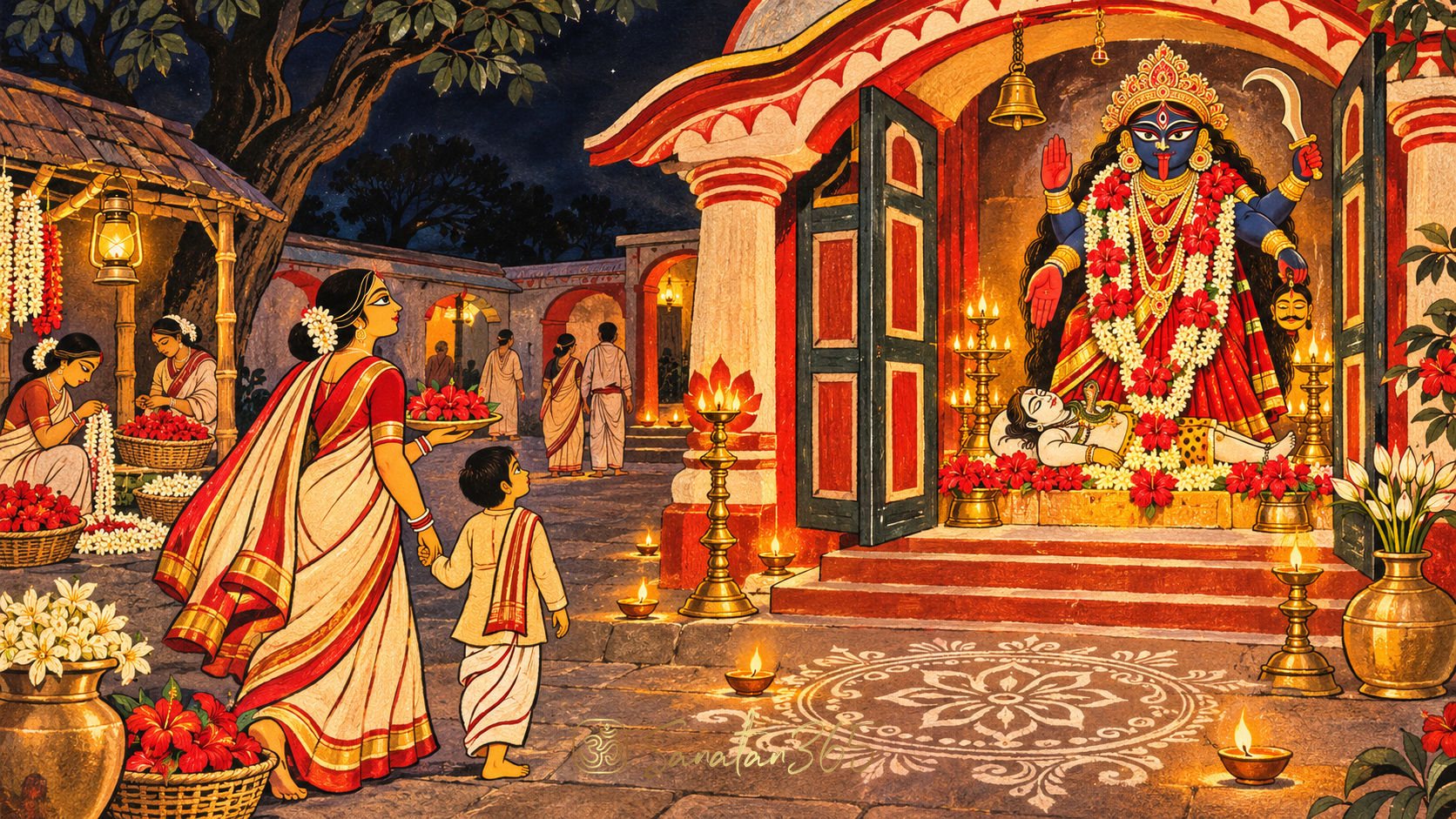
A lamp makes a small circle of light in a courtyard. Beyond an open doorway, flowers surround an image of Kali. A devotee steps closer and addresses her as Mother.
Kali Puja 2026 falls on Sunday, 8 November. In Bengal’s night-time observance, Kali is worshipped with the intimacy of that address. The date and local ritual window help a family plan the evening, while the name Mother offers a way to understand its devotion. Someone encountering the festival for the first time can begin with both the calendar and the relationship expressed in prayer.
When is Kali Puja 2026 in Kolkata?
For Kolkata, the 2026 Kali Puja calendar published by Drik Panchang gives Sunday, 8 November. Ramakrishna Math’s Yogodyan centre in Kolkata independently lists its 2026 Kali Puja celebration on that date. The calendar and the institution therefore agree on the day, though an institution’s programme and a calendar’s ritual window answer different questions.
The Kolkata calendar gives a niśītha (निशीथ, the deep-night ritual period) window of 10:55 p.m. to 11:46 p.m. IST. It places the beginning of amāvasyā (अमावस्या, the new-moon lunar day) at 11:27 a.m. on 8 November, continuing until 12:31 p.m. on 9 November. The relevant tithi (तिथि, lunar day) therefore extends across a midnight boundary. A civil date and a lunar day do not have matching edges.
These times belong to Kolkata. A family elsewhere should use its own city’s calendar and the programme of the place it plans to attend. An announced opening, the beginning of worship and a time for receiving visitors may be separate entries. A late-night calendar window by itself does not establish that a particular shrine is open to the public at that hour.
This also helps explain why the wider Diwali calendar can contain several observances on one date. Evening Lakshmi worship and night-time Kali worship have their own calendar criteria and local practices. The Diwali family preparation guide covers the broader planning question. For this evening, the useful first step is to identify the precise observance and place.
Key takeaway: For Kolkata, Kali Puja is on 8 November, with the cited deep-night window at 10:55–11:46 p.m. Check the actual local programme when planning a visit.
What does Shyama Puja mean for a devotee?
The festival is also called Śyāmā Pūjā (श्यामा पूजा, worship of Shyama, a name of Kali). Pūjā (पूजा, worship) names the act of honouring the deity. The alternate name can help a visitor recognise the same celebration on a neighbourhood notice or in a family conversation. The calendar gives a date, while the name tells the visitor whom the worship addresses.
At the level of attention, a person can begin very simply. There is someone being addressed in the prayer. The flowers, light and words have that focal point. Looking for it makes the space easier to understand. A visitor who has come with friends might ask them how they name the form of Kali before them and what part of the evening they most look forward to.
The reply may be personal. Someone might remember coming with a parent. Another person might speak about a song, a moment of quiet or the work of preparing the space. Such memories do not need to become a universal account of the festival. They show how a large celebration enters a particular life. Listening to them can give a newcomer a more exact understanding than a list of objects alone.
A person can also give the evening time to unfold. On first arriving, the eye may take in the light and colour all at once. After a few minutes, a smaller detail becomes clear. A garland has been placed with care, someone is waiting to make room for another visitor, or a familiar name is repeated in prayer. These are possible points of attention for the visitor, rather than instructions for conducting the worship.
Key takeaway: Shyama Puja names worship directed to Kali. Begin with that address, then listen to how the people who keep the observance describe its place in their lives.
Why is Kali addressed as the Divine Mother?
The word Mother gives devotion a relationship. It allows a prayer to begin from belonging, dependence, gratitude or a need that the speaker cannot put neatly into words. A powerful expression of this relationship appears in Sister Nivedita’s writing about Kali. Belur Math presents the passage with a reference to her book Kali the Mother.
“To Her we belong. Whether we know it or not, we are Her children, playing round Her knees.”
The passage presented by Belur Math offers a particular devotional voice. Nivedita describes a belonging that is already there, even before the person recognises it. The image of children near their mother makes the relationship familiar without making the Divine small. A reader can sit with that image before seeking a more elaborate explanation.
One way to reflect on it is to notice what happens to the prayer’s starting point. A speaker may arrive with a long account of what has gone wrong. Calling Kali Mother can bring that account into a relationship of trust. There can be room to ask, to grieve, to give thanks or simply to remain present. This is a devotional reading of the address, and its meaning will be heard differently by different worshippers.
The language can also affect how a visitor looks at the image. A first encounter may be dominated by unfamiliar features. The family or community looking at the same form may recognise someone deeply beloved. Asking what they see can open a more careful conversation. The guide to Kali’s symbolism and protective meaning introduces that wider subject. This festival article stays with the way a relationship is expressed through the act of address.
For a child, the first explanation can be short. The adults in the room are praying to Kali as Mother, and the flowers and lamps are part of their worship. A child can then ask about what they see. Their question may concern a colour, a hand or a name. Answering one question patiently lets familiarity grow through the actual encounter.
Key takeaway: The address Divine Mother expresses a relationship of belonging and trust. Nivedita’s image of children near their mother gives one way to contemplate that relationship.
How can a visitor participate in Kali Puja night?
A thoughtful visit starts before arrival. The practical preparation can be modest, especially for someone going with children, an older relative or a friend who is unfamiliar with the observance. The aim is to make enough room to be attentive once the family arrives.
Three questions can help.
- What does the local organiser say about visitor hours, entry and the programme? Save those details separately from a general calendar time.
- Who in the group needs a shorter visit or an earlier return? Agree on that before the evening becomes busy.
- What would the visitor like to understand? One question about a prayer, a name or the image can be easier to carry than an expectation to learn everything at once.
Inside the space, local guidance matters. Wait where visitors are asked to wait, leave room for the people carrying out the worship and follow instructions about photographs or offerings. A person can watch attentively without needing to imitate every action immediately. If something is unfamiliar, a quiet question at an appropriate moment may be more helpful than guessing.
The transition from watching to participating can be small. A visitor may join a familiar response when invited, sit for a time or offer a simple prayer in their own words. Someone who has grown up with the observance may find a different point of entry by accompanying a newcomer and listening to their questions. The familiar becomes visible again through what another person notices.
If prasāda (प्रसाद, food or another gift received as divine grace after offering) is distributed, follow the local arrangements. The article on prasad and sharing in Hindu worship explains the meaning of receiving and sharing. The programme itself will determine how that happens in the place being visited.
Key takeaway: Use the organiser’s practical guidance and choose a visit that gives the group room to attend. Participation can begin with listening, a question and a simple prayer.
What can a family carry from the prayer into the next morning?
The morning after a festival offers another kind of attention. The light is different, the clothes have been put away and the household returns to its usual tasks. A family might ask each person to name one detail they remember. Someone may recall the image, another a song, and another the person who helped them find a place to sit. Each memory gives the conversation somewhere concrete to begin.
A useful follow-up is to ask what the word Mother meant to the person during the visit. An adult may find it easier to describe a moment than an idea. Perhaps there was a point when a worried mind became willing to speak plainly in prayer. Another person may remember gratitude. A child may simply remember being able to see the flowers. These responses can sit beside one another without being made identical.
For relatives who could not attend together, a short message can preserve something of the encounter. Describe a moment, give the local name of the observance and explain why it stayed in memory. If photographs are permitted, a description can accompany one rather than leaving the picture to carry all the meaning. A person far away then has something to respond to in their own words.
The address to Mother can also return during an ordinary task. Someone preparing breakfast, waiting for a journey or beginning a difficult conversation may remember the prayer they offered. The festival’s date has passed, but its words remain available for a later act of remembrance. That continuing relationship is something a devotee can explore through practice.
The night begins with a calendar entry and an invitation to worship. It can be remembered through one clear moment of address. A family does not have to gather every detail into a single explanation. Sometimes the most lasting part is the name that could be spoken when the lamps were lit.
Key takeaway: Carry one remembered detail and one honest prayer into the next day. The relationship expressed in the night’s worship can continue through ordinary moments.
FAQ
What is the Kali Puja 2026 date?
For Kolkata and the institutional celebration cited here, it is Sunday, 8 November 2026. Check the programme of the place being visited.
What is the Kolkata Kali Puja night-time window?
The cited calendar gives 10:55 p.m. to 11:46 p.m. IST. Those times are specific to Kolkata and do not establish visitor hours.
Is Shyama Puja another name for Kali Puja?
Yes. Shyama is a name of Kali, and Shyama Puja refers to worship of her.
Why do devotees call Kali Mother?
The address expresses a devotional relationship of belonging, trust and dependence. Sister Nivedita’s passage about Mother and her children offers one expression of that relationship.
About the author
Sanatan365 Editorial
Bringing Sanatan Dharma to modern seekers through authentic, scripture-grounded content.
Related in Festivals
 Festivals
Chhath Puja 2026 Date: Sunset and Sunrise Offerings
Chhath runs 13–16 November in Patna. Follow the four days from household preparation to the sunset and sunrise offerings, with local solar…
 Festivals
Naraka Chaturdashi 2026: Why Deepavali Begins Before Dawn
Naraka Chaturdashi falls on 8 November 2026. Read the Narakasura story, understand the dawn oil bath, and see why Deepavali can begin in th…
 Festivals
Govardhan Puja 2026: Date, Annakut, and a Thoughtful Offering
Prepare for Govardhan Puja on 10 November with a clear local calendar, an understanding of Annakut, and an offering shaped by gratitude rat…

